Occasional Ideas: Misbehaving With Intent

Misbehaving.inddOk, while the tiny habits idea was compelling 48 hours ago, and is already having its impact on me, the notion of a daily series posting ideas I have come across may be too ambitious for all concerned. Hence, occasional.

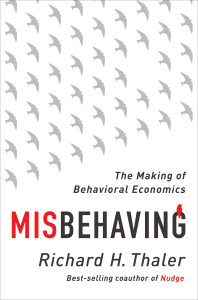
Richard Thaler was a professor when I arrived as a graduate student at Cornell University in 1988. He was, not surprisingly, awesome. But I had no real clue how much so, since it was all relative to my other professors who were also mostly awesome. In recent years it has become more verifiably clear, the scale of his awesomeness measured well by the popularity of his recent books. Also, awesome enough to make a cameo (in the scene at the casino table alongside Selena Gomez) in the great film The Big Short, which I also recommend. But for now, take advantage of this podcast: Continue reading

Architecture With A Purpose

13PRITZKER-articleLarge

Alejandro Aravena Credit ELEMENTAL

Breaking news on an architect of the people receiving the most coveted prize in his profession:

Pritzker Prize for Architecture Is Awarded to Alejandro Aravena of Chile

A Chilean architect who has focused his career on building low-cost social housing and reconstructing cities after natural disasters has been named the winner of architecture’s highest prize, the Pritzker. Continue reading

So Much Expertise, So Little Time

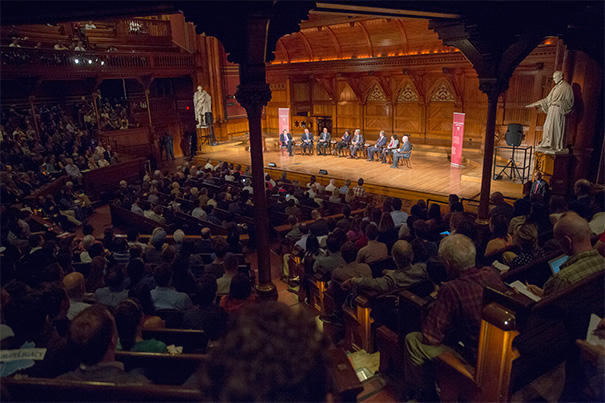
Kris Snibbe/Harvard Staff Photographer With Charlie Rose as moderator, a panel of experts in science, politics, business, economics, and history shared their views during Monday's Presidential Panel on Climate Change at Sanders Theatre. “The challenge of climate change is profound. The risks it poses are dire. Confronting those dangers is among the paramount tasks of our time,” said President Drew Faust in introducing the discussion.

Kris Snibbe/Harvard Staff Photographer. With Charlie Rose as moderator, a panel of experts in science, politics, business, economics, and history shared their views during Monday’s Presidential Panel on Climate Change at Sanders Theatre. “The challenge of climate change is profound. The risks it poses are dire. Confronting those dangers is among the paramount tasks of our time,” said President Drew Faust in introducing the discussion.

Thanks to the Harvard Gazette, and the panelists who took the stage last week for another in ongoing series of assessments of the urgency of need for action on climate change:

There is hope in global action to fight climate change, in the slow adoption of wind and solar power, in moves by the U.S. government to cut emissions from vehicles and power plants, in the lead taken by some businesses to clean up operations and draw attention to the problem.

But it’s too late to avoid several more degrees of warming by the turn of the next century, too late to completely stave off dramatic melting, and too late to avoid the slow swamping of Pacific island nations, whose thousands of years of history and culture seem certain to be swallowed by rising seas. Continue reading

Where Are The Market Forces When We Need Them?

More than half of the world’s forest loss between 1990 and 2010 took place in Brazil and Indonesia. Photograph: Nacho Doce/Reuters

More than half of the world’s forest loss between 1990 and 2010 took place in Brazil and Indonesia. Photograph: Nacho Doce/Reuters

Thanks to the Guardian‘s environment-focused reporting for this sad evidence on the state of affairs:

Subsidies to industries that cause deforestation worth 100 times more than aid to prevent it

Brazil and Indonesia paid over $40bn in subsidies to industries that drive rainforest destruction between 2009 and 2012 – compared to $346m in conservation aid they received to protect forests, according to new research

Brazil and Indonesia spent over 100 times more in subsidies to industries that cause deforestation than they received in international conservation aid to prevent it, according to a report by the Overseas Development Institute (ODI).

The two countries handed out over $40bn (£27bn) in subsidies to the palm oil, timber, soy, beef and biofuels sectors between 2009 and 2012 – 126 times more than the $346m they received to preserve their rainforests from the United Nations’ (UN) REDD+ scheme, mostly from Norway and Germany.

Continue reading

Dismal Dominance

Screen Shot 2015-02-11 at 5.45.41 AM

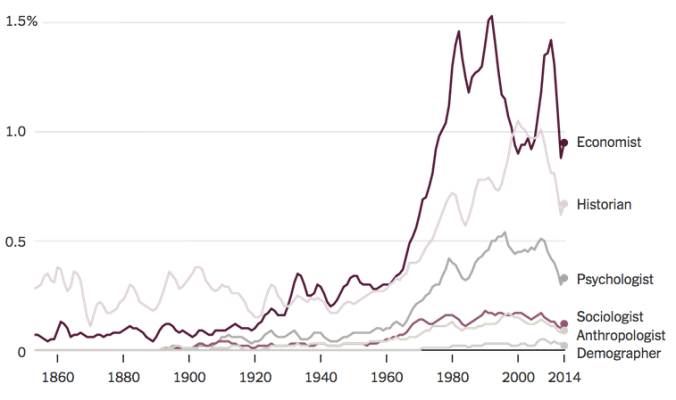
The Rise of the Economists: Interest in what economists have to say rises and falls with the economy. Measured by mentions in The New York Times, other professions aren’t as notable.

As a blog that features lots of history and literature, but little from the dismal science, this catches our attention.  Why so little economic reference at Raxa Collective? Wrong question. The economics of sustainable development are the foundation for all that we do, day in and day out, and those economics are embedded in many, if not most, of the stories we share on this blog. For that reason and more, this essay is worth a read and a ponder:

THE DISMAL SCIENCE

How Economists Came to Dominate the Conversation

Have we reached peak economist?

Two hundred years ago, the field of economics barely existed. Today, it is arguably the queen of the social sciences.

These are the conclusions I draw from a deep dive into The New York Times archives first suggested to me by a Twitter follower. While the idea of measuring influence through newspaper mentions will elicit howls of protest from tweed-clad boffins sprawled across faculty lounges around the country, the results are fascinating. And not only because they fit my preconceived biases. Continue reading

15 Years, And Counting

monopoly-man-with-green-wings

Click the image above or the title below to go to the summary, thanks as always to Conservation:

THE LOW-CARBON DEAL THAT’S ALMOST TOO GOOD TO BE TRUE

The economics of slashing carbon emissions look significantly better than they did only a few years ago. Continue reading

Breakthroughs In Nutrition Via Entrepreneurial Conservation

Exo's peanut butter-and-jelly bar contains about 40 ground-up crickets and has a familiar nutty, sweet flavor. Meredith Rizzo/NPR

Exo’s peanut butter-and-jelly bar contains about 40 ground-up crickets and has a familiar nutty, sweet flavor. Meredith Rizzo/NPR

Thanks to National Public Radio (USA)’s food-focused program, The Salt, for another story on unexpected breakthroughs in nutrition:

…”Insects are probably the most sustainable form of protein we have on Earth,” Bitty Foods founder Megan Miller, who spoke passionately about eating bugs at a TEDx Manhattan event earlier this year, tells The Salt. “The only real barrier to Americans eating insects is a cultural taboo.” Continue reading

Green Economy Realism

There’s no way toward a sustainable future without tackling environmentalism’s old stumbling blocks: consumption and jobs. And the way to do that is through a universal basic income.

Illustration by Edward Carvalho-Monaghan

Illustration by Edward Carvalho-Monaghan

There is nothing wrong, per se, with wishful thinking. It is when those wishful thoughts are left in dream state that they can become tedious, even dangerous. Action matters. It is where dreams meet reality. Reality matters at least as much as dreams in getting to a desired outcome. This is true with regard to environmental issues as with any other. We appreciate reminders whenever, wherever we find them:

For as long as the environment has existed, it’s been in crisis. Nature has always been a focus of human thought and action, of course, but it wasn’t until pesticides and pollution started clouding the horizon that something called “the environment” emerged as a matter of public concern.

In 1960s and 1970s America, dystopian images provoked anxiety about the costs of unprecedented prosperity: smog thick enough to hide skylines from view, waste seeping into suburban backyards, rivers so polluted they burst into flames, cars lined up at gas stations amid shortages, chemical weapons that could defoliate entire forests. Economists and ecologists alike forecasted doom, warning that humanity was running up against natural limits to growth, extinction crises, and population explosions.

But the apocalypse didn’t happen. The threat that the environment seemingly posed to economic growth and human well-being faded from view; relieved to have vanquished the environmental foe, many rushed to declare themselves its friends instead. Continue reading

Know Your High Seas, EEZs, And 1-2-3s

EEZs are shown in green and high seas in blue. EEZs comprise 42% of the planet’s oceans.

EEZs are shown in green and high seas in blue. EEZs comprise 42% of the planet’s oceans.

We are in awe of the scientists who help us understand this topic we write on and link to from time to time. The metrics required to understand overfishing in any meaningful way cannot be simple. But, a marker for a fishing zones we had not even known existed–the EEZ–is a good place to start counting:

The ocean is a big place, but not all seas are created equal. While 58% of the seas are classified as “high seas,” and open to access from all nations, there are over 150 exclusive economic zones (EEZs), which are the sole domain of the countries that operate them. EEZs comprise the remaining 42% of the ocean. The patchwork quilt of economic interests that blanket the ocean pose a problem for the fish who live there and the fisheries that exploit those fish. Continue reading

Electric Car Sharing In London

Vincent Bollore, CEO of investment group Bollore, poses by an electric car following a news conference in London March 12, 2014. CREDIT: REUTERS/OLIVIA HARRIS

Vincent Bollore, CEO of investment group Bollore, poses by an electric car following a news conference in London March 12, 2014. CREDIT: REUTERS/OLIVIA HARRIS

Various reports in the last year or so of sharing means of transportation focused on bicycles, which itself seemed remarkable; now reports of car-sharing schemes make it seem almost impossible to believe. Whether it is altruism, rational economics, or something else at work here we will soon find out:

First it was pedal power; now Londoners are being offered electric transport to dodge their way around the city.

French billionaire Vincent Bollore on Wednesday unveiled plans to park 3,000 electric cars on London streets by 2016, as part of a car share project that emulates the popular bike hire scheme started in 2010 under Mayor Boris Johnson.

Bollore, chief executive of the group bearing his name which set up the Autolib electric car-sharing program in Paris in 2011, said electric car hire could help cut congestion and reduce pollution in the British capital. Continue reading

Greening The Green, With Plastic?

Photo by Julian Herbert/Getty Images

Photo by Julian Herbert/Getty Images

We rarely have the chance to link to the writing of Hendrik Hertzberg, one of the New Yorker‘s cleverest turners of phrase, because he so frequently writes on political matters (generally outside our scope on this site).  But when he writes on another topic, it is invariably worth reading if nothing else for the quality of his writing.  This one, as it happens, is closer to our general range of interests because of the ecological implications:

On Wednesday came news that, starting in 2016, the Bank of England will replace its paper currency with plastic.

This doesn’t mean that our British cousins will thenceforth have to make all their purchases with credit cards, as in, “Do you take plastic?” They’ll still have folding money, but it will be printed on sheets of plastic polymers—a stiffer version of the stuff that the plastic bags which disfigure the trees of New York City are made of. Continue reading

Indian Art, The Business Side Of The Story

Christie’s Images Ltd. 2013 An untitled artwork by Vasudeo S. Gaitonde.

Christie’s Images Ltd. 2013. An untitled artwork by Vasudeo S. Gaitonde.

We would not know whether to say this news is welcome or not, but we thank India Ink for it nonetheless.  On the one hand we have been inclined to disfavor the hyper-commercialization of art. On the other hand, it seems better to know that Indian artists are now getting their fair economic shake relative to Western artists:

Demonstrating the robust demand for Indian art, Christie’s first auction in India almost doubled its high estimate of $8 million to bring in $15.4 million, or 965.9 million rupees, selling nearly all the works on offer and breaking a number of records for Indian artists. Continue reading

Tackling Tough Topics

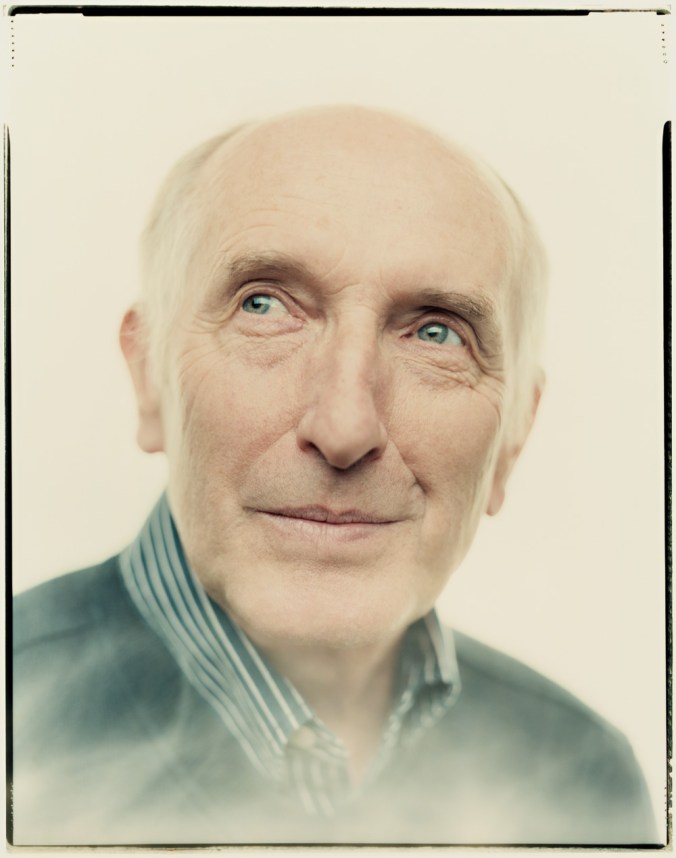
Author Vaclav Smil tackles the big problems facing America and the world.   Andreas Laszlo Konrath

Author Vaclav Smil tackles the big problems facing America and the world. Andreas Laszlo Konrath

Thanks to this interview in Wired magazine (click the image above to go to the source) we hear a bit about the craft of a thinker-writer’s approach to major economic, environmental and technological puzzles, one book at a time, but at an amazing pace:

You’ve written over 30 books and published three this year alone. How do you do it?

Hemingway knew the secret. I mean, he was a lush and a bad man in many ways, but he knew the secret. You get up and, first thing in the morning, you do your 500 words. Do it every day and you’ve got a book in eight or nine months.

What draws you to such big, all-encompassing subjects?

I saw how the university life goes, both in Europe and then in the US. I was at Penn State, and I was just aghast, because everyone was what I call drillers of deeper wells. These academics sit at the bottom of a deep well and they look up and see a sliver of the sky. They know everything about that little sliver of sky and nothing else. I scan all my horizons. Continue reading

If You Build It They May Come, But If You Build It Better Will They Pay For It?

fairTradeLogoThe following paper has been influential since its publication more than two and a half years ago, and seems destined to have a lengthy shelf life, which we hope to contribute to.  It is not only interesting theoretically, but gets at practical questions we consider existential at the level of our enterprise. If consumers (in our case travelers) are willing to pay a fair premium for building and operating a business that is more sensitive to environmental and social responsibility, we can afford to engage in fair trade; if they are not really willing, uh oh…

We are more than happy to share our empirical evidence, but for now let’s take a look at some scientifically-derived evidence:

Consumer Demand for the Fair Trade Label: Evidence from a Field Experiment

Jens Hainmueller

Massachusetts Institute of Technology (MIT) – Department of Political Science

Michael J. Hiscox

Harvard University

Sandra Sequeira

London School of Economics

April 1, 2011

MIT Political Science Department Research Paper No. 2011-9B

Abstract: 

A majority of surveyed consumers claim to prefer ethically certified products over non-certified alternatives, and to be willing to pay a price premium for such products. There is no clear evidence, however, that people actually seek out such ethically certified goods and pay a premium for them when shopping. We provide new evidence on consumer behavior from experiments conducted in a major U.S. grocery store chain. Continue reading

The Newest, Dismalest Branch Of Science

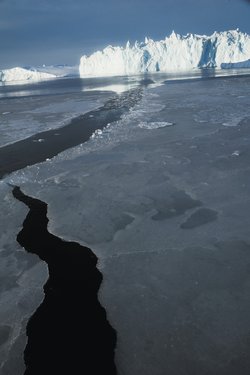
Stanley Greene/NOOR/Redux Greenland, photographed from a boat navigating the melt where dog sleds used to travel across the ice, October 2009

Stanley Greene/NOOR/Redux
Greenland, photographed from a boat navigating the melt where dog sleds used to travel across the ice, October 2009

We prefer the news about solutions to challenging problems. Preferably positive news. Preferably innovations that invoke smiles. Sometimes, dismal is the only way to move forward. Thanks to the New York Review of Books, and Paul Krugman for this review:

Forty years ago a brilliant young Yale economist named William Nordhaus published a landmark paper, “The Allocation of Energy Resources,” that opened new frontiers in economic analysis.1 Nordhaus argued that to think clearly about the economics of exhaustible resources like oil and coal, it was necessary to look far into the future, to assess their value as they become more scarce—and that this look into the future necessarily involved considering not just available resources and expected future economic growth, but likely future technologies as well. Moreover, he developed a method for incorporating all of this information—resource estimates, long-run economic forecasts, and engineers’ best guesses about the costs of future technologies—into a quantitative model of energy prices over the long term. Continue reading

Debt Is Not Desirable And Prison Is Not Pretty, But Debtors’ Prison?

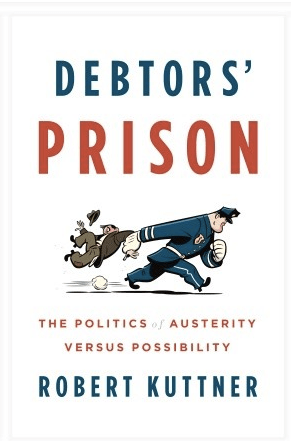
You can see what the publisher has to say about this book by clicking on the image to the right.  You can read about the book and its author, and even sample an excerpt. But our attention was brought to the book via this site, which provides a different excerpt from the book. We find this one intriguing because we see the author’s use of a literary figure to make a point about economics, entrepreneurship, risk-loss-gain tradeoffs, morality, civic duty and more:

“On October 29, 1692, Daniel Defoe, merchant, pamphleteer, and future best-selling author of Robinson Crusoe, was committed to King’s Bench Prison in London because he owed more than 17,000 pounds and could not pay his debts. Before Defoe was declared bankrupt, he had undertaken such far-flung ventures as underwriting marine insurance, importing wine from Portugal, buying a diving bell used to search for buried treasure, and investing in some seventy civet cats, whose musk secretions were prized for the manufacture of perfume. Continue reading

The Journalism-Academic Complex

Illustration to John Seabrook's 2011 article "Snacks For A Fat Planet" showing: Indra Nooyi, the C.E.O. of PepsiCo, says it must be a “good company” in a moral sense.

Illustration to John Seabrook’s May 16, 2011 article “Snacks For A Fat Planet” in the New Yorker. showing: Indra Nooyi, the C.E.O. of PepsiCo, says it must be a “good company” in a moral sense.

The Military-Industrial Complex that then-exiting President Eisenhower warned about is unfortunately alive and well, as we saw in the previous decade, when journalists were mostly asleep at the wheel, often even contributors to the dark complex. But journalism has been reborn in some quarters with a new sense of purpose, and new approaches to vigilance that is worthy of the Fourth Estate. Diligent investigative journalism allied with advanced academic research-driven thinking skills produces a better complex.

Case in point: when accomplished academics such as Professor Aaron Chatterji share cogent, punchy follow up posts to articles that caught our attention years back, today’s news on labor activism meets yesterday’s analysis of the intersection of food/health trends and corporate buzz phrases like social responsibility. Thanks to this Duke University professor, New Yorker readers get follow up on a story that might otherwise have been fading, but should not:

Nooyi has backed up her rhetoric with concrete steps, acquiring healthier brands like Tropicana and Quaker Oats and creating Pepsi Next, a lower-calorie version of the flagship brand. She even hired a former official from the World Health Organization to oversee the reforms. Continue reading

Deaccession, De-Weasled

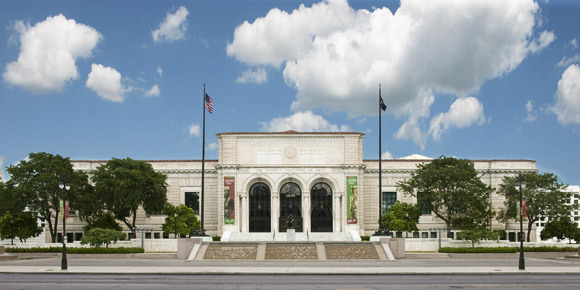
Several contributors to Raxa Collective have family living in Greece. There is nothing to be said here about that country’s economic and political woes that has not already been said better elsewhere, so no insult is intended to Greeks by making reference to the woes of another location.  Detroit, an American city facing economic woes comparable, when scaled to the municipal level, of Greece, is considering the sale of art it owns to raise what may be billions of dollars worth of needed cash.  Peter Schjeldahl, art critic for the New Yorker, has posted a brief observation about it, the latter portion excerpted below. Out of this mess comes an observation worthy of comment considering Raxa Collective’s mission:

…Art works have migrated throughout history. Unless destroyed, they are always somewhere. It’s best when they are on public display, but if they have special value their sojourns in private hands are likely temporary. At any rate, they are hardly altered by inhabiting one building rather than another. Continue reading

Conservation Is Sometimes The Story Of Change

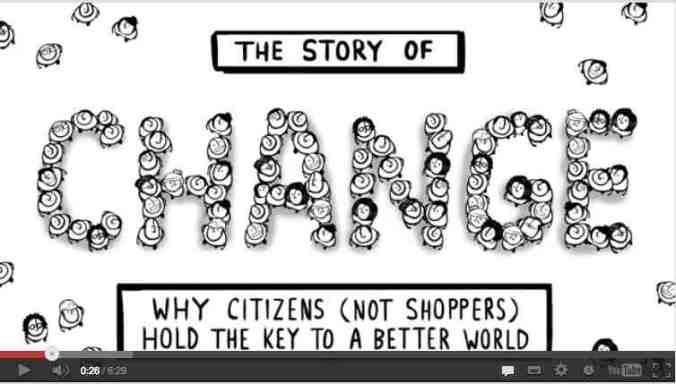
Click above to go to the location where Cornell University is hosting this brief video by a fellow alum of several Raxa Collective contributors:

Can shopping save the world? The Story of Change urges viewers to put down their credit cards and start exercising their citizen muscles to build a more sustainable, just and fulfilling world. Continue reading

WED 2013: Europe dumps fish dumping

WED 2013 - Raxa Collective

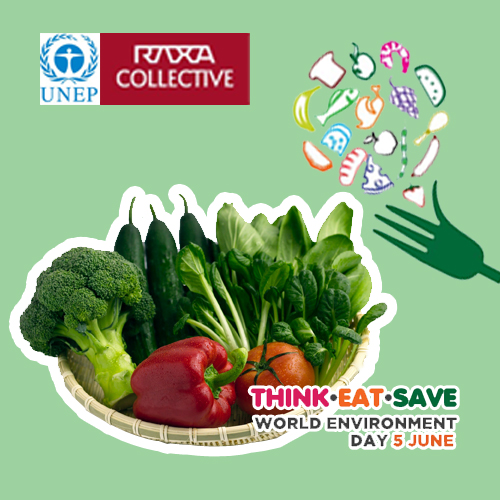
On June 5, we’ll celebrate World Environment Day. This year UNEP focuses on the theme Food waste/Food Loss. At Raxa Collective we’ll be carrying out actions and sharing experience and ideas. Come and join us with your ideas and tips to preserve foods, preserve resources and preserve our planet.

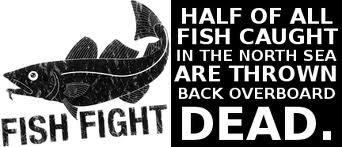
www.fishfight.net

…and about 80 per cent of Mediterranean stocks and 47 per cent of Atlantic stocks are overfished. It may seem rather odd but the European Union’s policy to avoid overfishing consists in tossing dead fish back in the sea if a fleet exceeds its quota.

For decades industrial fleets have been subsidised to plunder the European waters working under the rules of the  Common Fisheries Policy devised in the 1970s. And the rule of ‘discards’ has been let’s say counter-productive in reviving the fish stock. The practice allows fleets to net quantities of fish exceeding their quota, then simply throw any unwanted dead fish overboard.

Continue reading