Education
Was Einstein A Doodler?
I am enough of an artist to draw freely upon my imagination. Imagination is more important than knowledge. Knowledge is limited. Imagination encircles the world.
― Albert Einstein
October Air

National Geographic Magazine, Vol. 1
There must be something in the air. Some Universal Energy of Inspiration that touches down in October, if not annually, then biannually for a brief moment in time. Or is it just coincidence that two events of such simple, yet great significance should have happened on the same date?
What had begun as an elite club for academics and wealthy travel enthusiasts was reorganized in January 1888 into “a society for the increase and diffusion of geographical knowledge.” The National Geographic Society was incorporated a few weeks later and the first issue of the magazine was published as its official journal on October 1st.
William Morris Davis, often called the “father of American Geography” was an early member and contributor who wrote the introduction to Vol.1 of the newly minted magazine.
History became a science when it outgrew mere narration and searched for the causes of the facts narrated; when it ceased to accept old narratives as absolute records and judged them by criteria derived from our knowledge of human nature as we see it at present, but modified to accord with past conditions.
The society’s historic mission has continued for well over a hundred years, extending beyond the specifics of geography to increase and diffuse geographic knowledge while promoting the conservation of the world’s cultural, historical, and natural resources.”
And so we come to conservation. Continue reading
Green Backlash
My course load this semester throws some very interesting subject matter my way. In one of my classes, Marketing Research for Decision-Makers, the professor was asking the class to brainstorm a specific hospitality-related topic to research. The professor said that last year the class had looked into sustainable hospitality, and in passing, he mentioned that he and a colleague had put together a report on the class’s findings.
The report, titled Reversing the Green Backlash: Why Large Hospitality Companies Should Welcome “Credibly Green” Competitors, was written by Michael Giebelhausen and Helen Chun. It addressed a very interesting issue: how consumers would view a company if it introduced green initiatives. One of the steps consisted of in-depth interviews in order get people’s opinions on such initiatives. Results showed that interviewees distrusted company motivations for implementing sustainability programs. That is, the interviewees doubted that companies actually cared about the environment; they assumed they were instead implementing green practices for the marketing appeal and cost savings.

Greenwashing, the use of deceptive marketing to promote a company's sustainability, has exploded among hospitality firms.
When Wheels Start Turning
“180+ countries. 2000+ events. A single day to move beyond fossil fuels.”
Even if you missed one of 350.org‘s September 24th Moving Planet events, the goals of reducing CO2 in the atmosphere is a 365 days per year project.
Whether its with Climate Ride in California, Clif 2 Mile Challenge in your neighborhood, or the Great Power Race in 2010, there have been many ways to get involved in this global call to action.
365 Days a year; 40,075.16 km around the globe; cast of thousands; cost? Priceless.
Get Moving!
A Worldly Point of View

Emory’s Language Lab
Diversity in American universities is on the rise: just a little under a quarter (23%) of Harvard’s undergraduate enrollment consists of international students. At Columbia University, over a quarter (26%) of the university’s enrollment are international students. The story is the same at other top schools around the nation. UCLA, Boston University, Cornell and NYU all boast international student levels at around 15%. Here at Emory, the picture is roughly the same. Most of these international students in American universities hail from Asian countries, but there is plenty of exchange from Europe, Africa, the Middle East, and other parts of the world as well.
At Emory, many international students specifically come from China, India, South Korea, and Japan. Having spoken to these foreign exchange students, it is clear that international admissions to a top-20 American university are incredibly competitive, even more so than they are here. One friend told me that he was the only student from his entire town (a suburb of Calcutta, so quite a lot of competition) to attend a top-30 American school; even with his extremely impressive credentials Continue reading
Biophilia: E.O. Wilson, from Thoreau to Theroux

In December 2010 the Oxford English Dictionary (fondly called the OED) added 2,400 entries, including “biophilia“. But E.O. Wilson published the term (as well as it’s city kin) in 1984 in the book of the same name.
My attention was on the forest; it has been there all my life. I can work up some appreciation for the travel stories of Paul Theroux and other urbanophile authors who treat human settlements as virtually the whole world and the intervening natural habitats as troublesome barriers. But everywhere I have gone–South America, Australia, New Guinea, Asia–I have thought exactly the opposite. Jungles and grasslands are the logical destinations, and towns and farmlands the labyrinths that people have imposed between them sometime in the past. I cherish the green enclaves accidentally left behind. Continue reading

Is It Science?
Carl Sagan, Where Art Thou?
Collective Action & Learning
This site has more than one expression of gratitude for the founders, funders, faculties and students at more than one institution of higher learning. Students have written their own descriptions of gratitude for experiences that such schools (as well as their families and communities) have prepared them for. Recently I have interacted with the faculty and students of a course at Brown University and the takeaways keep on giving and then giving some more. Now, I extend an invitation, or recommendation, to students elsewhere: join!
I do not necessarily mean, as in here, join us. Just as well if you can support the efforts here or here or here; otherwise take your pick from other posts on this site.
I direct this to students at a course at Cornell University, taught by Steve Wolf. They are challenged to figure out the collective action problem, and solve it practically. Side note: some recent graduates of Cornell, such as Nicole and Katrina, have shared their personal experiences in projects inspired by the topics in this course; a couple of examples are here and here (see their other posts by clicking on their names on the right side of this site); so has Adrien, a couple of years out of Amherst; and David, who would have graduated Brown a few years ago if he had not been busy forming this organization.
You get the point. I hope that more of you join, wherever you may. And you are more than welcome here. We all look forward to your contributions.
Cool-Schooling
If you are a parent, and ever had a challenge related to your child(ren)’s school (what is the opposite of an oxymoron? this must be an example of it, but where is George Carlin when you need him?), you will likely want to read Clifford Levy’s moving description (alert: if you are not a subscriber to The New York Times this link will count as one of your free sample views) of enrolling his three kids from Brooklyn in a Moscow school a few years back.
If you are anyone who ever had your own momentary thoughts about being too cool for school (again the opposite of an oxymoron: who hasn’t? is it called a tautology? or just plain old redundant?), you will definitely want to read at least one snippet about the founder of the school in Moscow that Levy is describing:
…Bogin added courses like antimanipulation, which was intended to give children tools to decipher commercial or political messages. He taught a required class called myshleniye, which means “thinking,” as in critical thinking.
That is the school everyone could use a bit of: the one that enlightens, that empowers its students to become too cool to be fooled.
Takeaways & Giveaways
The mention of Brown and the questions students raised in a postscript exchange of ideas continues to inspire.
In a world of give and take, another mention of our favorite sculpteur of late is one way to think again about the fable mentioned here. Ants are not just the worker drones implied, and grasshoppers are not just the partiers implied. Could it be that the praying mantis has the answer? :
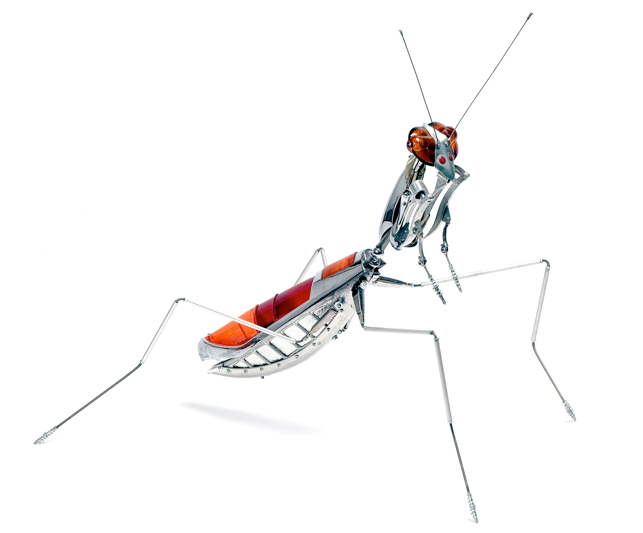
Lights Out!

The Celebration of Urban Birds isn’t just about “Bird Counts” and helping to create welcome habitats for your ornithological neighbors. Protecting migratory birds is an urgent part of this process. Just as we work to create and support buffer zones around nature reserves in various parts of the world, we need to think about ways that human lifestyles impact animal health and habitat.
New York City Audubon’s Director of Conservation Susan Elbin states that
Night-time migrants navigate using cues which include moon-light and star position, and may become confused by the glare of tall building lights.
Citizen Science
Bird watchers are everywhere. Countless households around the world sport bird-feeders in back yards, and thousands of photographers like Vijaykumar Thondaman dedicate much of their lives to capturing stunning images. It is practically impossible to believe that anyone could fail to see the beauty in a toucan or quetzal, Latin American species that tourists travel whole hemispheres to see for themselves in the wild.
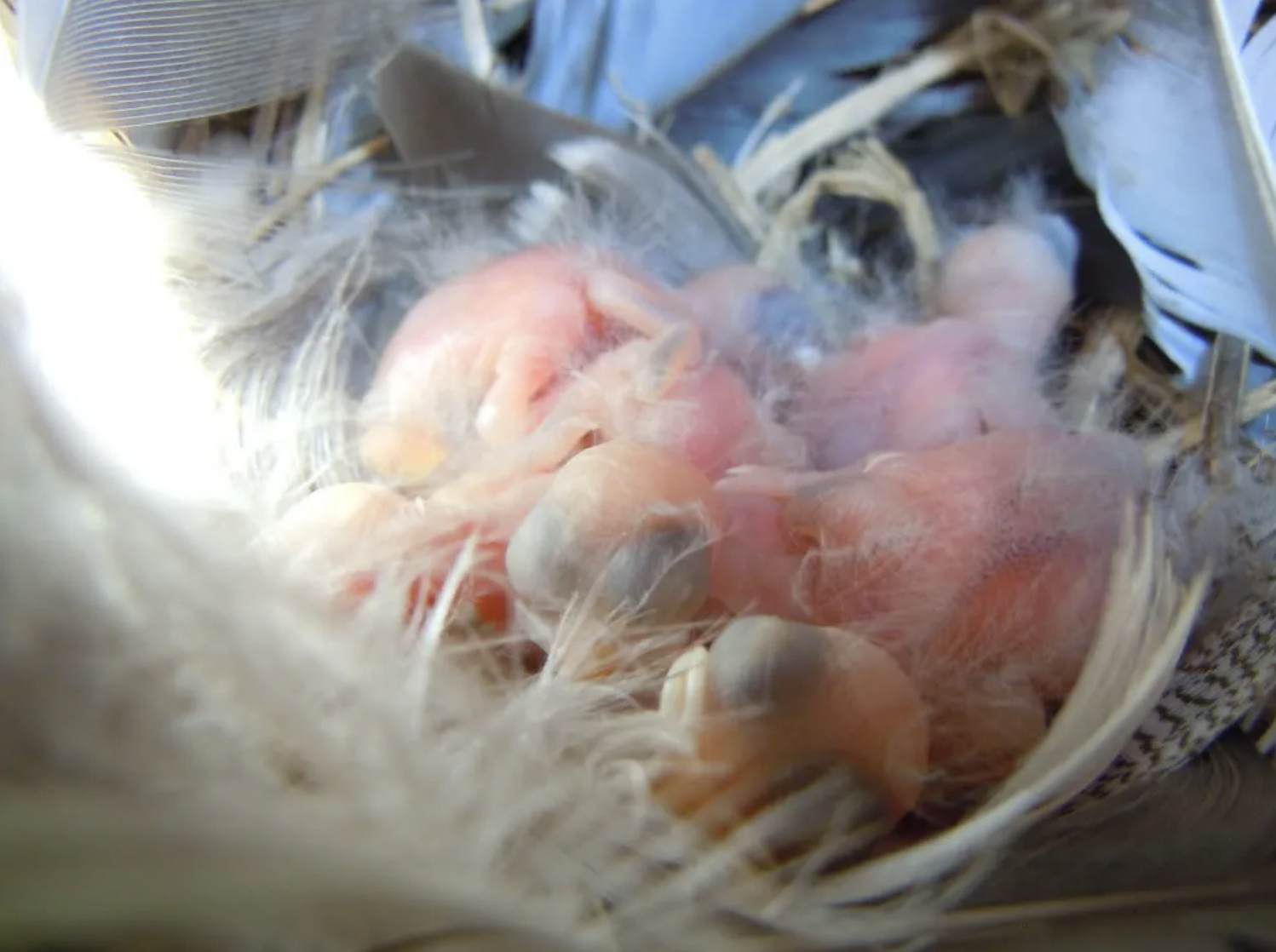
Swallow nestlings studied by Cornell students
Collecting data on birds is a difficult process because there aren’t enough ornithologists to be in the field all the time. But what about the casual bird watchers carrying around their binoculars, the families gathering on their porches to watch hummingbirds flit around flowers, or the schoolchildren staring out the classroom window at the distant and free shadows of birds of prey in the sky? Citizen science involves using these millions of bird lovers as a resource. As one of the world leaders in the study of birds, the Cornell Lab of Ornithology has been using citizen science since 1966, and is involved in many projects that bring bird watchers together while building an impressive database that is used for important research.
Here’s an article on Cornell Lab of Ornithology and the National Audubon Society’s citizen science project eBird.org.
Starting next week I will be working at one of these projects, called Celebrate Urban Birds, managing/deciphering this data and helping people around the country get involved in the surprisingly simple and rewarding experience of watching and identifying birds, whether they have a background in ornithology or not.
Takeaways
The video clip above is what comes to mind after a bit of reflection. Thanks to Alan, Bill and 30+ others, I have not only fonder thoughts for Brown University, but food for thought. The course ENGN 1930, aka Social Entrepreneurship, asks students to provide brief, written reflections on class sessions, readings, etc. In my session with them, I started by sharing my experience completing a PhD and moving to Costa Rica in the mid-1990s. I then described the process of learning from both public sector leaders and entrepreneurs there, and eventually forming a company that practices entrepreneurial conservation.
The gist of several of the “takeaways” from students is the reasonable question that I am chewing over now: are the Raxa Collective initiatives examples of social entrepreneurship? Is La Paz Group practicing social entrepreneurship? The snarky, if partially true reply would have been that I do not care all that much what it is called. Continue reading
Footprints & Impact
No sooner had I posted the words of a former President of Brown University than a colleague at Cornell sent me news that Mathis Wackernagel is serving a term as a Rhodes Professor (as it is known in shorthand). This brought to mind two things: first, this book that was published as I was completing my doctoral dissertation and starting work in Costa Rica on a related topic (more on which, soon); second, the President of Cornell University during all of my seven years on campus. The book was to have a huge, lasting impact. The same is clearly true for President Rhodes, whose hand I had the honor to shake more than once. The confluence of events in 1996–this book’s publication and an unrelated group of grateful and generous Cornell alumni creating this Professorship that would later honor the book’s author–is pretty cool:
Frank H. T. Rhodes Class Of ’56 University Professorship
To commemorate their 40th reunion, the Class of 1956 initiated an endowment to create the Frank H. T. Rhodes Class of ’56 University Professorship in honor of Cornell’s ninth president (1977–1995). The purpose of the Rhodes Class of ’56 Professorship is to strengthen the undergraduate experience by bringing to the university individuals from every walk of life who represent excellence of achievement and to create opportunities for interaction with undergraduates. The endowment also makes it possible to create public events related to the professorship such as lectures, performances, films, art exhibits, or conferences. Rhodes Class of ’56 Professors are full members of the faculty while in residence. Appointments are awarded for a period of three years. During each year of their appointment, Rhodes Class of ’56 Professors visit the campus for a week to engage in a variety of activities including public lectures, ongoing courses, and collaborative research.

Go Grinnell!
The inauguration of Grinnell College’s 13th president Raynard S. Kington, M.D., Ph.D in 2011 marked a transition point for the college. The prize commemorates the occasion and celebrates Grinnell’s historic and future commitment to positive social change.
News(Paper) Power
Despite the now ubiquitous use of the internet to follow both local and world news, newspapers continue to exist for many people as their daily connection to current events. In many countries that’s not their only use of course. We’ve written about the recycling initiatives of newspaper bags and baskets, as well as their use as wrappers and packaging in markets around the world. But used for fueling our cars? Now that’s news!
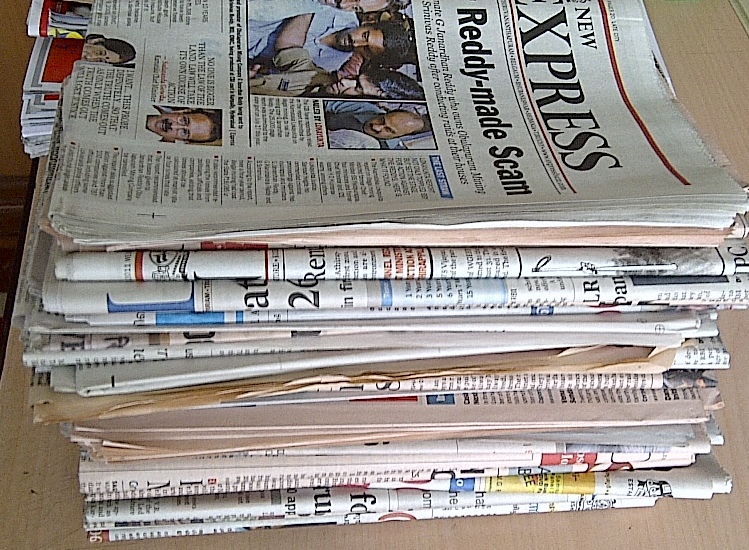
Tulane University associate professor of cell and molecular biology Dr. Mullin and his team have just applied for a patent for a method to produce the biofuel butanol from organic material. Continue reading
Flattering Mother Nature
The Art and Design worlds are constantly giving us examples of our interpretive abilities when it comes to nature. In fact, the very roots of Art go back to those expressions. But if “Imitation is the Sincerest Form of Flattery” then scientists and engineers are also following the adage that “form follows function” in ways that have the potential to direct us out of some of our environmental problems.
Lindsey Doermann writes about how an elephant’s trunk, water strider’s legs, woodpecker’s beak, peacock’s feathers or a beetle’s back (to name a few) are inspirations toward conservation focused engineering.
Balancing Act
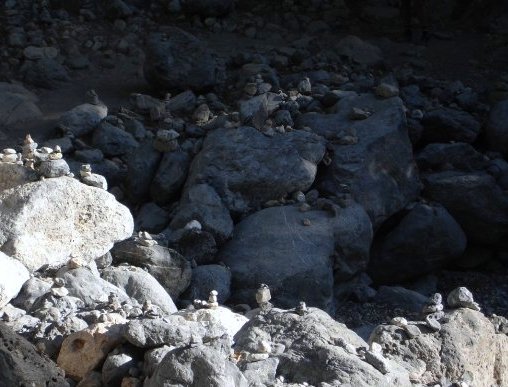
Stacked stones at Samaria Gorge on the Greek island of Crete
Many of us enter a wilderness area to get away from the obvious signs of human habitation. We go to commune with nature, to be awed by rock, tree or water that has power and age beyond what we can comprehend.
Ancient ruins and other cultural conservation sites have no less appeal. To stand near a structure built with the often inexplicable ingenuity of early civilizations can be literally breathtaking.
The desire to leave a time capsule of that moment by means of a scratched name and date is nothing new. Greeks, Romans, Egyptians, Mayans, not to mention Eighteenth Century Romantic Poets have succumbed. (Lord Byron’s carved name on a column of the Temple to Poseidon at Cape Sounion, Greece is likely one of the world’s most famous pieces of graffiti.) Continue reading
 Organikos