Zombie Ants

African ant (Pachycondyla sp) attacked by an insect eating Fungus (Cordyceps sp) Guinea, West Africa. Photo © PIOTR NASKRECKI/ MINDEN PICTURES/National Geographic Creative

A few years ago I wrote about a curious and very specific relationship between some beetles and their wood-eating fungus symbiotic partner, and we’ve also shared other work on crazy parasitic creatures that can alter their hosts’ behavior, sometimes pretty radically (warning, creepy video). Believe it or not, the photo above isn’t some weirdly-antlered African ant–well, actually it is, but the antlers aren’t part of the ant’s body, they’re the spore-spreading apparatus of a parasitic fungus. Read on for more about the real-life World War Z that has been going on between ants (as well as other insects) and a family of zombifying fungi for millennia.

Earlier this week I went to a lecture hosted by Cornell’s Department of Neurobiology and Behavior titled “Zombie Ants: the precise manipulation of animal behavior by a fungal parasite.” The lecturer was David Hughes, Professor of Entomology at Penn State University, whose faculty webpage provides PDF links to most of the articles that he has contributed to if you’re interested in checking out the actual journal pieces on this topic.  Continue reading
Cicadas In Love

First Cicadas Arrive As U.S. East Coast Braces For Billions MoreOur attention to entomological wonders dropped off, sadly, when Milo (whose interests and talents happily extend beyond bugs) left India last year.  To keep bug love alive, we posted recently about a current entomophenomenon linking to a blog post on the New Yorker’s website; now note that another of their writers has treated it, crafting words so we might have thought of it this way ourselves (if only):

It is the nature of youth to make a racket. This happens reliably in New York City every weekday between two and three in the afternoon, when school lets out. Teen-agers spill onto the sidewalks and descend below ground into the subway, where, having loosened their uniforms and shed decorum, they occupy the airwaves—shouting, flirting, arguing, cajoling, checking in, checking out. They sing the song of themselves, loudly, jubilantly, to a rhythm that only they can hear. Continue reading

Entomological Wonders

The New Yorker’s website has a post by Michael Lemonick describing a natural wonder than most people would not likely rate as highly as, say, an aurora borealis. But if you happen to be in the USA during the coming months, prepare for a natural shock and awe:

…The chirp of a single Magicicada septendecim, a type of cicada, is hardly noticeable. The simultaneous chirping of a million of them—a very rough estimate of how many insects will populate each infested acre—is not quite deafening, but it’s certainly overwhelming. The sound, a shrill, relentless whine, has been likened to the screech of a jet engine. Continue reading

Exoskeletal Bling

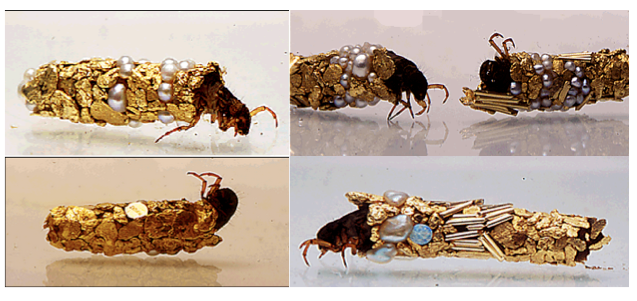
The caddis worm (order Trichoptera) may not be as popular as its famous shiny cousin, the scarab beetle, but it carries the extra charisma of an intrinsic aesthetic behavior.

French artist and science enthusiast Hubert Duprat took his natural curiosity to an elaborate level when he began providing these case building larva with gold spangles and semi-precious materials in lieu of the bits of sand and gravel they would normally use.

An amazing observation is that the worms seem to approach their work with an artistic eye, choosing the color and quality of the materials they use. In the 1930s an American entomologist observed in a Nevada river that “among all the little particles of sand and minerals swept along by the water, the Trichoptera make meaningful selections of bright blue opals—in other words, the most conspicuous or garish materials.” Continue reading

Star-Led Little Critters

Further on the the various compasses we navigate by:

Look up at the sky on a clear, moonless night, and you can make out the broad, hazy band of the Milky Way. For the longest time, observers were unsure what the milkiness was. Celestial clouds? Tiny stars? The “fiery exhalation” of large, sublunar stars, as Aristotle proposed? In 1610, using a telescope (a recent invention), Galileo revealed that the haze is made up of individual, barely visible stars; they are faint only because they are so distant. So continued the hard process of putting us in our proper cosmic place—an orientation that only gets more disorienting with each new scientific discovery. Continue reading

Mexican Moths

_MG_7886

Entomology is a relatively minor hobby of mine. I enjoy chasing after and photographing insects when I have the chance – and most places in the world have an abundance of insects. Cabo’s airport, located on the southern point of Baja California, is no exception. These photographs were taken mere minutes after disembarking the airplane on which we arrived. The thousands upon thousands of egg-laying moths were easily mistaken for bird droppings, until examined more closely.

_MG_7888 Continue reading

Krulwich Wonders About The Little Things

Click above to go to the post where this video is hosted:

Every year, thousands of college graduates pour into big cities, find themselves a fun place to live in a cool neighborhood, great location, friends all around. But then, their luck turns, they run short of money, lose their first job, their second job, lose their lease, and then, step by step, find themselves in places that are less safe, less airy, less and less livable, until they’re on the bad side of town in a scary, dank room … and life is grim. You know people like this?

Well, this is their mascot: an animal with a serious real estate problem. Continue reading

2012 YouTube Your Entomology Contest

The Entomological Society of America (ESA) is the largest organization in the world serving the professional and scientific needs of entomologists and people in related disciplines. Founded in 1889, ESA today has more than 6,000 members affiliated with educational institutions, health agencies, private industry, and government.

If you have followed our blog you know we are not averse to celebrating the normally less celebrated corners of the natural world.  We are therefore not surprised to learn of this organization, and are pleased to point to its entertaining and informative contest on YouTube. The sample video below won the Open category, and shows a swarm of predatory ponerine ants searching the African savanna for their prey–termites. When they locate a colony, they bite and sting their victims, and then return to the nest with jaws loaded with dead prey.

Nature’s Relics

This slideshow requires JavaScript.

Entomologist, author and photographer Piotr Naskrecki, based at Harvard University’s Museum of Comparative Zoology, has published a book whose photos we first saw here, and whose attention to cycads we first took note of here.  His book is available here.  For an ever-expanding catalogue of his amazing nature images with accompanying entomological (and other) interpretive guidance, see his blog here.

Georgian Dragon

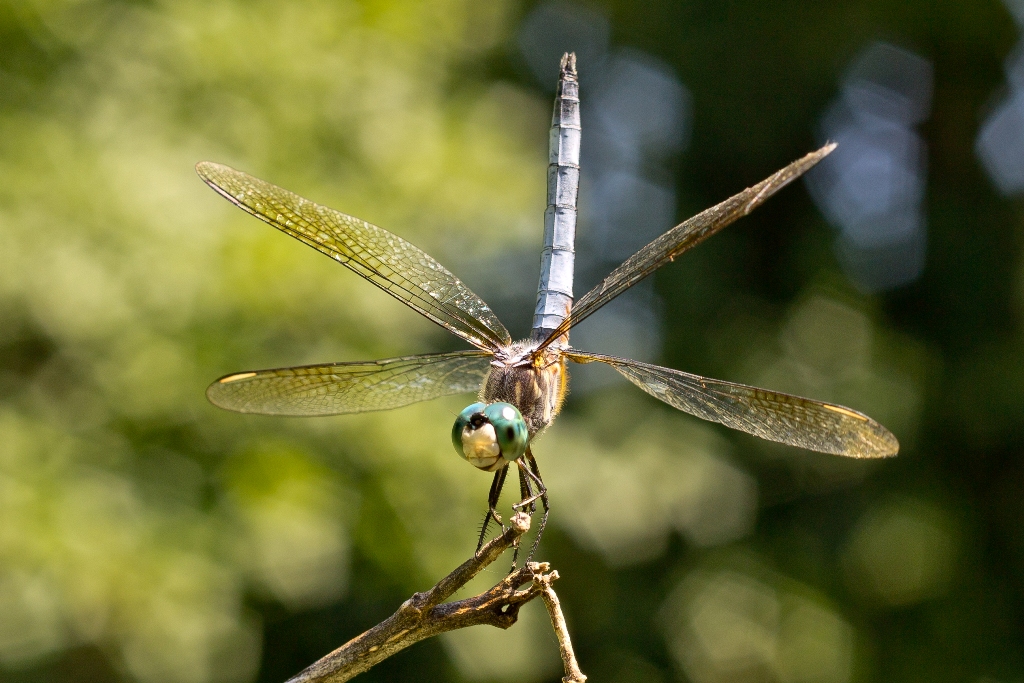
I shall resist the underwhelming urge to throw in a bit of canonical wordplay concerning St. George, and merely say that this is my first insect photograph with my new 50mm F1.8 lens. The dappled sunlight behind the dragonfly is a testament to the glory of shooting with this enormously apertured lens – the bokeh is a pleasure to both create and to view. I was only in Georgia for ten days in between Kerala and New York, but it was a pleasure to step out of my grandmother’s (an avid odonatophile) back door to find this dragonfly patiently waiting for me. Continue reading

Granite Ghost – Revisited

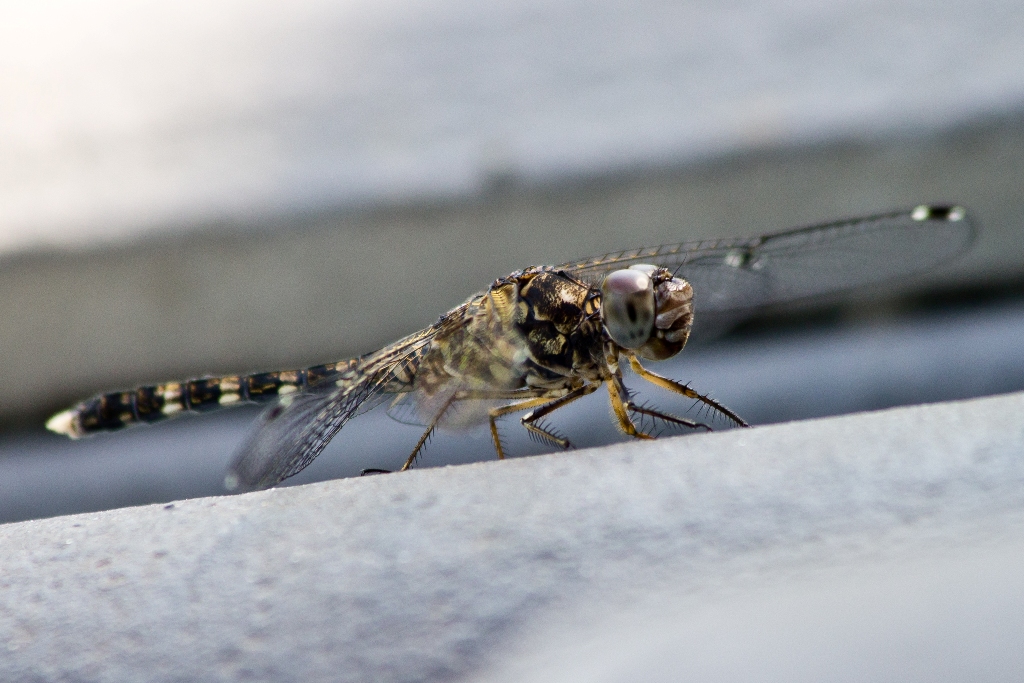
As the monsoons blow through Kerala, the native dragonfly and damselfly populations in the area appear to wax and wane along with the water levels. A sunny day by any water body guarantees sighting at least one species, but as is only so common during the season, overcast days dominate the calendar. Nevertheless, Kerala’s entomological biodiversity remains  as strong as the summers, during which dozens of Odonate species whizz back and forth teritorially over their little stretch of pond-shore or riverbank.  The main reason that these insects are not out in force as frequently as the rest of the year is that they are most active in hot and dry climates, particularly in direct sunlight. Contrarily, monsoons traditionally offer respite to natives, being wet and (slightly) cooling. When they’re not visibly hunting or mating, dragonfly and damselfly populations are probably strongest in the larval stage – extraordinarily aggressive aquatic predators. I got lucky a few days ago on a sunny day on the backwaters when I saw a Granite Ghost – in my books a rarer species of dragonfly that I’ve only sighted once in Goa.

Continue reading

The Truly Golden Dartlet

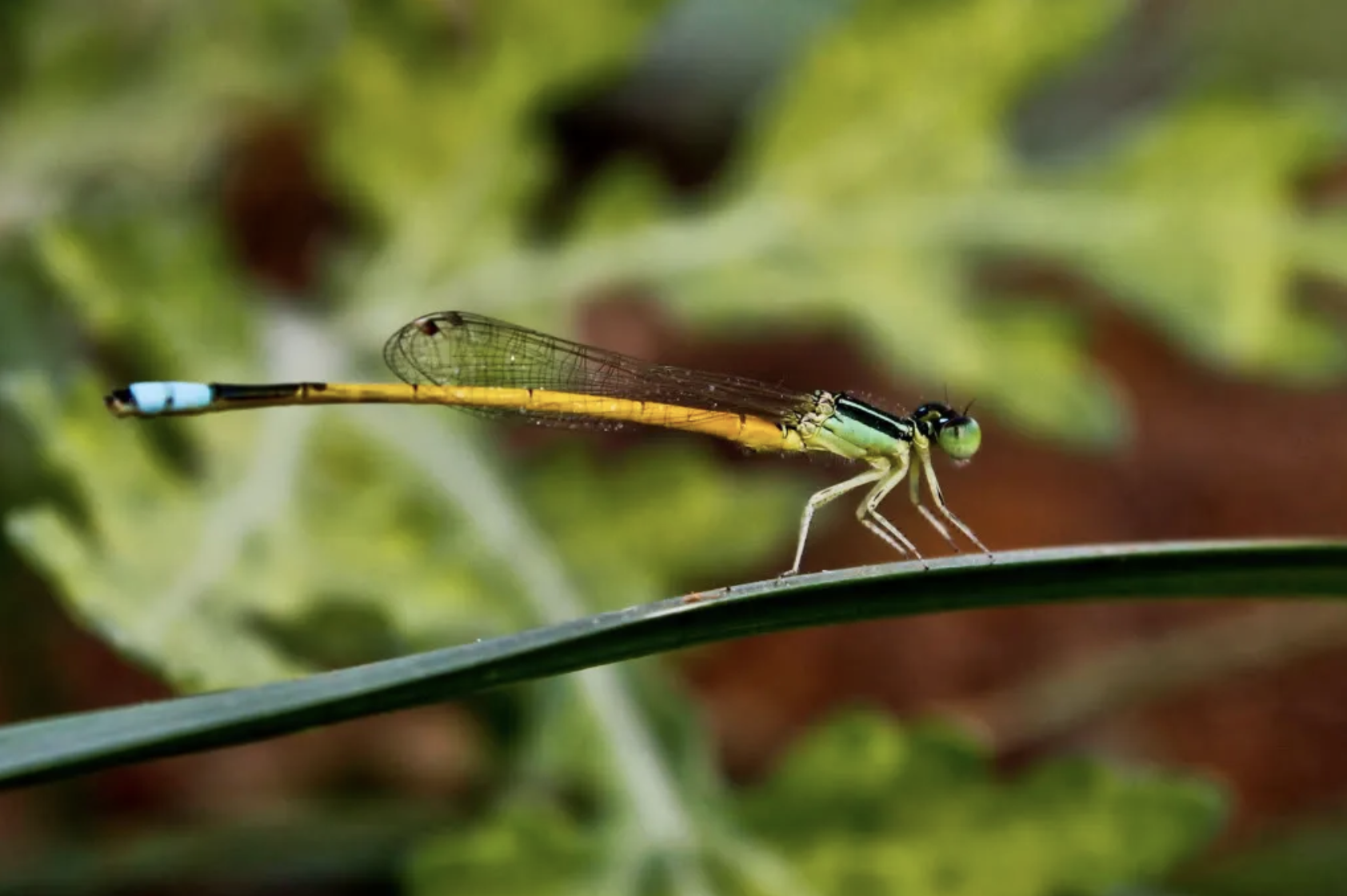
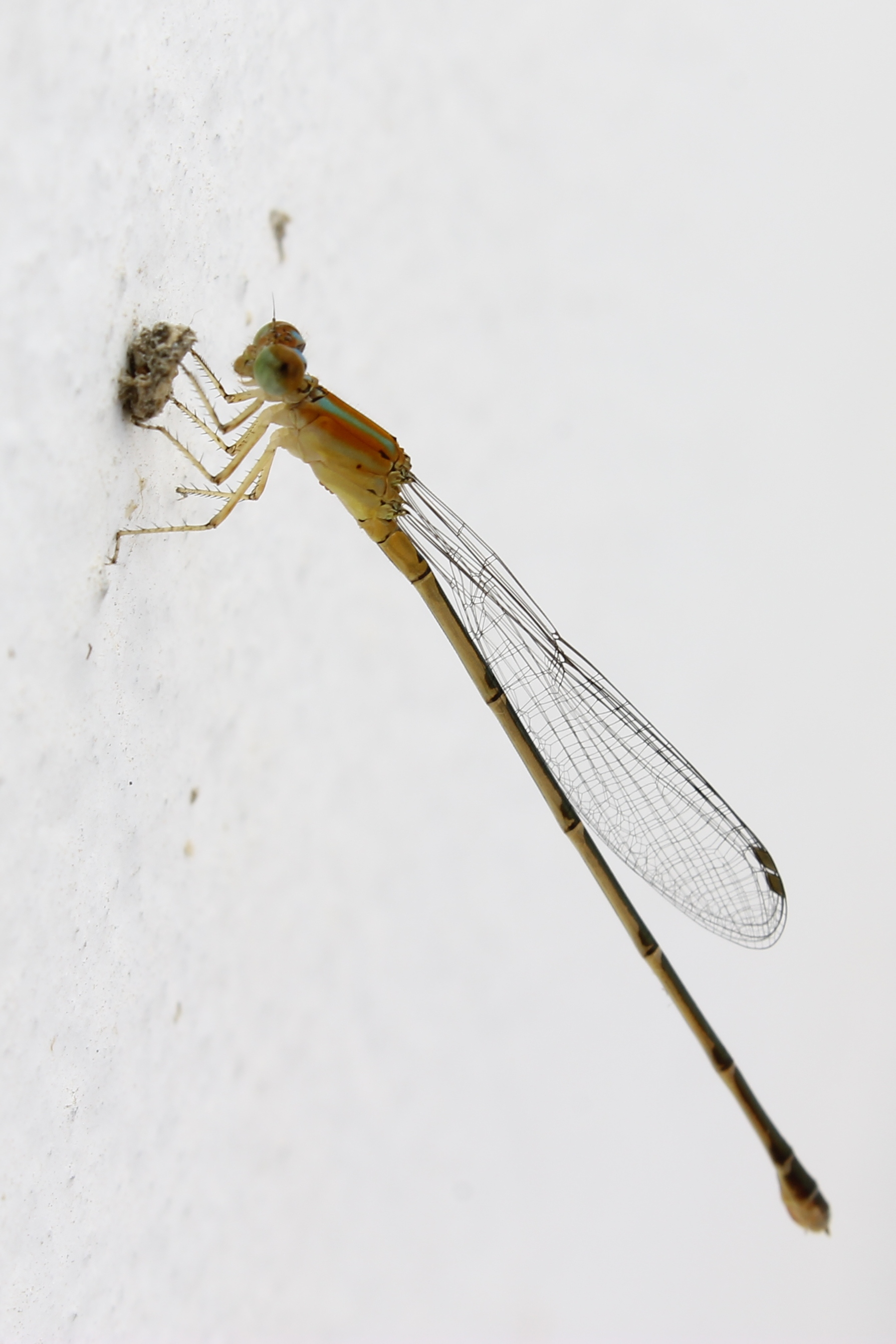
The Golden Dartlet, or Iscnura aurora, is a small species of damselfly that resides in the general vicinity of small streams and ponds. The above photograph was taken several hundred meters from any sizable body of water – a testament to the creature’s rugged and functional, yet beautiful design.  Continue reading

Pied Paddy Skimmer, Revisited

A few days ago while walking around Kumily, I saw one of Kerala’s more common species of dragonfly, Neurothemis tullia. Having written about the species before, I didn’t photograph it as usual, until I realized I had a new accessory on my person. The reverse lens adapter is a brilliant money saver, and while not quite as powerful or versatile as a macro lens, costs close to 50 times less than a new lens. Using the final technique described here, the adapter basically replaces the duct tape and allows for much steadier hands. Focusing is still very difficult, and the focal plane is usually limited to under a centimeter, but this often allows for very unusual and abstract images. Such as this young female Pied Paddy Skimmer:

Continue reading

Beetles, Dancing, Rock & Roll

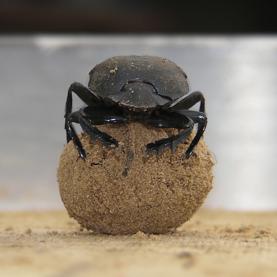
Click the image to the left to go to an article in Scientific American about a beetle that is capable of a remarkable architectural feat while dancing a remarkable two-step:

Emily Baird of Lund University in Sweden and her colleagues study how animals with tiny brains—such as bees and beetles—perform complex mental tasks, like navigating the world. The dung beetle intrigues Baird because it manages to roll its dung ball in a perfectly straight line, even though it pushes the ball with its back legs, its head pointed at the ground in the opposite direction. If the six-legged Sisyphus can’t see where it’s going, how does it stay on its course?

Continue reading

Blue Grass Dartlet

The first time I saw this species, I was dumbfounded, to say the least. We live in a 10th floor apartment in urban Cochin, which admittedly is on the banks of the backwaters. Nonetheless, I was quite surprised to see a dull-colored damselfly float through a window and over our dining room table, and out the door onto the balcony on the opposite side of the room. Fortunately, I gathered my wits quickly enough to rush back with my camera, and corralled the enigma into a corner in the balcony (non-violently, of course), and was able to get a few shots before it breezed off in the lethargic float I’ve come to associate with damselflies. The only time I’ve seen any damselfly zooming the way most dragonflies do is when they’re swooping in on their prey, at which point even the laziest, slowest, and smallest of them can put on quite a turn of speed.

Continue reading

Male Trumpet Tail (Revisited)

A few months ago while staying at Cardamom County, I spent a morning with a wonderful character named Jain – a tribal man with an avid interest in insects and arachnids, working as a guide in the Periyar Wildlife Sanctuary, and incidentally, a friend and student of Mr. Vijaykumar Thondaman‘s. Both armed with cameras, Jain and I entered the reserve just after dawn, and spent the best part of the morning hunting dragonflies and damselflies across streams and fields, ponds and gullies. Continue reading

Bi-Colored Damselfly

As mentioned in an earlier post, I’ve been developing my techniques for improved macro photography without a macro lens. Tough work, but highly rewarding. Besides areas I will soon explore thanks to a new array of equipment (extension tubes, magnification filters, etc.), I have currently enjoyed a great deal of success with the relatively unknown backward-lens trick. Although you lose the ability to focus and meter light, the technique is excellent for artistic photographs of small things. And if it hasn’t been made clear from my dozens of posts on the subject – I love small things. Continue reading

The Buzz

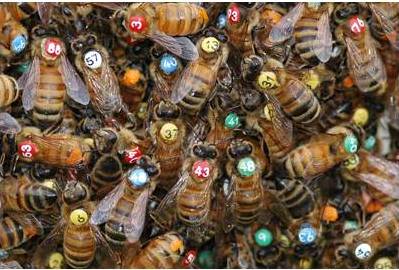
Bee swarm labeled for individual identification. Photo:Thomas Seeley

Cornell professor and chair of neurobiology and behavior Thomas Seeley has been fascinated with bees for much of his life. His new book Honeybee Democracy (Princeton University Press) steps way beyond entomology and apiculture by suggesting the swarming habits of Apis melllifera in decision making as “analogous to how the nervous system works in complex brains.”  Continue reading

Scarlet Basker, Revisited

In my previous post about this species, I gave a very brief description of its physiological features. Urothemis signata is indeed called the Scarlet Basker because of the mature male’s coloration, although the young male and female are quite similar, and therefore difficult to differentiate.  The difference (prior to maturity) between the two, as far as I can tell, is that the female’s abdomen has somewhat more extensive black markings, becoming almost ringlike, whereas the male’s markings are more like patches.

Although it is very possible that there were mature males flying about the area in which I photographed this specimen (there were probably 6 or 7 immature ones about), it would be almost impossible to tell because  Continue reading