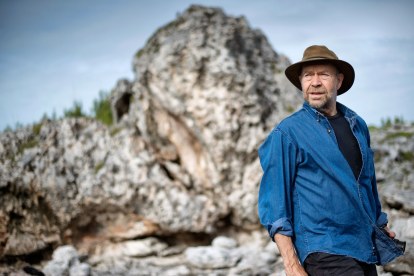
Thirty years ago, James Hansen, a scientist at nasa, issued a warning about the dangers of climate change. The predictions he and other scientists made at the time have proved spectacularly accurate. Photograph by Charles Ommanney / The Washington Post / Getty
I have always been appropriately alarmed by Elizabeth Kolbert’s articles and her comment pieces in the New Yorker. This brief comment below is alarming enough, but with a twist. Science has done its job, but we as citizens, business people, civic leaders have not acted with sufficient urgency considering the clear scientific evidence.
 It may be true that scientists have not been the most compelling communicators, but that is no excuse for our inaction. As someone who left a scientific career developing a theoretical framework for entrepreneurial conservation in favor of opportunities to apply those ideas in the real world, I am in the same boat as a climate scientist. I look around today, after decades of best effort and I conclude that we have not accomplished enough in our practice. In our efforts to offer alternatives to messier forms of tourism, we have not accomplished enough. That is discouraging. But discouragement is not an option. We must find a better way to communicate that generates the required action for a less messy planet:
Listening to James Hansen on Climate Change, Thirty Years Ago and Now
On June 23, 1988—a blisteringly hot day in Washington, D.C.—James Hansen told a Senate committee that “the greenhouse effect has been detected and is changing our climate now.” At the time, Hansen was the head of nasa’s Goddard Institute for Space Studies, and though his testimony was certainly not the first official warning about the “greenhouse effect”—a report to President Lyndon Johnson, in 1965, predicted “measurable and perhaps marked changes in climate” in the decades to follow—it was the first to receive national news coverage. The Times ran the story at the top of the front page, with a graph showing a long-term rise in average global temperatures. Continue reading






 14 years ago, the word organikos crept into my vocabulary. My family’s company had recently been transformed from an advisory service to a management company. They were one year into the process of establishing protocols for “hospitality with sense and sensibility” and some generalizable principles for entrepreneurial conservation.
 There were small experiments over the years since then, starting with a single estate coffee from Costa Rica’s Tarrazu region; then wine from the Croatian island of Hvar; then monsooned coffee from the Malabar coast of India.






 Organikos