Fishing Boats

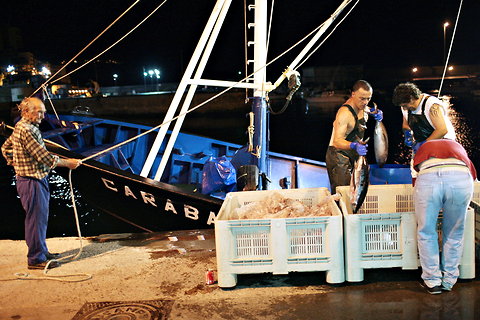
Kerala is an important fisheries centre with a 590 kilometre long coastline on India’s southwest corner.  Additionally, multiple rivers and backwaters, and several lakes offer vast potential to the industry. Plywood boats with outboard motors, sailboats and canoes are dot the water, adding colour to the already scenic landscape.

Continue reading

Trout Threads

Hanging by a thread? A study offers new insights on the greenback cutthroat trout. Image: Fish and Wildlife Service

From the Green Blog in the New York Times, a story about this beautiful creature:

The rare greenback cutthroat trout, Colorado’s state fish, is even more imperiled than scientists thought, a new study suggests. Continue reading

Diving with Scuba Iguana

Scuba Iguana trips start from the office on Charles Darwin Ave. either going north in a taxi to Itabaca Canal or taking a boat at the Scuba Iguana dock behind the office. All boat rides ranged from 35 to 120 minutes, and were generally pretty smooth. On the way, we could see Common Noddies, Blue-footed Boobies, Elliot’s Storm Petrels, Galápagos Shearwaters, and on North Seymour I saw a Red-billed Tropicbird twice! If I remember correctly, some Nazca Boobies were sitting on the coast of Floreana as well.

Continue reading

Bluefin Activism

Click on the logo image below to go to the main page of this activist organization.  Click here for the story where the text below the logo and after the jump comes from.

…The company which owns the tuna farm where the fish were released is called Kali Tuna and is part of the US based company Umami Sustainable Seafood. Umani is a major player in the bluefin tuna industry with operations in US, Mexico and Croatia. The firm went public last year with shareholders from around the world now cashing in on the company’s lucrative bluefin tuna trading, which is set to have landed them with over $54.000.000 US in profits last year. With slogans such as ‘Aquaculture – Growing to the tune of Mother nature’ and ‘Keeping Bluefin tuna stocks thriving’, the company is keen to portray itself as a ‘sustainable’ bluefin tuna trader. Continue reading

Are Cormorants Evil?

Funny to see this headline at the same time as Martin’s photo just published; not to mention previous posts of Cormorants from time to time.

With a nickname like Black Death (click the headline for the full story), it seems some think of these amazing birds in quite strong, negative terms; they sound evil.  Are they? Of course not.  Just providing a little friendly competition to those with rod and reel:

Known to anglers as the Black Death, the cormorant is a killing machine that can swim two minutes underwater and diving 80ft. In China, fishermen hunt with trained cormorants, but in Europe the protected species is a hated rival, blamed for emptying rivers of fish.

Anglers have been petitioning the government to do something about the birds for more than a decade. But a perception that cormorant numbers are now out of control has resulted in a clamour for unprecedented action.

My First Dives in Galápagos (2/2)

Six legs and two sail-like fins! What?!

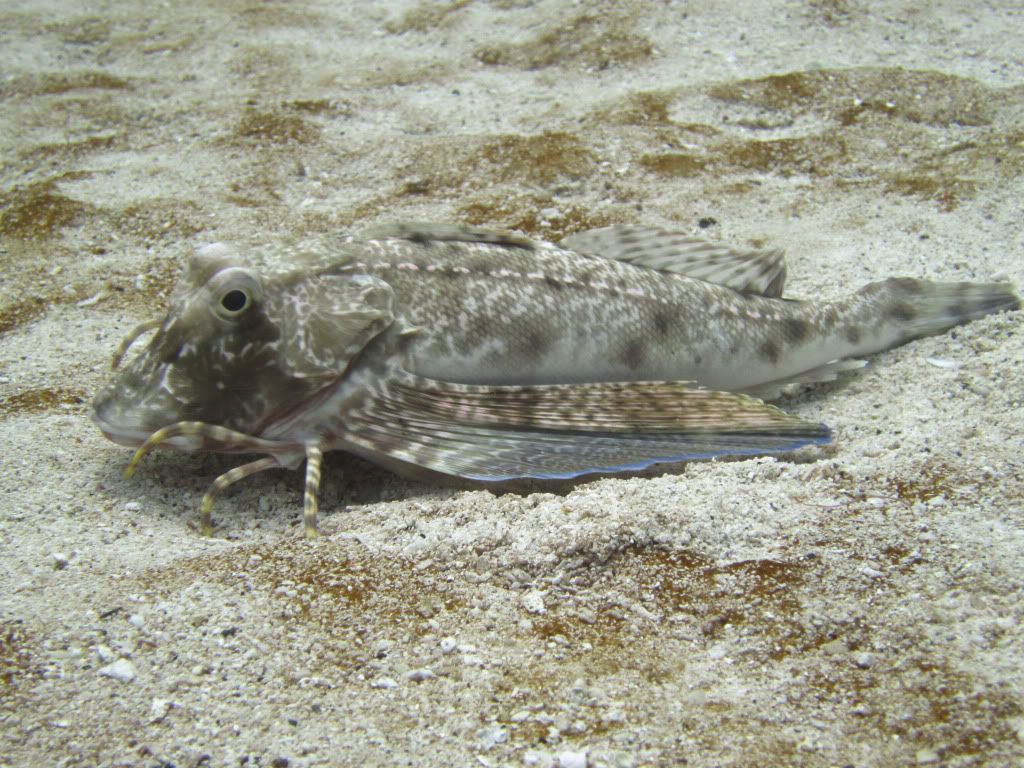
My last post shared a video of some of my scuba trips and a few images of two absolutely bizarre ocean species: the Red-lipped Batfish and the Galápagos Searobin. I had no clue that any such creatures existed in nature, or at least not under the light of the sun no more than 15 meters below surface level. Once again, Quike Morán of Scuba Iguana took the pictures and video with a point-and-shoot digital camera in a plastic waterproof case, and the two dives featured here were at Seymour Island and Mosquera Island, north of Santa Cruz.

My First Scuba Dives in Galápagos (1/2)

Last week, I had my first, second, third, and fourth dives since I got my CMAS diving certification in 2007 in Croatia. I saw two of the weirdest organisms I’ve ever encountered in the flesh (to be named in the next post), and was also able to fulfill one of my longtime wishes: to be underwater with any aquatic mammal!

I leave for a camping trip on the island of Isabela today, so for now my two brief and scheduled posts will be limited to a couple photos and the video that will be in each! All images and videos were taken by Quike Morán, my Scuba Iguana guide.

Whale Shark Freed From Fishing Net

Another day, another story of net-freed.  Click the image below, which looks like the one in the story here, for the story told briefly by video; yet another hero story we thank The Guardian for:

Scientists free a whale shark caught in a fishing net in Indonesia’s Cenderawasih Bay. Conservation International have completed the first expedition to tag whale sharks with radio-frequency identification making them easier to track and film. Whale sharks swimming into fishing nets has become a problem in the area.

Heroes & Tuna

A Sea Shepherd activist cuts a tuna fishing net in the Mediterranean in 2010.
Photograph: Simon Ager/Sea Shepherd

Click the image above to read the whole viewpoint, which we have commented on previously here and here, captured briefly here:

These people are, in my view, heroes. They are stepping in where governments have failed, to protect our common heritage. They are among the few people on Earth who will be able to give a straight answer when their children ask them what they did to prevent the avoidable ecological tragedies we now confront.

We’re No Angels

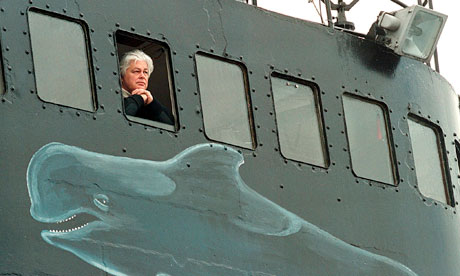
Captain Paul Watson says that the alleged incident in 2002 did not occur in Costa Rican waters. Photograph: Corbis

He’s no angel.  That would be the view of whaling and fishing interests, which include countries and big companies (plus plenty of soulless mercenaries, poachers and thugs).  Whales might think otherwise. 800 large endangered bluefin tuna, saved from poachers by this man and his organization, might too.  He counts plenty of our contributors as admiring, angel-cheering, distant observers.  Our observations are tempered by acknowledgement of the conundrums wrapped up in his in-your-face, semi-legal tactics (not our style).  But we care about fisheries and related topics as much (while trying to keep our wits about us) as those complexities.  And those forces Paul Watson is battling are certainly not always angelic themselves. Nor are we, always, for that matter.  Click the image above for the story in The Guardian:

California-based marine conservation organisation Sea Shepherd suspects that Costa Rica may have made a deal with Japan to have him extradited. Continue reading

Fish-Eater’s Dilemma

Click the image above to go to the story in Dot Earth:

Talk about timing. As American and European fisheries officials met this week in Brussels to talk about, among other things, the problem of illegal and unregulated fishing, Chinese boats were illegally in the Mediterranean, making a mockery of efforts to manage the bluefin tuna fishing season.

Beholder’s Eye

Robert Krulwich has more to say on topics we referred to in several links and observations about dwindling fisheries.  Is it just a matter of perception?

Yes, there are more and more people on the planet, and yes, there are fewer and fewer fish in the sea, but do we really notice? After all, fish live in water and we live on land; so we don’t mingle that much. If fish were sparrows, we might see a dramatic decline, but who misses what they don’t see in the first place?

Click the image to go to the full line of reasoning.

The Catch

In a post last August, Seth referred to the problem of over-fishing as an example of a complex set of challenges constantly facing societies, simply stated as how we cooperate to solve problems.  Overfishing is not a new problem, and like many challenging ones seems to be getting more and more daunting, with no solutions in sight no matter how far and wide we search.  Click the image below for a well-written documenting of one facet of this problem.  It may leave you in need of a lighter treatment of the future of fish

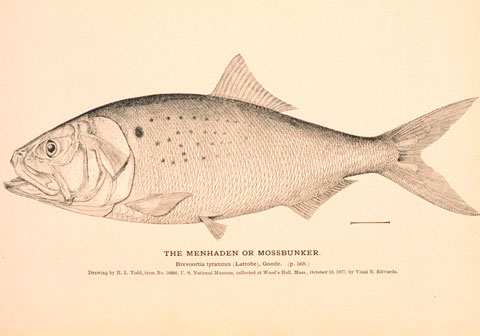
Harvested by the billions and then processed into various industrial products, menhaden are extruded into feed pellets that make up the staple food product for a booming global aquaculture market, diluted into oil for omega-3 health supplements, and sold in various meals and liquids to companies that make pet food, livestock feed, fertilizer, and cosmetics. We have all consumed menhaden one way or another. Pound for pound, more menhaden are pulled from the sea than any other fish species in the continental United States, and 80 percent of the menhaden netted from the Atlantic are the property of a single company.