The Golden Swallow Expedition

From left: Justin Proctor, Seth Inman, and John Zeiger.

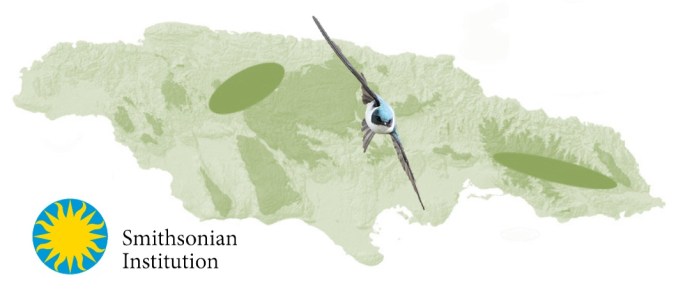
It’s now been several months since we last shared any news on the Smithsonian Institution’s expedition to search for the Golden Swallow (Tachycineta euchrysea) in Jamaica, where no sightings have been reported since 1989 — and even that report is a little questionable. While the Hispaniolan subspecies of the Golden Swallow is labeled as vulnerable, the Jamaican subspecies is labeled as critically endangered and possibly extinct, so this research trip is designed to lend some more finality to the issue. If our team of three positively identifies a Golden Swallow in Cockpit Country or the Blue Mountains between mid-January and late March, it will be the first confirmed sighting of the species in Jamaica in several decades, and new conservation efforts might be kick-started into action. If during our pair of one month trips to these two isolated areas of Jamaica we don’t see any signs of the Golden Swallow, the ornithological community can move a little closer to declaring the Jamaican subspecies of Tachycineta euchrysea extinct.
Continue reading

Golden Swallows, Jamaica Expedition

Article BannerIt was in 1844 that English naturalist Philip Henry Gosse arrived in Jamaica for his first time. Gosse would ultimately spend 18 months on the island, where he became fascinated in studying the local birdlife he found there. After returning back to London, he went on to publish a book entitled, “The Birds of Jamaica,” in which can be found the first formal descriptions of many birds still cruising about the Caribbean landscape today. The encounters he had with one bird in particular inspired Gosse to write the following:

This exceedingly lovely little Swallow, whose plumage reflects the radiance of the Hummingbirds, is found, as I am informed by Mr. Hill, in the higher mountains formed by the limestone range of the very centre of the island, as in Manchester, and St. Ann’s. It is not until we ascend this central chain, that we meet with this sweet bird, occasionally in the more open dells, but principally confined to the singular little glens called cockpits.

In this passage Gosse speaks of the Golden Swallow, a small passerine that has only been historically known from two islands, Hispaniola and Jamaica.  And while populations of this species continue to persist in several mountain ranges of Haiti and the Dominican Republic, the beautiful bird that Gosse describes in his Jamaican travels has not been seen on that island for more than 25 years.

Continue reading