Ideas
Was Einstein A Doodler?
I am enough of an artist to draw freely upon my imagination. Imagination is more important than knowledge. Knowledge is limited. Imagination encircles the world.
― Albert Einstein
October Air

National Geographic Magazine, Vol. 1
There must be something in the air. Some Universal Energy of Inspiration that touches down in October, if not annually, then biannually for a brief moment in time. Or is it just coincidence that two events of such simple, yet great significance should have happened on the same date?
What had begun as an elite club for academics and wealthy travel enthusiasts was reorganized in January 1888 into “a society for the increase and diffusion of geographical knowledge.” The National Geographic Society was incorporated a few weeks later and the first issue of the magazine was published as its official journal on October 1st.
William Morris Davis, often called the “father of American Geography” was an early member and contributor who wrote the introduction to Vol.1 of the newly minted magazine.
History became a science when it outgrew mere narration and searched for the causes of the facts narrated; when it ceased to accept old narratives as absolute records and judged them by criteria derived from our knowledge of human nature as we see it at present, but modified to accord with past conditions.
The society’s historic mission has continued for well over a hundred years, extending beyond the specifics of geography to increase and diffuse geographic knowledge while promoting the conservation of the world’s cultural, historical, and natural resources.”
And so we come to conservation. Continue reading
When Wheels Start Turning
“180+ countries. 2000+ events. A single day to move beyond fossil fuels.”
Even if you missed one of 350.org‘s September 24th Moving Planet events, the goals of reducing CO2 in the atmosphere is a 365 days per year project.
Whether its with Climate Ride in California, Clif 2 Mile Challenge in your neighborhood, or the Great Power Race in 2010, there have been many ways to get involved in this global call to action.
365 Days a year; 40,075.16 km around the globe; cast of thousands; cost? Priceless.
Get Moving!
Man Versus Color?
Field of Dreams

Walter De Maria, The Lightning Field, 1977. © The Estate of Walter De Maria. Photo: John Cliett
Based on his oeuvre one would say that Walter De Maria is an artist fascinated by mathematical precision and order. His work at Gagosian Gallery in New York City or The Nelson-Atkins Museum of Art in Kansas City in the United States or even the Chichu Art Museum in Naoshima, Japan exemplify this focus on the predictable progression of sunlight as it relates to planetary rotation and the perfection of spheres.
A Worldly Point of View

Emory’s Language Lab
Diversity in American universities is on the rise: just a little under a quarter (23%) of Harvard’s undergraduate enrollment consists of international students. At Columbia University, over a quarter (26%) of the university’s enrollment are international students. The story is the same at other top schools around the nation. UCLA, Boston University, Cornell and NYU all boast international student levels at around 15%. Here at Emory, the picture is roughly the same. Most of these international students in American universities hail from Asian countries, but there is plenty of exchange from Europe, Africa, the Middle East, and other parts of the world as well.
At Emory, many international students specifically come from China, India, South Korea, and Japan. Having spoken to these foreign exchange students, it is clear that international admissions to a top-20 American university are incredibly competitive, even more so than they are here. One friend told me that he was the only student from his entire town (a suburb of Calcutta, so quite a lot of competition) to attend a top-30 American school; even with his extremely impressive credentials Continue reading
Walton Ford, Come To India!
In my last post, I walked along a border–the one separating the land of nostalgia from the land of meaning–and am still not sure which side of the border I was on. One person’s memory lane is full of madeleines, and another’s may have no particular there there (so be it, glass houses and all). The link to Brother Blue is the puzzle. Can anyone, out of context, realize who that man was and what he accomplished from that little bit of Lear jive? I do not know. But recycling is an ethos that India is instilling, so I go with it.
The thread linking Thoreau and Brother Blue for me the other day kept un-spooling, and led me back to my favorite living artist:
Mystical India, In Practical Terms
There have already been plenty of posts on this site that give the perspective of non-Indians living in or visiting India. Here is another good example of an Indian describing a local feature of life that, to the non-Indian, is more of a phenomenon. And so the style of delivery, while quite different from that of this man, is equally intriguing (fair warning: the accent is stronger here, but you can train your ear to understand)–both men talking about old stuff, rather genially and humbly, but clearly aware that they are sharing with the world something of value that might have been overlooked because it has been hiding in plain sight for so long.
The style of delivery, in fact, is as interesting as the content itself, if you are a non-Indian trying to figure out what makes the place called India so worthy of attention. It is not what Robert Hughes called the Shock of the New, translated from art to service or organization; it is another example of the Shock of the Old. And the style of delivery reinforces just that.
The joking self-effacement–no Silicon Valley-type innovation or technology, but we get by in our own way–belies an organizational philosophy made tangible that would be the envy of many organizations around the world.
Biophilia: E.O. Wilson, from Thoreau to Theroux

In December 2010 the Oxford English Dictionary (fondly called the OED) added 2,400 entries, including “biophilia“. But E.O. Wilson published the term (as well as it’s city kin) in 1984 in the book of the same name.
My attention was on the forest; it has been there all my life. I can work up some appreciation for the travel stories of Paul Theroux and other urbanophile authors who treat human settlements as virtually the whole world and the intervening natural habitats as troublesome barriers. But everywhere I have gone–South America, Australia, New Guinea, Asia–I have thought exactly the opposite. Jungles and grasslands are the logical destinations, and towns and farmlands the labyrinths that people have imposed between them sometime in the past. I cherish the green enclaves accidentally left behind. Continue reading

The Wind Lens
After the earthquake in Japan earlier this year, critics of nuclear energy are clamoring for the retreat to the ‘safe’ and ‘reliable’ fossil fuels so commonplace of this age – the fossil fuels which are rapidly depleting due to the glut and the delusion of surplus of today’s culture. Not enough critics of the world’s energy policies are on what we at Raxa Collective consider to be the ‘right side’ of the argument – the one keeping the environment clean and safe. Nuclear energy is perhaps cleaner than burning fossil fuels for electricity, but even the slim chances of a catastrophe like Japan’s are enough to sell the public back to the gas-guzzling camp. But who is fighting for the third choice? The safe, the clean, the green – wind and solar power, the still-in-development responsible option

for civic-minded citizens wanting to lower their carbon footprint.
As explained in the link above, Japan’s Kyushu University is currently researching the most efficient form of harnessing wind power, and is developing a simple and cost-effective solution to the problems posed by the widely used ‘tri-blade” wind turbines of today. The main issue at hand is that the common turbine’s blades are too heavy (which is the case because lightweight materials are too weak), and more wind energy is necessary to spin the turbine, producing less energy than the potential. Kyushu University’s solution? The Wind Lens – a simple but ingenious addition to either existing or modified turbine designs which can double (or even triple) the energy output of the devices. The mechanism, in essence a ring around the turbine’s blades, acts in respect to wind much the same way a magnifying glass does to light – it takes the existing wind power, and thanks to the physics of pressure, concentrates the energy in such a way that the wind is forced through the tunnel at a significantly increased speed, resulting in a great increase in energy output. Environmentalists, intellectuals, and a few key organizations. Also, the Japanese. Continue reading
Captivating Vision
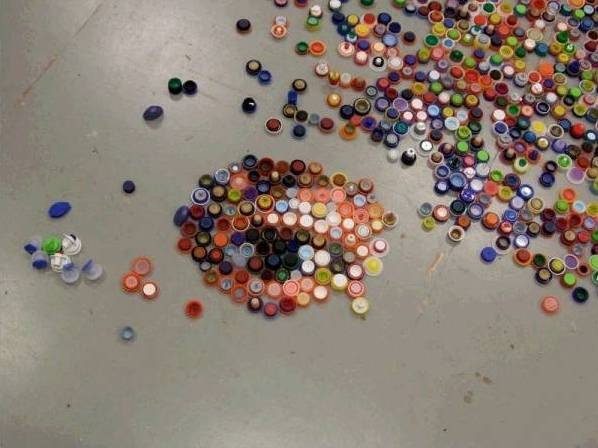
Mary Ellen Croteau’s “Nested Caps/eye”
Even the most enthusiastic recycler gets bogged down by bottle caps. Their chemical make up is different from the bottles they top, so often they don’t fit into the categories of those ubiquitous numbers that are ascribed to other plastic items.
Artist (and self proclaimed Agitator) Mary Ellen Croteau has a history with statement art and commenting on the quantity of plastic waste has been part of her work for some time. She’s used both bags and the caps to create work that is both captivating and provocative. Continue reading
A Few More Dots

Seth’s reference yesterday to one of the writers who most influenced me, combined with Amie’s reference today (do give a moment to her link on Niemann’s brilliance) to autumn, caused some sort of mnemonic chemical reaction. It started by thinking about the quotation of Thoreau overnight. By the time I saw Amie’s mention of autumn this morning, I suddenly remembered a trip I took to Walden Pond in the autumn of 1979. Continue reading
Connecting Dots
The news of Jad Abumrad being selected as a MacArthur Fellow, the so-called “genius grant” in recognition of his accomplishments and his future contributions, was worthy of celebration. That defenestration reference led me back to that episode, which was a series of oddly connected sub-segments on the topic of Falling. I use the word odd at the same time that I think: these are clearly examples of structured relevance.
What’s more odd is the coincidence between the Jad news and the fact that I just recently had pulled out material from my doctoral dissertation that I had only looked at one other time since 1997. I pulled it out for the presentation I made to the students at Brown mentioned here. Some visual highlights of that presentation (more on my dissertation, which is more clearly linked to Seth’s post here, and this one too, another time) are in the slideshow above, and complement Radio Lab’s treatment of the same (cue up at just prior to the 35th minute of this episode if you can download it and listen to it on your own player). Continue reading
Is It Science?
Wordsmithing: Biophilia
Our usual thanks to OED, but a special one too this time. One of the words we have been working into our sentences in recent years is this word that had two primary definitions different from the one we associated with one of our favorite biologists. Now they have added a third definition, thanks to E.O. Wilson and everyone who follows his ideas and words, and repeats them:
3. A love of or empathy with the natural world, esp. when seen as a human instinct.
Jad!
You knew he deserved it, but never thought about it, did you? Sounds like a question for Radio Lab. If you agree with us on comfort food, you might agree that Jad has something in common with those oreos, mostly in that he helps us adjust to wherever we find ourselves, but also when introducing us to new words such as defenestration (about 26 minutes into the segment in this link). For those who feel as strongly about Robert Krulwich as they do about Jad–what a team–you know that the Radio Lab partner is beaming with pride, don’t you? One word; good.

Carl Sagan, Where Art Thou?
Green House Redefined
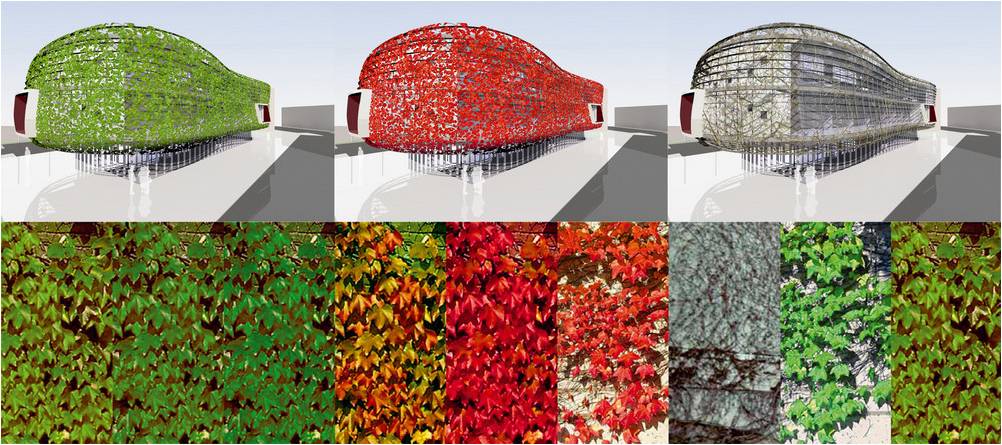
Use of natural light, passive and active energy saving systems, relative position to the sun, air flow, leaf moistened air….
This doesn’t sound like “business as usual” for a municipal building. But the Noain City Hall in Navarre, Spain designed by Award winning Zon-e Arquitectos stems logically from the fact that the region leads Europe in its use of renewable energy technology. Continue reading
Cool-Schooling
If you are a parent, and ever had a challenge related to your child(ren)’s school (what is the opposite of an oxymoron? this must be an example of it, but where is George Carlin when you need him?), you will likely want to read Clifford Levy’s moving description (alert: if you are not a subscriber to The New York Times this link will count as one of your free sample views) of enrolling his three kids from Brooklyn in a Moscow school a few years back.
If you are anyone who ever had your own momentary thoughts about being too cool for school (again the opposite of an oxymoron: who hasn’t? is it called a tautology? or just plain old redundant?), you will definitely want to read at least one snippet about the founder of the school in Moscow that Levy is describing:
…Bogin added courses like antimanipulation, which was intended to give children tools to decipher commercial or political messages. He taught a required class called myshleniye, which means “thinking,” as in critical thinking.
That is the school everyone could use a bit of: the one that enlightens, that empowers its students to become too cool to be fooled.
 Organikos