Jack London & Literature’s Role In Environmental History

Caleb Crain‘s book review of this biography will no doubt be of interest to any of our readers who follow Seth’s work on the history of environmentalism.  Subscription to the New Yorker is required, and worth it, but here is the blurb available to all prior to passing the pay wall:

Jack London never felt that he got enough meat. When he was seven, he stole a piece from a girl’s basket—an incident that he called “an epitome of my whole life.” Although his mother claimed that “he didn’t go hungry in our house!” and a childhood friend recalled being served steak during a visit, London insisted that he had been deprived. “It has been hunger,  Continue reading

Reading, Libraries & Good Citizenship

'We have an obligation to imagine' … Neil Gaiman gives The Reading Agency annual lecture on the future of reading and libraries. Photograph: Robin Mayes

‘We have an obligation to imagine’ … Neil Gaiman gives The Reading Agency annual lecture on the future of reading and libraries. Photograph: Robin Mayes

Libraries still have enough friends that we do not yet count them out, but the challenges they face are undeniable. Thanks to the Guardian‘s coverage of one prominent writer’s address on this important topic:

Neil Gaiman: Why our future depends on libraries, reading and daydreaming

A lecture explaining why using our imaginations, and providing for others to use theirs, is an obligation for all citizens

It’s important for people to tell you what side they are on and why, and whether they might be biased. A declaration of members’ interests, of a sort. So, I am going to be talking to you about reading. I’m going to tell you that libraries are important. I’m going to suggest that reading fiction, that reading for pleasure, is one of the most important things one can do. I’m going to make an impassioned plea for people to understand what libraries and librarians are, and to preserve both of these things. Continue reading

Parents, Kids, Travel

Whether it is to India or somewhere less far afield geographically, culturally, culinarily this advisory essay is well taken:
Taking a child out of the country is no small feat. Heck, taking a child to grandma’s house for the holidays can be exhausting! Not only is it important to prepare logistically for your trip—plane tickets, passports, itineraries, etc.—it is important to prepare your child emotionally, physically, and awesomely. Your mini-me is about to become a citizen of the world, and you are already nailing it.

Note To Self: Explore

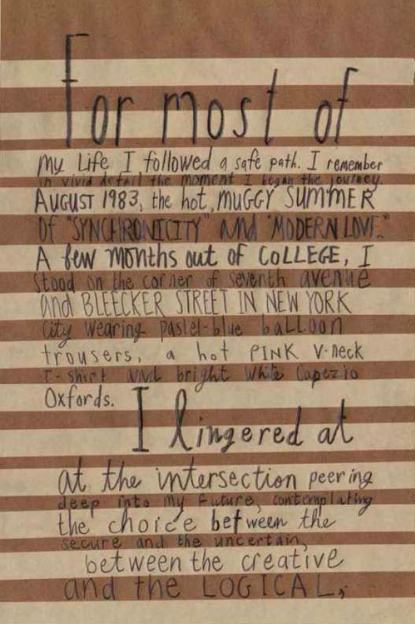
Thanks to the team at exp,lore.com, and hopefully by clicking the image above you will always be able to find the series of handwritten texts described here:

The seasonal trope of the commencement address is upon us as wisdom on life is being dispensed from graduation podiums around the world. After Greil Marcus’s meditation on the essence of art and Neil Gaiman’s counsel on the creative life, here comes a heartening speech by artiststrategist, and interviewer extraordinaire Debbie Millman, delivered to the graduating class at San Jose State University. Continue reading

If You Happen To Be In New York City

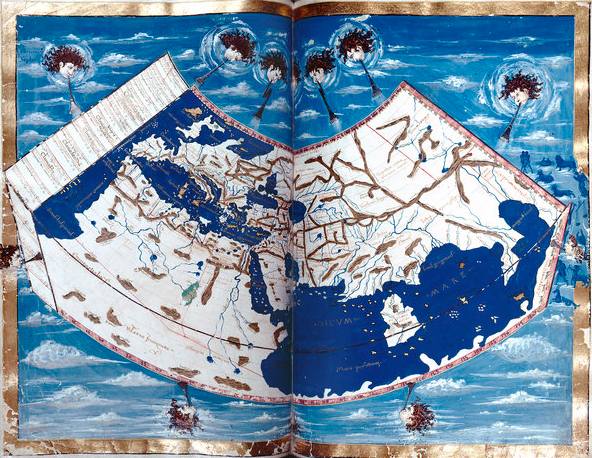
New York University’s Institute For The Study Of The Ancient World is hosting an exhibition that speaks to those of us who love maps and the ideas they represent in historic as well modernistic terms. (GPS-guided navigation systems, we love you, but this is about your ancestors). Those ideas can be as simple as “Getting From Here To There, In Hindsight,” which might have been a subtitle to this exhibition:

Measuring and Mapping Space will explore the ways in which ancient Greek and Roman societies understood, perceived, and visualized both the known and the unknown areas of their world. It brings together more than forty objects, combining ancient artifacts with Medieval and Renaissance manuscripts and printed books that draw upon ancient geographic treatises. Together, they provide a fascinating overview of Greco-Roman theories of the shape and size of the Earth, ancient methods of surveying and measuring land, and the ways in which geography was used in Roman political propaganda. A specially designed multimedia display examines the increasing importance of modern technologies in mapping the ancient world. Continue reading

If You Happen To Be In Austin

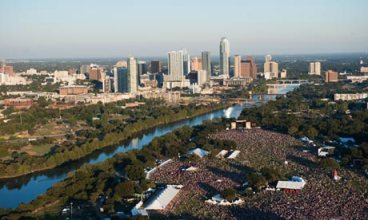
An expected 3,000 attendees are gathering in Austin, Texas, for SXSW Eco next week. Photograph: Austin CVB

An expected 3,000 attendees are gathering in Austin, Texas, for SXSW Eco next week. Photograph: Austin CVB

We normally think of technology or music when we think of Austin, or SXSW.  This even provides more to think about with regard to either of them. Thanks to the Guardian for letting us know about it:

Activists and industrialists might be like oil and water, but 3,000 of these strange bedfellows are gathering together in Austin, Texas, to discuss oil and water at SXSW Eco 2013 next week. Now in its third year, the annual conference aims to encourage cross-sector collaboration between professionals in business, government, academia and nonprofits on topics ranging from policy to consumer engagement. Continue reading

Gandhi’s Deep Ecology

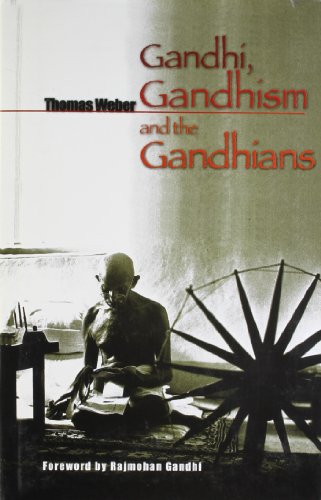
Among the many writings about Gandhi, Thomas Weber’s books seem to be held in esteem in India, with the book to the right being the most recent:

Mahatma Gandhi and his philosophy of truth and non-violence have intrigued the world for decades. Looking at the Western and Indian influences that had gone into making Gandhi the Mahatma, and the central importance of Gandhi to non-violent activism, these essays reclaim the power of truth and non-violence, which can still change the destinies of people and nations. In this collection, Weber discusses Gandhi, his ideology, and how India and the rest of the world is interpreting and reinterpreting the Mahatma. The doctrine of conflict resolution theory, new environmentalism, peace research, deep ecology, and Buddhist economics based on Gandhian principles renews the world`s belief in Mahatma and his teachings for our lives and our times.

One of the most visible and active Gandhi-focused websites posted an essay by Weber* about Gandhi’s influence on what eventually came to be known as deep ecology, and that seems a fitting reference on our site to commemorate this year’s birthday, which is also a national holiday in India.  A few snippets: Continue reading

Science Journalism And The Dynamics Of Democratizing Commentary

Wellcome Images

Wellcome Images

Lovely, thoughtful, radical stuff happening over at this old school publication as it navigates the new world of social media (click the image above to go to the source):

Comments can be bad for science. That’s why, here at PopularScience.com, we’re shutting them off.

It wasn’t a decision we made lightly. As the news arm of a 141-year-old science and technology magazine, we are as committed to fostering lively, intellectual debate as we are to spreading the word of science far and wide. The problem is when trolls and spambots overwhelm the former, diminishing our ability to do the latter. Continue reading

Hoteliers, Collective Action, And Outcomes As Yet Unwritten

CheHotelUnion

Raxa Collective has a commitment to the locations in which we operate our hotels, resorts and houseboats: we strongly prefer to hire, train and employ local community members.  Recently this sign has been visible in Thekkady, near Cardamom County.  It is meant to attract hotel workers to join the union representing the hospitality labor force across the state, and hangs in front of one of that union’s offices.  Without any irony or sarcasm, this photo was snapped by one of our contributors to stimulate conversation among several other contributors. Continue reading

Franzen’s Dilemma

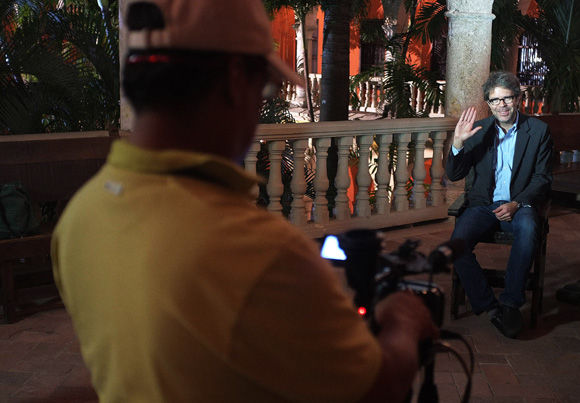
Photo by Kaveh Kazemi/Getty Images

Photo by Kaveh Kazemi/Getty Images

It is going to be our generation’s contribution to the colloquial cliche; equivalent to Catch 22.  Maria Bustillos makes the best case, in the fewest and least heavy words. for a great writer to change his mind. She is compelling. But he is an activist for a good cause, so we must be in his corner, even if it is just wiping the sweat:

Jonathan Franzen has a real gift for getting people into a tizzy. This time, the fracas was occasioned by a September 13th essay he wrote for the Guardian (“What’s Wrong With the Modern World”) excoriating our “media-saturated, technology-crazed, apocalypse-haunted historical moment” and lauding the early-twentieth-century Viennese satirist Karl Kraus, whose essays Franzen reveres, as a prophet for our own times. Though the essay’s specific criticisms are so familiar as to be unremarkable—he writes that Salman Rushdie “ought to have known better” than to “succumb” to Twitter, and rages against Amazon’s depredations of the book trade and the various hegemonies of Apple—in the few days since its publication, the author has been accused of irrelevance and cane-shaking, his sex life and his digestion have been impugned, and Rushdie told him to “enjoy [his] ivory tower”; he’s been called “an old windbag,” “a whingeing miseryguts,” and a “Chardonnay bore,” and has been generally dragged through the digital mud. Continue reading

Hermes, Circa 1979

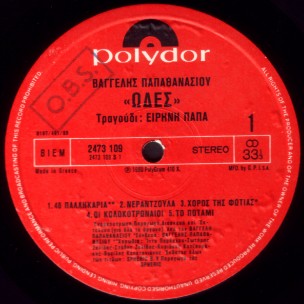
OdesLPLabelAt Easter time, 1979, my mother and I traveled back to Vourthonia. Musical soundtrack can accompany an occasion in life, just as in film. Vangelis, in collaboration with Irene Pappas, had just released the soundtrack for that visit.  Click the image to the left to read a bit about the album; better yet find the music and listen.

The lamb had been over the fire since morning, and was now on the table. Feta, salads, and the best olives in the world were there too. That music was playing from the open doors of an old VW Beetle parked near where we were sitting–my mother, many villagers, and me. That god gave safe passage. Continue reading

Obviously Worth A Look

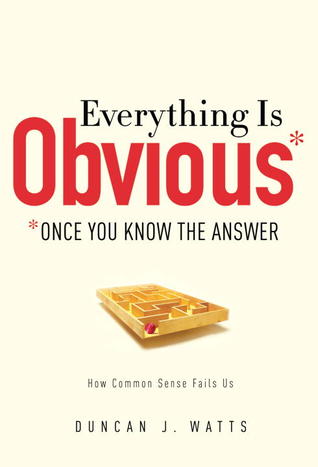
Avid consumers of Malcolm Gladwell’s scientific gumshoe writings for the masses, occasional consumers of Daniel Kahneman‘s constant illuminations of cognitive science, and those who just watch out for randomly passing-by phenomenal thinker/researcher/writers, will likely appreciate this from the Cornell Alumni Magazine profile of Watts:

A central part of Watts’s argument is that hindsight isn’t 20/20; it’s reductive and unreliable. In a section on the Mona Lisa, for example (see excerpt), he discusses how the painting languished in relative obscurity for centuries, only becoming world famous after it was stolen from the Louvre in the early 1900s—but since the idea of its greatness owing to a fluke is so inherently unsatisfying, people ascribe post-facto “common sense” explanations. (It’s the smile! It’s the fantastical background! It’s the genius of Leonardo da Vinci!) Continue reading

Understanding Better How Our World Works

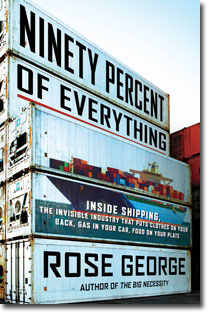
We are frequently late to the party. Fortunately it is often just in the nick of time.  This time, thanks to one of the podcasts we regularly listen to for exactly this purpose, we re-discovered Rose George (having first learned of her through her book previous book, The Big Necessity) and discovered her new book as it hits the market. There does not appear to be much in direct relation to community, conservation or collaboration  within this book, but we appreciate the author’s dedication to a topic that helps us understand better how our world works:

On ship-tracking websites, the waters are black with dots. Each dot is a ship; each ship is laden with boxes; each box is laden with goods. In postindustrial economies, we no longer produce but buy. We buy, so we must ship. Without shipping there would be no clothes, food, paper, or fuel. Without all those dots, the world would not work.

Freight shipping has been no less revolutionary than the printing press or the Internet, yet it is all but invisible. Away from public scrutiny, shipping revels in suspect practices, dubious operators, and a shady system of “flags of convenience.” Continue reading

Hermes, Circa 1969

As one of the contributors referred to in this post, and as the one who took the photographs in that post, it occurred to me that I should comment further on the reference.  And in doing so, perhaps I could add to the small collection of personal statements that have been gathering on this site since mid-2011.  I am 100% sure I took the photograph above during that same visit to Greece in 2008.  As I snapped this photo my mother was at my side and we both remembered having stood in the same spot in 1969. Continue reading

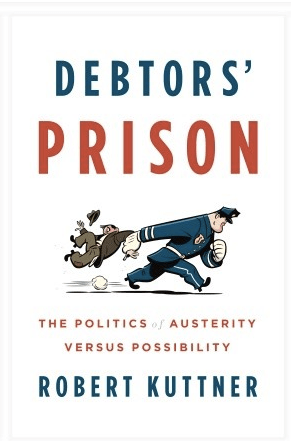
Debt Is Not Desirable And Prison Is Not Pretty, But Debtors’ Prison?

You can see what the publisher has to say about this book by clicking on the image to the right.  You can read about the book and its author, and even sample an excerpt. But our attention was brought to the book via this site, which provides a different excerpt from the book. We find this one intriguing because we see the author’s use of a literary figure to make a point about economics, entrepreneurship, risk-loss-gain tradeoffs, morality, civic duty and more:

“On October 29, 1692, Daniel Defoe, merchant, pamphleteer, and future best-selling author of Robinson Crusoe, was committed to King’s Bench Prison in London because he owed more than 17,000 pounds and could not pay his debts. Before Defoe was declared bankrupt, he had undertaken such far-flung ventures as underwriting marine insurance, importing wine from Portugal, buying a diving bell used to search for buried treasure, and investing in some seventy civet cats, whose musk secretions were prized for the manufacture of perfume. Continue reading

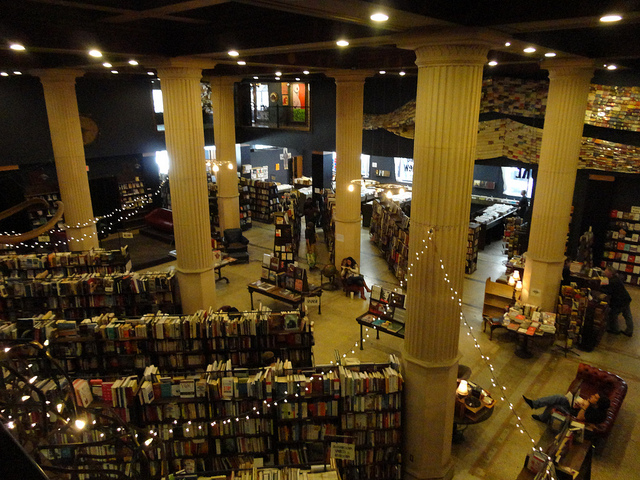
The Last Bookstore

Photography credit Scott Garner.

Thanks to Paris Review, and particularly Casey N. Cep, for a reminder of why bookstores have more meaning than other forms of merchandising:

…Our inheritance felt large, but it was the sawhorses that I most admired, especially when my father put them to use constructing bookshelves for my bedroom. My father was no stranger to construction; he built the log cabin in which I was raised. He inherited not only tools but also skills from his father, so he was able to cut, stain, and install the wide bookshelves on my bedroom walls in no time. The shelves were required to house my growing library, acquired book by book in a thrilling sequence of gifts, purchases, and trades. Continue reading

Photographic Wonder

Marvin Heiferman. Photo: Alex Welsh/WIRED

We know that one day, hopefully not too far off, the wunderkind of La Paz Group’s photographic contributors will get his gear fired up and we will be displaying his latest wonders here again. We hear that his hiatus in Ithaca, NY since about one year ago has run its course, full of fascinations, back-looking reflections, photographic recapitulations, and even small distractions. Onward, westward, as ancestors of his did in previous centuries. More from Milo soon, we hope.

Meanwhile, on the topic of photography and wonders, Wired offers an interview to illuminate what might not otherwise be obvious at first glance:

For his book Photography Changes Everything, Marvin Heiferman spoke to experts in 3-D graphics, neurobiology, online dating, the commercial flower industry, global terrorism, giant pandas, and snowflake structure to understand the infinite ways imagery affects our everyday lives… Continue reading

Thinking, Communicating, Doing

From even just one brief interaction with students and faculty at Brown University, I might have predicted that a leader of that university would be so well suited to make this argument:

…we should embrace the debate about the value of the humanities. Let’s hear the criticisms that are often leveled, and do what we can to address them. Let’s make sure we give value to our students, and that we educate them for a variety of possible outcomes. Let’s do more to encourage cross-pollination between the sciences and the humanities for the benefit of each. Let’s educate all of our students in every discipline to use the best humanistic tools we have acquired over a millennium of university teaching—to engage in a civilized discourse about all of the great issues of our time. A grounding in the humanities will sharpen our answers to the toughest questions we are facing… Continue reading

Writing To Clarify

The Washington Post is not one of our go-to sources for interesting stories, but we care deeply about journalism as a pillar of the communities we are involved in. What happens to this particular journalistic institution is of interest because of its perceived influence on policy in an influential community. For that reason, 12 minutes spent listening to the man who led the decision to sell the newspaper to one particular buyer may be worthwhile.  But there is a much better reason to listen to him, and it comes exactly at minute 10 in this interview, when he describes how meetings are conducted at Amazon, and the importance of writing to clear communication.