The Chumbawamba Principle Illuminated

jps_1_custom-46f5ed44c65bca033c8c555328e154e8183d6de3-s1400-c85

Nearly four years ago we posted about this commencement address that we still love for The Chumbawamba Principle it espoused. Until today I could not have recognized any piece of music belonging to Chumbawamba, but now, surprisingly, that has not only changed but I feel richer for it.   Continue reading

Biomimicry Institute Ideas

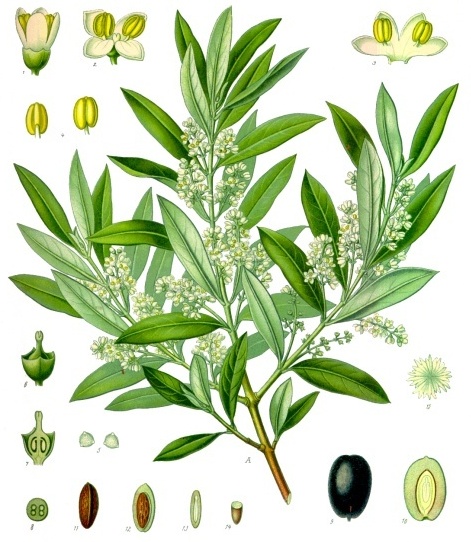
Illustration by Franz Eugen Köhler via Wikimedia

Just a few days ago we shared a piece on biomimicry, and two weeks before that, this little drone showed the advantage of copying flying animals’ ability to perch. Today, via GreenBiz.com, we heard from the Biomimicry Institute about three ways that asking nature “how do you make energy?” can potentially help industries like construction, transportation, and energy:

Humans are becoming increasingly dependent on our ability to connect via technology and easily access the energy grid. Practically every facet of our lives is somehow plugged in and powered up. Yet as our demand for power increases, so must the innovative and life-friendly ways we access and use that energy.

Here’s a light bulb idea: how does nature make energy? For the billions of species that have existed on planet earth, humans are the only ones who have placed such a premium on unsustainable and non-local sources of energy. How then, does nature balance its energy books while producing relatively little energy waste?

Continue reading

Sea Sonata

Sometimes a moment of Zen is meant to be just that. In this case the ingenuity of the concept and the elegance of the execution increase the impact all the more. The sea creates random chords with this natural musical instrument as the waves push air through 35 tuned subterranean tubes set into the steps.

For a period of time some of of our team called Croatia home. This is definitely a Siren Call to return…

The Intelligence Of Clever Animals

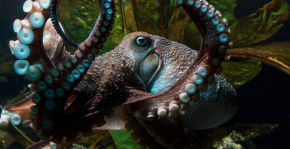
Riederer-Inky-the-Octopus-290x149-1461702146We are susceptible to stories that spotlight animal intelligence, and challenge our assumptions about the unique capacities of humans. Cleverness and intelligence can be difficult to parse, so the details of the story matters.  This one is better than most such stories for reasons we cannot quite explain:

Earlier this month, under the cover of night, an octopus named Inky hauled his basketball-sized body out of the tank he shared with a companion at the National Aquarium of New Zealand, heaved himself across the floor, and squeezed his gelatinous mantle into a narrow drain leading to the Pacific Ocean. Continue reading

Spiral Jetty: Art that Informs

Photo by George Steinmetz, September 2002

In 1970, artist Robert Smithson built a massive sculpture as a piece of land art, or an “earthwork,” that is normally found just below the surface of the water of Great Salt Lake at Rozel Point. In drought conditions, the art piece, titled Spiral Jetty, becomes visible, often with salt encrustations that decorate the basalt spiral formation. Great Salt Lake, in addition to being salty, is also home to microorganisms that live or even thrive in extremely salty conditions and produce pigments that give them a red to orange color, which becomes visible in the water at times. Chau Tu reports for this week’s Science Friday written piece:

Great Salt Lake is known as a terminal basin, meaning its water has no outlet. “Water escapes through evaporation, and everything else stays there,” says Jaimi Butler, coordinator of the Great Salt Lake Institute. At the time the sculpture was built, the water level of the lake was particularly low. But by 1972, the water rose again to near-average levels, submerging the artwork.

“Smithson anticipated that the lake would rise and fall, the residue of salt crystals causing the black rocks to glisten white whenever the water level dropped,” the New York Times Magazine wrote in 2002. And indeed, that very year, regional droughts caused the jetty to reappear “for the first prolonged period in its history,” according to the Dia Foundation, which now owns the sculpture. (The Great Salt Lake Institute partners with the Dia Foundation and the Utah Museum of Fine Arts to oversee the Spiral Jetty.)

Continue reading

Palau Power!

21mag-21palau-t_CA4-jumbo

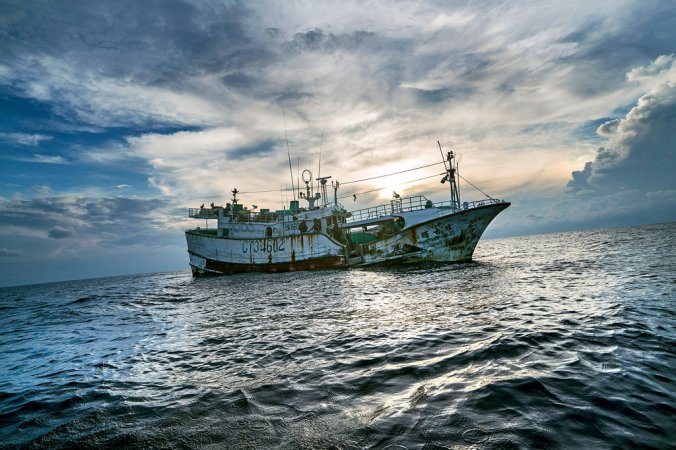
The Sheng Chi Huei 12, a Taiwanese fishing vessel. BENJAMIN LOWY/REPORTAGE, FOR THE NEW YORK TIMES

Where are the heroes on the high waters? Sea Shepherd, one of our favorites, is out there and Paul Watson continues to lead the charge; but not only them. Little places also do big things. Thanks to Palau for the inspiration, and the reporter/publication for the investigation:

Palau vs. the Poachers

The island nation has mounted an aggressive response to illegal fishing in their waters. How they protect themselves may help the rest of the world save all of the oceans.

Late on a January 2015 evening in Shepherdstown, W.Va., a data analyst named Bjorn Bergman, surrounded by whiteboards scribbled with computer code, was orchestrating a high-stakes marine police chase halfway around the world. Staring at his laptop in a cramped ground-floor office, he drank from his sixth cup of coffee and typed another in a long series of emails: ‘‘Try and cut them off rather than making for the last known position.’’ Nearly 9,000 miles away, the Remeliik, a police patrol ship from the tiny island nation Palau, was pursuing a 10-man Taiwanese pirate ship, the Shin Jyi Chyuu 33, through Palauan waters. Bergman, working for a nonprofit research organization called SkyTruth, had mastered the use of satellite data to chart a ship’s most likely course. Instead of pointing the police to where the pirate ship was, he would tell them where it was about to be. He took another sip of coffee, studied his screen, then typed again: ‘‘It may be advisable for the Remeliik to turn southeast.’’ Continue reading

Let Yourself In


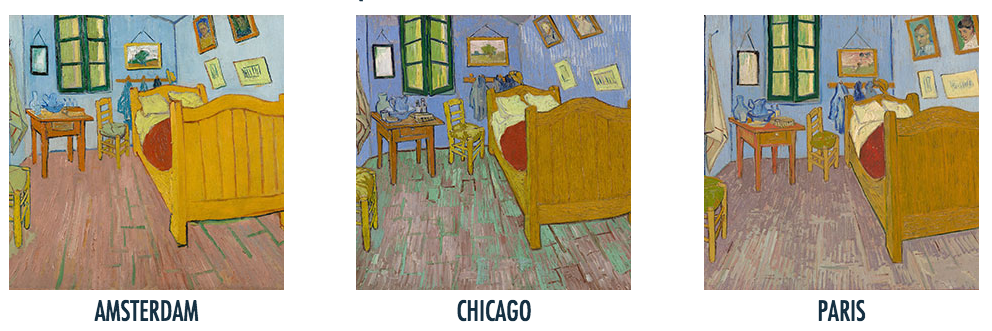
It’s been scientifically proven that people respond emotionally to color and light. The artist Vincent van Gogh was a master of both, and the vibrant, intimate paintings of his bedroom in Arles are evocative examples.

Not only have the curators at the Art Institute of Chicago brought together the artist’s three versions of the room, they’ve created an installation that invites the viewer into a 3-dimensional experience of the iconic painting.

This exhibition is the first to truly delve into the fascinating history of these three paintings and explore the motif of home and its significance to Van Gogh—as haven, creative chamber, and physical reality. The show features approximately 36 works by the artist, including paintings, drawings, and illustrated letters, as well as a selection of books and other ephemera known to have been in Van Gogh’s possession. Continue reading

Entrepreneurship, Ghana and Bamboo Bikes

In the early days of this site I wrote with enthusiasm about High Design bamboo bikes. We can’t overstate the importance of bicycles in both rural and urban environments.

Ghanian Entrepreneur Bernice Dapaah’s work is not only empowering the women who she employs in making bamboo bicycles, but the product should serve as an inspiration to people worldwide,  Continue reading

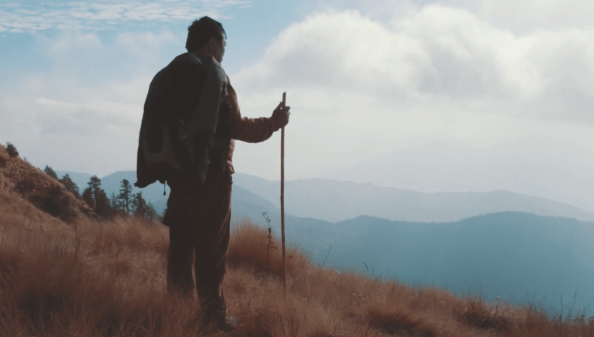
Hiking for E-mail

mahabir pun

For six years, Mahabir Pun trekked long distances to check emails in Nepal. Until he brought the Internet home to his remote village. PHOTO: Hiking for Emails, Vimeo

In India, there exists this dwindling practice of writing letters to the Editor. Of publications. Most people write on current affairs, some write to highlight issues that range from a lack of streetlights to dissent. Some write in to commend actions, public campaigns. A handpicked bunch of these are published in a column titled Letters to the Editor. Mahabir Pun of a remote village in the mountainous country of Nepal wrote to BBC, asking for help to bring the Internet home.

Continue reading

Get Your Garden Going

Screen Shot 2016-01-12 at 9.56.32 AMEcowatch, every day, provides something we can use in our extended La Paz Group operations, and in our daily lives. This one, for our homes:

…The idea of growing an indoor farm, full of healthy food you can spoil yourself with over summer may sound too good to be true. But with a little love and care, whether you live in a house or a flat, you can grow a variety of fresh vegetables, fruit and even edible flowers ready for your next dinner party—guaranteed to impress… Continue reading

Little People, Big Things

“Unstuck”. The quotation marks in this post below are all too familiar. They stemmed from well-worded conversations that traveled across the 16,894 kilometers between Kochi, India, and Costa Rica. Between me and Crist Inman. About “getting back in”. Going back and forth on happiness and redefining it. On dreaming. Together.

And, I remembered this bouncing, hugging ball of happiness that owned me by the beach at Xandari Pearl in Kerala. Little person, but home of good things.

Continue reading

Ponder The Journey

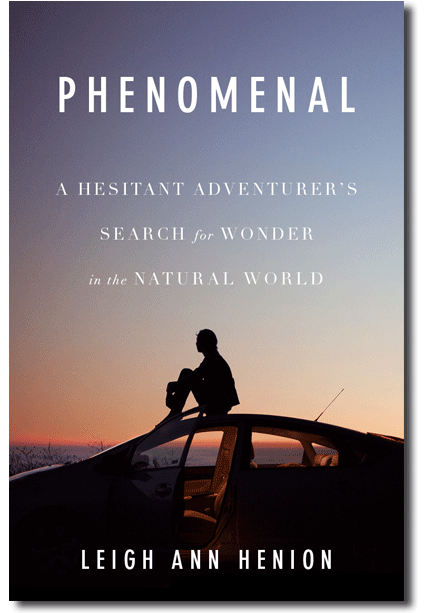
BookWe are aware of how fortunate we are, across the ranks of Raxa Collective, to be doing what we want, where we want, how we want. That is an exceptional privilege. Not everyone gets to the opportunity to choose their work. Not everyone has the luck to pursue a mission. But our privilege does not stop us from promoting some basic tenets that drive us. One of them is: if you can, when you can, chase the higher calling.

The author of “Phenomenal: A Hesitant Adventurer’s Search for Wonder in the Natural World” (Penguin Press, click above to go to the author’s website) provides an op-ed short essay that provides useful bearings for the first Monday of a new year:

A Job That Nourishes the Soul, if Not the Wallet

By

The lawyer was in his mid-20s. He narrowed his eyes, peered at me from behind his cluttered desk and said, “So, why are you quitting?”

Continue reading

Wall Dancing & Puzzle Solving

Ashima

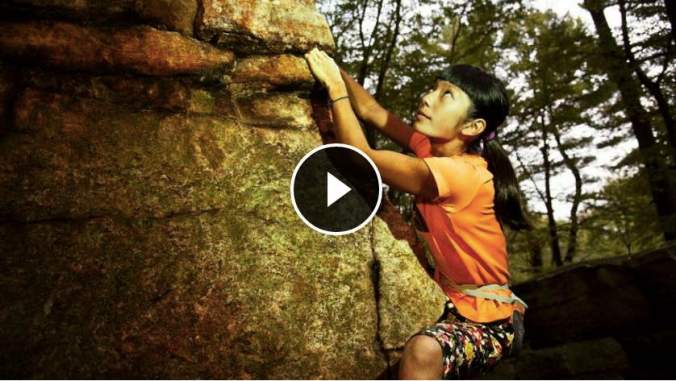
THE CLIMBER’S LIFE. Ashima Shiraishi on why she climbs.

Just when we thought we had shared the most awesome recent story from the world of climbing, now this profile, which helps us see dancing and puzzle-solving where we once saw expeditions:

…Ungrudgingly admired by seasoned dirtbags and muscular young rock rats, she is, even though still young, perhaps the first female climber whose accomplishments may transcend gender, and the first rock climber who could become a household name. Continue reading

Nell Zink, Come To Kerala!

Bricklaying “was more valuable for my intellectual life than my entire college career.” PHOTOGRAPH BY GARETH MCCONNELL

Bricklaying “was more valuable for my intellectual life than my entire college career.” PHOTOGRAPH BY GARETH MCCONNELL

No doubt, Nell will be a good fit among La Paz Group’s global community of artistically and/or conservation-oriented invitees, many of whom you have not likely heard of, some of whom are more famous, but all with unusual talents and interests. Thanks to Kathryn Schulz for another invitation-worthy story: Nell Zink turned her back on the publishing world. It found her anyway.

The kookaburra in the Berlin Zoo is ten thousand miles from home, squat, top-heavy, large of beak, attractive of plumage, and making what is, ounce for ounce, the loudest, strangest sound I have ever heard emerge from a living creature. It begins with a classic evil laugh, bwaaahahahaha, à la Vincent Price in “Thriller,” then the bird throws back its head and lets out a series of hoots, like a plump British woman with an unbecoming but infectious laugh or a parrot that grew up in a frat house, dissolves into giggles, transitions to a chortle, appears to become an entire dinner party going to pieces, then starts to pull it together, O.K., O.K., the guests wiping their eyes and settling down, until out comes a little chuckle and hahahahoik!ha, the bird is cracking up again. Continue reading

Collective Roots

Attention to detail is a highly prized attribute in all aspects of the work we have been doing in India since 2010, and we hope it doesn’t seem pedestrian to extend that concept to something as commercial as shopping. Some people may beg to differ, but there are many cases where the “consumer transaction” is so much more.

We’ve spent many happy hours in exploration to find sustainably produced, cottage industry items. A trip to Gujarat led us to the Kala Raksha Trust. Walks in Cochin led us to the Vimalalayam Convent School, and the NGO A Hundred Hands has introduced us to many of the wonderful craftswomen whose products we highlight, including designer Usha Prajapati from Samoolam.

We’ve been great fans of the results of her work with the women of Bihar from the moment we saw it, and hearing her personal story adds a beautiful dimension to the concept of “self-help”. Thanks to FvF (Freunde von Freunden) for their inspiring online interview.

Samoolam, Usha’s design collective, which is making a name for its beautiful hand-crocheted lifestyle products, is incredible not just because its founder is young, talented and inspiring, but because its process of creation is held together by a network of strong and talented women much like her – women who make things happen, who are changing their worlds, one crochet bead at a time.

Continue reading

Tricksters, Animals, And Narratives We Are Meant To Learn From

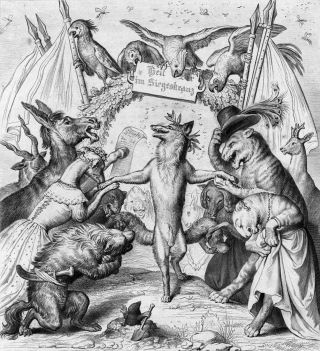
“Reynard” is a defining document of a vast tradition in Western art: the trickster story. CREDIT ART AND PICTURE COLLECTION / THE NEW YORK PUBLIC LIBRARY

“Reynard” is a defining document of a vast tradition in Western art: the trickster story. ART & PICTURE COLLECTION, THE NEW YORK PUBLIC LIBRARY

Thanks to Joan Acocella for illumination of a narrative form we are quite fond of:

…Animal narratives have allowed writers with lessons on their mind to make art rather than just lessons.

Such tales are no doubt as old as animal paintings on cave walls. The earliest evidence we have of them is the beast fable, a form that is said to have come down to us by way of Aesop, a Greek storyteller who was born a slave in the sixth century B.C. Actually, no solid evidence exists that there ever was an Aesop, any more than there was a Homer. As with the Iliad and the Odyssey, we are talking about manuscripts that date from a period much later than the supposed author’s, and were probably assembled from a number of different fragments. In any case, a beast fable is a very short story (the Penguin Classics edition of Aesop renders “The Tortoise and the Hare,” perhaps the most famous of the fables, in five sentences) in which, typically, a couple of animals with the gift of speech learn a lesson from their dealings with one another. This moral is then stated at the end of the fable, and it is usually of a cautionary variety: don’t eat too much, don’t brag, watch out for this or that. As early as the third century B.C., these stories were being gathered together in various editions, usually for children, to teach them Latin (most were in Latin until the late Middle Ages) and some basic rules about life. Continue reading

Tending Our Fields

We have a strong reaction of affinity with the theme of this op-ed essay in the New York Times from an author, an avid birder, we think highly of:

Matthew The Horse

Matthew The Horse

Anyone over the age of 40 who went to school in Britain will know what a nature table is. Almost anyone younger than that will not because the nature table — the classroom altar or grotto made of child-gathered natural treasure — is no more. From the age of 7 to 11, I was a major contributor to the one in my suburban junior school. I mostly brought old nests like various leafy crowns, but also a squirrel’s drey, a wren’s foot and a goldfinch’s wing. My classmates came with furry catkins in jam jars,  Continue reading

Full-Spectrum Farming

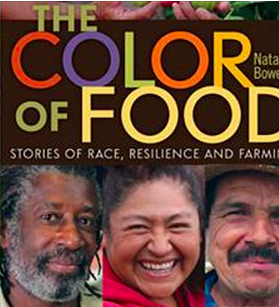
We haven’t met Natasha Bowens but her perspectives on the cultural empowerment of growing one’s own food tell us she’s a kindred spirit.

 Storytelling & Photography

The Color of Food is photographic and documentary in nature because I wanted to capture the personal stories of these farmers while also changing the image of agriculture as it is currently portrayed in the media. This project is not only political in it’s message, but also helps us celebrate and preserve the history, tradition and beautiful culture that make up our agricultural communities.

Continue reading

The New Grand Tour

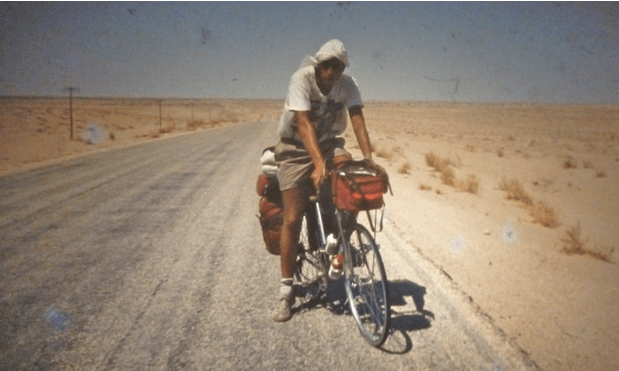
Trevor Ward on a cycle tour in the Sahara. Photograph: Trevor Ward

Trevor Ward on a cycle tour in the Sahara. Photograph: Trevor Ward

In the summer of 1988 Crist and I boarded a flight to Missoula, Montana, watching nervously through the window as the luggage that included our bikes and gear was loaded on the plane. We’d been “training” for several months, riding our bikes around New York City, our panniers filled with heavy phone books. Our 900 kilometer journey through the Canadian Rockies from Missoula to Jasper, Alberta – carrying all the requisite gear – was exhilarating, “impossible” and crazy, especially for biking novices such as ourselves. Reading about Trevor Ward’s experiences strikes a chord.

Back in the mid-1980s, I did something that members of my local cycling club found hilarious – I cycled to the Sahara Desert and back.

In their Lycra shorts and replica Peugeot and La Vie Claire racing jerseys, they laughed at my bike which, laden with panniers, tent, cooking stove, sleeping bag, spare tyres and even a small folding deckchair, had been transformed from a sleek blade of steel to something resembling the aftermath of a gas explosion.

My humiliation continued in the remotest parts of Tunisia and Algeria where groups of children would greet my arrival at their villages by throwing lumps of rock at my head. Continue reading

Transformative Practices For A Better World

Christophe Archambault/AFP/Getty Images

Students use tablets in a classroom in Mae Chan, a remote town in Thailand’s northern province. Christophe Archambault/AFP/Getty Images

Scanning the developing world, anywhere that poverty puts lives at risk, it is useful to have a short list of particularly transformative practices as in this four minute story podcast from National Public Radio (USA):

There are so many projects in global health that sometimes it’s hard to figure out which ones are the most important.

So Lawrence Berkeley National Laboratory set out to list the 50 breakthroughs that would most transform the lives of the poor, especially in sub-Saharan Africa and South Asia. Shashi Buluswar, an author of the study, spoke with Morning Edition‘s Renee Montagne. Here’s a sampling:

A low cost, fuel-free way to desalinate water. Many people in the world do not have enough fresh water to grow crops, and more and more fresh water runs off into oceans. Desalination creates usable water out of salty or brackish sources. “Right now it’s tremendously energy intensive and expensive,” Buluswar tells Montagne, “so trying to come up with a much more affordable, scalable and energy-efficient way of desalinating water would be tremendous.” Continue reading