Radical Interpretation Of Plants’ Secret Lives

When he goes out on a limb he invites others to join him, and like any journalist worth his salt he keeps pushing further out onto the limb. The venues in which he publishes deserve credit for having faith in readers willing to get out onto that limb:

In 1973, a book claiming that plants were sentient beings that feel emotions, prefer classical music to rock and roll, and can respond to the unspoken thoughts of humans hundreds of miles away landed on the New YorkTimes best-seller list for nonfiction. “The Secret Life of Plants,” by Peter Tompkins and Christopher Bird, presented a beguiling mashup  Continue reading

Speaking Of Science Journalism

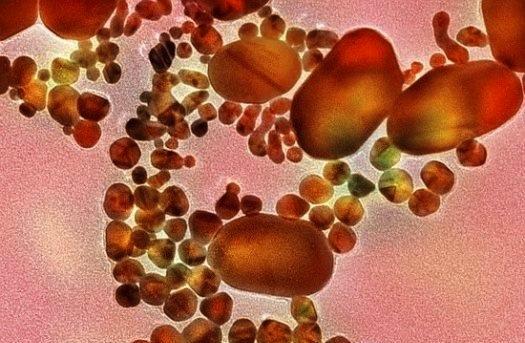
“This is our artificial sun,” Joel Ager said, as he gestured with mock grandeur toward a metal box about the size of an old computer tower. A glowing lens, which looked like it was transplanted from a projector, shined out of a hole in its side. It was aimed at a beaker filled with water sitting a few inches away. Ager’s colleague produced a metallic toothpick-sized stick, alligator-clipped it to electrodes, and dunked it. Under the light, the submerged stick became a luminous red.

And this is Annalee Newitz, Andrew Revkin said, as he got on with down-to-earth reporting at his Dot Earth blog.  She writes clearly. She looks funny (as in, she has a sense of humor, which is equally clear from her writing). This is Annalee Newitz in her own words.
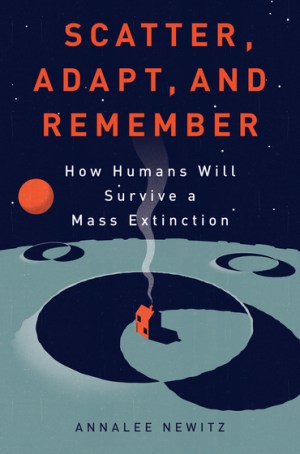
And this is Annalee Newitz, in her own words, on the topic of the end of the world as we know it (click the image above, or here, to go to the full version of her recent post on the New Yorker website) in her new book:

This speculative and hopeful work of popular science focuses our attention on humanity’s long history of dodging the bullet of extinction—and suggests practical ways to keep doing it. From bacteria labs in St. Louis to ancient underground cities in central Turkey, we discover the keys to long-term survival. This book leads us away from apocalyptic thinking, into a future where we live to build a better world.

Science reporting is an art as much as it is anything else. Facts are an essential ingredient (along with humor and others) in our daily doses of information-sharing.

Science Journalism And The Dynamics Of Democratizing Commentary

Wellcome Images

Wellcome Images

Lovely, thoughtful, radical stuff happening over at this old school publication as it navigates the new world of social media (click the image above to go to the source):

Comments can be bad for science. That’s why, here at PopularScience.com, we’re shutting them off.

It wasn’t a decision we made lightly. As the news arm of a 141-year-old science and technology magazine, we are as committed to fostering lively, intellectual debate as we are to spreading the word of science far and wide. The problem is when trolls and spambots overwhelm the former, diminishing our ability to do the latter. Continue reading

Little Wonder

Thanks to the Science section folks at the New York Times, who have added to an already excellent Tuesday paper section with lots of excellent online resources such as this (click the image to the left to go to the video):

SCIENCE

ScienceTake: A Frog’s Secret to Sticking

Nature is full of animals with amazing abilities that scientists are trying to understand, and the torrent frog is one of them. True to its name, it lives stuck to waterfalls.

Emerging Photographers , Subscribe

This slideshow requires JavaScript.

We have been experiencing an acceleration in the growth rate of our admiration for the New Yorker‘s embrace of its digital future. We believe this erstwhile magazine is worth a subscription. We have nothing to gain by saying so other than the theoretical possibility that more subscribers and visitors to their site makes their recent innovations and improvements more worthy of more such experimentation. Such is our social media obligation: to point out to our friends what we take note of. Earlier this month we noticed this and neglected to share, but we correct that now:

As part of our ongoing Emerging Photographers series, today we’re highlighting the work of Sara Cwynar, a Vancouver native who lives and works in Brooklyn. I have been following her work for a while, and was drawn in particular to the monochromatic “Color Studies” as well as the series “Accidental Archives”—both of which drew on a confluence of literature, kitsch, and photographic tropes, which she cites as inspirations. Most recently, Cwynar has been preparing for her solo show, opening this week, at the Cooper Cole Gallery in Toronto, where she will début a new collection of photographs called “Flat Death” (a reference to Roland Barthes). I caught up with Cwynar to find out more about the exhibition and her latest work. Continue reading

Boys, Girls, Science And Geek Myths

Thanks, as always with Natalie Angier, for incisive reportage on an important scientific concern:

Peter Ostrander, the tireless coordinator and cheerleader for a renowned science and mathematics magnet program at Montgomery Blair High School in Silver Spring,  Continue reading

The Journalism-Academic Complex

Illustration to John Seabrook's 2011 article "Snacks For A Fat Planet" showing: Indra Nooyi, the C.E.O. of PepsiCo, says it must be a “good company” in a moral sense.

Illustration to John Seabrook’s May 16, 2011 article “Snacks For A Fat Planet” in the New Yorker. showing: Indra Nooyi, the C.E.O. of PepsiCo, says it must be a “good company” in a moral sense.

The Military-Industrial Complex that then-exiting President Eisenhower warned about is unfortunately alive and well, as we saw in the previous decade, when journalists were mostly asleep at the wheel, often even contributors to the dark complex. But journalism has been reborn in some quarters with a new sense of purpose, and new approaches to vigilance that is worthy of the Fourth Estate. Diligent investigative journalism allied with advanced academic research-driven thinking skills produces a better complex.

Case in point: when accomplished academics such as Professor Aaron Chatterji share cogent, punchy follow up posts to articles that caught our attention years back, today’s news on labor activism meets yesterday’s analysis of the intersection of food/health trends and corporate buzz phrases like social responsibility. Thanks to this Duke University professor, New Yorker readers get follow up on a story that might otherwise have been fading, but should not:

Nooyi has backed up her rhetoric with concrete steps, acquiring healthier brands like Tropicana and Quaker Oats and creating Pepsi Next, a lower-calorie version of the flagship brand. She even hired a former official from the World Health Organization to oversee the reforms. Continue reading

Bee News, Weekly

Thanks to the Guardian‘s expanding coverage of an important topic with a series that routinely rounds up bee news (yes, it sounds funny, but try living without bees):

About this series

Concerned about the the worldwide bee crisis? Join us for Buzzfeeds, a weekly analysis featuring our resident bee expert Alison Benjamin Continue reading

Writing To Clarify

The Washington Post is not one of our go-to sources for interesting stories, but we care deeply about journalism as a pillar of the communities we are involved in. What happens to this particular journalistic institution is of interest because of its perceived influence on policy in an influential community. For that reason, 12 minutes spent listening to the man who led the decision to sell the newspaper to one particular buyer may be worthwhile.  But there is a much better reason to listen to him, and it comes exactly at minute 10 in this interview, when he describes how meetings are conducted at Amazon, and the importance of writing to clear communication.

170 Million Year Old Barometer For River Water Quality

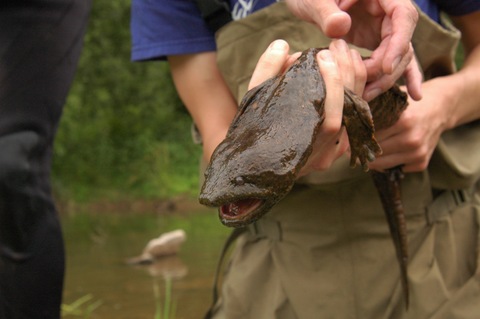
Matt Neff from the Smithsonian’s National Zoo holds a hellbender salamander that he caught in the Blue Ridge mountains of Virginia. Scientists hope to learn how healthy and viable the population is. Photo by Rebecca Jacobson

Thanks to the Public Broadcasting System of the USA for this story segment as their Science Wednesday feature this week:

…At the end of a long day snorkeling in the clear streams of southwestern Virginia’s Blue Ridge Mountains, Terrell and her team assumed their positions. As three scientists lifted a flat, heavy rock, Terrell groped underneath the stone, let out a muffled cry through her snorkel mask and popped out of the water.

“Where did it go? Did you see it?”

The biologists checked their nets and scoured the water. Sarah Colletti from the Aquatic Wildlife Conservation Center pointed at the slick rocks under the water. “Right there, he’s looking right at you.” One of the biologists lunged, secured a firm grasp, and triumphantly pulled it out: a nearly two-foot long hellbender. Continue reading

Kitchen Collaboration

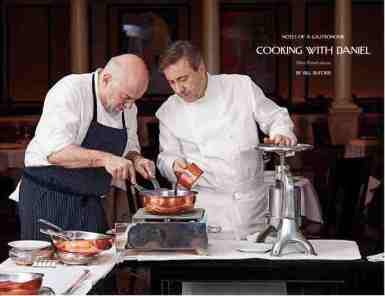
Kitchen Confidential juggled with foodies’ fascinations in new and unusual ways, and since then reality television seems to be the appropriate new home for that side show.  Oddly, it began in 1999 with an article in the New Yorker. So it is only fitting that the magazine has been balancing those dynamics with the work of less celebrity-oriented writers ever since.  None better than Bill Buford, who gets out there, and in there, like a citizen scientist for the story (though he is not shy of carny, either). Here what catches my attention is the collaboration, but plenty on the ethos of an artisan, the farm as the garden of eden, and last but not least the role of food in heritage and heritage in food (click the image above to go to the article):

Two years ago, during the summer of 2011, Daniel Boulud, the New York-based French chef, told me he had been thinking about a project that we might do together. We were both in France at the time. I was living in Lyons—I had moved there in order to learn French cooking—and Boulud was visiting his family in Saint-Pierre-de-Chandieu, a nearby village on a wooded ridge in the open countryside. Continue reading

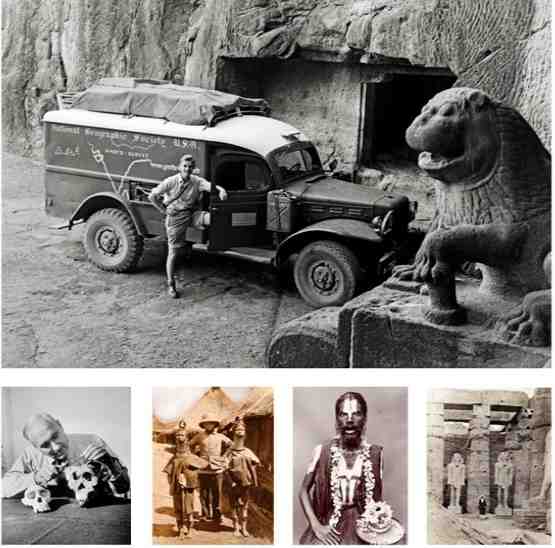
National Geographic Over the Years

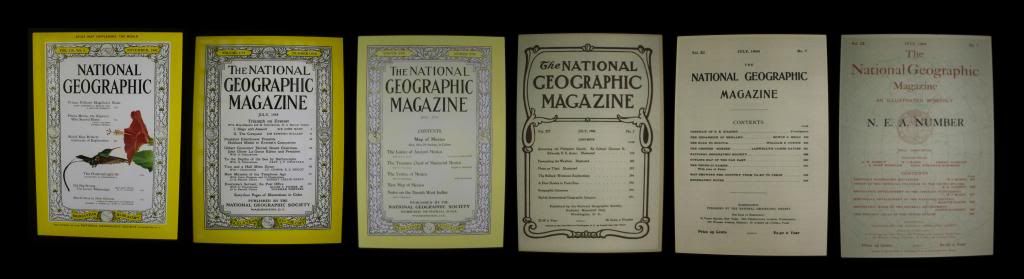
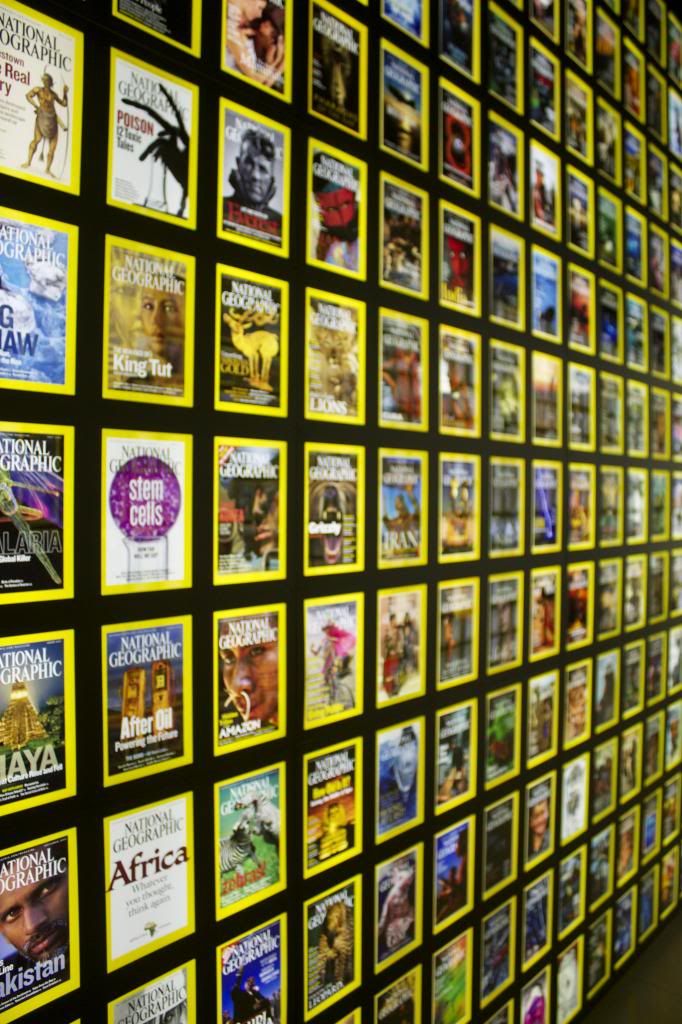
NatGeo’s magazine covers over the years, stitched together from individual photos I took at the National Geographic Museum in Washington, D.C.

As National Geographic celebrates its 125th year of journalism, it is interesting to see how small things, like the magazine covers and the information they conveyed, have changed. In the photo above, the November, 1960 issue (far left) was priced at $1.00; the July, 1954 issue (second from left) at 65¢; and from then backwards each magazine was a whopping 25¢. Today’s magazines don’t disclose their individual price, but a yearly subscription at $15 is not too shabby considering it was $8/yr in 1960, up from $6.50 in 1954.

The July, 1954 issue’s first featured article is titled, “Triumph on Everest,” and the last, “Everyone’s Servant, the Post Office”; July, 1898 (far right in the photo above), on the other hand, saw “American Geographic Education” and “The Geologic Atlas of the United States” as the first and last articles.

Continue reading

To Read It To The End, You Must Disbelieve It

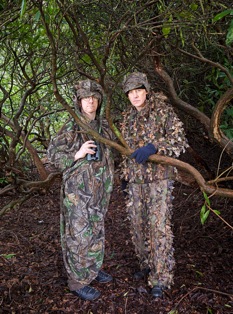
Mark Thomas (left) and Guy Shorrock keep watch on Britain’s egg obsessives. “These are not normal criminals,” Shorrock says. Photographs by Richard Barnes.

Thanks to the New Yorker‘s commitment to a difficult topic–birds and their fate at the hands of regular and irregular people–and especially to Julian Rubinstein and his confidants for this taxing piece of journalism:

On the afternoon of May 31, 2011, Charlie Everitt, an investigator for the National Wildlife Crime Unit in Edinburgh, Scotland, received an urgent call from a colleague in the Northern Constabulary, the regional police department whose jurisdiction includes the islands off the country’s western coast. The officer told Everitt that a nature-reserve warden on the Isle of Rum, twenty miles offshore, had reported seeing a man “dancing about” in a gull colony. Everitt looked at the clock. It was 4 p.m., too late to catch the last ferry, so he drove Continue reading

Hyperlocal Journalism With A Heritage Twist

The Rajasthan Patrika headquarters in Kesargarh, Rajasthan.

The Rajasthan Patrika headquarters in Kesargarh, Rajasthan.

Thanks to India Ink for this story about hyperlocal journalism:

JAIPUR, Rajasthan – On the June 25, I walked into Kesargarh Fort in Jaipur, the capital of the northern Indian state of Rajasthan. Where cannon were once mounted, now lies a silver printing press. The monotype-casting machine is the only giveaway that the stone and terracotta façade is home to a newspaper group, Patrika. Continue reading

A Master Class For “Creative Business” Entrepreneurs

Pip Jamieson, Jeff Lyons, Danny Miller

Pip Jamieson, Jeff Lyons, Danny Miller

The Guardian continues its quest to creatively avoid the irrelevance and economic demise challenging all print-based journalism enterprises:

Overview

In a uncertain economic climate, many of us dream of setting up our own business – using our creative skills, while becoming our own boss. It could be a design studio, a series of events, a retail empire or a web venture – there are common challenges to meet and problems to solve. Continue reading

Astronaut Coffee Taste Test

Thanks to Megan Garber, one of the Atlantic‘s other intrepid investigative writers for this story of collaboration by members of the food and astronaut communities:

So we finally have an answer to that age-old culinary question: What do professional foodies think about … space coffee?

Two celebrity chefs — David Chang of Momofuku and Traci Des Jardins of Jardiniere — made a trip to the Johnson Space Center in Houston. Their particular mission? To do some testing of the culinary offerings developed in the Space Food Systems Laboratory. Continue reading

Community-Enhanced Blogging

On occasion we have linked to stories in The Atlantic, one of the oldest continuously published magazines in the world. Most recently we have been paying attention to a science writer there. One writer we have not had occasion to link to is Ta-Nehisi Coates, who writes often about race, social justice, politics and other topics we care deeply about but which are not the focus of this blog.  He writes for the print magazine but he is also among the most prolific bloggers on the magazine’s website.  He has just posted a profound note (pasted in full below, but please click here so he gets full “internet metrics” credit for it) about the importance of community, aka The Horde, in his writing:

Last night The Atlantic won two awards. The first was for best website. The second was for essays and criticism. The essay in question was written by me. In my mind, these awards are linked. Writing for the website has fundamentally changed how I write in print. Continue reading

Sticky Science Reporting

Thanks to Mr. Krulwich for pointing this out:

In a cluttered, noisy world with so many distractions, it’s yet another way to stop people in the middle of their day and make them say, “Really?” Science intimidates people. Yet we’re all curious. The sly goal here is to poke folks with a good question, and then say, “You want to know the answer?”…

Continue reading

For Your Consideration

If you follow American popular culture, and care about race relations, you may find this piece interesting:

In a recent article on the lack of ethnic diversity on American television, the critic Emily Nussbaum paused from pondering the absence of blacks on TV — the usual complaint against homogeneity — to note the sudden ubiquity of South Asians. “Black and white are not the only colors of diversity,” she wrote, and listed roles accorded to desi actors in The OfficeParks and RecreationCommunitySmashThe Big Bang TheoryWhitney, and The Good Wife. Continue reading

A Great Magazine Becomes A Great Insititution

The consistently superb essayist Adam Gopnik, who often writes about topics unrelated to the themes of our blog, in this week’s New Yorker writes on a topic close to our heart (click the image above to go to the article, subscription required):

Magazines in their great age, before they were unmoored from their spines and digitally picked apart, before perpetual blogging made them permeable packages, changing mood at every hour and up all night like colicky infants—magazines were expected to be magisterial registers of the passing scene. Yet, though they were in principle temporal, a few became dateless, timeless. The proof of this condition was that they piled up, remorselessly, in garages and basements, to be read . . . later. Continue reading