Foodie’s Feature


NYT Food

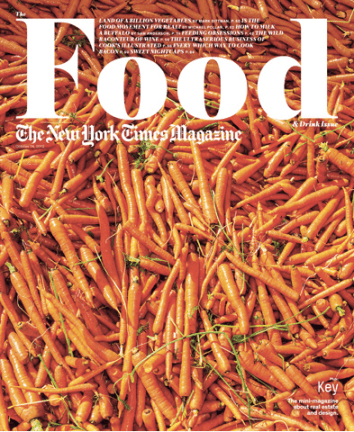
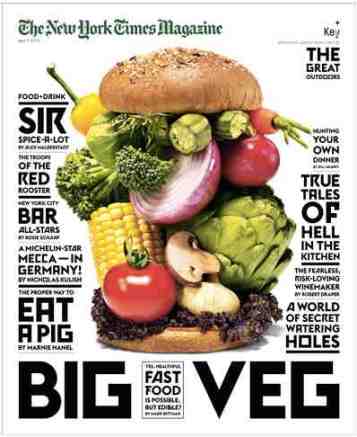
Click the image for today’s Sunday New York Times, our annual favorite edition, dedicated to Food and as recently more and more is the case, particular attention is paid to the intersection between food and wellness:

The Food & Drink Issue

Time to supersize your bean burger and sweet potato fries.

Natalie Angier Strikes Again

This slideshow requires JavaScript.

We used the terminology natural born killers too soon. Apparently these unassuming creatures are the real efficient ones. And, like cats, disguised as gracefully admirable, and often unnoticed. In today’s New York Times Science section there is a story by one of our favorite science writers:

Science Times: April 2, 2013

New research suggests that dragonflies may well be the most brutally effective hunters in the animal kingdom. Continue reading

Foodways Through The Long Lens Of History And Brought To Your Attention By A Great Magazine

9780465021765

In this week’s New Yorker, two great things that add up to more than two great things:

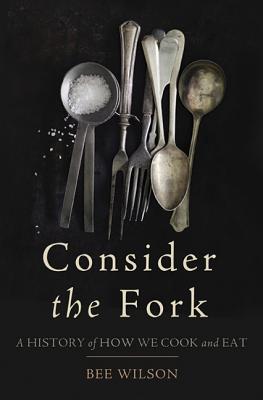
Jane Kramer reviews “Consider the Fork: A History of How We Cook and Eat,” by the British food writer and historian Bee Wilson. It’s more than a book review, though: The New Yorkers European correspondent brings into it her own passion for cooking and her years of writing about food.

The book review mentioned above is discussed in a podcast on the magazine’s website, meaning the book to the left generating two contributions from one of that magazine’s finest writers.  How does 1 + 1 add up to more than 2?  Here is a magazine, against all odds of print journalism in the 21st century, adding value with the very technology that is killing other publications.  Creative destruction, culling out weaker publications, is also working its magic. Continue reading

Vegetarian Roulette

joe-yonan

Yonan says he became a vegetarian in part for health reason, but also for environmental ones.

Click the image above to go to the podcast of this interview with Washington Post food editor Joe Yonan. It is funny to think that committing to a vegetarian diet could pose a career risk to anyone, but if you are a food-focsed writer or editor, of course:

You could see how high cholesterol might be a job hazard for these folks. “The meals that we food people get into can sometimes be way over-the-top of the kinds of things that normal people eat,” Yonan says.

But it’s not just foodies who are cutting back on meat. In a poll conducted last year with Truven Health Analytics, NPR found that 39 percent of adults surveyed said they eat less meat than they did three years ago. The main reason they cited for the change? Health concerns. Continue reading

Mumbai In Gotham Perspective

This slideshow requires JavaScript.

Sometime in recent months we discovered a blog on the New York Times website called India Ink.  It is meant to keep the readers of that newspaper apprised of important information from the world’s largest democracy (and the world’s largest English-speaking country).  Most days, for those of us living and working in India, we have already seen that news in the newspapers here.  Also, most days most of the posts on that blog tend to the dark side of India’s news–always important news but not enough of the positive, vibrant stuff we see each day here. We tend to pass on 90% of the posts, but the other 10% are always worth a look.  Today’s keeper is here:

Continue reading

Sticky Explanations

Pea aphid on alfalfa

Pea aphid on alfalfa

Thank you, Ed.  Thank you, National Geographic. A smart fellow who communicates clearly, a great publication with a long history of communicating important information with good writing and excellent photography; now we have an explanation for:

How Falling Aphids Land on Their Feet Like Cats

by Ed Yong

Cats are famous for landing on their feet after a fall, but they aren’t the only animals that do so. The tiny pea aphid can also right itself in mid-air, and it does so in a way that’s far simpler than a falling feline. Continue reading

Tell Them It Cannot Be So

The Guardian and New York Times are the two newspapers of record in the English language that have invested well in coverage of environmental issues.  This news below is not welcome and we hope it is not final.  Why did we learn this news in the Guardian?  Can we influence the reversal of this decision?

The New York Times will close its environment desk in the next few weeks and assign its seven reporters and two editors to other departments. The positions of environment editor and deputy environment editor are being eliminated. No decision has been made about the fate of the Green Blog, which is edited from the environment desk. Continue reading

Writer Will Walk, We Will Watch

We will link to the updates as they arrive.  For now, the plan:

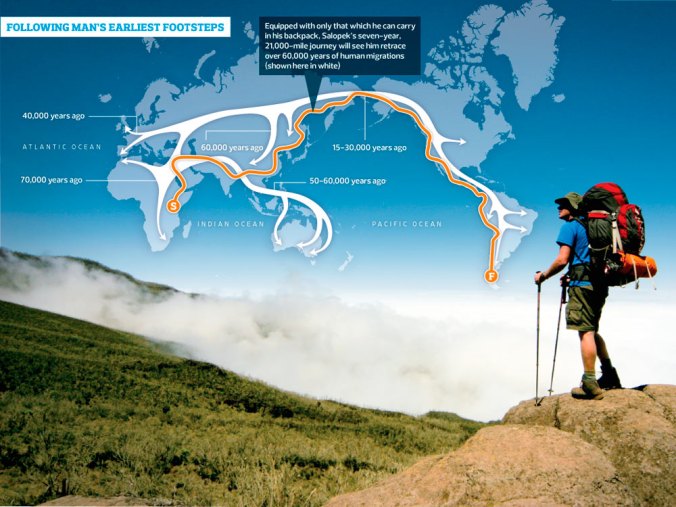
It will be a journalistic assignment like no other. Call it “the longest walk”.

In what is probably the longest, most arduous piece of reportage ever undertaken, Paul Salopek, an experienced writer for the Chicago Tribune and National Geographic, is embarking on the astonishing task of retracing the journey taken by early man tens of thousands of years ago.

Beginning in the exotic surroundings of the Great Rift Valley in Ethiopia, Salopek will take an estimated 30 million steps, reaching his destination seven years later, three continents away at the most southerly point of South America. Continue reading

Zombie Architecture & Rainforest Creatures

In the New York Times, the great science-explaining journalist Carl Zimmer writes about a mystery most of us would never otherwise encounter:

In the rain forests of Costa Rica lives Anelosimus octaviusa species of spider that sometimes displays a strange and ghoulish habit.

From time to time these spiders abandon their own web and build a radically different one, a home not for the spider but for a parasitic wasp that has been living inside it. Then the spider dies — a zombie architect, its brain hijacked by its parasitic invader — and out of its body crawls the wasp’s larva, which has been growing inside it all this time. Continue reading

Food Issues

Usually the links to great journalism, or books worth reading, or art exhibitions, etc. on this site are left to to the group as a whole, and under the name Raxa Collective we share things like the video you can click through to on the image above.  The text below will introduce you to that particular video.

But in my own voice, I urge you to pick up a real copy or click through to browse virtual portions of this week’s New Yorker magazine.  For however many years they have been producing a “food issue,” a theme which (in the world we live in) could be tasteless but in this magazine almost never is, I think this year’s is the best yet.  And this little video+writing piece is a good sample (Mimi, you have been much loved in our home and you always will be):

There are very few sausage- and salami-makers left in New York City, and presumably only one with “Swami of Salami” printed on his business cards. Cesare Casella is the executive chef at Salumeria Rosi, on the Upper West Side, where he cooks sausage and conjures up closely guarded formulas for gourmet cured meats. Casella said that cooking sausage brings him back to his childhood in Lucca, Italy, where he raised pigs as pets and then ate them. We sat down with him to see how sausage is made at his restaurant, and find out why so many people are so obsessed with his luscious links. Mimi Sheraton wrote about her obsession with sausage and salami in this week’s magazine.
BBC Wildlife Camera-trap Photos

This slideshow requires JavaScript.

Any time a journalistic enterprise makes the effort to publish images, stories, video or other media that helps us understand and appreciate wildlife and the habitats they depend on, we hope to catch it and link to it here.  Thanks to the BBC for these snapshots.

Really, Exxon?

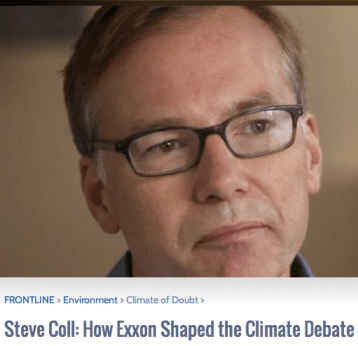
Okay, we admit that Exxon fails the Really? test.  Little about them shocks us at this point. We have highlighted examples of passing that test with flying colors, looking no further than our living room and even in our favored reading materials.  But thanks to one of the best investigative journalists out there, a writer at The New Yorker and author of Private Empire: ExxonMobil and American Power, we find we still have a bit of shockability. Steve Coll, interviewed for a Front Line series on Climate Change (caveat emptor: that documentary film series is exhaustively full of Really? revelations; for a smaller dose, click the image above for the transcript of the Coll interview, or here for a podcast of an interview he gave about the book on Fresh Air):

In some ways, it’s kind of a no-brainer that Exxon would go after climate science on a very superficial level. It’s sort of in their self-interest to keep government away from fossil fuels, right? Is that how it began? Continue reading

Favored Food Journalism

One of our favorite annual food-related publishing traditions has come to pass, again.

Mark Bittman (“California’s Central Valley is our greatest food resource. So why are we treating it so badly?”) has an excellent contribution.

And Michael Pollan (“Is this the year that the food movement finally enters politics?”) covers a topic that, four years ago, got us thinking he might be tapped for a [Hope + Change] Cabinet position.

Both of these are worth the click (among your 20 free clicks per month if you are not a subscriber) and the read time:

1.  Vote for the Dinner Party

2.  Everyone Eats There

Did Rachel And David Ever Meet?

This particular question clearly does not matter, but if we celebrate Rachel Carson’s contributions and their longevity (not to mention their impact on the next generation) and David Attenborough’s contributions over roughly the same period, it seems reasonable to wonder whether they ever met considering they shared common interest in the wonders of the earth and concern for the its health: Continue reading

Paul Watson, Sea Shepherd & The Rogue’s Gallery Of Nations After Him

A woman with a Sea Shepherd tattoo, the organisation of marine conservationist Paul Watson (not pictured). Photograph: Thomas Peter/Reuters

Quite a few of us contributing to this site have called Costa Rica home at one point or another and it is probably fair to say all of us admire and respect that country’s pioneering role in modern conservation schemes.  For some of us, it was literally the country that inspired us to do what we do.  But no country is perfect, and at least in one current affair Costa Rica seems to be playing the stooge.  Shame on Germany and especially Japan for their leading roles in this farce. Costa Rica’s official abandonment of its core values should not be winked at, even by those of us who otherwise love the country and its people.  Paul Watson deserves our attention and support (click the image above for his editorial in today’s Guardian, which has played its fourth estate role well in this affair):

I must serve my clients, the whales

I can do that far better commanding the Sea Shepherd fleet than I can defending myself from bogus charges by Japan

Birdman Of Skomer

For our bird-loving contributors and followers, an interesting story told in a brief video, thanks to The Guardian. (Click on video image to go to the source.)
Tim Birkhead, professor of zoology at the University of Sheffield, talks to Steven Morris about his study of Amos guillemots on the tiny, uninhabited island of Skomer, south-west Wales. Birkhead first visted Skomer in 1972 as a 22-year-old PhD student interested in the sex life of the guillemot. His 40-year investigation into the birds is one of the longest-running field studies of its kind.

Understanding Social

It is not every day that a publication comes out of left field into your life and illuminates something so interesting and important.  Take a look at this article in the Columbia Journalism Review.  The issues are huge.  The characters are a mix of the usual suspects and the unusual innovators:

Jonah Peretti was 29 and had already earned a reputation as something of a wise guy. He had been a technology teacher at a New Orleans private school when he was admitted to a graduate program at MIT. His plan was to study ways networks might foster communication among teachers, but got sidetracked midway through his master’s thesis. In 2000, Nike was inviting customers to create footwear with personalized wording. The company had been criticized widely for selling sneakers made by desperately poor people in impoverished countries. Peretti, tall, skinny and bespectacled, submitted his request: He wanted his sneakers emblazoned with the word SWEATSHOP. Nike declined. At which point, Peretti did a clever thing: he e-mailed.

5 Lenses For Every Vacation

Hey guys,

All of us photobugs and travel-junkies have struggled with the age-old question: which lens should I bring on my River Escapes backwaters adventure or my Roman holiday or my trip to the moon?

As a casual photographer, I’m not crazy about specs. I don’t get the numbers and technical terms! JUST TELL IT TO ME STRAIGHT! I know there are people out there who are like me, so Ben, Milo, and I will make it as easy as possible to understand which lens YOU need to bring on your next vacation! We’d also love to know what YOU brought on your last vacation!

See which of description fits you best:

  1. I’m out to shoot wildlife. Tell me what I need to know.
  2. I love architecture and the built world. What should I bring with me?
  3. I’m a tourist who’s going to stick out like a sore thumb, but I really want to capture candid portraits of interesting people– help!
  4. I’m going to a naturey place filled with dust/humidity/dirt/whatever and I don’t want to constantly change my lens. What’s the best daily walk-around lens?
  5. I’m going on a service trip and I’ll be working on a construction site. How do I make it look epic?
Here’s what we’ll be introducing from our private collections today:
  1. Canon EF 70-200mm f/2.8 L IS USM with 2x extender
  2. Canon EF 70-300mm f/4-5.6 IS USM
  3. Canon EF 50mm f/1.8
  4. Canon EF-S 10-22mm f/3.5-4.5 USM
  5. Canon EF-S 18-55mm f/3.5-5.6 IS

ALRIGHT, I’M READY!! NOW SHOW ME THE 5 LENSES I SHOULD BRING ON MY NEXT VACATION!!!

Continue reading

Guardian Contributors

This slideshow requires JavaScript.

I have mentioned at least once why we like the publication, not least for our sharing some etymological roots with it, name-wise. Its journalism is among the best for helping us keep things in perspective. Sometimes we find entomological common ground as well. Milo, our in-house odonatographer, might have easily found a place for his work in the reader-contributed collection above, but we are just as happy to be the outlet of record for his work.