Gulf Of California Partnership

Reviewing events in the region since I was last there, I came across this news (three years late, for something this interesting, is better than never to learn about it). WWF, to its great credit and the world’s benefit, found creative ways to partner with entities during the time since I completed my small task for them.  Listening to this man speak on behalf of the aquarium, I see the enormous educational impact such an institution can have (and here I must acknowledge that I have always found zoos and aquariums melancholia-inducing places, with charismatic mega-fauna trapped in relatively small spaces for us to muse over; but I am changing my perspective):

The WWF press release at the time started:

Long Beach, Calif., April 30, 2008— Described by Jacques Cousteau as the world’s aquarium, Mexico’s Gulf of California is one of five marine ecosystems in the world with the highest diversity of wildlife.

Continue reading

La Giganta, Baja California Sur

As noted in the first and second posts on this topic, the question at hand is whether there is a formulation that can effectively bring thousands of hectares of private lands into a conservation area that is supported by entrepreneurial activity.  That activity puts conservation and social welfare of the local communities as the top priorities–the motivation for bringing conservation-minded travelers to valorize these protected areas.

This slideshow requires JavaScript.

Continue reading

Gulf Of California

I had not been exposed to the corridor known as La Giganta, which you can see in the background of the above photo, when I carried out my work on behalf of WWF several years ago.  Now that I have, over the last week, I can only say that it had such an impact on me that I am still processing it.  It is partially the geology of this portion of the peninsula known as Baja California Sur.  It is partially how that geology intersects with the marine ecosystem. But it is mostly–and here I refer to the impressions I am still processing–the intersection of local people with those two natural wonders that really got to me.  The photo above looks from the back of a panga (the type of boat local fishermen use) as we departed a property that is best described as an oasis. Continue reading

Protecting Penguins

Penguins – one of the most charismatic and charming birds on the planet, and yet very few people ever get the chance to see them. They are not enigmatic, nor are they rare, for the most part. And yet, the majority of people are under the impression that the only penguins living today are the Emperor Penguins, and that they live in the Arctic region. However, not only are the emperors one in over twenty extant species, but no penguins whatsoever live in the Arctic region. In fact, no penguins at all even live in the northern hemisphere – all are native to the southern hemisphere, but not exclusively in icy-cold climates such as Antarctica. They are spread over the entire hemisphere, with significant populations on the east coast of South America, the entire Sub-Antarctic, Oceania, and various islands on the Indian and Pacific oceans.

This slideshow requires JavaScript.

Continue reading

A Four Year Echo Of Hope

For all of the challenges facing the Gulf Of California region ecologically, global trends in sustainable tourism offer potential solutions.  Broadly speaking, the mass tourism model propagated on the most accessible coastal regions of the world—particularly those visited by European and North American travelers—has been challenged by this alternative model.

Still, the mass tourism model has its advocates, in Mexico as in other parts of the world, and creeps into the planning models of destinations where sustainable development is the nominal platform. This happens because for at least half a century the notion of success or failure in tourism development has been defined according to this older model.  If WWF is to have an effective strategy for conservation in the GOC region, then a clear definition of competitiveness vis a vis sustainability must be established.

Those words opened the first draft of a report submitted four years ago . Continue reading

Brown Takeaways, & Galapagos Giveaways

For the work we do, there are a few places always on my radar.  I do not mean some search engine tool for getting all the news on such and such.  I mean radar in the sense of, what really matters?  Why? When and where did it start mattering for me?  September, 1983 at JFK Airport is at the very top of the list, believe it or not, but I will save that story for another day. August, 1988 at Cornell University is near the top, as is February, 1995 in Costa Rica.  The Galapagos Islands joined the list in July, 1998 when I had my first work assignment there.  Ever since, I have had WWDD? buzzing in my thoughts, something like a bumper sticker in the back of my mind that cannot and will not go away.

This story from 2000 is a reminder of one my my subsequent visits.  Continue reading

Jellyfish Preserves

Ever heard of Jellyfish Lake? Located on the Eil Malik island of Palau, Ongeim’l Tketau (as the natives call it) is a lake which was formed about 12,000 years ago by the Pacific Ocean. Along with the clean blue waters of the Pacific, the tides brought in  immigrants – jellyfish of the genus Mastigias . Today, after 12,000 years of isolation and removal from the predator-rich environment of the Pacific Ocean from which they originated, the jellyfish have evolved into a significantly different organism. Due to the fact that the only predators the scyphozoans have is a species of anemone which is significantly removed from their swimming depth, they reduced their defensive mechanisms to virtual non-existence, meaning that unlike most beach-faring jellyfish, they don’t sting.

Due to this remarkably friendly gesture, Jellyfish Lake has become a popular snorkelling destination, and those fortunate enough to swim those waters are graced with an ethereal sensation of a world different and far removed from our own.


[vimeo 23079092]

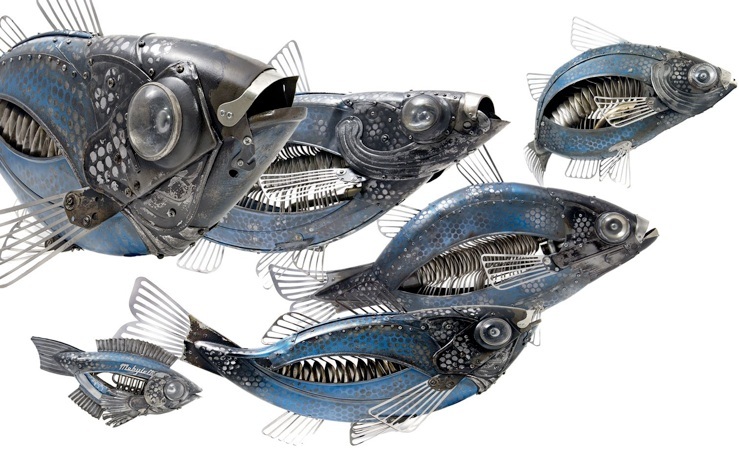
Sculpteur Par Excellence

If you were as amused as we were by this animation, and especially if it gave you hope related to beautiful, if not organic, marine ecosystems of the future, then this display of sculpture is probably for you.  Edouard Martinet’s lovely and lovable marine life is rivaled by his entomological wonders, which you will see at his entry page but be sure to dig deeper to find the other lovelies.

Honey, Hope & Future Cod

Milo’s post yesterday is of special interest to various initiatives we support related to food.  We will have much more to say on bees (and honey), but for now, it gets us thinking. Combined with Seth’s recent post, touching on the subject of overfishing (do read Mark Kurlansky’s books related to food, in addition to Cod), provide a reminder to stop and take a breath.  In a world full of challenges that daunting, how do we keep our wits about us?  How do we remain, fundamentally, hopeful?  An answer, but not necessarily with explanation, can be found sometimes in art (defined as you choose).  If we do not solve the tragedy of the commons with fisheries, might we still hope for a beautiful future for marine life that looks something like this?

Refresher

From the New York Times, a statistical reminder of progress to date and how far yet to go:

Over the past 25 years, the number of conservation areas set aside for the nonhuman species has grown considerably. Globally, there are now more than 100,000 protected areas, including national parks, biological reserves and marine sanctuaries. All told, they protect slightly less than 13 percent of the land on earth and slightly more than a half-percent of the oceans, though only a minute fraction are “no-take” zones that bar fishing. But can these protected areas do enough to protect biological diversity?