Libreria Bookshop & Review Of Once Upon A Prime

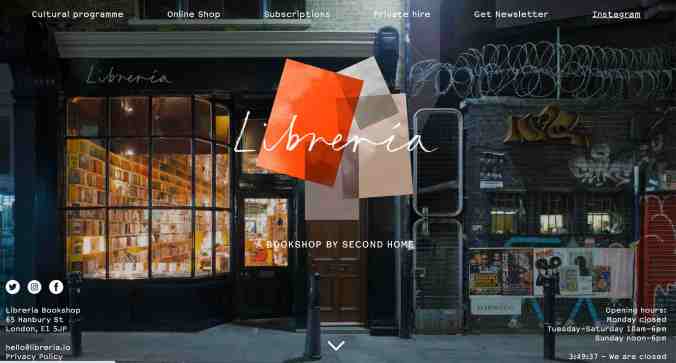
Click above to visit an independent bookshop whose platform for selling books online is a welcome distraction. Below, the owner of that shop (a character worth contemplating) writes a great book review. Oddly enough, we could not find, or figure out how to find, this book on his bookshop’s website.

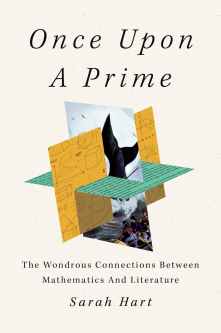
But nevermind that, we have linked to the publisher’s blurb on the book to the left:

Once Upon a Prime review – why maths and literature make a winning formula

Prof Sarah Hart’s exuberant study of the enduring conversation between mathematics and literature is fascinating

The universe (which others call the Library) is composed of an indefinite, perhaps infinite number of hexagonal galleries.” That’s how Jorge Luis Borges starts The Library of Babel, beloved by maths geeks and book nerds alike for the way it toys with the mathematical concept of infinity. Continue reading

Hidden Numbers, Brought Into Daylight

FlatironThe mission of the Flatiron Institute is to advance scientific research through computational methods, including data analysis, modeling and simulation.

The institute, an internal research division of the Simons Foundation, is a community of scientists who are working to use modern computational tools to advance our understanding of science, both through the analysis of large, rich datasets and through the simulations of physical process.

If you are seeing the name above for the first time, so are we. It has come to our attention through this profile below. The questions raised are important. The answers, to the degree there are any, are fascinating. Thanks to longform journalism, which we need now more than ever, we have profiles like this:

Jim Simons, the Numbers King

Algorithms made him a Wall Street billionaire. His new research center helps scientists mine data for the common good.

171218_r31148 (1).jpg

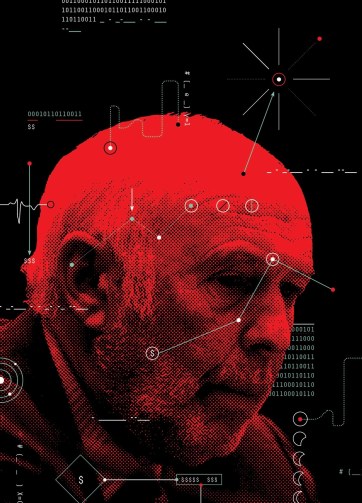
Simons is donating billions of dollars to science. But much of his fortune, long stashed offshore, has never been taxed. Illustration by Oliver Munday; photograph by Tim Sloan / AFP / Getty

By D. T. Max

A visit to a scientific-research center usually begins at a star professor’s laboratory that is abuzz with a dozen postdocs collaborating on various experiments. But when I recently toured the Flatiron Institute, which formally opened in September, in lower Manhattan, I was taken straight to a computer room. The only sound came from a susurrating climate-control system. I was surrounded by rows of black metal cages outfitted, from floor to ceiling, with black metal shelves filled with black server nodes: boxes with small, twinkling lights and protruding multicolored wires. Tags dangled from some of the wires, notes that the tech staff had written to themselves. I realized that I’d seen a facility like this only in movies. Nick Carriero, one of the directors of what the institute calls its “scientific-computing core,” walked me around the space. He pointed to a cage with empty shelves. “We’re waiting for the quantum-physics people to start showing up,” he said. Continue reading

Interview with Creator of Segway and More Important Technologies

Dean Kamen. Credit: DEKA Research

It is a somewhat morbid urban legend that the inventor of the Segway drove off a cliff in a fatal freak accident, but is founded in some truth: the man who purchased the company from inventor/entrepreneur Dean Kamen did indeed pass away in such a manner, a year after acquiring the tech manufacturer and nine years after the creation of the two-wheeled transportation tool. Mr. Kamen being alive and well, with hundreds of patents and plenty of ideas for inventions that particularly help in the medical world, spoke with Chau Tu from Science Friday about his company DEKA Research and Development and his history of prolific invention:

How did you first get interested in engineering?
I think I got started in a much more unusual way than most people I know. I sort of got into it as a kid, because I wanted to make things that weren’t available at the time, and in order to make them, I had to learn some engineering. I learned a little bit of electronics, I learned a little bit about mechanics, and I learned a little bit about how to make things and run machines—a lathe and a mill and a machine shop. I did that long before I academically studied any engineering or math or physics.

When I was in college, I had an older brother in med school who was a pediatric hematologist, and he needed ways to deliver very, very tiny amounts of drugs to very, very tiny babies. The equipment in the hospital was pretty much made for adults. So he asked if I could find a way to make a drug delivery system do what he needed. That was one of my first businesses and projects. [This was the AutoSyringe.]

Continue reading

Everybody Wants To Rule The World

rexfeatures_4272778a_web-487x800Logic, even if it seems to be missing much of the time, provides a set of rules by which the world can at least make more sense. It may not always help one rule the world, but it helps understand some of the rules of the world. Mr du Sautoy’s idea here is akin to the one we make, and link out to from time to time, about the value of liberal arts education for the sake of learning how to think and communicate clearly:

Visualize Pi (and Happy Birthday Albert!)

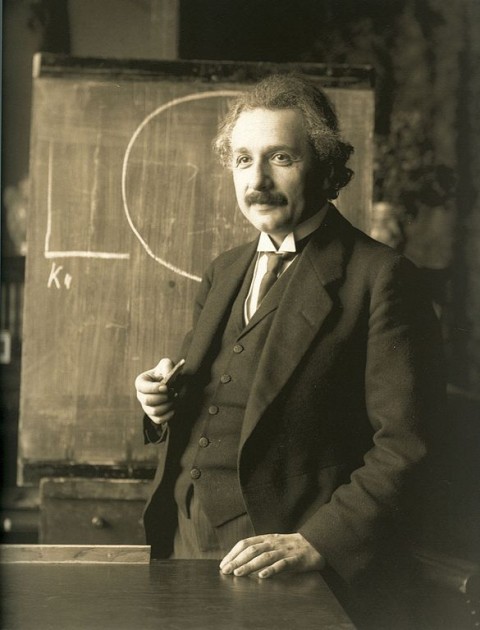
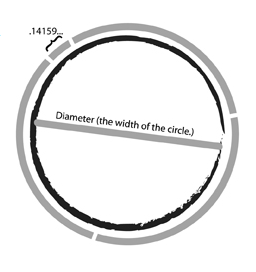
Both a transcendental and an irrational number, Pi (π) is the ratio of a circle’s circumference to its diameter. And both in definition and actuality it epitomizes coolness, inspiring musical homages, from rap to fugue. Albert Einstein, master of the time-space continuum, was born on this day. Makes sense, right?

But what about visual inspiration?

Artist Ellie Balk collaborates with students from The Green School in East Williamsburg, Brooklyn to combine mathematics and art to VISUALIZE Pi as murals in their community. 

Starting in 2011 the artist/student/educator teams graphed Pi in colorful, creative and innovative ways: a histogram of emotions; a weather mural, a reflective line graph that resembles a sound wave and the relationship between the golden ratio and Pi.

For example:

In 2012, students constructed an image of the golden spiral based on the Fibonacci Sequence and began to explore the relationship between the golden ratio and Pi. The number Pi was represented in a color-coded graph within the golden spiral. In this, the numbers are seen as color blocks that vary in size proportionately within the shrinking space of the spiral, allowing us to visualize the shape of Pi and its negative space to look for “patterns”.  The students soon realized that the irrational number of Pi created no patterns at all, resulting in a space that resembles “noise”. 

In response to that, in 2013 students worked to visualize the number Pi as a reflective line graph that resembles a sound wave. The colors of the mural change at each prime number in Pi so that the viewer can visualize a pattern of prime numbers within Pi. Located on a busy corner in East Williamsburg, Brooklyn, the sounds of the bustling traffic and rhythmic commuter passing creates the perfect backdrop for our visualization.   Continue reading

Mathematically Inclined Plant Life

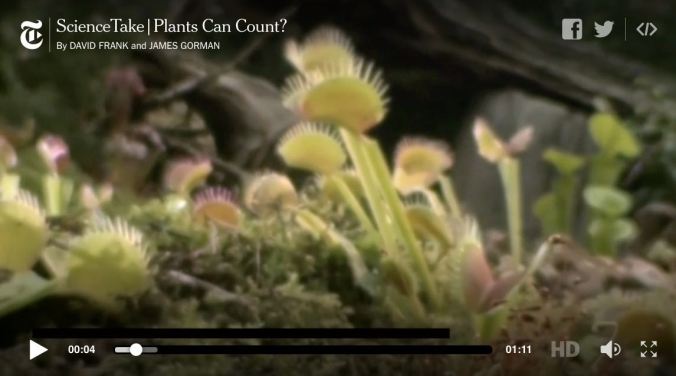
Screen Shot 2016-02-03 at 7.38.22 AM.jpg

We pore the Science section of the New York Times each Tuesday, looking for stories that seem intriguing, and therefore (however much a stretch related to the “fascination with nature”) relevant to our conservation message. We rely on many publications with online outlets for such stories, but always stop at a certain point with stories that simply get us to ick, or which lead to implications not inherently appropriate to a company that operates lodging establishments around the world.

Nonetheless, we read even those stories that make us wince–in the spirit of eat your vegetables, in the interest of learning–but there are some phenomena we promise never to subject our readers to. Not that we do not see the value in understanding such things, but we can only stand so much ick in a day.

Pi Day of the Century 3-14-15

It’s been a few years since we wrote about Pi, but we wouldn’t possibly skip the once in a century shout out to the famous irrational number when the numbers line up for a full 10 digits: 3/14/15 at 9:26:53 (AM or PM!) Add that it’s Albert Einstein’s birthday and we have a mathematical wow factor that can’t be missed.

Scientific American offers some great suggestions on how to celebrate, and where.

If there was ever a year to commemorate Pi Day in a big way, this is it. The date of this Saturday—3/14/15—gives us not just the first three digits (as in most years) but the first five digits of pi, the famous irrational number 3.14159265359… that expresses the ratio of a circle’s circumference to its diameter… Continue reading

Hyphal Highways

Hyphae are filaments of cells that join together to make the structures in fungi. When you look at the fuzzy patch of mold growing on any of the fruit in your kitchen, you’re looking at lots of hyphae growing into the strands of mold (chances are the mold is a strain of Botrytis cinerea). There’s hundreds of reasons to be studying fungi today — the parasitic wonders they can achieve, the materials they can provide through science in the future, and the foods and medicines that can be cultivated or collected from them.

Continue reading

Mathematics & Community

Alexander F. Yuan/AP Images

Alexander F. Yuan/AP Images

This article, in the Atlantic, at first seemed to have nothing to do with our core themes of community, collaboration or conservation, but reading it to the end, we see that on the contrary there is a strong link. All three of those words are closely connected to education, which is closely connected to economic opportunity, which is closely connected to the feasibility of conservation, our deepest concern.  Plus, many in our realm can attest to childhood mathematical experiences, many unpleasant, that might not after all be required to develop aptitude and appetite for what is after all just another language:

The familiar, hierarchical sequence of math instruction starts with counting, followed by addition and subtraction, then multiplication and division. The computational set expands to include bigger and bigger numbers, and at some point, fractions enter the picture, too. Then in early adolescence, students are introduced to patterns of numbers and letters, in the entirely new subject of algebra. A minority of students then wend their way through geometry, trigonometry and, finally, calculus, which is considered the pinnacle of high-school-level math. Continue reading

A Science Writer’s Public Service

41EWvquSk3L_SL500_AA300_.5095659_std

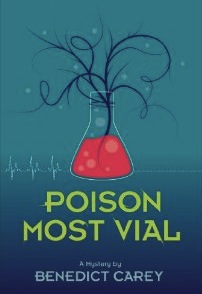
The famous forensic scientist Dr. Rama is dead – murdered – and suspicion has fallen on Ruby Rose’s father, the only family she has. Ruby is new to her school and is having enough trouble just making a friend; now she has far bigger problems. To save her father, she will have to solve the murder herself, relying for help on an elderly neighbor who used to be a toxicologist. But is this woman reliable? And is there enough time?

Benedict Carey is better known as a science reporter for the New York Times, but that is just his day job.  It certainly qualifies as public service, but in addition he moonlights on further public service. He explains his purpose:

Both books are adventures in which kids use science to save themselves and solve a mystery. It’s real science, accessible but not obvious, and builds understanding of some fairly advanced principles – transcendental numbers (among other things) in “Island of the Unknowns,” and mass chromatography in “Poison Most Vial.”

In a trailer park called Adjacent, next to the Folsom Energy Plant, people have started to vanish, and no one seems to care. At first Lady Di and her best friend, Tom Jones, barely notice the disappearances—until their beloved math tutor, Mrs. Clarke, is abducted, too. Mrs. Clarke has left them clues in the form of math equations that lead them and other kids all over the trailer park, through hidden tunnels under “Mount Trashmore,” and into the Folsom Energy Plant itself, where Lady Di and Tom Jones and a gang of other misfits uncover the sordid truth about what’s really happening there. That's Di on the left and Tom on the right.

In a trailer park called Adjacent, next to the Folsom Energy Plant, people have started to vanish, and no one seems to care. At first Lady Di and her best friend, Tom Jones, barely notice the disappearances—until their beloved math tutor, Mrs. Clarke, is abducted, too. Mrs. Clarke has left them clues in the form of math equations that lead them and other kids all over the trailer park, through hidden tunnels under “Mount Trashmore,” and into the Folsom Energy Plant itself, where Lady Di and Tom Jones and a gang of other misfits uncover the sordid truth about what’s really happening there. That’s Di on the left and Tom on the right.

Perfectly principled reality: if you had been restricted to Benedict Carey’s better known science reporting for the New York Times, that would be not such a bad thing. He also serves on the board of Edge, a non-profit which seeks to “arrive at the edge of the world’s knowledge, seek out the most complex and sophisticated minds, put them in a room together, and have them ask each other the questions they are asking themselves.” Again, not bad.

But we like in particular the effort to branch out further, reaching the next generation and aiding the mathematical and scientific efforts of educators who otherwise compete with entertainment of all sorts for the hearts and minds of youth.

That said, do not miss his reporting. He is a master at this trade, and improves the quality of conversation we are determined to engage in more often. His most recent article for the Times reviews the research into cognitive performance and aging and with humor and gravitas all at once he acknowledges why as we get older we tend not to be too interested in these findings: Continue reading

A Different Kind Of Travelogue

10-08discovery_full_380We are unabashedly in favor of reading, thinking and decision-making in advance of travel, during travel, and after travel. We are also in favor, when the fancy strikes, of just hitting the road without knowing why, where to, or for how long. On our pages you will find posts for either end of the spectrum from meticulously planned to wanderlust journeys.  It is about  discovery.  So this book caught our attention. Nothing to do with hobbits, as reviewed by the Monitor (click the book image to the left to go to the source) it sounds like the perfect prelude, accompaniment or postscript for travel in a part of the world we have not been covering in our pages as much as we maybe should:

…In “The Discovery of Middle Earth,” Robb sets out to establish the momentous contributions made to the arts of cartography and communication by the once-great Celtic peoples, who at various points in history spread all the way from modern-day Turkey to Ireland. In the process, he consults old documents, interviews experts, examines artifacts, and bicycles more than 26,000 kilometers across France, taking his readers along with him… Continue reading

Smiling, Thinking Of Math As Language

Planning our work with communities in diverse locations, language is a challenge, a puzzle. We are constantly on the lookout for new ways of thinking about how to resolve this puzzle, so when we hear this fellow speak on the topic, it makes us smile. Nothing to do with conservation, but everything having to do with community and collaboration at a very fundamental level, we thank Open Culture for bringing this wonderful recording to our attention:

The essay is called “The Common Language of Science.” It was recorded in September of 1941 as a radio address to the British Association for the Advancement of Science. The recording was apparently made in America, as Einstein never returned to Europe after emigrating from Germany in 1933. Continue reading

Pi With Pies

Krulwich is our go-to guy on a certain kind of day. A day when important scientific ideas might otherwise put us to sleep, and just need a fresh approach to get our attention. Today is one of those days, and the pied piper of fun science delivers a short and sweet one:
Continue reading

How Big Is A Billion?

Community, collaboration and conservation are the categorical things–ideas, actions, examples–that we most like to talk about on this site and point to with links elsewhere.  Still, perhaps half of the posts here would be hard pressed to fit into those categories in any literal sense.  This little item below, for example.  Two guys talking about cultural differences in mathematical expression.  Go figure.

Complex Ideas Made Simple

Maths in Deauville, Normandy (Rene Maltete)

Click the image above for a Krulwich confection.  While nominally about the challenge of understanding genetics, it is actually a reminder that when we celebrate the oddball, often underdog approaches to challenging ideas or situations, we sometimes oversimplify in the interest of clever/cute and sometimes in the spirit of brevity (which Shakespeare called the soul of wit, and Dorothy Parker called the soul of lingerie).

Meeting in the Middle

Pi, Greek letter (π), is the symbol for the ratio of the circumference of a circle to its diameter.  The area of a circle is calculated using Pi and the radius of the circle.

In honor of this perfect proportion, math enthusiasts around the world celebrate Pi Day on March 14th. Pi = 3.1415926535…

Multiple ancient civilizations including Egypt, Greece and Iron-Age India have stunning examples of the use of Pi; think “Great Pyramids” and you get the idea. Continue reading