Being Full of It: A Meaningful Word

Since arriving in Kerala, I have been greeted many ways.  I have exchanged many smiles and hellos, and I have been veiled with jasmine garland and pressed with traditional dika.  However, the greeting I find most profound lies in a single word: Namaskaram.
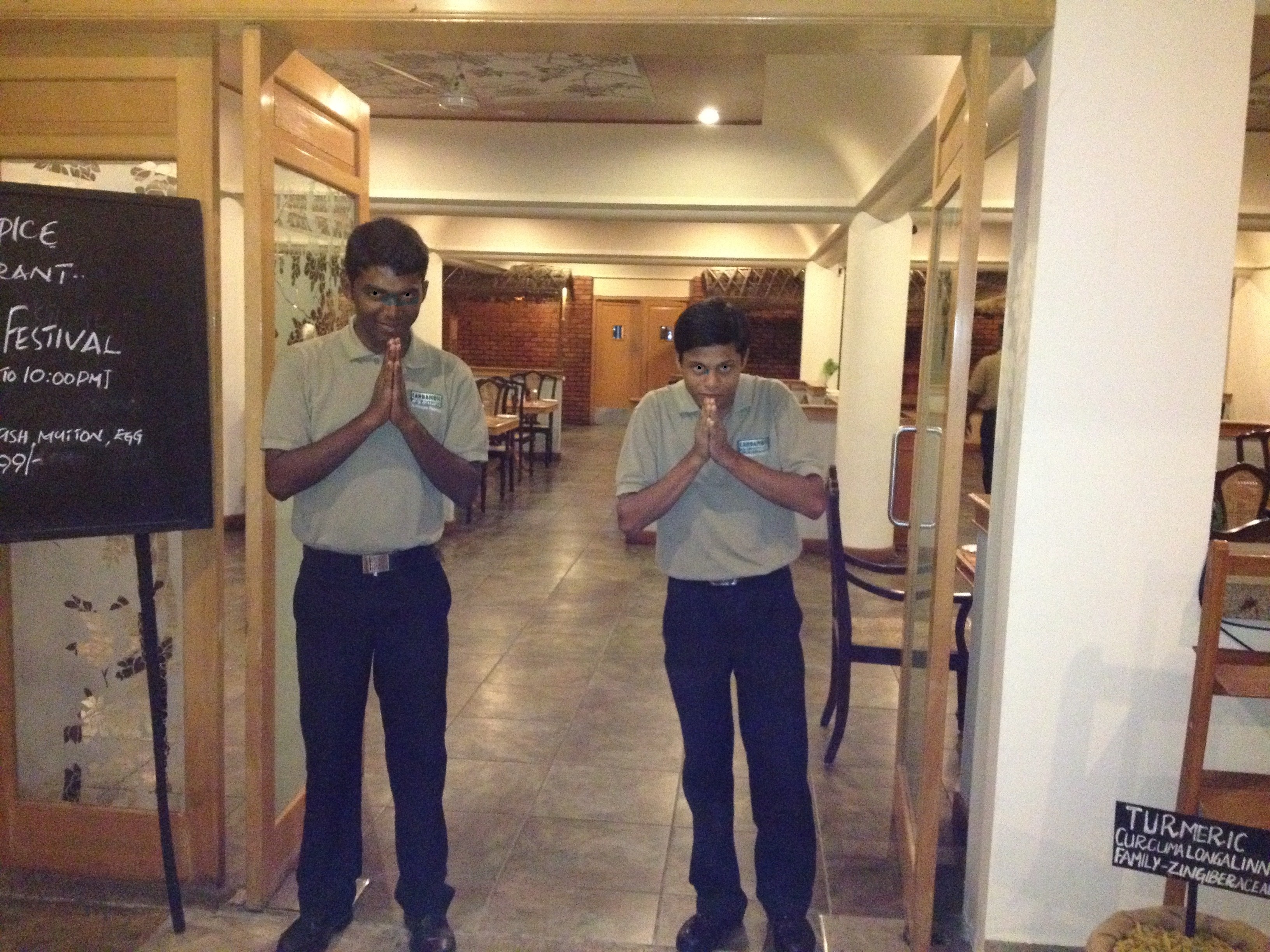
Two people, worlds apart, meet with this word.  Each of their hands draws together in a prayerful pose in the nest of their individual chests.  With a bow of their heads, they utter, “Namaskaram.”  At first, it seemed like a simple interaction, yet when I asked the native people for the meaning, I learned that it has a much deeper connotation.

A signal of respect.  A promise of hospitality.  A notion of putting aside one’s ego.  All of these meanings are understood with Namaskaram.  I witness and experience them with nearly every interaction among the people here at Cardamom County, but the latter meaning, putting aside one’s ego, has struck a powerful chord in me. Continue reading

Connecting The Madeleines

The young man working his way through the kitchen brought to mind a young man of about the same age, three decades earlier. I had the good fortune, in my early adulthood, to work in a restaurant owned and operated by a man who is one of the great chefs of his generation.  I did not work in the kitchen, but in the dining room, from 1983-1985. It provided the most important education of my life, which is saying a lot because I eventually earned a Ph.D. and even that did not top the learning earned in Guy Savoy’s restaurant.

Continue reading

Ideas About Why To Hug A Tree

In several earlier posts Seth highlighted the evolution of environmental philosophy in readings for a course he was taking at Cornell University.  For those of us not lucky enough to be in a course like that, there is a magazine whose current issue covers some of the same terrain.  From one of the articles in that issue (click the image above to go directly to the source):

Leopold argued for the extension of what we see as worthy of our respect from the human community to include animals and the natural world, or what he referred to as ‘the biotic community’. His famous principle, briefly expressed, was, ‘A thing is right when it tends to preserve the integrity, stability and beauty of the biotic community. It is wrong when it tends otherwise’.

Continue reading