Overriding Politics with Play

A set of pink seesaws allowed people to share some fun along the U.S.-Mexico border wall this week. Here, a woman helps her little girls ride the seesaw that was installed near Ciudad de Juarez, Mexico. Christian Chavez/AP

Despite being a few days late within the news cycle, this story deserves to be highlighted. In fact, in face of the bombardment of negatives along the border, we’d say it’s imperative to keep the power of joy as a constant point of reference.

See-Saw Diplomacy Lets People Play Together Along U.S. Border Wall

A stretch of the border wall between the U.S. and Mexico was adorned with a set of pink see-saws this week — allowing children (and grownups) to play together across the barrier. The event was “filled with joy, excitement, and togetherness,” says architect Ronald Rael, a leader of the project.

The seesaws were installed on Sunday, when their steel beams were eased through the slats of the tall fence that divides Sunland Park, N.M., from Colonia Anapra — a community on the western side of Ciudad Juárez in Mexico.

“Everyone was very happy and excited to engage the seesaws,” Rael says via email, describing the mood at Sunday’s event. And while he admits to being a little nervous about the completion of a project that had been brewing for 10 years, he says it went off without a hitch.

“It was peaceful and fun — a day at a park for the children and mothers of Anapra,” Rael says.

The seesaws were created by Rael and fellow architect Virginia San Fratello; the two are partners in a design firm. By installing playground toys, they sought to tweak the meaning of a border fence. Continue reading
People At Play

1127-bks-heffernancook-master768-v2

Brandon Celi

This book review puts our work, with would be categorized as providing recreation services, in an interesting context:

Steven Johnson on How Play Shaped the World

By

WONDERLAND
How Play Made the Modern World
By Steven Johnson
322 pp. Riverhead Books. $30.

Steven Johnson’s “Wonderland” makes a swashbuckling argument for the centrality of recreation to all of human history. The book is a house of wonders itself. Marvelous circuits of prose inductors, resistors and switches simulate ordinary history so nearly as to make readers forget the real thing. Red wires connect haphazardly to blue, and sparks fly. Who needs a footnoted analysis of “the ludic,” as play is known to the terminally unplayful? Barnumism of the Johnson kind is much, much more fun. Continue reading

Slacklining in Rio

Image of Giovanna Petrucci via youtube.com

I wrote about slacklining last year, as James did the year before that, but we were nowhere near the class of skill practiced by professional slackers like those in Rio de Janeiro, where lots of young people go to the beaches and enjoy the relatively new sport in a much more acrobatic fashion than the simple balancing I’ve been doing in back yards and college campuses. Anna Jean Kaiser reports on the world champion of slacklining, an eighteen-year-old girl who practices in her hometown at Ipanema Beach:

RIO DE JANEIRO — Bouncing in the air above the sand of Ipanema Beach, not an Olympic venue in sight, is one of the most remarkable athletes in the world who has nothing to do with the Rio Games. Her name is Giovanna Petrucci, and her acrobatics rival those of the gymnasts and divers competing across this city.

Continue reading

A Pouncing Tradition

20160715_110556_zpsb3jygeqb

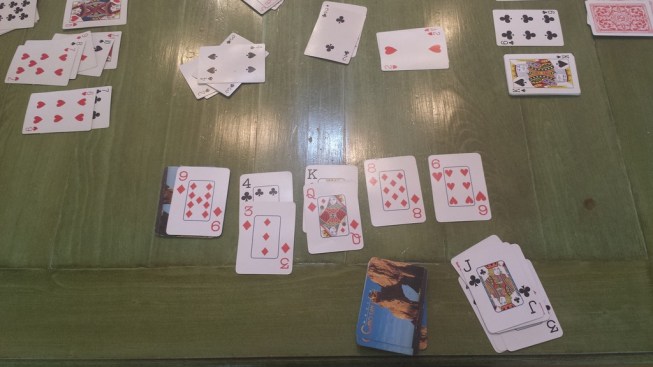
On one of my first days at Villa del Faro, the subject of card games came up during a dinner meal and my ears perked up. Everyone at the table seemed eager to learn a new card game so I pounced at the opportunity to share the story of the epic card game that I can confidently say characterizes a Toll family member.

In general terms, Pounce is like Solitaire but with three to five people playing all at once and playing on the same stack that you are trying to play out your cards toward. It’s a very fast-paced game that does not cater to the faint of heart. Continue reading

Corvid Playtime

Speaking of birds, we love playing around with examples of creativity in the animal kingdom. There was a time when scientists claimed the use of tools was what set humans apart from animals. Continue reading

Bird Fun (…and Aristotle?) around Tacacorí

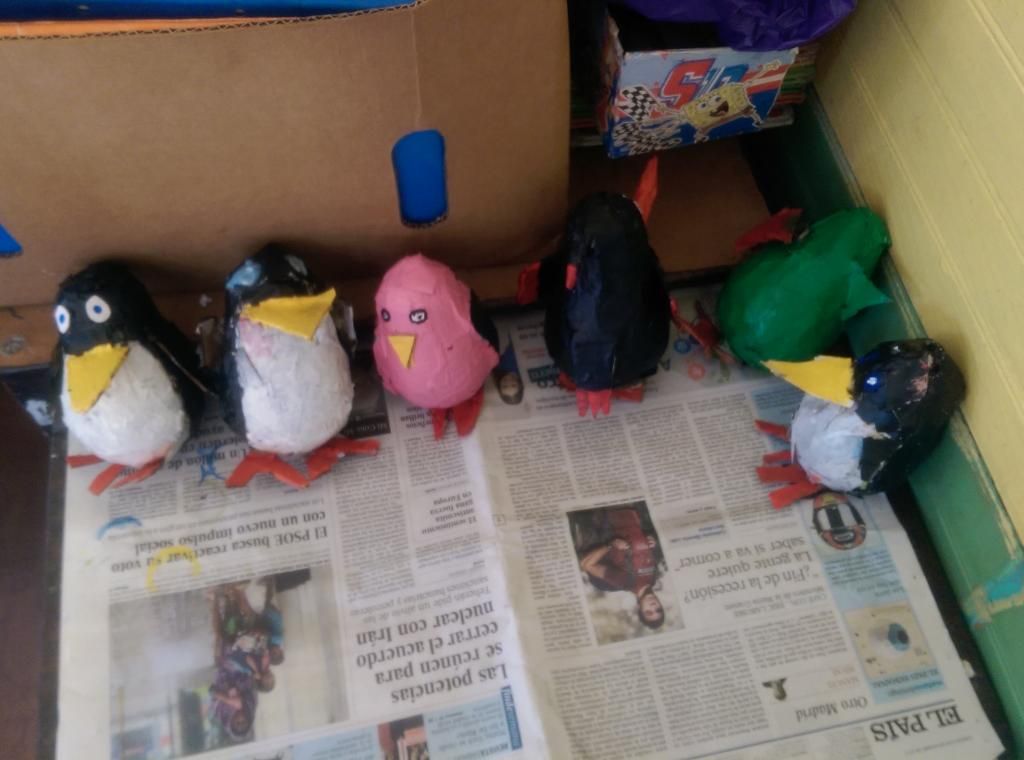
Papier-mâché penguins and other birds from the fourth grade class

In his recent post on our work at the local school in Tacacorí, Seth outlined our papier-mâché and painting ambitions with the third and fourth grades there. The second half of the week, Seth and I were split up because of the kids’ conflicting class schedules. I took fourth grade on the last few days, and he worked with third grade.

In his Poetics, Aristotle elaborates an aesthetic theory partly on the basis of μίμησις (mimēsis), or “imitation.” According to Aristotle, humans are “mimetic” beings, that is, disposed to imitate nature and other human beings. Art’s basis is precisely in Continue reading

A Scientist, On Play

Another keeper on the topic of play, from another of the Baffler’s notable contributors:

Rationalists tend to frown upon group activities that seem to serve no evident biological or political purpose, like the drumming and masking so often indulged in by protest movements like Occupy Wall Street. Or, for a more historically venerable example, consider the reaction of European conquerors and missionaries to the shocking spectacles they encountered during the “age of exploration.” Almost everywhere they went—from Africa to the Western plains of America, from Polynesia to the Indian subcontinent—Europeans came across native peoples engaged in ecstatic rituals involving dancing, drumming, body-painting, masks, costumes, and feasting. Failing to notice the parallels between these exuberant native rituals and the traditional carnivals of Europe, missionaries tended to explain them as outbreaks of demonic possession, or as proof that the natives were not human at all, only “savages.” Continue reading