Mining Companies Gonna Mine

MAËLLE DOLIVEUX

MAËLLE DOLIVEUX

We try to stay away from stereotypes, cliche, cute kitten videos and memes. But the editorial below will leave you with heightened awareness of just how low mining companies can go, literally, figuratively and spiritually to get what they want. Rio Tinto is a cliche, a nightmare about killing the earth and any cultural artifacts that get in the way of its profits. Let’s awake from this nightmare. Come on, Arizona, be better than this:

Selling Off Apache Holy Land

Lydia Millet

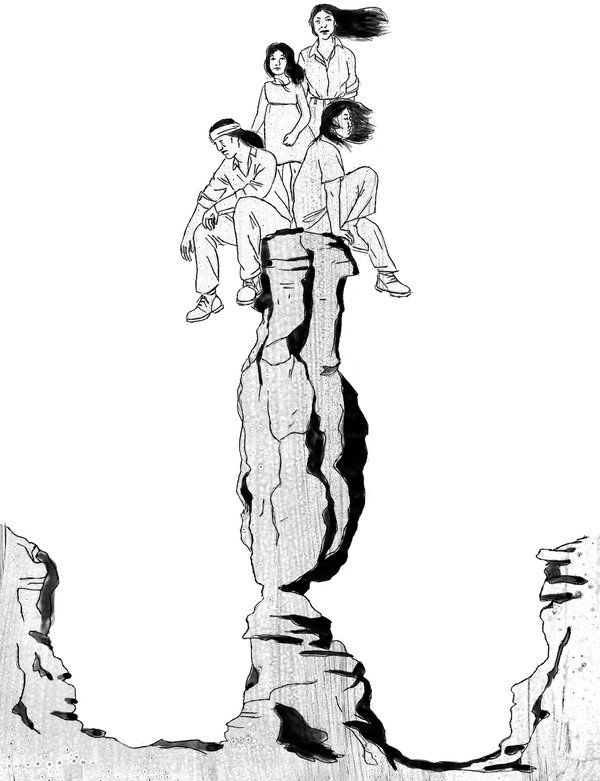
ABOUT an hour east of Phoenix, near a mining town called Superior, men, women and children of the San Carlos Apache tribe have been camped out at a place called Oak Flat for more than three months, protesting the latest assault on their culture. Continue reading

#PeopleVsShell

Photo credits: Greenpeace.org

Environmental Activism has never taken a back seat in Seattle and we continue to root for the individuals, organizations and public officials who are working to draw global attention to a possible environmental disaster. Certainly not the moment to “Keep Calm & Carry On”…

Hundreds of kayakers in Seattle were preparing to go and “shake their paddles” in protest at a newly arrived 400ft long, 355ft tall Royal Dutch Shell oil rig on Saturday, with hundreds – perhaps thousands – more scheduled to attend on dry land.

“We here in Seattle do not want Shell in our port. We want them to get out and change their business before they change our planet and destroy the life of future generations,” said Annette Klapstein, a 62-year-old retired attorney and member of activist group the Raging Grannies.

On Monday, the Obama administration effectively gave Shell the green light to restart its Arctic drilling and exploration operations with an approval issued by the Bureau of Ocean Energy Management, a governmental regulatory agency.

Shell was forced to halt its Arctic exploration in 2012 amid a series of severe security mishaps.

Environmental groups and scientists reacted to Monday’s news badly, warning that letting Shell back into the Arctic for exploration and drilling was very likely to cause an ecological disaster and contribute to climate change. Continue reading

We Will Cheer This Until Completion

db757a96-5214-4e59-b0d5-8631d7e250d7-460x276

The proposed marine reserves around the South Sandwich Islands, Ascension and Pitcairn Islands would protect rare and threatened marine life. Photograph: Matthias Graben/Alamy

We write about marine reserves whenever we hear of a new initiative, and try to keep up with the progress of those as we can. The Guardian is reporting here on a new one; if Helena is in, we are in to support this as we can, and will post updates as available:

Conservationists call for UK to create world’s largest marine reserve

Three proposed reserves in UK waters around the Pitcairn Islands in the Pacific, and Ascension Island and South Sandwich Islands in the Atlantic, would more than double the size of the world’s existing marine protected areas

Pressure is mounting on the UK government and opposition parties to commit to creating at least one massive marine reserve in the Pacific or Atlantic to protect rare and threatened whales, sharks, fish and corals ahead of the general election.

Continue reading

When New Roads Signal Nothing But Danger Ahead

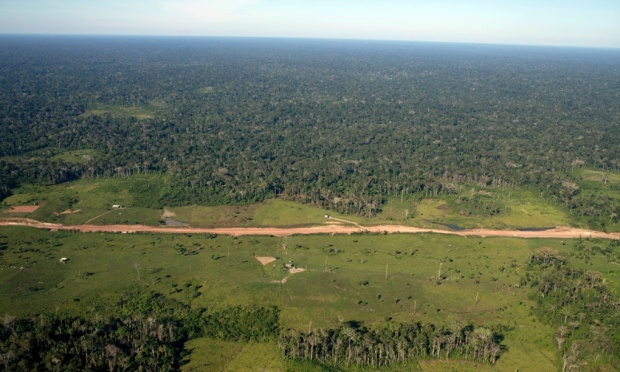
 A newly constructed road goes through the Amazon rainforest outside Rio Branco, the capital of Acre province, Brazil. For every 40 meters or road created, around 600 sq km of forest is lost. Photograph: Per-Anders Pettersson/Corbis

A newly constructed road goes through the Amazon rainforest outside Rio Branco, the capital of Acre province, Brazil. For every 40 meters or road created, around 600 sq km of forest is lost. Photograph: Per-Anders Pettersson/Corbis

Thanks to the Guardian for keeping us up to date with news, no matter how dismal, which in this case raises red flags about the future of our earth’s lungs:

Roads are encroaching deeper into the Amazon rainforest, study says

Oil and gas access roads in western Amazon could open up ‘Pandora’s box’ of environmental impacts

Oil and gas roads are encroaching deeper into the western Amazon, one of the world’s last wildernesses and biodiversity hotspots, according to a new study.

Roads across Bolivia, Colombia, Ecuador, Peru and western Brazil could open up a ‘Pandora’s box’ of negative environmental impacts and trigger new deforestation fronts, the study published in Environmental Research Letters finds.

“The hydrocarbon frontier keeps pushing deeper into the Amazon and there needs to be a strategic plan for how future development takes place in regards to roads,” said the report’s lead author, Matt Finer, of the Amazon Conservation Association.

Continue reading

Profits, Privileges, Environmental Destruction

Mombiot blog on sea protection : Fishing boats near the beach at Flamborough head Yorkshire

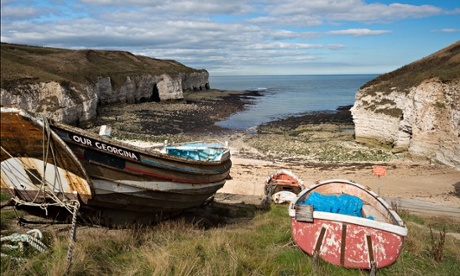
Fishing boats near the beach at North Landing, Flamborough Head, on the Yorkshire coast. Falmborough Head is home to one of the UK’s three ‘no take’ zones – that in total cover just 5 sq km. Photograph: Paul Richardson/Alamy

The excellent Guardian editorialist, whom we have linked to more than once, strikes again:

Ripping up the sea floor on behalf of royal profits

George Monbiot: Even the pathetic laws protecting marine life in this country are instantly swept aside in response to lobbying by Prince Charles’s tenants

A few days ago, I visited the Flamborough Head “no take zone”, one of the UK’s three areas in which commercial fishing is prohibited.

Here marine life is allowed to proliferate, without being menaced by trawlers, scallop dredgers, drift nets, pots and all the other devices for rounding it up, some of which also rip the seabed to shreds. A reef of soft corals, mussels, razorfish and other species has begun to form, in which plaice and cod, crabs and lobsters can shelter, unmolested by exploitation. Fantastic, isn’t it?

Well curb your enthusiasm. Continue reading

Bring On The Night

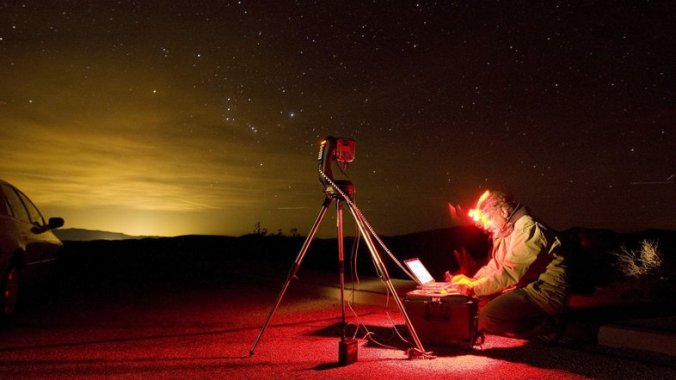
Dan Duriscoe works at a special computer-controlled camera used to photograph the night sky at Dantes View in Death Valley National Park in California. John Locher/AP

Dan Duriscoe works at a special computer-controlled camera used to photograph the night sky at Dantes View in Death Valley National Park in California. John Locher/AP

Supporting an activity that depends on the mitigation, if not reduction, of light pollution? We are all for it:

When was the last time you looked at the Milky Way? Or saw the shape of Cassiopeia? If you live in a city, you might not even remember. In the world’s most populated areas, air and light pollution obscure the sight of thousands of stars once visible to the naked eye. Continue reading

Say It Ain’t So, Ferran!

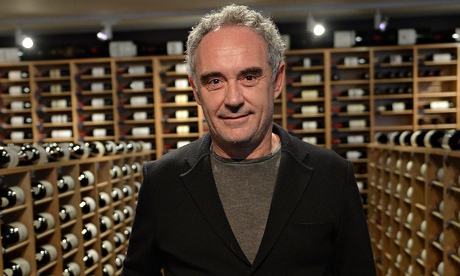
Ferran Adrià, of the award-winning restaurant elBulli. Photograph: Emmanuel Dunand/AFP/Getty Images

Ferran Adrià, of the award-winning restaurant elBulli. Photograph: Emmanuel Dunand/AFP/Getty Images

The quote from a group supporting the development of a museum on a protected coastal ecosystem–“We understand that it’s very easy to raise the populist flag in defence of the environment and that this always manages to attract a good number of supporters,”–says all you need to know to understand how important this issue is. In fact, it is not so easy. It is not easy at all to protect the last remaining unspoiled beaches in the world. We are sure that with a bit of publicity, the right outcome will prevail in this case:

When Ferran Adrià shut the doors of his elBulli restaurant in 2011, he quickly reassured gastronomes that it was not closing for good, just for a revamp. ElBulli would become a cultural foundation , complete with museum and visitor centre called elBulli 1846, all to reopen on an expanded plot in 2015.

Foodies may have been reassured, but not so environmentalists, who are furious that the expanded elBulli will eat up more space on the Cala Montjoi, one of Spain‘s few protected Mediterranean beaches. Continue reading

Home On The Range

Prairie Project

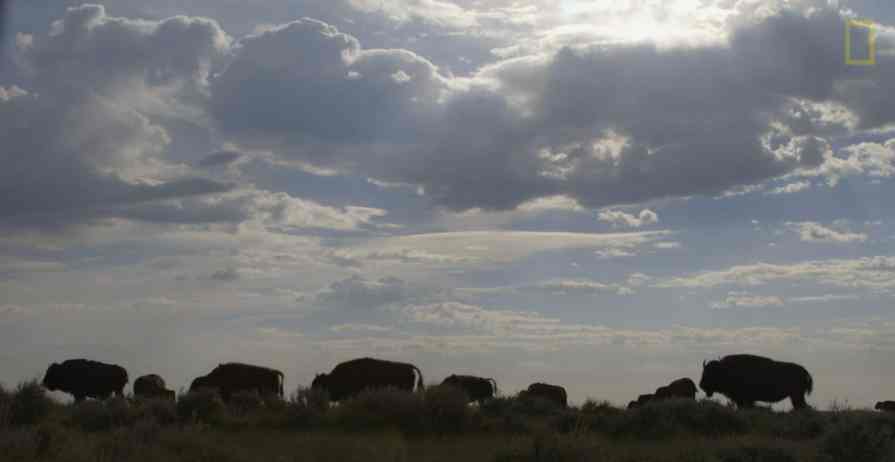
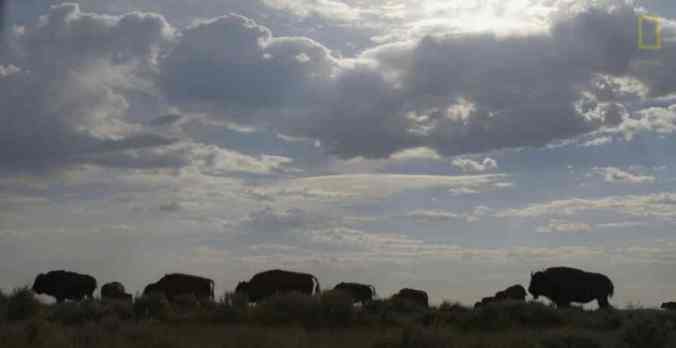
The great plains play an important role in both the history and prehistory of North America on many levels–in terms of wildlife, ecosystems and human occupation–and the American bison were an integral part of all three. The American Prairie Reserve is an ambitious project to reintroduce herds of the species into 3.5 million acres of public and private land patched together to create a protected area roughly the size of the state of Connecticut.

Sean Gerrity is passionate about the project, so much so that he is able to leverage his successful Silicon Valley business acumen into creative 21st-century solutions to the world’s conservation challenges with ideas that include the 73 bison calves awaiting their release into the wild the next day.

If all goes well, this bull calf will spend the rest of his life roaming grasslands that once teemed with millions of his forebears. He will encounter herds of elk, deer, and pronghorn. He will sniff the wind nervously for the scent of cougar and bear and wolf. Prairie dogs will dive for cover at the tremor of his hooves while hawks soar hungrily overhead in the endless sky. He will run for miles, for days, with no fence to hinder him.

If all goes well, this bull calf—or perhaps this calf’s children or his children’s children—will belong to a herd 10,000-bison strong, the largest conservation herd in all the world and the cornerstone inhabitants of the American Prairie Reserve, which has set its sights on becoming the largest wildlife reserve in the continental United States. Continue reading

World’s Largest Ocean Sanctuary, Maybe

This slideshow requires JavaScript.

Thanks to the CS Monitor for this welcome news:

Obama seeks to create world’s largest marine sanctuary

With the aim of protecting marine wildlife, President Obama is considering greatly expanding the Pacific Remote Islands Marine National Monument, an ocean preserve that lies between Hawaii and Samoa.

President Barack Obama is looking to create the largest marine preserve in the world by protecting a massive stretch of the Pacific Ocean from drilling, fishing and other actions that could threaten wildlife, the White House said.

Aiming to protect marine wildlife, Obama will also direct the government to create a program to deter illegal fishing. The executive steps come as Obama is searching for ways to leave his second-term mark on the environment despite opposition from many Republicans in Congress.

Obama was to announce the steps Tuesday in a video message to those participating in an “Our Ocean” conference that the State Department and Secretary of State John Kerry are hosting. Continue reading

Saving Species–One Paper, One Video, One Course, And One Initiative At A Time

saving-species-logo-long-small

We thank Stuart Pimm for his ongoing excellent contributions to conservation through science and education, as well as creative activism, and congratulate him and his colleagues for their most recent publication:

new scientific paper was published today in the prestigious journal Science and it has important findings for biodiversity. Though it reaffirms what we already know—that there is a global extinction crisis and it is worse than we believed—it also details how technology and smart decision-making are offering hope for endangered species and their habitats. Continue reading

A Minor Detraction From Aging’s Major Detractors

old-tree

Thanks to Roberta Kwok for her ever-concise summaries of remarkable scientific findings on Conservation‘s website, this one following the theme of a companion post with regard to aging organisms:

SCORE ONE FOR THE REALLY OLD GUYS

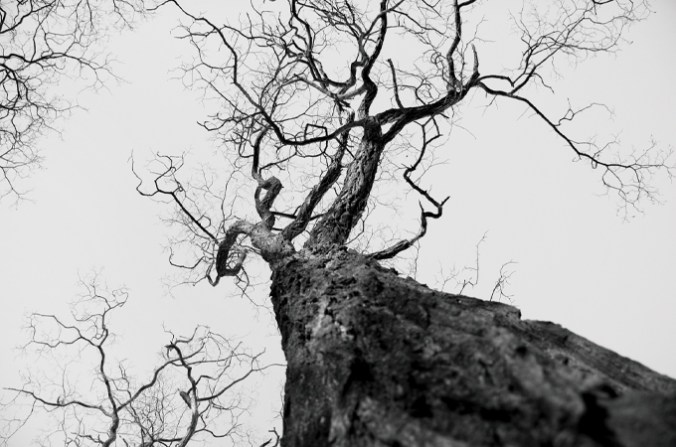
Aging is generally associated with slowing down. But scientists have found that trees actually grow faster as they get older, making them star players in a forest’s carbon storage. In fact, one old tree can fix as much carbon in a year as the total amount of carbon in a “middle-aged” tree. Continue reading

Natural Capital Valuation and Protection of Marine Megafauna

Photo © Fabrice Jaine

I’ve noticed a number of positive and interesting developments as of late in the area of marine species protection, pointing to an increasing recognition, by policymakers, of the value of natural capital and associated ecosystem services, particularly the value arising from ecotourism.

In February of this year, the Government of Indonesia granted full protection to manta rays within its nearly 6 million square kilometer exclusive economic zone (EEZ), making it the world’s largest sanctuary for manta rays. This reverses the trend of the past three decades wherein Indonesia has had the dubious distinction of being home to the world’s largest fishery for sharks and rays. Why the reversal? It seem that studies showing that the ecotourism value of a manta ray is an estimated $1 million over its lifetime, as compared to the onetime value of several hundred dollars for its gill rakers and meat played a key role in persuading policymakers to take action to protect the iconic species.

A few weeks later, the President of Palau announced that the country’s entire 200 nautical mile EEZ will be declared a marine sanctuary and closed to commercial fishing and seabed mining.  This follows a move a few years earlier to declare Palau a shark sanctuary. In explaining the reasoning behind the moves Palau’s president noted that a dead shark is worth several hundred dollars, whereas a live shark is worth $1.9 million in tourism during its life span, and that his country will promote scuba diving, snorkelling and ecotourism as an alternative income to commercial fishing. Continue reading

Tiger Census In Kerala Is Well Under Way

2,088 field staff taking part in the eight-day exercise in five landscapes

2,088 field staff taking part in the eight-day exercise in five landscapes

Today’s Hindu newspaper reports that:

The eight-day phase-one of the all India tiger estimation 2013-2014 by 2,088 field staff began in the forests of the State on Monday.

The estimation, at the initiative of the National Tiger Conservation Authority (NTCA), is a countrywide exercise conducted every four years to assess the status of wild tigers, co-predators, prey species, and their habitat. Continue reading

Urban Muse

This slideshow requires JavaScript.

It does not matter whether you are a farmer, a geneticist, or whatever you do with your time: you will almost certainly be affected in important, unexpected ways after time spent in Paris.   Continue reading

Lost City Of The Monkey God

Another great article (click the image to the left to go to the source), complementing this recent one from the New Yorker, about one special location within the region several members of Raxa Collective have called home for most of the last two decades:

The rain forests of Mosquitia, which span more than thirty-two thousand square miles of Honduras and Nicaragua, are among the densest and most inhospitable in the world. “It’s mountainous,” Chris Begley, an archeologist and expert on Honduras, told me recently. “There’s white water. There are jumping vipers, coral snakes, fer-de-lance, stinging plants, and biting insects. And then there are the illnesses—malaria, dengue fever, leishmaniasis, Chagas’.” Nevertheless, for nearly a century, archeologists and adventurers have plunged into the region, in search of the ruins of an ancient city, built of white stone, called la Ciudad Blanca, the White City. Continue reading

Camera Traps, Unite

This slideshow requires JavaScript.

Sharing technology, data, knowhow.  Pooling resources in the common interest across regions of the tropical world for the sake of biodiversity conservation.  Take a look at what TEAM is doing. A six minute video appears on the Guardian‘s website, providing much-appreciated coverage:

One million images of wildlife in 16 tropical forests around the world have been captured by the Tropical Ecology Assessment and Monitoring (TEAM) Network. Since it began its work in 2008 to monitor changes in wildlife, vegetation and climate, cameras in the the Americas, Africa and Asia have photographed more than 370 different species including elephants, gorillas, chimpanzees, large cats, honey badgers, tapirs and tropical birds Continue reading

Mayan-Like Patterns

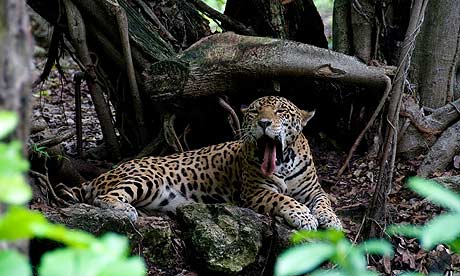
A jaguar – a symbol of Mayan royalty – is endangered but roams free in the Maya Biosphere Reserve, Guatemala. Photograph: Larry Larsen/Alamy

A jaguar – a symbol of Mayan royalty – is endangered but roams free in the Maya Biosphere Reserve, Guatemala. Photograph: Larry Larsen/Alamy

We make frequent links and comment on topics meant to raise awareness about innovative, fun and sometimes loony efforts—from the humble to the grand– to avert environmental collapse.  The dangers are real enough that we assume readers get enough of the doom and gloom elsewhere, so that we can focus our efforts on evidence of potential solutions, and encourage collective action.

The photo above accompanies a story in the Guardian worth a read, to put in perspective why it is that the Mayan calendar doomsdate hoopla, or at least some of the accompanying history, was worth a bit of attention:

…Today, much of the Mayans’ ancient homeland is a 7,700-square mile protected area in Guatemala called the Maya Biosphere Reserve. With an area greater than the states of Connecticut and Rhode Island combined, the reserve protects the largest remaining forest in Central America. Beneath the canopy, monumental vestiges of temples and palaces attest to past splendour. Similar magnificence is found in the reserve’s wildlife. The jaguar, once a symbol of Mayan royalty, still roams free in one of Central America’s last wild places. Continue reading

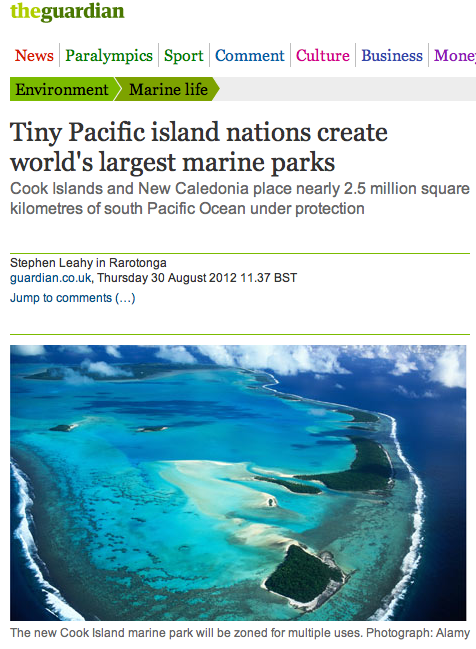
Largest Marine Park

Click the image above to go to the story:

Two of the world’s smallest countries are to place nearly 2.5 million square kilometres of south Pacific Ocean in newly created marine protected areas.

The Cook Islands, nation of 20,000 people on 15 islands, formally announced on Tuesday the creation of the world’s largest marine park covering nearly 1.1m sq km, an area bigger than France and Germany.

“This is our contribution not only to our own wellbeing but also to humanity’s wellbeing,” said the prime minister, Henry Puna.