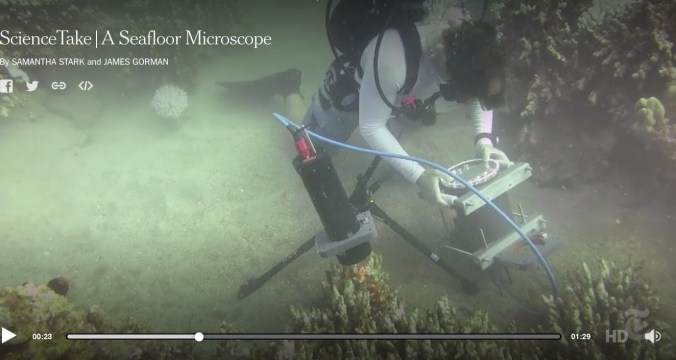
Let’s hope Jocelyn’s snorkel future allows her to consider working with one of these…
Let’s hope Jocelyn’s snorkel future allows her to consider working with one of these…

Jon Chase/Harvard Staff Photographer. Radcliffe fellow and HMS professor Ann-Christine Duhaime, whose new project explores how inherent brain drive and reward systems may influence behaviors affecting the environment and global warming.
One possible breakthrough approach to countering the causes of climate change is to frame the issue as an epic scale equivalent to what we do to improve our diets, or to address conspicuous consumption of other varieties. If a neurosurgeon has an idea that I can relate to, that gives some hope after an otherwise kind of gloomy week of news. Thanks to the Harvard Gazette for this one:
Turning the brain green
Neurosurgeon wants to unleash our anti-hoarding tendencies
By Colleen Walsh, Harvard Staff Writer
Could a better understanding of the brain’s reward system — a network fine-tuned over millions of years and laser-focused on survival — help mankind skirt environmental disaster? Continue reading

If you happen to be in London, starting July 15 this exhibition at the Natural History Museum looks worth a worth a visit:
Investigate how different animals see the world, and explore your own relationship with colour, through interactive experiences and immersive films.More than 350 specimens feature, from beautiful birds to fossils of the first organisms with eyes. And British artist Liz West has produced a stunning light installation, inspired by Newton’s colour spectrum and blue morpho butterflies in the Museum’s collection.
The BBC gives it a strong review here:

A new exhibition exploring the relationship between colour and vision in the natural world is opening at the Natural History Museum.
Intense and vibrant natural colours will be displayed in specimens and photographs of insects, animals and plants. At the heart of the exhibition – Colour and Vision, which opens on 15 July – is the question of how we perceive colour. Continue reading
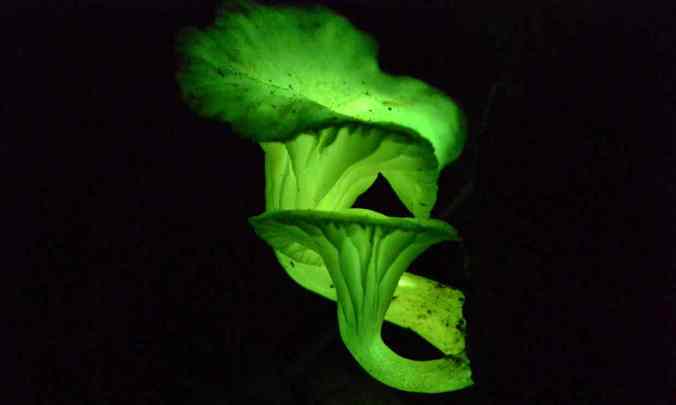
Fungal luciferin could eventually allow the creation of an autonomously luminescent plant. Photograph: Cassius Stevani at the San Paulo University in Brazil
Bioluminescence has appeared in these pages so many times that people probably wonder why. The answer would be because we have contributors who see its wonder of the world quality as directly relevant to our communications mission.
And there was a time when stories about fungi, mushrooms, etc. were the domain of one key contributor. We used to leave stories like this one to our resident mycoenthusiast Milo, but he is no longer in residence with us; instead, busy now setting up a permaculture organic farm in the rolling hills to the west of Ithaca, NY (USA). So, for lack of a better post-person, this recommendation is from the team:
How research into glowing fungi could lead to trees lighting our streets
Bioluminescence, the peculiar ability of some organisms to behave like living night-lights, could be the key to some remarkable advances
On a moonless night deep in a Brazilian rainforest the only thing you are likely to see are the tiny smears of light from flitting fireflies or the ghostly glow of mushrooms scattered around the forest floor. Both effects are the result of bioluminescence, the peculiar ability of some organisms to behave like living night-lights. Continue reading

The dark spots stained blue are placodes, which develop into scales, feathers and hair. The animals from left to right are a mouse, snake, chicken and crocodile. Credit Nicolas Di-Poï, Michel C. Milinkovitch and Athanasia Tzika
For some time now it’s been known that hair and feathers share a root, but the link between scales and feathers was not so clear. New research published in Science Advances shows that all three growths do, in fact, share a common ancestor. Nicholas St. Fleur reports for the New York Times:
Reptiles have scales. Birds have feathers. Mammals have hair. How did we get them?
For a long time scientists thought the spikes, plumage and fur characteristic of these groups originated independently of each other. But a study published Friday suggests that they all evolved from a common ancestor some 320 million years ago.
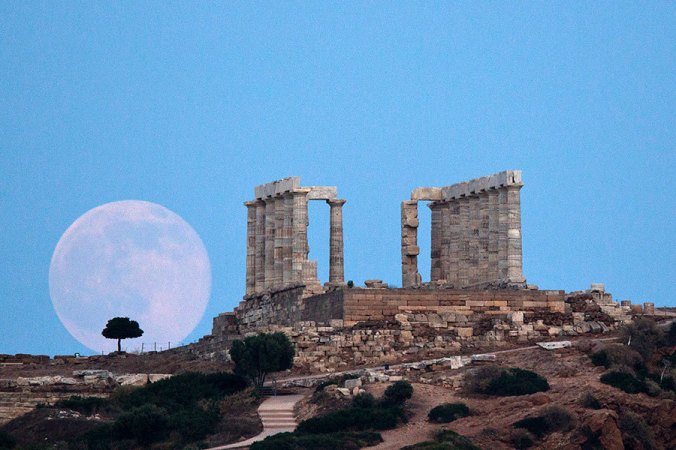
The full moon rises behind a tree next to the ancient marble Temple of Poseidon at Cape Sounion, southeast of Athens, on the eve of the summer solstice on Monday. The temple, built in 444 BC, was dedicated to Poseidon, god of the sea. Petros Giannakouris/AP
Thanks to the CS Monitor for bringing this image to our attention in their “Photos of the day” series, which are always worth a visit. The moon, we have been reading in the Monitor and various other news outlets, is a variety that occurs every 46 years. Wishing we might have seen it where Mr. Giannakouris saw it, but by the time we learned about this phenomenon it was already time for morning coffee in Kerala.

Map showing the largely artificial salinity of the Persian Gulf.
Desalination is clearly going to be a very important technology for the future, as our drinking water supply dwindles. Carbon capture/storage is also an imperative process to be working on in an effort to slow down global warming in any way possible. So the fact that a scientist at Qatar University is working on a process that takes pure CO2 waste from natural gas plants, waste brine from desalination plants, and ammonia, which all react chemically to create sodium bicarbonate (baking soda), calcium chloride (used as a preservative or tanning chemical), and ammonia (which can be recycled to continue the process). Erica Gies reports for Scientific American:
Farid Benyahia wants to solve two environmental problems at once: excess carbon dioxide in the atmosphere and excess salt in the Persian Gulf (aka the Arabian Gulf). Oil and natural gas drive the region’s booming economies—hence the excess CO2—and desalination supplies the vast majority of drinking water, a process that creates concentrated brine waste that is usually dumped back into the gulf.

Photo by Nadia Drake
If you’re a fan of James Bond films, then chances are you’ve seen the Arecibo Observatory in Puerto Rico on a screen at some point–it was the location for the climax of Goldeneye, where Pierce Brosnan debuted as the British spy character. The largest radio telescope in the world, and for several decades managed by Cornell University, Arecibo Observatory is now threatened with defunding in the coming year, but the community around it in Puerto Rico, as Nadia Drake (whose father once directed the Observatory) reports for NatGeo and Science Friday, is rallying around it:
SAN JUAN and ARECIBO, Puerto Rico — Francisco Cordova just started his job as director of Puerto Rico’s Arecibo Observatory, the world’s largest radio telescope. But at a public meeting on day two of his new post, he was already facing the iconic telescope’s potential demolition.
At meetings June 7 in San Juan and Arecibo, students, scientists, observatory staff and community members spoke about what would be lost in terms of science and education if the observatory were to close, an outcome that no one in attendance seemed to find acceptable in any way. As the world’s largest single-dish radio telescope, Arecibo is famous for searching for distant galaxies, gravitational waves, and signs of extraterrestrial life.

Photo by homeanddecor.com
Although the titles are similar, this post and the previous one from today are not about related subjects other than light and darkness. The lights referred to in this post’s title are artificial ones on land, not bioluminescence under the sea. Lights from houses and street lamps that distract moths from pollinating plants that need their pollen transported, and often result in moth deaths (by predation or getting trapped indoors). Sarah DeWeerdt reports for Conservation Magazine on a recent UK study on the disruption of pollination by light:
Everyone knows moths are attracted to light, but scientists are just now learning that this attraction may have negative consequences for other parts of the ecosystem. Moths drawn to artificial sources of light may do less work pollinating plants, according to research published last week in the journal Global Change Biology.
Researchers sampled moths at 40 sites along hedgerows bordering agricultural fields in Oxfordshire, England. Half of the study sites were lit with streetlights and half were not. Surprisingly, no one had previously investigated how this very common source of artificial lighting affects the behavior and ecological function of moths.
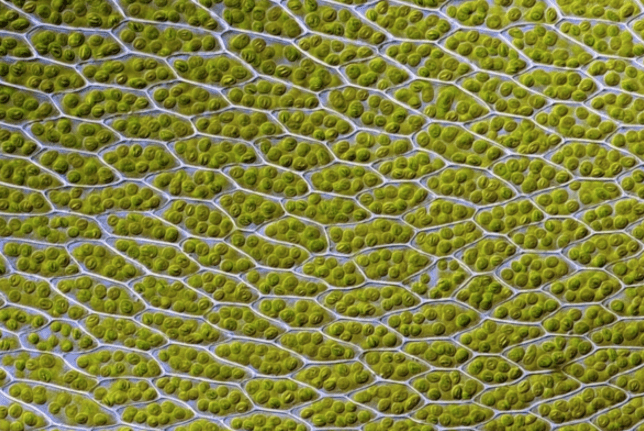
The device uses solar electricity from a photovoltaic panel to power the chemistry that splits water into oxygen and hydrogen, then adds pre-starved microbes to feed on the hydrogen and convert CO2 in the air into alcohol fuels. Credit: Des_Callaghan via Wikimedia Commons
Renewable energy is manifested in multiple forms, utilizing all the classical elements. All the better when innovation brings things full circle in this form of biomimicry.
A tree’s leaf, a blade of grass, a single algal cell: all make fuel from the simple combination of water, sunlight and carbon dioxide through the miracle of photosynthesis. Now scientists say they have replicated—and improved—that trick by combining chemistry and biology in a “bionic” leaf.
Chemist Daniel Nocera of Harvard University and his team joined forces with synthetic biologist Pamela Silver of Harvard Medical School and her team to craft a kind of living battery, which they call a bionic leaf for its melding of biology and technology. The device uses solar electricity from a photovoltaic panel to power the chemistry that splits water into oxygen and hydrogen, then adds pre-starved microbes to feed on the hydrogen and convert CO2 in the air into alcohol fuels. The team’s first artificial photosynthesis device appeared in 2015—pumping out 216 milligrams of alcohol fuel per liter of water—but the nickel-molybdenum-zinc catalyst that made its water-splitting chemistry possible had the unfortunate side effect of poisoning the microbes… Continue reading

These worms in Colorado’s Sulphur Cave are believed to live on the chemical energy in the sulfur in the cave, similar to deep-ocean tube worms. On the left are streamers—colonies of microorganisms similar to those in hot springs in Yellowstone National Park. PHOTOGRAPH BY NORMAN R. THOMPSON
We like the discovery of new species, and caves are cool too. And beneath Steamboat Springs in Colorado, USA, a cave full of noxious carbon dioxide and hydrogen sulfide gas has harbored a new species of worm, as well as weird bacteria formations called snottites. Erika Engelhaupt reports for NatGeo’s Phenomena blog:
Lurking below the quaint ski town of Steamboat Springs, Colorado, lies a cave belching deadly gases. Its ceiling is dotted with snottites, dangling blobs that look like thick mucus and drip sulfuric acid strong enough to burn holes through T-shirts. And the whole place is covered in slime.
So why would anyone want to go there?
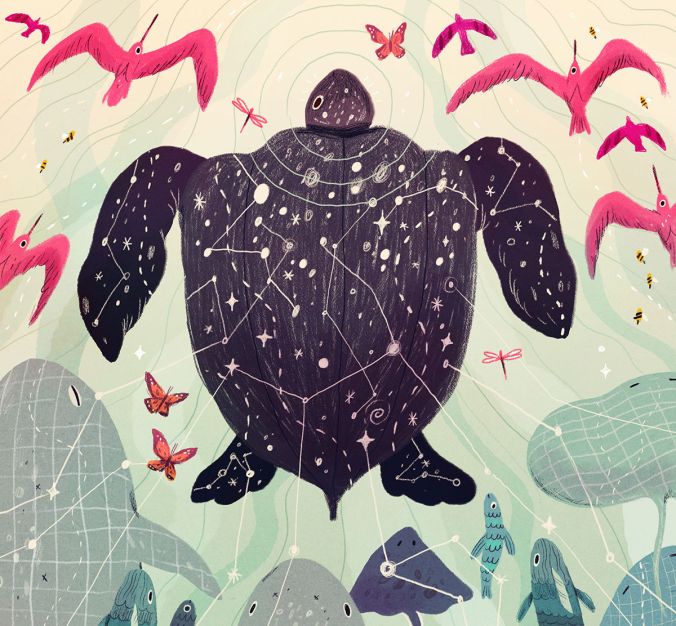
A huge variety of animals seem capable of reading Earth’s geomagnetic field. The question is how they do it. ILLUSTRATION BY NATALIE ANDREWSON
From the New Yorker website, the beginning of an answer to a question we ponder every so often:
HOW DO ANIMALS KEEP FROM GETTING LOST?
By M. R. O’Connor
Every three years, the Royal Institute of Navigation organizes a conference focussed solely on animals. This April, the event was held southwest of London, at Royal Holloway College, whose ornate Victorian-era campus has appeared in “Downton Abbey.” For several days, the world’s foremost animal-navigation researchers presented their data and findings in a small amphitheatre. Most of the talks dealt with magnetoreception—the ability to sense Earth’s weak but ever-present magnetic field—in organisms as varied as mice, salmon, pigeons, frogs, and cockroaches. This marked a change from previous years, Continue reading
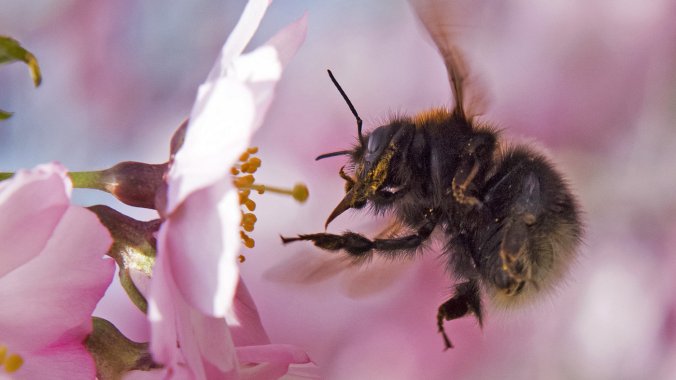
Scientists say bumblebees can sense flowers’ electric fields through the bees’ fuzzy hairs. Jens Meyer/AP
Thanks to National Public Radio (USA) for this small scale science lesson:
Bumblebees’ Little Hairs Can Sense Flowers’ Electric Fields
The fields bend the hairs and that generates a nerve signal, scientists say.
Flowers generate weak electric fields, and a new study shows that bumblebees can actually sense those electric fields using the tiny hairs on their fuzzy little bodies.
“The bumblebees can feel that hair bend and use that feeling to tell the difference between flowers,” says Gregory Sutton, a Royal Society University Research Fellow at the University of Bristol in the United Kingdom. Continue reading

Scientists at the University of Lund in Sweden have shown that dung beetles use mental “snapshots” of the Milky Way to navigate. E. Baird / Lund University
Thanks to National Public Radio (USA) for this story, which we link to even though we just recently linked back to some earlier stories on the same.
And speaking of NPR, one of the podcasts that originates on its New York City affiliate WNYC–Radio Lab, which was featured in some of our earliest posts–this episode featuring another beetle may have been the greatest of all time.
Dung Beetles Navigate Poop-Pile Getaways Using Celestial ‘Snapshots’
It’s not easy being a dung beetle.
Besides the obvious fact that they eat, well, dung, the act of just getting a meal is an involved process.
In the most elaborate carry-out scenario, the dung beetles must first stake claim to their piece of poop at the main dung pile, then shape it into a sphere for easy transport, fend off other dung beetles trying to steal it, and then — using the stars to navigate — determine the fastest way to roll their prize away to a safe spot for consumption. Continue reading
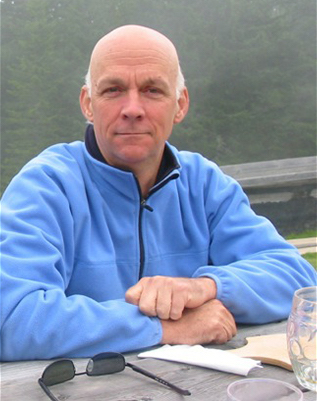
Photo courtesy of William Clark. William Clark, Harvey Brooks Professor of International Science, Public Policy, and Human Development at Harvard Kennedy School, has co-authored a new book on sustainability. “Achieving more equitable and sustainable use of the Earth requires a great deal of working together,” he said.
Thanks to the Harvard Gazette for this interview with William Clark:
Pursuing sustainability
A Q&A on connecting science and practice, balancing conservation with use
By Amanda Pearson, Weatherhead Center Communications
United Nations Secretary-General Ban Ki-moon on Friday will welcome 130 heads of state who have pledged to sign the Paris Agreement, the global agreement on managing climate change. For William Clark, Harvey Brooks Professor of International Science, Public Policy, and Human Development at Harvard Kennedy School (HKS), sustainability is a global imperative and a scientific challenge like no other.
Clark sees the Paris Agreement as just one step, though an important one, in this urgent pursuit, as officials wrestle with how to meet the needs of a growing human population without jeopardizing the planet for future generations. He and co-authors Pam Matson of Stanford University and Krister Andersson of the University of Colorado at Boulder tackle that issue in a new book, “Pursuing Sustainability: A Guide to the Science and Practice.” By looking at sustainability as a means of alleviating poverty and enhancing well-being, the book highlights the complex dynamics of social-environmental systems, and suggests how successful strategies can be shaped through collaborations among researchers and practitioners.
Clark, who trained as an ecologist, said that while exhausting Earth’s natural resources would jeopardize future generations, sustainability could counter that. The goal is to find a healthy equilibrium between human adaptation and natural evolution. Clark, the co-director of the Sustainability Science Program at HKS, spoke with the Weatherhead Center for International Affairs about building a more sustainable future. Continue reading
We are concerned, and therefore generally against, GMOs up to now. But we are not 100% sure and so welcome new information when it is available. The University of Washington’s magazine, Conservation, is back in full awesomeness as a public service:
Despite the controversy surrounding genetically modified crops, they can be an important tool for developing disease-resistant crops that can eliminate the use of pesticides and reduce crop losses. In a trio of papers published recently in Nature Biotechnology, researchers documented how new, faster methods of isolating genes—and looking in some unexpected places—led them to identify, clone, and transfer disease-resistant genes into soybean, wheat, and potato plants. Continue reading

Leonard Scinto, a researcher at Florida International University, standing beside a concrete post that measures the subsidence of soil in the Everglades Agricultural Area. In 1924, the top of the post was level with the ground surface. Dan Charles/NPR
Five minutes to listen to how your food greens, or does not green, our planet (thanks to National Public Radio, USA):
The Environmental Cost Of Growing Food
Let’s say you’re an environmentally motivated eater. You want your diet to do as little damage as possible to our planet’s forests and grasslands and wildlife.
But how do you decide which food is greener? Continue reading
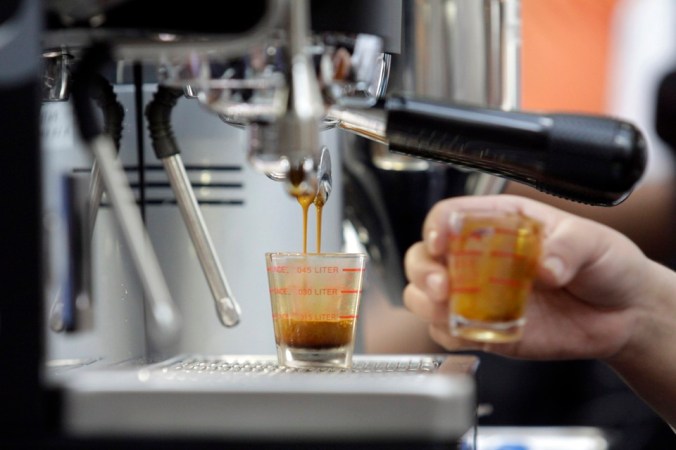
STR New / Reuters
From the Atlantic, where some of (but not all) our favorite coffee stories have come from in the past, we have this new item to share:
Specialty Coffee’s Resident Scientist
A computational chemist is changing the way coffee makers think about water.
by Sarah Kollmorgen
Wherever he goes, Christopher H. Hendon brings a homemade supply of powdery white chemicals. Made from coral-reef care sets, the little bottles and plastic bags may raise some TSA eyebrows, but they serve a perfectly innocent purpose. The substances comprise his personal water filtration titration kit.
“Who travels with this much white powder?” Hendon says with a laugh. His duffel currently contains several compounds including calcium chloride, magnesium sulfate, and potassium bicarbonate. These mixtures help detect the invisible chemicals present in a glass of water, he explains. Using them, Hendon can determine how hard the water is in any geographical area, based on the minerals it contains. Continue reading

Climbers, including a master instructor, made their way up Grandfather, an 800-year-old, 200-foot-tall redwood near Los Gatos, Calif., last month. Credit Steve Lillegren
A topic we have been coming back to on a regular basis for years–the value of biodiversity in general (we are not averse to stating the obvious in these funny times we live in) and in particular the as-yet still to be explored forest treetops–appears in the Science section of this week’s New York Times. Apart from reminding us of a tree-inclined scientific friend (Meg, of treetop science fame, we have just recently learned you are now out in the vicinity of these redwoods, and so we shout this one out to you!), and reminding us of one of the great long-form pieces of journalism on the same topic, it is worth a read:

Corvid Behaviors poster by the Cornell Lab of Ornithology
“Meet the Bird Braniacs,” reads the header for three stories in the March-April issue of Audubon Magazine, highlighting the American Crow, Eurasian Jay, and Common Raven as especially smart species of bird (the three of them are Corvids, or members of the Corvidae family). In the different research projects covered in the Audubon pieces, the idea of empathy in birds is explored by Nicky Clayton at Cambridge University with Eurasian Jays; the problem of deterring Common Ravens from predating upon desert tortoises is a challenge for Tim Shields in the Mojave desert; and the general intelligence of the American Crow is studied by John Marzluff at the University of Washington. All the articles are quite interesting and worth a read online if you have the time. Below, a brief excerpt from the three essays, by Michael Balter, Alisa Opar, and Kat McGowan, respectively:
“I love you!” says Nicky. “I love you!”
“I love you!” says Lisbon.Nicky Clayton has shoulder-length blonde hair and a posture that reflects her background in dancing. She is a scientist. She is very smart. Lisbon is a bird, a Eurasian Jay. He’s pretty smart, too. Like most Eurasian Jays, especially the males, Lisbon is also a good mimic. So it’s not clear whether he really loves Nicky, although he certainly likes it when she gives him a worm.
If he loves anyone, it’s probably Rome, his longtime mate. Lisbon and Rome, both eight years old, have been together since they were just two. They share a wired enclosure out here at the edge of Madingley, a peaceful, manicured English village a few miles west of Cambridge.
Clayton, 53, moved to Cambridge University about 16 years ago, around the time when she was becoming an international science superstar for her investigations into avian intelligence. As part of the deal, the university agreed to construct several aviaries at its Madingley annex according to Clayton’s specifications. They’re not fancy, but the birdcages include plenty of space for the captives to fly around, play, and mate, as well as special compartments where they collaborate with Clayton in state-of-the-art bird cognition experiments. Today the aviaries house about 70 birds, including Eurasian Jays, Western Scrub-Jays, and Rooks, all members of the corvid family. At night, the caws and kuks can be heard over much of the village.

 Organikos