More Reasons To Spend Some Time In Mozambique

This pygmy chameleon is one of many such unique and new species discovered in the Mount Mabu forest of Mozambique. Photograph: Kew Gardens/Julian Bayliss

This pygmy chameleon is one of many such unique and new species discovered in the Mount Mabu forest of Mozambique. Photograph: Kew Gardens/Julian Bayliss

Bob Dylan, in 1976, released a song called Mozambique. It does not mention biodiversity as one of the reasons to visit the country, but it is better written than the following headline (something has happened to the Guardian‘s Environment section in recent months):

Protect the Mozambique forest found on Google Earth, scientists say

Mount Mabu rainforest teeming with new and unique species including pygmy chameleons and bronze-colour snakes

We will leave it to the grammar police and philosophers to parse those two sentences (commercial software should not be the focus of a headline justifying conservation; and these are certainly not new species but newly discovered); nonetheless we recommend reading the excellent information about this ecosystem: Continue reading
Adding Some Interesting Facts To The Conversation

  If we do have more conversation in 2014 and beyond, it will definitely be improved with the science writers we have been following the last few years, and the successors who follow in their footsteps. For example, we appreciate Virginia Hughes and the kind of writing that she publishes all over the place, and which National Geographic‘s Phenomena website collects under the name Only Human, with this most recent example here:

An Old and Optimistic Take On Old Age

I’ve been reading and thinking a lot lately about the process of aging. Many scientists who study it argue — quite convincingly — that it’s the most important scientific topic of our time. In his 1997 bestseller Time of Our Lives, biological gerontologist Tom Kirkwood writes that the science of human aging is “one of the last great mysteries  Continue reading

More Conversation Is More Interesting In More Languages

“It’s on the left,” he says. “No, it’s southeast of here,” she says. iStockphoto

If we are going to engage in more conversation in 2014 and beyond, we all would do well to do so with as much perspective as possible, wherever we are. This reporting on scientific findings about bilingualism is particularly interesting for those of us in India, where most of our colleagues speak a minimum of two but often three or four distinct languages:

Lera Boroditsky once did a simple experiment: She asked people to close their eyes and point southeast. A room of distinguished professors in the U.S. pointed in almost every possible direction, whereas 5-year-old Australian aboriginal girls always got it right.

She says the difference lies in language. Boroditsky, an associate professor of cognitive science at the University of California, San Diego, says the Australian aboriginal language doesn’t use words like left or right. It uses compass points, so they say things like “that girl to the east of you is my sister.” Continue reading

Journeys, Science, Souvenirs, Photographs

A GLORIOUS ENTERPRISE. Photographs from a book of Philadelphia’s Academy of Natural Sciences’ collection depict the making of American science. Cleared and stained specimens of youg horse-eye jacks (Caranx latus) from Dominican Republic, Santo Domingo. ANSP Ichthyology Department. This is a species that was first described by Academy member Louis Agassiz (1807-1873) in 1831. Photography by Rosamond Purcell

Click on the image above to go to the Audubon Magazine website, where a review of the photographs in this book, A Glorious Enterprise, was published.  Just realizing that, for a blog that features birds every day, we do not link to stories in the best magazine in the world for bird lovers, we aim to correct this.  First, credit where due. The photographer Rosamond Purcell, whose work accompanies the text in a book that sounds worthy of accompanying a long journey, has more work featured in an article currently on National Geographic’s website:

Walter looks comfortable. Dead for 50 years, the giant Pacific octopus is resting in a ten-gallon tank of ethanol solution, six-foot arms folded in cephalopod repose. His next-door neighbors hail from the Atlantic: a jarred colony of sea squirts, their blue-green bioluminescence long extinguished. Corals and algae bloom on a shelf. Leis of Tahitian snails dangle from hooks. Pearly shelled mussels from the Mississippi River, source of a once profitable button industry, glisten under glass. Continue reading

Self-Sufficiency Taken To The Outer Extremes

Before the lights go out on the last New Yorker issue of 2013, one more of several articles we found worth the read, and relevant to our common themes of interest–community-building, innovation, environmentalism, farming, etc.–on this blog, even if we tend to incremental change rather than the radicalism on display here:

Marcin Jakubowski, the owner of a small farm in northwestern Missouri, is an agrarian romantic for high-tech times. A forty-one-year-old Polish-American, he has spent the past five years building industrial machines from scratch, in a demonstration of radical self-sufficiency that he intends as a model for human society everywhere. He believes that freedom and prosperity lie within the reach of anyone willing to return to the land and make the tools necessary to erect civilization on top of it. His project, the Global Village Construction Set, has attracted a following, but among the obstacles he has faced is a dearth of skilled acolytes: the people who show up at his farm typically display more enthusiasm for his ideas than expertise with a lathe or a band saw. Continue reading

Gift-Giving Across Species

David Plunkert …Gift-giving has been seen in spiders, birds, mammals and the land snail, which shoots darts at its intended.

If you think humans are unique as gift-givers, think again, and read Natalie Angier’s current article in The New York Times:

…The drive to exchange presents is ancient, transcultural and by no means limited to Homo sapiens. Researchers have found striking examples of gift-giving across the phyletic landscape, in insects, spiders, mollusks, birds and mammals. Many of these donations fall under the rubric of nuptial gifts, items or services offered up during the elaborate haggle of animal courtship to Continue reading

Opposable Thumbs Are Great, But What About Flexible Memory?

Robert Krulwich/NPR

Robert Krulwich makes us wonder, as always:

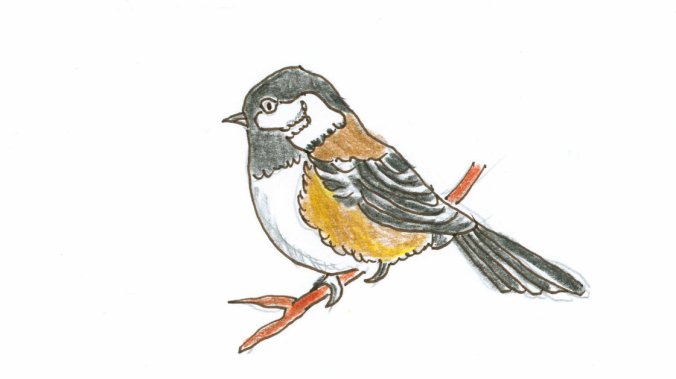
What Chickadees Have That I Want. Badly

First I look in my right coat pocket. Nothing. Then my left. Nothing. Then my pants, right side — no. Then my pants, left side — yes! This is me at my front door, looking for my keys. Every day.

Continue reading

Cooperation And Exploitation In Bird Communities


In a story about the co-evolution of two sides of the “kindness of strangers” coin Ed Yong, one of the most readable of the current pantheon of great science writers shares some scientific findings that we consider to be heartening:

The common cuckoo is famed for its knack for mooching off the parental instincts of other birds. It lays its eggs in the nests of at least 100 other species, turning them into inadvertent foster parents for its greedy chicks. For this reason, it’s called a brood parasite. Continue reading

Experiments In Plant Intelligence

The article we linked to here is now unlocked so non-subscribers can access the full story, and the video currently posted on the New Yorker‘s website (click the image above to go to the source) is a good accompaniment:


Last week, in our World Changers Issue, Michael Pollan wrote about the growing field of plant neurobiology and the ways that plants seem to exhibit intelligence, intention, and even choice. Continue reading

Radical Interpretation Of Plants’ Secret Lives

When he goes out on a limb he invites others to join him, and like any journalist worth his salt he keeps pushing further out onto the limb. The venues in which he publishes deserve credit for having faith in readers willing to get out onto that limb:

In 1973, a book claiming that plants were sentient beings that feel emotions, prefer classical music to rock and roll, and can respond to the unspoken thoughts of humans hundreds of miles away landed on the New YorkTimes best-seller list for nonfiction. “The Secret Life of Plants,” by Peter Tompkins and Christopher Bird, presented a beguiling mashup  Continue reading

Geology And The Natural History Of The Environment’s Future

Here is the second installment in a series on natural/environmental history from the perspective of what is referred to here as human impact and the geology of the future. The author requires you to work, but it is important work, worthy of the effort to focus the lens of history for the sake of our decisions about the future:

The Geological Society of London, known to its members as the Geol Soc (pronounced “gee-ahl sock”), was founded in 1807, over dinner in a Covent Garden tavern. Geology was at that point a brand-new science, a circumstance reflected in the society’s goals, which were to stimulate “zeal” for the discipline and to induce participants “to adopt one nomenclature.” There followed long, often spirited debates on matters such as where to fix the borders of the Devonian period. “Though I don’t much care for geology,” one visitor to the society’s early meetings noted, “I do like to see the fellows fight.” Continue reading

Controlling The Appetite To Feed

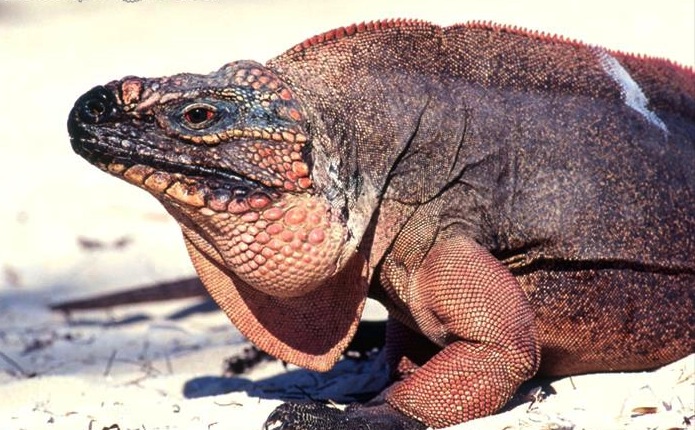
Bahamian Rock Iguana (click image to go to source)

Bahamian Rock Iguana (click image to go to photo’s source)

In its Conservation This Week feature, Conservation Magazine (last week) carried the following, which we hope gets plenty of circulation (we wish it was not even necessary to say so, but wishful thinking is not sufficient):

TOURISTS: STOP FEEDING JUNK FOOD TO IGUANAS

December 6, 2013

On islands in the Bahamas, tourists routinely feed iguanas grapes, cereal, ground beef, and even potato chips. This unnatural diet could be affecting the health of these endangered reptiles, researchers warn in Conservation Physiology. Continue reading

Science-Education-Technology Convergence


Museums and libraries are the stewards of culture in many ways. They both offer us a place to go for quiet contemplation as well as dynamic discovery. Kudos to the Smithsonian for accepting new technologies with open arms and sharing it with their researchers, curators, educators and conservators, and thereby with us.

Continue reading

Dear Dr. Rodrigues, Thank You From The Western Ghats

The research of Dr. Ana Rodrigues and her colleagues, much appreciated by our team here in the Western Ghats (no hard feelings, of course, that Colombia has a hotspot considered greater in terms of irreplaceability), is featured in a story in today’s Guardian

…”This beautiful mountain, which is not far from cities and towns, is being colonised by rich people building second homes,” said Dr Ana Rodrigues, a researcher at the CEFE-CNRS institute in France, who led the new study. The team’s analysis of the world’s 173,000 nature reserves identified 138 that were “exceptionally irreplaceable.”

Continue reading

Understanding Food More, Better

This slideshow requires JavaScript.

Speaking of food transparency, if you have not yet watched any of the lectures, you are missing an amazing opportunity to learn about the science of food from some of the greatest chefs of our time, in one of the great institutions of higher education. Click here to see this article at its source, and/or click the link below to visit the website where the course’s recordings of lectures by visiting guest chefs, including this one, are made available:

When Joanne Chang ’91 was approached by a cable TV network in 2006 to host a show about the science of sweets, she was thrilled. The owner of the landmark Flour Bakery and graduate of Harvard College, where she was an applied mathematics concentrator, Chang always enjoys discussing her pastries, but she loves talking about them at the molecular level best.

Continue reading

The Newest, Dismalest Branch Of Science

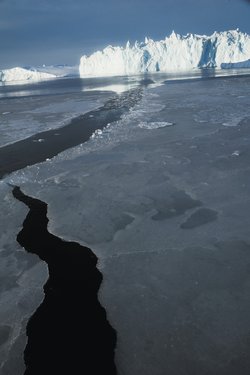
Stanley Greene/NOOR/Redux Greenland, photographed from a boat navigating the melt where dog sleds used to travel across the ice, October 2009

Stanley Greene/NOOR/Redux
Greenland, photographed from a boat navigating the melt where dog sleds used to travel across the ice, October 2009

We prefer the news about solutions to challenging problems. Preferably positive news. Preferably innovations that invoke smiles. Sometimes, dismal is the only way to move forward. Thanks to the New York Review of Books, and Paul Krugman for this review:

Forty years ago a brilliant young Yale economist named William Nordhaus published a landmark paper, “The Allocation of Energy Resources,” that opened new frontiers in economic analysis.1 Nordhaus argued that to think clearly about the economics of exhaustible resources like oil and coal, it was necessary to look far into the future, to assess their value as they become more scarce—and that this look into the future necessarily involved considering not just available resources and expected future economic growth, but likely future technologies as well. Moreover, he developed a method for incorporating all of this information—resource estimates, long-run economic forecasts, and engineers’ best guesses about the costs of future technologies—into a quantitative model of energy prices over the long term. Continue reading

Paleo-ethical Questions

young-tyrannosaur-990x664

Scientists, like all others, are faced with puzzling  ethical questions from time to time. Questions where there is no right or wrong answer, but for which “do the right thing” is the imperative. We like to think we know exactly how we would answer such a question, but sometimes the questions (or answers) are dark grey or light grey rather than black and/or white, as various characters referred to in this blog post make clear (click the image above to go to the original post):

On November 19th, science may lose a pair of dinosaurs. Preserved next to each other – and given the dramatic title the “Dueling Dinosaurs” – the tyrannosaur and ceratopsid are going up for auction at Bonham’s in New York City. The two are expected to rake in around nine million dollars, with no guarantee that the fossils will go to a museum or that their beautiful bones will even have the chance to be rigorously studied by scientists. That’s exactly why paleontologists were aghast when the auction block tyrannosaur made an appearance at the Society of Vertebrate Paleontology annual meeting yesterday afternoon. Continue reading

Ants, Wasps And That Nagging Question

Mr. Zimmer’s the one to finally comment on the suspicious similarities between ants and wasps, in blurb form here and in full form linked below to his New York Times column:

Growing up on a small farm, I was able to get to know the insects that lived on the property pretty well. Some I liked, and some I hated. Continue reading

If You Happen To Be In Sydney

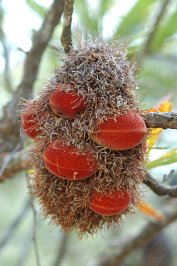
Fruit of Banksia aemula

Fruit of Banksia aemula

Tomorrow, at long last, the latest greatest seed bank in the world is opening:

The Australian PlantBank

The Australian PlantBank is a science and research facility of the Royal Botanic Gardens and Domain Trust and is located at the Australian Botanic Garden, Mount Annan. It houses the Trust’s seedbank and research laboratories that specialise in horticultural research and conservation of Australian native plant species, particularly those from New South Wales.

Visiting PlantBank

The Australian PlantBank opens to the public on Saturday 12 October, 12 noon to 4 pm.

Continue reading