Field of Dreams

Walter De Maria, The Lightning Field, 1977. © The Estate of Walter De Maria. Photo: John Cliett

Walter De Maria, The Lightning Field, 1977. © The Estate of Walter De Maria. Photo: John Cliett

Based on his oeuvre one would say that Walter De Maria is an artist fascinated by mathematical precision and order. His work at Gagosian Gallery in New York City or The Nelson-Atkins Museum of Art in Kansas City in the United States or even the Chichu Art Museum in Naoshima, Japan exemplify this focus on the predictable progression of sunlight as it relates to planetary rotation and the perfection of spheres.

Continue reading

A Worldly Point of View

Emory’s Language Lab

Diversity in American universities is on the rise: just a little under a quarter (23%) of Harvard’s undergraduate enrollment consists of international students. At Columbia University, over a quarter (26%) of the university’s enrollment are international students. The story is the same at other top schools around the nation. UCLA, Boston University, Cornell and NYU all boast international student levels at around 15%. Here at Emory, the picture is roughly the same. Most of these international students in American universities hail from Asian countries, but there is plenty of exchange from Europe, Africa, the Middle East, and other parts of the world as well.

At Emory, many international students specifically come from China, India, South Korea, and Japan. Having spoken to these foreign exchange students, it is clear that international admissions to a top-20 American university are incredibly competitive, even more so than they are here. One friend told me that he was the only student from his entire town (a suburb of Calcutta, so quite a lot of competition) to attend a top-30 American school; even with his extremely impressive credentials Continue reading

Mystical India, In Practical Terms

There have already been plenty of posts on this site that give the perspective of non-Indians living in or visiting India.  Here is another good example of an Indian describing a local feature of life that, to the non-Indian, is more of a phenomenon.  And so the style of delivery, while quite different from that of this man, is equally intriguing (fair warning: the accent is stronger here, but you can train your ear to understand)–both men talking about old stuff, rather genially and humbly, but clearly aware that they are sharing with the world something of value that might have been overlooked because it has been hiding in plain sight for so long.

The style of delivery, in fact, is as interesting as the content itself, if you are a non-Indian trying to figure out what makes the place called India so worthy of attention.  It is not what Robert Hughes called the Shock of the New, translated from art to service or organization; it is another example of the Shock of the Old.  And the style of delivery reinforces just that.

The joking self-effacement–no Silicon Valley-type innovation or technology, but we get by in our own way–belies an organizational philosophy made tangible that would be the envy of many organizations around the world.

The Wind Lens

After the earthquake in Japan earlier this year, critics of nuclear energy are clamoring for the retreat to the ‘safe’ and ‘reliable’ fossil fuels so commonplace of this age – the fossil fuels which are rapidly depleting due to the glut and the delusion of surplus of today’s culture. Not enough critics of the world’s energy policies are on what we at Raxa Collective consider to be the ‘right side’ of the argument – the one keeping the environment clean and safe. Nuclear energy is perhaps cleaner than burning fossil fuels for electricity, but even the slim chances of a catastrophe like Japan’s are enough to sell the public back to the gas-guzzling camp. But who is fighting for the third choice? The safe, the clean, the green – wind and solar power, the still-in-development responsible option

for civic-minded citizens wanting to lower their carbon footprint.
As explained in the link above, Japan’s Kyushu University is currently researching the most efficient form of harnessing wind power, and is developing a simple and cost-effective solution to the problems posed by the widely used ‘tri-blade” wind turbines of today. The main issue at hand is that the common turbine’s blades are too heavy (which is the case because lightweight materials are too weak), and more wind energy is necessary to spin the turbine, producing less energy than the potential. Kyushu University’s solution? The Wind Lens – a simple but ingenious addition to either existing or modified turbine designs which can double (or even triple) the energy output of the devices. The mechanism, in essence a ring around the turbine’s blades, acts in respect to wind much the same way a magnifying glass does to light – it takes the existing wind power, and thanks to the physics of pressure, concentrates the energy in such a way that the wind is forced through the tunnel at a significantly increased speed, resulting in a great increase in energy output. Environmentalists, intellectuals, and a few key organizations. Also, the Japanese.  Continue reading

Green House Redefined

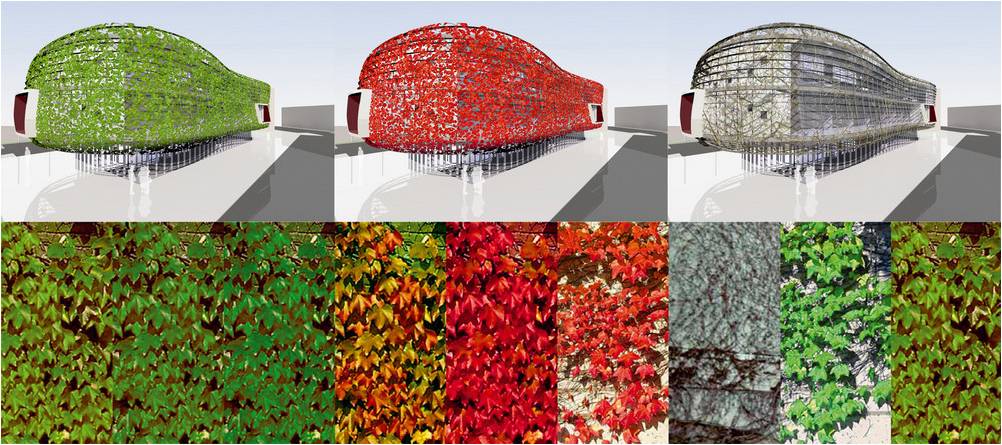
Use of natural light, passive and active energy saving systems, relative position to the sun, air flow, leaf moistened air….

This doesn’t sound like “business as usual” for a municipal building. But the Noain City Hall in Navarre, Spain designed by Award winning Zon-e Arquitectos stems  logically from the fact that the region leads Europe in its use of renewable energy technology.  Continue reading

Solar on the High Seas

There was a time when all seafaring vessels used renewable energy sources…they moved either by manpower or wind power, or a combination of the two. The Industrial Revolution changed that and the steam engine, powered by coal or wood, pushed ships out of carbon neutrality.

In March, 2010 I had the privilege to experience the Vela Sud America, a Bicentennial Regatta of tall ships commemorating the creation of the independent South and Latin America, as they passed through the Straits of Magellan near Punta Arenas, Chile on their way up the west coast of South America. The weather hadn’t yet turned very cold (it was nearing winter in the southern hemisphere) and it was a bright sunny day.

Coincidentally today, September 15th, is Independence Day in all 5 countries of Central America–Feliz Día de la Independencia! Continue reading

What Goes Around, Comes Around

Despite the fact that this post makes me look like a “one trick pony” I have to share yet another recycling innovation that involves, well, you know…

The Canadian company Knowaste has opened several facilities in the U.K. that are making a significant dent in the nearly 800,000 tons of disposable nappies and other “absorbent hygiene product” waste that would normally go directly to landfills annually.

The company has pioneered a system that, after heat sterilization, converts the plastics in the products into items such as roof shingles and plastic tubing, with the waste from that processing used to generate heat and power for the plant itself. Continue reading

Beta-Think Is Better

Jeff Jarvis has this to say in a post combining the topics Beta-Think and End Malaria Day:

The modern cure to Voltaire’s paradox [“Le mieux est l’ennemi du bien,” or “the best is the enemy of the good”]—and a gift of the digital age—is the beta: the unfinished and imperfect product or process that is opened up so customers can offer advice and improvements.

Those of us who have worked in bricks and mortar environments, especially hospitality businesses, might wonder: did he never hear of a “soft opening” before?  Those have been around since long before the digital age.  But he likely means, and we agree, that digital and especially social media facilitate more effective soft openings of all kinds, everywhere.