Earth’s Eye

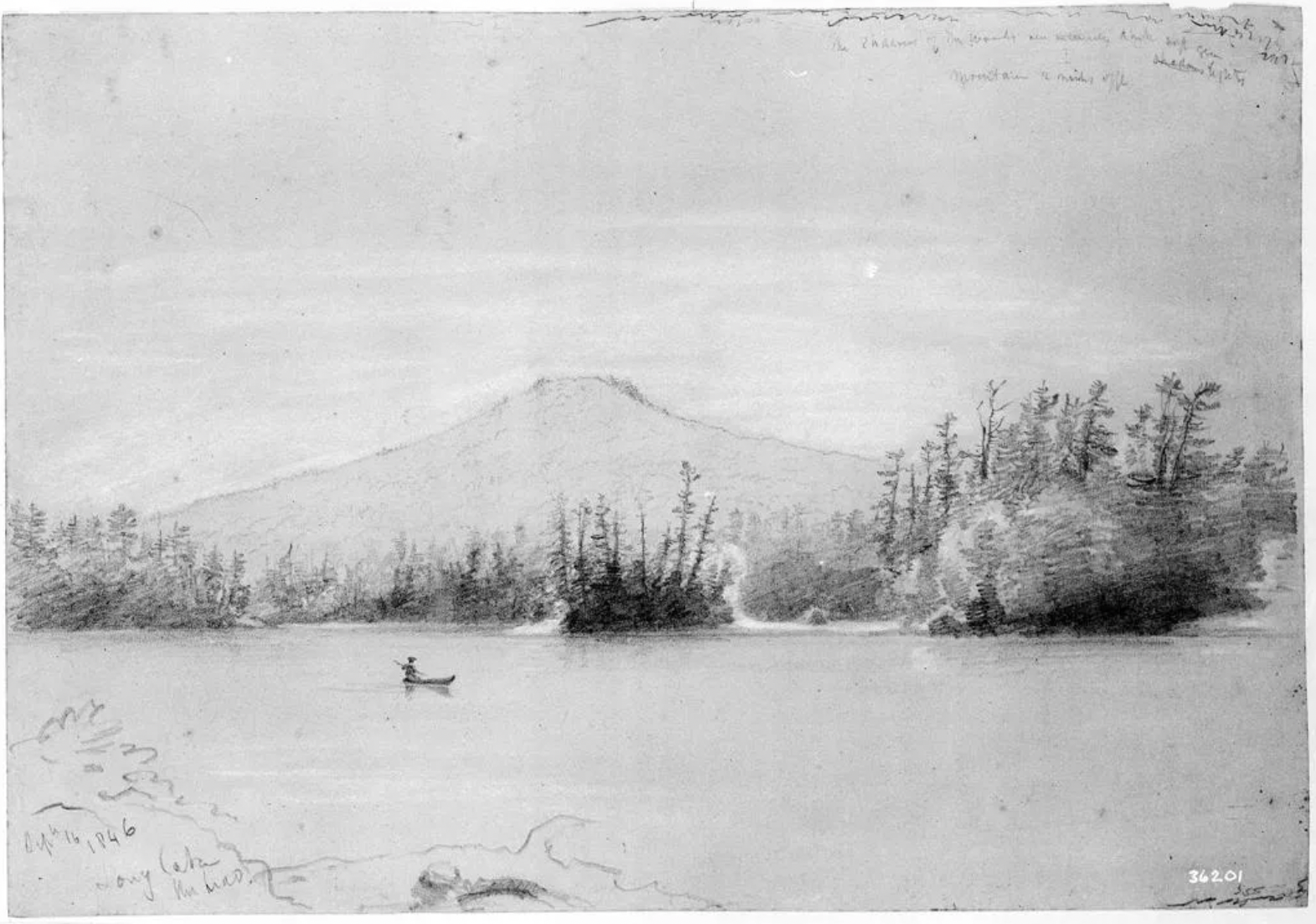
Thomas Cole’s Long Lake Sketch 1846

“Nothing so fair, so pure, and at the same time so large, as a lake, perchance, lies on the surface of the earth. Sky water. It needs no fence. Nations come and go without defiling it. It is a mirror which no stone can crack, whose quicksilver will never wear off, whose gilding Nature continually repairs; no storms, no dust, can dim its surface ever fresh; a mirror in which all impurity presented to it sinks, swept and dusted by the sun’s hazy brush—this the light dust-cloth—which retains no breath that is breathed on it, but sends its own to float as clouds high above its surface, and be reflected in its bosom still.” — Henry David Thoreau, Walden p177
Thoreau’s description of Walden and other lakes in New England came to mind this weekend as I was canoeing and swimming with friends across Lake Cayuga, Ithaca’s own majestic mirror (albeit a crinklier one than Walden, given our weather). Continue reading

Live an Example

Lullwater at Emory

Do you respect your friends? Unless you have very strange relationships, I’m guessing you can say that your friends’ ideals and opinions are meaningful to you. If you know that a buddy doesn’t enjoy country music, you’re probably not going to blast Keith Urban when he’s around. If your best friend can’t stand whistling, maybe you’ll refrain from providing your most rousing rendition of the Star Wars theme song. If she’s not so into politics, perhaps that’s not the person you’ll run to and inform of Glenn Beck’s latest revelation.

The point is, what matters to your friends usually matters to you, and vice versa. If you’re mindful of this Continue reading

Still In Motion

There is something fascinating to me about images that depict stationary objects while also imparting a sense of rapid motion. Night-shots of city streets with cars trailing lights are tricky, difficult to stage, and unnatural, yet still beautiful. Finding natural scenes depicting motion while the environment stands still is difficult, but a reliable source of endless photographs is the waterfall. Whether a mega-million gallon monolith or a trickling stream tickling down the side of a wall, the endless motion of a waterfall starkly contrasts against the backdrop, and the patterns which are the result of the water’s movement over a period of time can often be breathtaking.


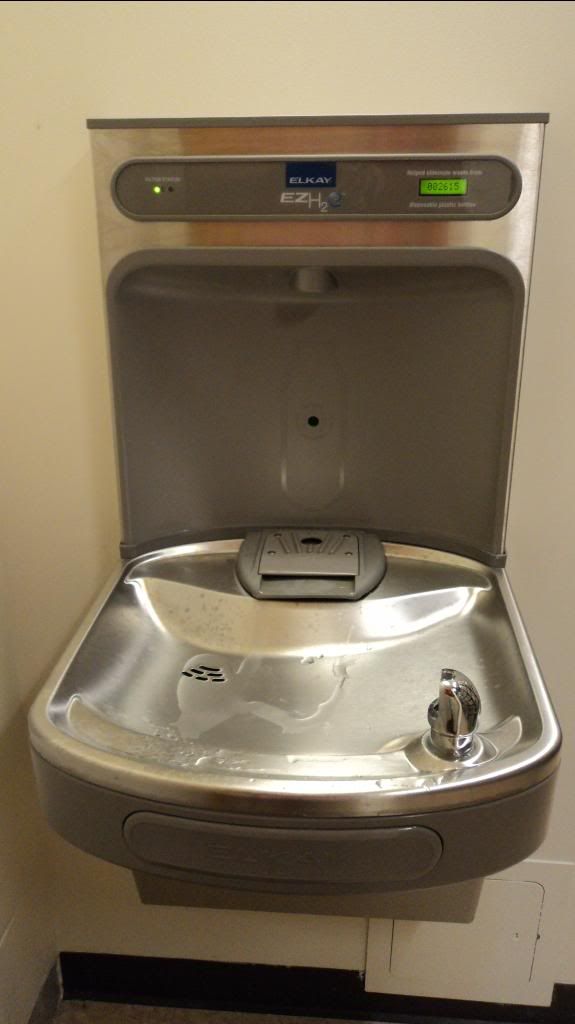
EZ Water Fountain

From the side the water fountain looks like most others: a spigot shoots arcs of water from a corner when you press a button somewhere. But when you face the EZH2O water station — a bottle-filling station — you see that the spigot in the corner is not the only mechanism on the wall.

I’ve been carrying around aluminum or hard plastic bottles for years, and am always annoyed when I have to replenish from a water fountain that doesn’t shoot water in a high enough arc so that my bottle can fill to the brim. With the EZH2O, all you have to do is place a bottle in front of the motion sensor in the back panel, or simply stand it on the grey plastic platform, and water will come down in a straight and soft stream.

As your bottle fills, a little meter in the top corner of the panel tallies how many plastic bottles have been saved by using reusable bottles. Also, the bottle filling station has a WaterSentry filter (and a light in the top right corner that shows when it needs to be replaced). So far, I have only seen these in Cornell’s Olin Library, both in the stacks and the basement. Hopefully they will spread to every building at Cornell.

Water Harvesting & Accumulated Wisdom

As Gourvjit pointed out in an early post, Cardamom County is in the process of revamping its water management systems.  The search is still on for learning resources.  Besides an accent and wit that are mesmerizing, this man’s stories and visual accompaniments are stunning.  Learning is sometimes a simple matter of respecting elders.  Especially those who are so at ease on a stage as big as this one.

Water + Sunlight = Electricity?

Plants are typically regarded as the most efficient energy producers of the biological world, and I myself have imagined the possibility of harnessing their photosynthetic capabilities to generate sustainable energy. In my daydreaming, I visualized the biochemical transfer of a leaf’s photosynthetic output, adenosine triphosphate (ATP), down the plant’s stem and into a battery via some half-baked imaginary electrical conversion process. A possibility I had never before considered was that scientists were not focused on using the biological resources available to them, but rather mimicking and improving the processes carried out by their biological models. This recent development (late March, 2011) is described by Discover Magazine:

Scientists say that they’ve passed a chemistry milestone by creating the world’s first practical photosynthesis device. The playing-card-sized photosynthetic gadget uses sunlight to split water molecules into oxygen and hydrogen, which can then be used to produce energy, and is reputedly 10 times more efficient than a natural leaf. Researchers say they expect it to revolutionize power storage, especially in remote areas that don’t currently have electricity. “A practical artificial leaf has been one of the Holy Grails of science for decades,” says lead researcher Daniel Nocera, who’s presenting this research at the National Meeting of the American Chemical Society this week.

Full story here.