Al Fresco Meals Across Time and Space

This slideshow requires JavaScript.

Long after humans made living indoors commonplace we still carry the strong desire to commune with nature in one way or another. Whether through gardening or exploration, we crave being outdoors, and that often has meant bringing our meals with us.

The origin of the word “picnic” is unclear. It first appeared in an English dictionary in 1748, and it probably derived from the French pique-nique.

A 17th-century French pique-nique may have been what we now think of as a potluck. In the 18th century, its American counterpart may have been more like a salon gathering. By the 19th century, though, it had become common for Americans to hold these events outside. Continue reading

Ichnology, Xandari-Style

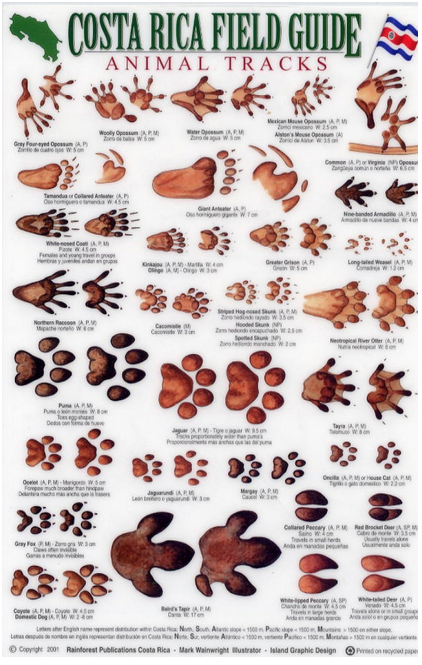
Ichnology is the study of animal traces—commonly tracks, but also anything else that organisms leave behind in their activities (for example, burrows, nests, scat, feeding remnants, or territory markers). It is often far easier to discover an animal’s presence through tracks than direct visual sighting, especially for shy or nocturnal mammals. “An animal can only be in one place at a time, its tracks can be everywhere,” one of my environmental science professors sometimes remarked in support of this principle. Indeed, around Emory’s campus (Atlanta, Georgia) I found tracks on stream banks that belonged to animals I had never actually clapped eyes on in the flesh. Prized among those were a  Continue reading

Landscape Restoration

Tianjin-225x132

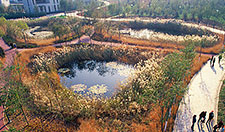
Turenscape Qiaoyuan Wetland Park in Tianjin, China, has terraced ponds that incorporate designed experiments to monitor benefits.

We watch for stories about innovative approaches to fixing things in the natural environment, wherever those stories may be found.

And whatever name they may be given.

Thanks to Yale360 for their ongoing attention, including this recent article:

Rebuilding the Natural World: A Shift in Ecological Restoration

From forests in Queens to wetlands in China, planners and scientists are promoting a new approach that incorporates experiments into landscape restoration projects to determine what works to the long-term benefit of nature and what does not.

by Richard Conniff Continue reading

Terrible Trade

Photo © Matt Reinbold

Photo © Matt Reinbold

Thanks to Miles Becker for this summary of an article that touches on a theme we have highlighted in the past–sourced from Bush, E.R. et al. 2014. Global trade in exotic pets 2006-2012. Conservation Biology doi: 10.1111/cobi.12240— at Conservation Magazine‘s website:

Pet stores are filled with colorful critters originating from the wilds of other continents. All the cages and terrariums stay well stocked while many prized species decline in their native habitat. Does the global fascination with exotic pet species hasten their extinction?

One way to find out is to compare the list of traded species with a list of species in trouble. The Convention on International Trade in Endangered Species (CITES) maintains records of reported legal exports from its 180 member countries. The conservation status of species are listed on the red list curated by the International Union for Conservation of Nature and Natural Resources (IUCN). Both datasets were analyzed by conservation biologists for a seven-year period of international trade in bird, reptile, and mammal species. Continue reading

Mind-Bending Race

This slideshow requires JavaScript.

A friend who lives in Costa Rica left a few weeks ago for a visit to Alaska. We did not learn until after he was already there what it was he planned to do there during the deepest depth of winter. We knew he was serious about endurance racing. We also believed that we knew something about expedition races, both in terms of adventure and endurance.  A post on the New Yorker‘s website, about the results of this year’s Iditarod, reminded us to search on the race our friend is in, to learn more about its details, and now our minds have been bent:

WHAT THIS RACE IS ALL ABOUT

The Iditarod Trail Invitational is the world’s longest winter ultra marathon by mountain bike, foot and ski and follows the historic Iditarod Trail from Knik, Alaska over the Alaska Range to McGrath and to Nome in late February every year one week before the Iditarod Sled Dog Race. The short race 350 miles finishes in the interior village of McGrath on the Kuskokwim River and the 1000 mile race finishes in Nome. Racers have to finish the 350 mile race in a previous year before they can enter the 1000 mile race.

We invite 50 racers to take part in this unique challenge every year.

To qualify for the race go to our sub page “qualifiers” or “winter training camps” to find out more. Continue reading

Sun Bear Habitat, Palm Oil Cultivation, And The Conflict Of Interests

Sun bearJust as we were beginning to worry about what might have happened, months having passed since the Guardian’s Environment section had an article we wanted to link to, yesterday we encountered a semi-precious and today a gem quality article that reminds us of why we check that section each day:

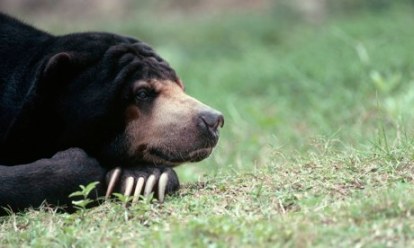
Like a proud dad, Siew Te Wong’s office walls and desk are covered in baby pictures, but unlike ordinary infants these possess four-inch claws and a taste for insects and honey. Wong, a leading sun bear researcher, has a heartfelt passion for the world’s smallest bear that is as big as the problems facing the species. Continue reading

170 Million Year Old Barometer For River Water Quality

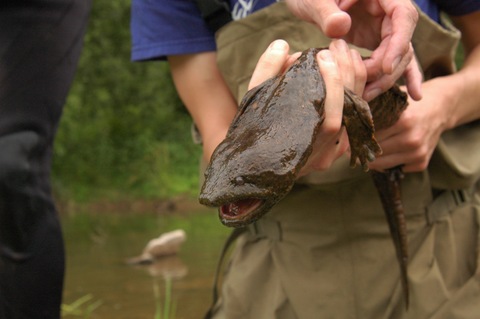
Matt Neff from the Smithsonian’s National Zoo holds a hellbender salamander that he caught in the Blue Ridge mountains of Virginia. Scientists hope to learn how healthy and viable the population is. Photo by Rebecca Jacobson

Thanks to the Public Broadcasting System of the USA for this story segment as their Science Wednesday feature this week:

…At the end of a long day snorkeling in the clear streams of southwestern Virginia’s Blue Ridge Mountains, Terrell and her team assumed their positions. As three scientists lifted a flat, heavy rock, Terrell groped underneath the stone, let out a muffled cry through her snorkel mask and popped out of the water.

“Where did it go? Did you see it?”

The biologists checked their nets and scoured the water. Sarah Colletti from the Aquatic Wildlife Conservation Center pointed at the slick rocks under the water. “Right there, he’s looking right at you.” One of the biologists lunged, secured a firm grasp, and triumphantly pulled it out: a nearly two-foot long hellbender. Continue reading

Alaska, Brown Bear And Salmon Via Camera Trap

This slideshow requires JavaScript.

We had already come to the conclusion that camera traps are valuable for the sake of conservation. Thanks to the Guardian‘s coverage of these bears and the camera trap provided by a generous foundation to a worthy recipient:

Caught on camera trap: brown bears feast on salmon – in pictures

Explore.org has launched a summer salmon bearcam to stream live video from Brooks river in Alaska’s Katmai national park. Organisers hope for the first time to record the entire salmon run, from the frenzied dash upstream in July through to the autumn months

Exploring My New Surroundings

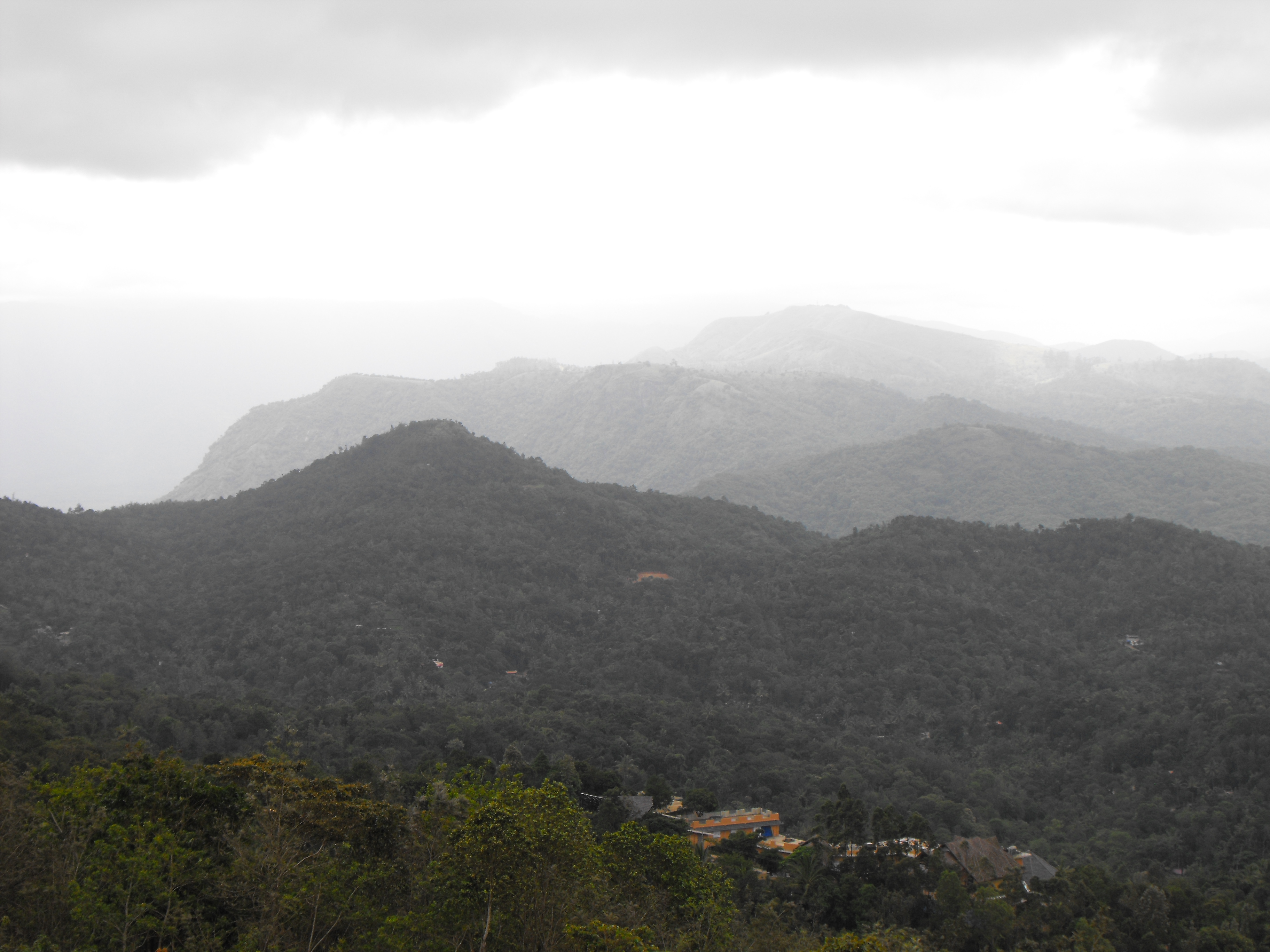
Mountain ridge border between Kerala and Tamil Nadu

Mountain ridge border between Kerala and Tamil Nadu

This past weekend I was able to explore the surrounding areas of Kumily and Thekkady, where I am staying for the next three and a half months. For this trek I went with RAXA Collective team member Salim, who is very knowledgeable and familar with the area. First he took me to see a scenic overlook. Here I saw and learned about the natural mountain border that separates parts of the state of Kerala and Tamil Nadu.  After a short drive from the overlook we arrived at a small spice plantation where Salim taught me about some of the local spices grown in the area such as cardamom, lemongrass, mint, and cinnamon. Continue reading

Sourcing Icelandic Wilderness

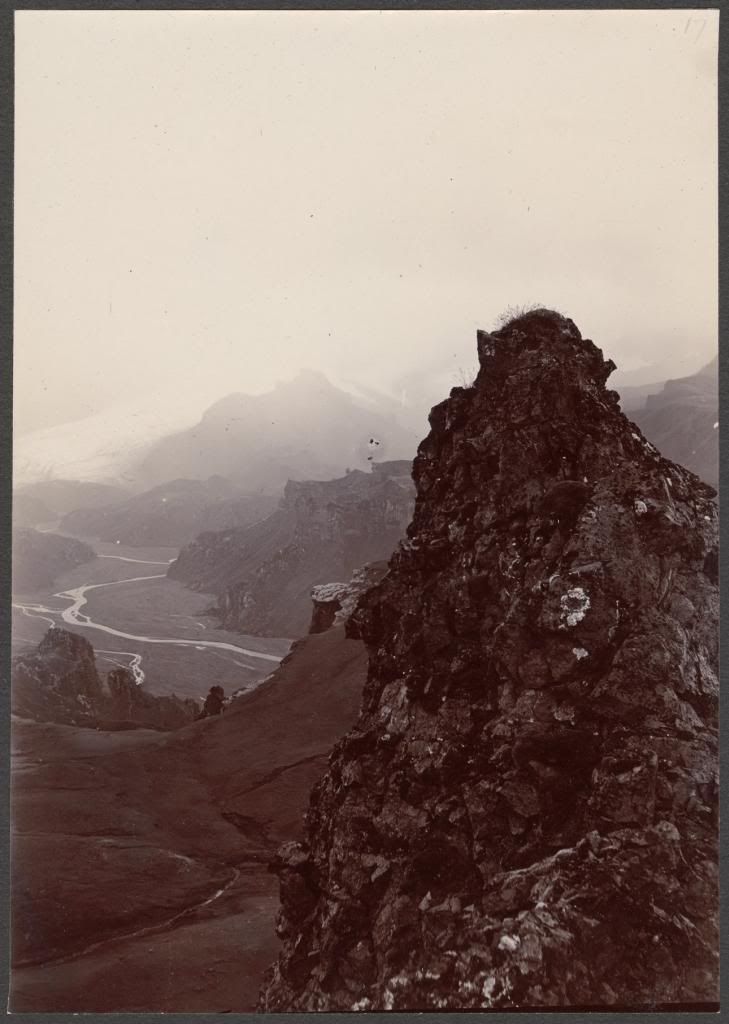
Þórsmörk. Glacier descending from Eyjafjallajökull. Collodion print by Frederick W. W. Howell ca 1900. Bequest of Daniel Willard Fiske; compilation by Halldór Hermannsson; Cornell University Library Rare & Manuscript Collections.

How Icelanders themselves saw the inner regions of their country, and the differences in perspective between the more and less educated segments of the population, can give valuable insight to the environmental practices of Iceland today, as well as portray the influence of European teaching on the more erudite Icelanders.

Although my focus is on the eighteenth and nineteenth centuries, it will be useful for me to explore the roots of Icelandic and European thought on unused open land and Nature, especially since much of the rural Icelanders’ perceptions were tinted by folklore and legend. Therefore, at least a cursory background of Icelandic folklore as it relates to my research topic is necessary, so I will consult the multitude of translated Icelandic myths, folk stories, and sagas, as well as the vast literature on wilderness and Nature in European thought, that Cornell Library owns in its Icelandic collection. Continue reading

Mapping Iceland

In my last post on the subject I mentioned that portions of Iceland on contemporary maps all the way up to the early 20th century remained blank. The main culprit for explorers, travelers, and cartographers was the great glacial region of Vatnajökull, at 3,139 sq. mi (8,130 sq. km) the largest glacier in Europe, and now a national park in southeast Iceland. Terrible snowstorms, heavy rains, unreliable ice, and poor local knowledge of the frigid plateau contributed to the failure of multiple expeditions by many men into the interior of the “Glacier of Rivers,” and during the late 1800s it became clear that there was frequent volcanic activity in the area as well.

1906 geological map by Icelandic geographer/geologist Þorvaldur Thoroddsen, who is credited with being the first to map the interior of the Icelandic Highlands in 1901, which is when this map was first published. The different colors represent different compositions of the island, such as basalt, liparite, volcanic ash, etc.

Continue reading

Exploring Iceland

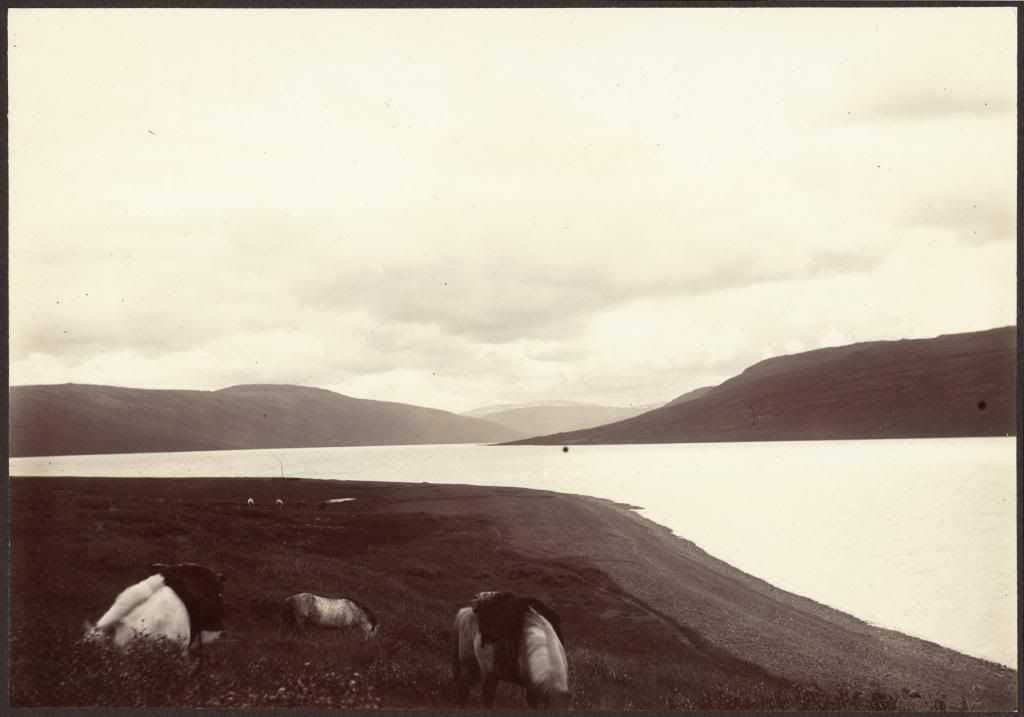
The head of Skorradalsvatn. Collodion print ca. 1900 by Frederick W. Howell. Bequest of Daniel Willard Fiske; compilation by Halldór Hermannsson at the Fiske Icelandic Collection of Cornell University.

Þórsmörk. Head of Krossárdalur. Collodion print ca. 1900 by Frederick W. Howell. Bequest of Daniel Willard Fiske; compilation by Halldór Hermannsson at the Fiske Icelandic Collection of Cornell University.

It was mentioned a week or two ago that Iceland is in the air. For me, Iceland is on my mind, in my laptop, hidden throughout the Cornell libraries, and scattered about my room. After a couple essays for an environmental history course last year and some preliminary research for finding an honors thesis topic in the history major, I discovered that, thanks primarily to Cornell University’s first librarian, we have one of the largest collections of Icelandic material in the world. Since one of my projects for the environmental history class had shown me that Iceland was an interesting place to examine more closely, I did some more research and found the topic of European travel there during the eighteenth and nineteenth centuries engaging enough to choose as an honors thesis subject.

One of the places in Europe with the most spaces left blank by cartographers through the eighteenth and nineteenth centuries, Iceland’s inner regions were not fully mapped until 1901. Continue reading

Lost City Of The Monkey God

Another great article (click the image to the left to go to the source), complementing this recent one from the New Yorker, about one special location within the region several members of Raxa Collective have called home for most of the last two decades:

The rain forests of Mosquitia, which span more than thirty-two thousand square miles of Honduras and Nicaragua, are among the densest and most inhospitable in the world. “It’s mountainous,” Chris Begley, an archeologist and expert on Honduras, told me recently. “There’s white water. There are jumping vipers, coral snakes, fer-de-lance, stinging plants, and biting insects. And then there are the illnesses—malaria, dengue fever, leishmaniasis, Chagas’.” Nevertheless, for nearly a century, archeologists and adventurers have plunged into the region, in search of the ruins of an ancient city, built of white stone, called la Ciudad Blanca, the White City. Continue reading

Privacy Disturbed

Emperor penguin colony

The newly discovered 9,000-strong emperor penguin colony on Antarctica’s Princess Ragnhild coast. Photograph: International Polar Foundation/PA

Click the photo above for the story in the Guardian. It sounds beautiful. They are so charismatic.  But it also raises the question of whether these creatures might have been happier without the visitors:

A previously unknown colony of about 9,000 emperor penguins has received its first human visitors.

Scientists from the British Antarctic Survey and US colleagues discovered the colony from satellite images. Continue reading

Thanksgiving: For Animals In & Out Of Context

Thanksgiving, as a national holiday, has its pluses and minuses (most holidays innocently suffer from the tendency we have to overdo things).  Thanksgiving as a practice, a daily or just occasional reflective practice, can only be good.  Today I reflect thankfully on the young animal in the video above (click to spend a minute or so viewing it).  At first glance you might think it is a puppy.  In the video it is clearly in a dog crate, and its facial expressions and movements could just as well be that of a small husky or shepherd dog, or even a mut.

It is a young bear cub.  If you want to know its story, click above.  The story in that video coincides with the story below.

This leopard kitten was found recently separated from its mother in a protected forest area in Kerala, and I happened to be in the right location at the right moment to witness what happens in such cases if our modern world is working at its best.  I learned something in the process, and that has completely changed my view on zoos (for which, this thanksgiving reflection).  The coincidence is that both the bear cub and the leopard kitten enlightened me within days of each other, and within that same set of days I had just been listening to a story on Radio Lab on the topic of zoos; all that,  just at the time when my calendar reminds me each year (the last Thursday of November) to reflect on what I am thankful for.

Continue reading