We have committed not to succumb to cute kitten syndrome.
It has been our preference not to to succumb to the second most acute syndrome plaguing file-sharing on the internet. Not that those kittens, monkeys and elephants are not adorable–they are. But the video clip above is different… Continue reading
Every minute of this is fun. The 35th minute is particularly fun for those of us based in Kerala because members of our organization join the stage with the stars of this show.
About five months ago we were approached by a film production company about a show they were filming for National Geographic Channel. They told us that River Escapes was recommended to them as having the best houseboats in the Kerala backwaters (a bit of music to our ears). Then they proposed that their Kerala episode should be based on our houseboats (we danced to that music).
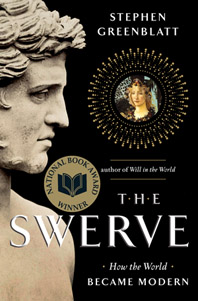 It is just the way things are. My reading list/pile is always longer/taller than I have time for. And living between the rice fields and spice-laden Western Ghats I do not have access to the kind of bookstores we took for granted while living elsewhere. Amazon does not deliver in India, nor would I put a penny in their coffers until I have the sense that they are not trying to monopolize the book trade, not to mention everything else.
Even if I had access to a great book store I might not have picked this one up off the shelf, though I admire the author’s writing. I have not been in the mood for anything too canonical or Great lately; rather merely useful, interesting, lesser reading. Short- and long-form journalism tend to be my standard fare. There was something in the pile with Greenblatt’s name on it, a magazine article, that I kept burying for months and which persistently kept resurfacing. Continue reading

Travancore Coins from Beena Sarasan’s Collection. Photo: Special Arrangment
A couple of my recent posts appreciating the perspective of a capable Western observer on the topic of India, combined with my family’s pending celebration of Thanksgiving in a foreign land (as per our tradition), got me thinking: what news item in India since living here am I most grateful for.

No hesitation. It has to do with the aftermath of a discovery in July. The discovery happened not too far from where we live, in the foundations of a Hindu temple. The descriptions were remarkable on their own, in part just because of the difference between journalistic style in the culture where I grew up (fourth estate and all) versus India’s journalistic flourish:
…gold, jewels, and other treasures were unearthed in the vaults of the temple. Several 18th century Napoleonic era coins were found, as well as a three-and-a-half feet tall gold idol of Mahavishnu studded with rubies and emeralds, and ceremonial attire for adorning the deity in the form of 16-part gold anki weighing almost 30 kilograms (66 lb) together with gold coconut shells, one studded with rubies and emeralds… Continue reading
Reading this post from Elizabeth Kolbert, a familiar cloud of doom came over me. Read almost anything she writes, and you will know what I mean. She writes most frequently about seemingly intractable environmental problems, and those about climate change have the most intense effect on me. But ignorance is not an option, so I read. The cloud lasted about seven hours, and parted just now in a most interesting manner. As if my head were just lifted out of the sand. First, the portion that stuck with me:
Since we can’t know the future, it is possible to imagine that, either through better technology or more creativity or sheer necessity, our children will be able to find a solution that currently eludes us. Somehow or other, they will figure out a way to avoid “a 4°C world.” But to suppose that an answer to global warming can be found by waiting is to misunderstand the nature of the problem.
 Earlier this year one of the news outlets we trust when establishing a point of view had this report on a rock.
It was not until a few days ago that the memory of that rock coincided with a post of Amie’s. In it, she linked out to a very illuminating video explaining the role natural selection plays in shaping our aesthetic tastes. It seems we have been remarkably consistent in our preference for the shape of rocks, or at least in those rocks that humans have been chipping away at for millennia. Continue reading
 Click the photo to the left for a short essay about someone you almost certainly never heard of.
And never likely will again. It is worth the 20-30 minutes of reading time.
If he is an unsung hero, then song seems an appropriate response. You will recognize, hopefully, someone you know when you read about Raymond. Probably good to let them hear the song sooner, rather than later.
Today I saw something very odd: dozens of ladybugs crawling along the top of a recycling bin. Some were the dark red that we normally associate with ladybugs, while others were a pale orange verging on yellow. Strange looking half-formed ladybugs, seemingly crouched in tight balls, adhered themselves along the surface as well. In the midst of it all swarmed long, fat black bugs with orange spotting along their backs. What was going on here? And what was this panoply of ladybug life occurring on a recycling bin in the middle of a college campus?
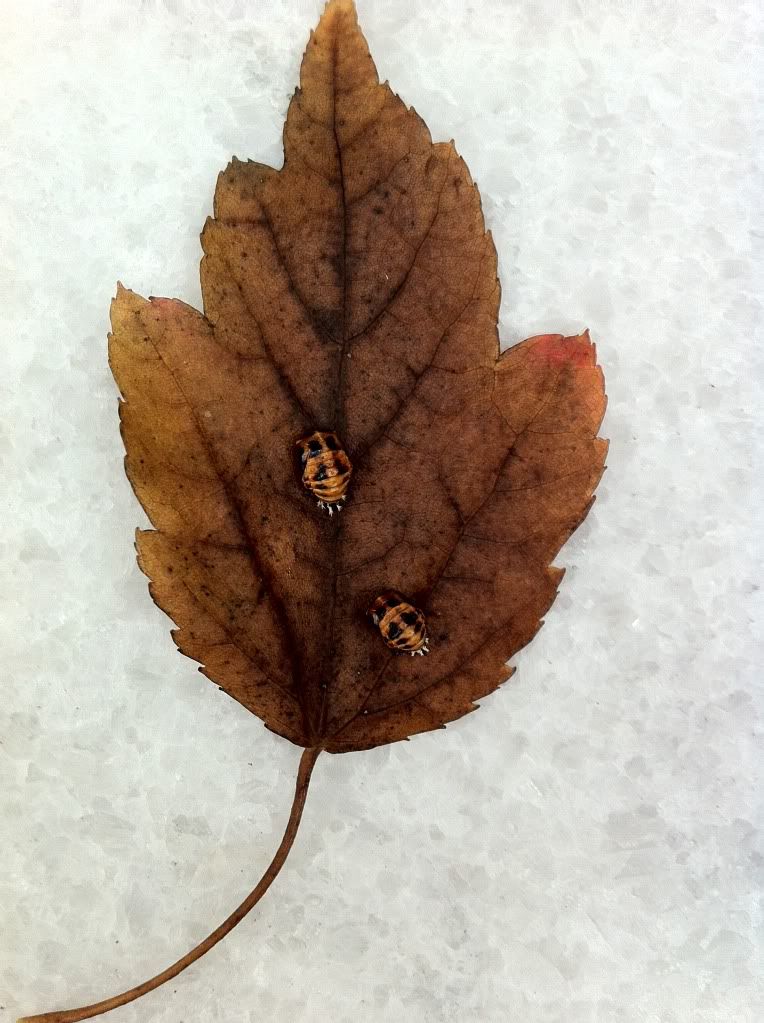
Two ladybug pupae
When I afterwards looked up ladybugs, I found that I had actually witnessed something pretty cool: the full life cycle of Coccinellidae, known as the ‘ladybug’ in America but the ‘ladybird’ elsewhere in the world. It’s also known as ‘God’s cow,’ the ‘ladyclock,’ or the ‘lady fly.’ There are over five thousand species worldwide, but the name ‘ladybug’ is perhaps most readily synonymous with the image of a small, round red bug with black spots.
The ladybug, as I had seen, has four distinct phases in its life cycle. The life of the ladybug begins in an egg; small clutches hatch after three or four days at which point the larval form of the bug emerges. It may molt three to four times over a period of about twelve days before pupation (i.e., the beetle creates a pupa). Continue reading
An interesting question to ask about a fully intact and functional brain’s cognitive abilities is this: how do we know that each individual’s perception isn’t unique, whether it’s visual, olfactory, or of any other sense? Processing and emotional responses aside – how do we know that people actually see things the same way, physically? The color I identify as red might appear as residing on the opposite end of the spectrum to someone else, despite the light’s wavelength being constant. The smell I identify as vanilla may be different from another person’s perception of vanilla’s odor, but because we are both correctly identifying the scent as that of vanilla, it is both futile and impossible to determine whether or not the stimulus is perceived identically between the two people.
Enter science! Everyone’s nose (at least those without ‘abnormalities’) has the same scent molecule receptors, meaning we all have the same capabilities for smelling the odors in the air (yes, they are molecules! they are not magically dispersed by the scent fairies, contrary to popular belief). Continue reading

The Sulphur-Bottom Whale
The sulphur-bottom whale is the largest mammal on (or under) the earth’s surface; many speculate that it might be the largest animal ever to have inhabited our terraqueous globe. These immense creatures can typically grow to between eighty and a hundred feet long, with the largest specimens caught suggesting that the whales might exceed one hundred and ten feet in length! The weight of the sulphur-bottom whale is commensurate with its size: they can weigh between one hundred and one hundred and fifty tons. For comparison, the largest elephant ever recorded weighed a mere twelve tons. If the sulphur-bottom whale rolled over in its sleep Continue reading
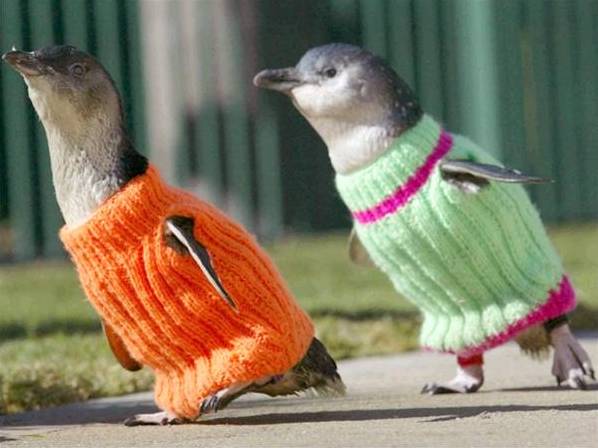
Toby Zerna / Newspix via Rex USA file
The environmental impacts of ocean oil spills are often incalculable, but for better or for worse the effects on wildlife are well-known. New Zealand’s coastal waters are home or breeding grounds to nearly 85 species of seabirds, and during breeding season the situation becomes increasingly desperate as the birds dive in and out of the water to find food for their chicks. Continue reading
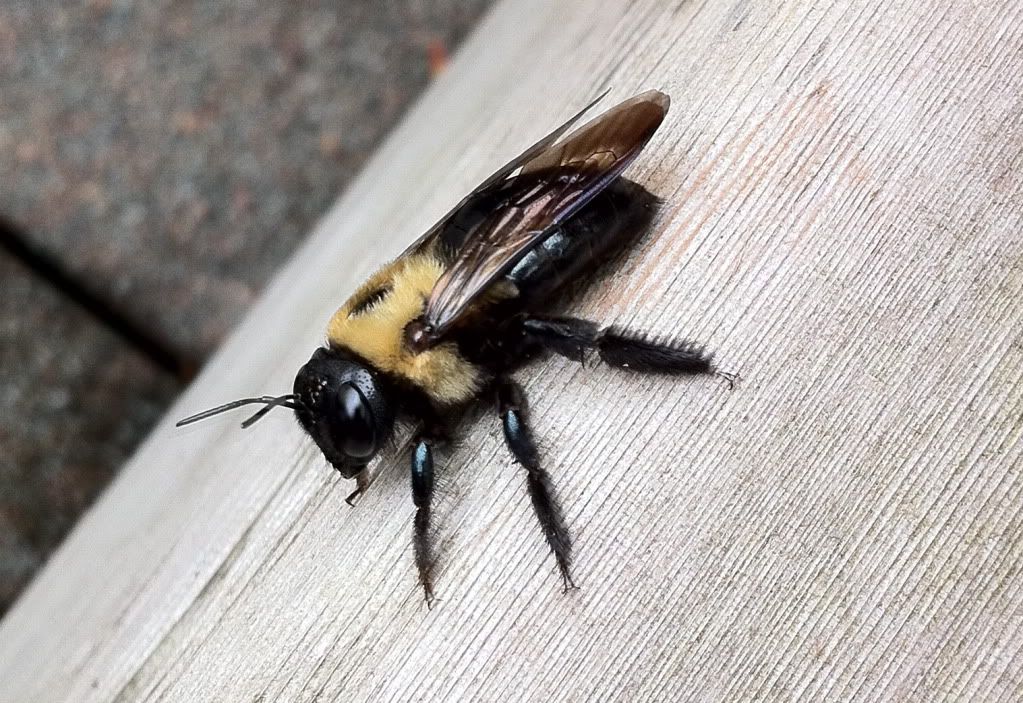
A snapshot of the inebriated bee. Click for higher resolution!
No, it’s not a new mixed drink.
I was sitting on a bench a few days ago when I noticed something interesting Continue reading

Bicycles are ubiquitous forms of transportation in my part of the world. Previously I’ve posted how they can mean more than the sum of their parts, or in the urban art example, they can represent only their parts!
So what happens when form and function converge with sustainability, balance and simplicity? Continue reading
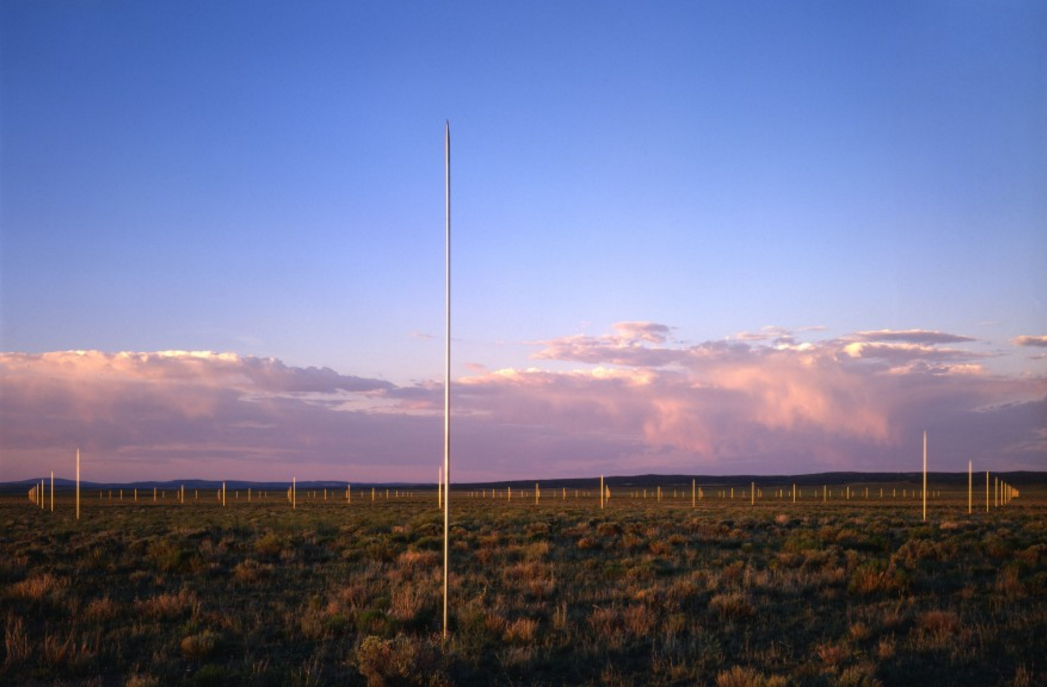
Walter De Maria, The Lightning Field, 1977. © The Estate of Walter De Maria. Photo: John Cliett
Based on his oeuvre one would say that Walter De Maria is an artist fascinated by mathematical precision and order. His work at Gagosian Gallery in New York City or The Nelson-Atkins Museum of Art in Kansas City in the United States or even the Chichu Art Museum in Naoshima, Japan exemplify this focus on the predictable progression of sunlight as it relates to planetary rotation and the perfection of spheres.

When I ponder the question “why I travel” I often return to the same answer; I travel to gather new experiences, to learn, to refresh, to reconnect with something lost. I think we all have the tendency to become complacent with the familiar. Even one step outside of that familiarity brings us closer to a broader vision. And for many who live in urban areas, the drive to step outside is a power in itself. I believe we are programmed to feel connected with the outdoors, soothed by the power of green, taking in spiritual chlorophyll like deep breaths, to speak metaphorically.
But not everyone who craves communion with nature is ready to “rough it” in her embrace. An innovative hotel built in Sweden’s Boreal forest (the same forest region that has inspired Land Art Installations) offers an inspiring way to wake up amid birdsong. Continue reading
In my last post, I walked along a border–the one separating the land of nostalgia from the land of meaning–and am still not sure which side of the border I was on. One person’s memory lane is full of madeleines, and another’s may have no particular there there (so be it, glass houses and all). The link to Brother Blue is the puzzle. Can anyone, out of context, realize who that man was and what he accomplished from that little bit of Lear jive? I do not know. But recycling is an ethos that India is instilling, so I go with it.
The thread linking Thoreau and Brother Blue for me the other day kept un-spooling, and led me back to my favorite living artist:
 It may have seemed implied in the previous post that looking backwards is the only amazement India offers. Not so. To outsiders and locals alike, in India sometimes the Shock of the New is the only path forward. This week in The New Yorker there is an article (click on the image to the left to read the abstract, but either full subscription or pay-per-article is required for the full text) about one of India’s many new billionaires, and his private sector approach to a moonshot.
We could distinguish his approach from the entrepreneurial bootstrapping initiatives we highlight on this sight in a few obvious ways (ok, a few billion obvious ways), but why bother? We need only say we like it. And in a place with thousands of years of experience making things work against all odds, we can also say we have hope. Even optimism.
 Organikos