Yale e360, with news like this, titles it carefully:
Scientists Say They Have Found a Viable Replacement for Petroleum-Based Plastic
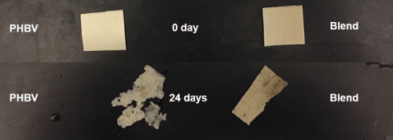
Scientists at Ohio State University say they have developed a viable alternative to petroleum-based plastic food packaging by using natural tree-based rubber. According to the researchers, the new biodegradable material holds promise for fighting the world’s growing plastic pollution problem, as well as for helping curb our reliance on fossil fuels.
The original source, with slightly more flowery language, titles it as if packaging can be friendly to the environment. The way we use packaging, not so. But we will take what we can get at this point:
The new bioplastic and rubber blend devised by Ohio State researchers proved much more durable than the bioplastic on its own
The quest to keep plastic out of landfills and simultaneously satisfy the needs of the food industry is filled with obstacles.
A biodegradable replacement for petroleum-based products has to meet all sorts of standards and, so far, attempts at viable replacements from renewable sources have faced limited success due to processing and economic constraints. Among the obstacles, products to date have been too brittle for food packaging.Continue reading →
Investors are finally paying attention to climate change — though not in the way you might hope.
By JESSE BARRON
The New York Times Magazine is on to something. More than most magazines, it is offering stark, long form accounts of the stakes being wagered against our planet.
By 1979, we knew nearly everything we understand today about climate change—including how to stop it. Over the next decade, a handful of scientists, politicians, and strategists, led by two unlikely heroes, risked their careers in a desperate, escalating campaign to convince the world to act before it was too late. Losing Earth is their story, and ours. Continue reading →
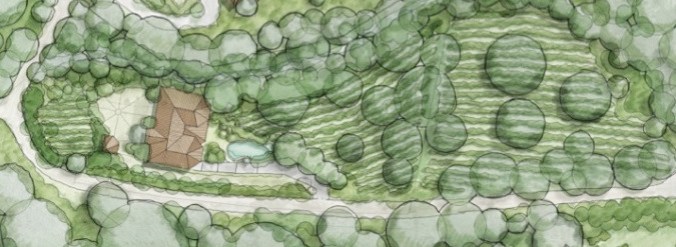
The image above shows where coffee can be planted on land that currently has grass cover. For most of the last century that land had high grade arabica coffee growing on it, but two decades ago the coffee was removed. The residential value of the land was seen to be greater than the agricultural value, and a large plantation was subdivided into parcels between 3 and 10 acres.
That was then, this is now. Coffee is more valuable than grass. And the value of coffee that is as world class as what Seth planted at Xandari and also resistant to the challenges brought on by climate change is even greater. The trees that will be planted to shade the coffee will be of greater value–to birds as well as to the coffee–than the view of undulating hillside. The image above is a first step in the planning process of this restoration initiative. Organikos will start selling coffee in August, and the proceeds of those sales will pay for the restoration and ongoing improvements of this lot. That is an example of what we mean by 100% Forward.
In 2015, the Adorers of the Blood of Christ, a congregation of nuns, learned that an energy company planned to build a pipeline on their land. So they started a resistance movement. Photograph by Dave Parry
Thanks to Eliza Griswold, who writes about religion (which does not feature often in our pages) and occasionally finds an overlap with environmental causes:
On a crisp October morning in 2017, Sister Sara Dwyer, a sixty-eight-year-old nun wearing a red T-shirt that read “you will not spoil our land,” led three elderly nuns and seventy other protesters onto an industrial work site in Lancaster County, Pennsylvania. Many carried red banners stencilled with wheat sheaves. They were there to protest Williams, an Oklahoma-based pipeline company that was trying to build the Atlantic Sunrise Pipeline, a two-hundred-mile natural gas pipeline that would carry shale gas from fields in northeastern Pennsylvania to the coast, where the fuel could be shipped abroad. The company was trying to lay the line under a cornfield belonging to the nuns, and the sisters had decided to fight back, hoping that they might draw attention to the issue of climate change. “Just being in resistance is not the goal,” Dwyer told me. “The goal is spiritual conversion.” As the protesters entered the work site, Malinda Clatterbuck, who had helped plan the event with the sisters, reminded the participants, “This is a nonviolent protest in all ways. We’re not going to yell or speak to the workers.” She walked around asking each person to nod in agreement. “If you’re angry today, go home and come back to an action once you’re in a better place,” she said. Continue reading →
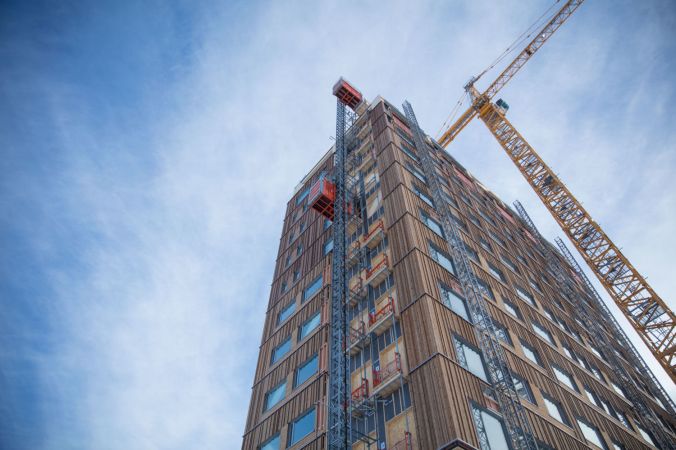
Mjösa Tower, the world’s tallest wooden building, under construction in Brumunddal, Norway. ANTI HAMAR
Thanks to Yale e360 and especially to Jim Robbins, as always, for keeping us up to date on the most interesting new developments in our natural world and its built spaces:
Mass timber construction is on the rise, with advocates saying it could revolutionize the building industry and be part of a climate change solution. But some are questioning whether the logging and manufacturing required to produce the new material outweigh any benefits.
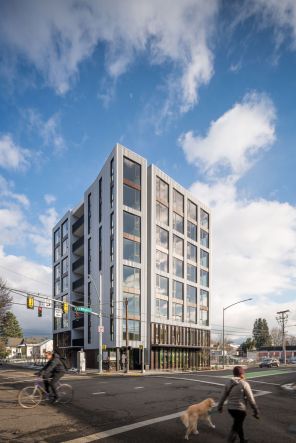
Carbon 12 in Portland, Oregon is the tallest building in the United States made with mass timber. COURTESY OF KAISER + PATH 2 / 4
The eight-story Carbon 12 building in Portland, Oregon is the tallest commercial structure in the United States to be built from something called mass timber.
If the many fervent boosters of this new construction material are right, however, it is only one of the first mass timber buildings among many, the beginning of a construction revolution. “The design community in Portland is enthralled with the material,” said Emily Dawson, an architect at Kaiser + Path, the locally-based firm that designed Carbon 12.
The move to mass timber is even farther along in Europe. That’s because mass timber – large structural panels, posts, and beams glued under pressure or nailed together in layers, with the wood’s grain stacked perpendicular for extra strength – is not only prized as an innovative building material, superior to concrete and steel in many ways, it is also hoped it will come into its own as a significant part of a climate change solution. Continue reading →
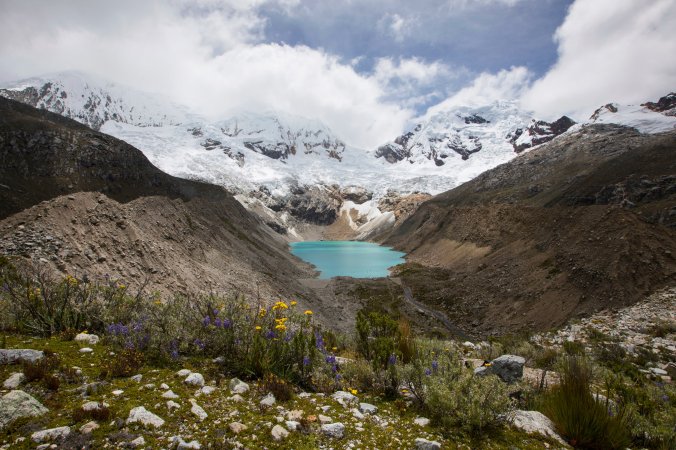
Lake Palcacocha in the Peruvian Andes. Felipe Fittipaldi for The New York Times
Brooke Jarvis, whose mastery of the complex environmental story we have pointed to a couple times already, shares the story below about a novel legal approach to fighting climate change. It is long, detailed and even more complex than the other stories we have seen by her. But if her subject prevails, the result may be even more profound as well. These two photos alone should draw you in. Thanks to the New York Times Magazine:
The city of Huaraz in the Peruvian Andes. Felipe Fittipaldi for The New York Times
In the mountains far above the red-brick city, behind a locked gate, there is a great, green valley. Its high stone walls are streaked by waterfalls; its floor dotted with flowers and grazed by horses and cows. Six boulder-strewn miles beyond the gate, the valley ends abruptly at an enormous wall of rock and ice. Beneath it lies a stretch of calm, bright water in milky turquoise — Lake Palcacocha. Though few of its residents have ever seen this lake, the city below lives in fear of it. Continue reading →
Drawing on advances in social science, evolutionary biology, genetics, neuroscience, and network science, “Blueprint” attempts to show how and why evolution has placed us on a humane path — and how we are united by our common humanity.
For too long, the author contends, scientists have focused on the dark side of our biological heritage: our capacity for aggression, cruelty, prejudice, and self-interest. But natural selection has given us a suite of beneficial social features, including our capacity for love, friendship, cooperation, and learning. Beneath all our inventions — our tools, farms, machines, cities, nations — we carry with us innate proclivities to make a good society.
There are not many reviews available yet, but here is one:
A social scientist looks at the good and bad sides of human character, arguing that we are evolutionarily inclined “to make a particular kind of society—a good one full of love, friendship, cooperation, and learning.”…
…A refreshingly optimistic view of our kind.
If, like me, you had previously only known of him due to this incident, the blurb and the review are catchy enough to warrant further attention. So I found an interview he recently gave (on a podcast I would not normally have sought out, but it was all I could find) and listening to him talk about it has made me want to find this book and have a read.
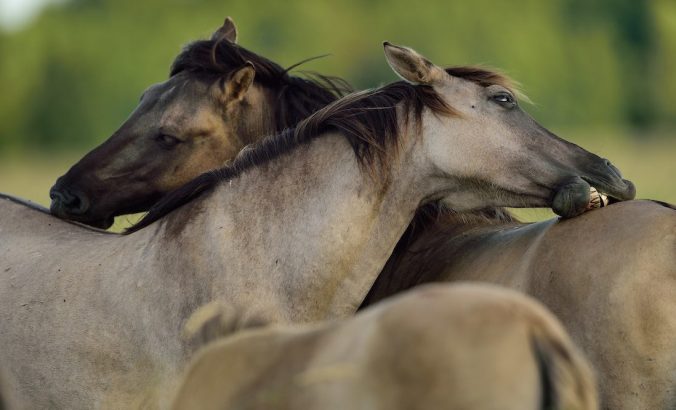
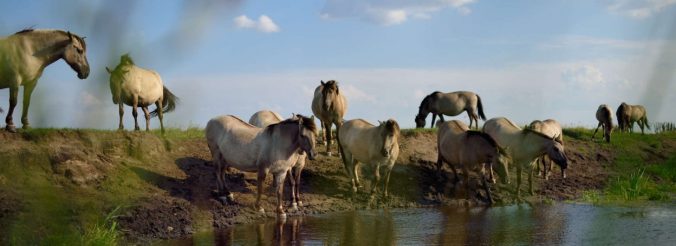
The group of 23 wild Konik horses which arrived in the Ukrainian village of Orlovka on March 26 represents the first translocation of such animals into the Danube Delta. SOLVIN ZANKL / REWILDING EUROPE
Thanks, as always, to our friends at Rewilding Europe for another story about an animal we always think of as one of the oldest examples of domestication, and its role in rewilding:
Representing the first ever translocation of Konik horses into the Danube Delta, the shipment of 23 animals travelled by road from Latvia to the Ukrainian village of Orlovka. By helping to create and maintain mosaic landscapes, their grazing will help to boost biodiversity in the Danube Delta rewilding area.
The sturdy Koniks, which lived over 20 years in the wild in Latvia, are well-suited to life in the Danube Delta. SOLVIN ZANKL / REWILDING EUROPE
Two herds of wild Konik horses will soon be roaming the landscapes of the Ukrainian Danube Delta, boosting the area’s biodiversity through their natural grazing. A shipment of 23 horses (made up of two family groups) arrived in the small delta village of Orlovka on March 26, having made the long road journey from Latvia. Despite the lengthy trip of around 1800 kilometres, which took nearly two days and two nights, all of the animals were pronounced fit and well on arrival by a veterinarian. Continue reading →
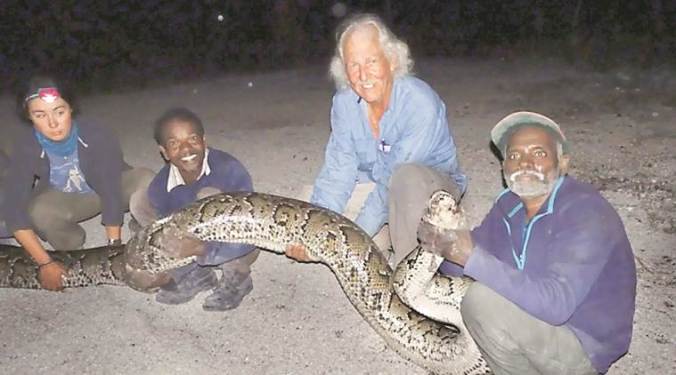
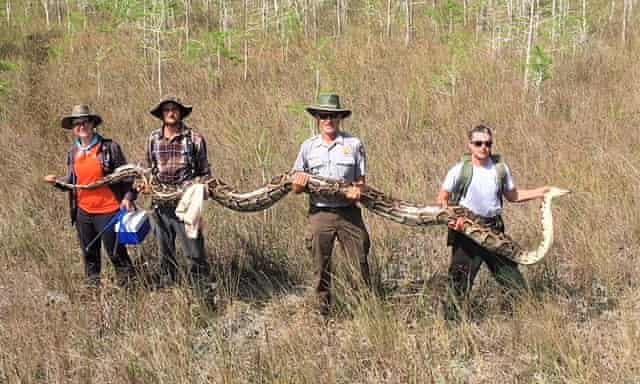
Snake hunters have captured what they say is the largest python ever found in the swamps of the Florida Everglades: a pregnant female more than 17ft (5.2 metres) long and weighing 140lb, or 63.5kg.
The team from the Big Cypress National Preserve posted news of their record-setting catch in a Facebook post that also noted the giant reptile was carrying 73 eggs.
Big Cypress National Preserve group captures 17ft female python on 4 April. Photograph: Big Cypress National Preserve/Facebook
Environmentalists have been struggling to find ways to eradicate Burmese pythons, a non-native species, from the 1.5m-acre wilderness since the 1980s, when some were released into the wild as overgrown pets. Others escaped from a breeding facility wrecked by Hurricane Andrew in 1992. Continue reading →
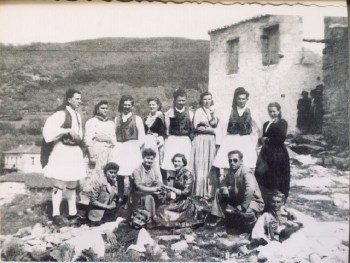
I have shared the photo above on this platform once before. I wrote a series of reflections on the village where that photo was taken, and today I share a riff on all that. That photo was enlarged to take up an entire wall of our office in India, as a reminder to me each day of the purpose behind what I was doing. Our company’s mission includes education. It is mostly about conservation. That building, which I photographed 10+ years ago, after it had recently been abandoned, has been a reminder for me that one of these days I am determined to share whatever I can from our work in that village.
This photo was taken of Bangor Vamvakou immigrants in 1949 as they returned to their village. Top left is Nikos Niarchos, a relative of the Greek shipping tycoon. From Top Left, the others are: Vasso Anglesi; George Limberogiannis; Eleni Markos; Panayiotis Servetis; Vasso Kokini; Katsilis Demetrios and Anna Leakou. Middle Row, from Left: Pota Anglesi; Angeliki Skoufi; Eleni Hatzi and Panos Dialialis. At bottom, Left to Right, are Yiannis Limberogiannis and Harris Belbekis.
Thanks to an online publication I follow for news from Greece I found this story that helps explain why I thought of the photo above just now. It gives me both hope and tangible ideas of what might be done. It starts with a group of immigrants in Bangor, Maine whose life trajectory was like that of so many others from the Lakonia region of Greece, including my mother. And the story leads back to a foundation that has been referenced once before in our pages, but this time the foundation’s work hits closer to home:
The saying goes that it takes a village to raise a young person. But sometimes it takes young people to raise up a village, and this is exactly what’s happening in the Laconian village of Vamvakou.
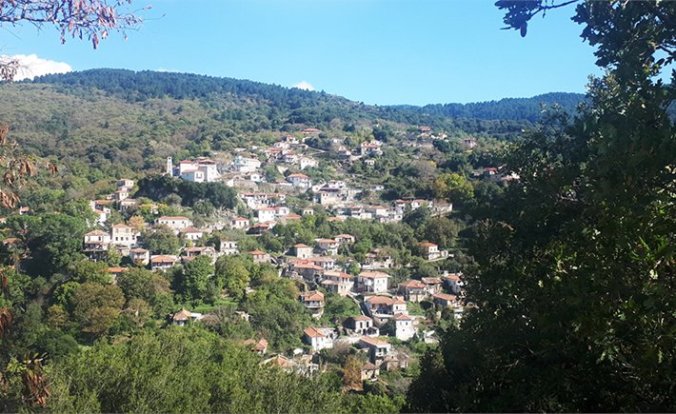
Vamvakou is a short drive from Vourthonia, my mother’s village. So this video below strikes a chord.
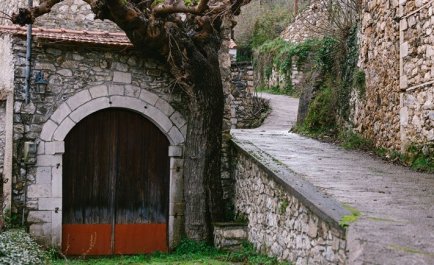
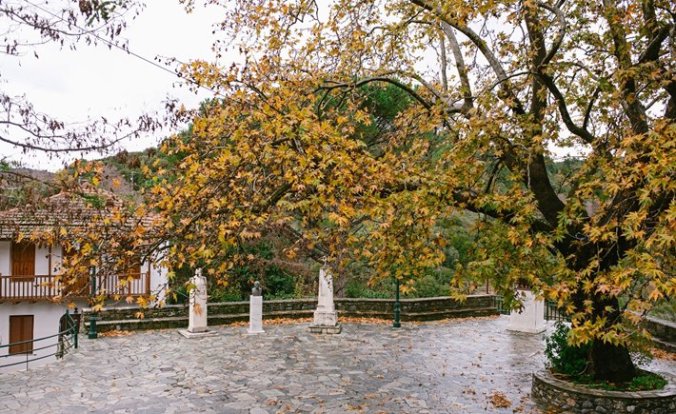
Some of the images from Mamvakou could as easily have been taken in Vourthonia.
Can a once-thriving mountain village, today home to only nine inhabitants, come to life again?
Can it fill with visitors, permanent inhabitants, and model businesses while retaining its traditional character? This is the wager laid by a group of five young people who want to revitalize the village of Vamvakou, 900 meters up the slopes of Mount Parnon in the southeastern Peloponnese.
Source: SNF
To realize this ambitious project, the five friends, Haris Vasilakos, Anargyros Verdilos, Eleni Mami, Tasos Markos, and Panagiotis Soulimiotis established the “Vamvakou Revival” Social Cooperative Enterprise and decided to move to the village. Continue reading →

 That was then, this is now. Coffee is more valuable than grass. And the value of coffee that is as





 Organikos