Pfeiffer Burns State Park, California
Marine Biologists & Earth’s Future
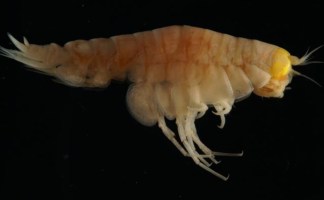
Hirondellea gigas, an amphipod collected from the Mariana Trench (ALAN JAMIESON / NEWCASTLE UNIVERSITY)
Ed Yong’s story will not make you happy. But it is a plastics must-read. Marine biologists are akin to climate scientists whose job requires sharing specific unsettling findings. To put it mildly. The scientist in this case says he does not like doing this work. But he continues in the interest of science and in the interest of the planet’s future. Thanks to him and people like him:
A Troubling Discovery in the Deepest Ocean Trenches
In the Mariana Trench, the lowest point in any ocean, every tiny animal tested had plastic pollution hiding in its gut.
Alan Jamieson remembers seeing it for the first time: a small, black fiber floating in a tube of liquid. It resembled a hair, but when Jamieson examined it under a microscope, he realized that the fiber was clearly synthetic—a piece of plastic. And worryingly, his student Lauren Brooks had pulled it from the gut of a small crustacean living in one of the deepest parts of the ocean. Continue reading
Bird of the Day: Ruddy Kingfisher

Adaptation & South-South Cooperation
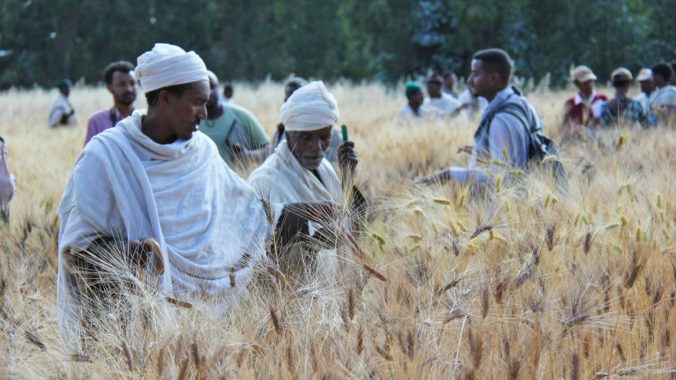
Ethiopian farmers examine the results of a trial of wheat varieties. BIOVERSITY INTERNATIONAL
The bread we eat in the not so distant future may depend on the type of cooperation described below. Thanks to Yale e360 and Virginia Gewin for this story:
How Crowdsourcing Seeds Can Help Farmers Adapt to Climate Change
In Ethiopia and other developing nations, scientists are working with small-scale farmers on trials to see which seed varieties perform best in changing conditions. These initiatives are enabling farmers to make smarter crop choices in the face of rising temperatures, drought, and more extreme weather.
Durum wheat varieties grow in trial plots in Ethiopia’s Amhara region. Thousands of farmers participated in the project, testing how various wheat strands performed under changing climatic conditions. BIOVERSITY INTERNATIONAL
In Ethiopia’s undulating, high-elevation grasslands, farmers — most of them working parcels of only two to three acres — produce more wheat than anywhere else in sub-Saharan Africa. They accomplish this feat in the face of chronically short supplies of high-quality seed. Still, Ethiopia’s record harvest of 4.6 million metric tons in 2017 didn’t satisfy the country’s needs, forcing it to import an additional 1.5 million tons of wheat. Continue reading

Bird of the Day: White-cheeked Pintail
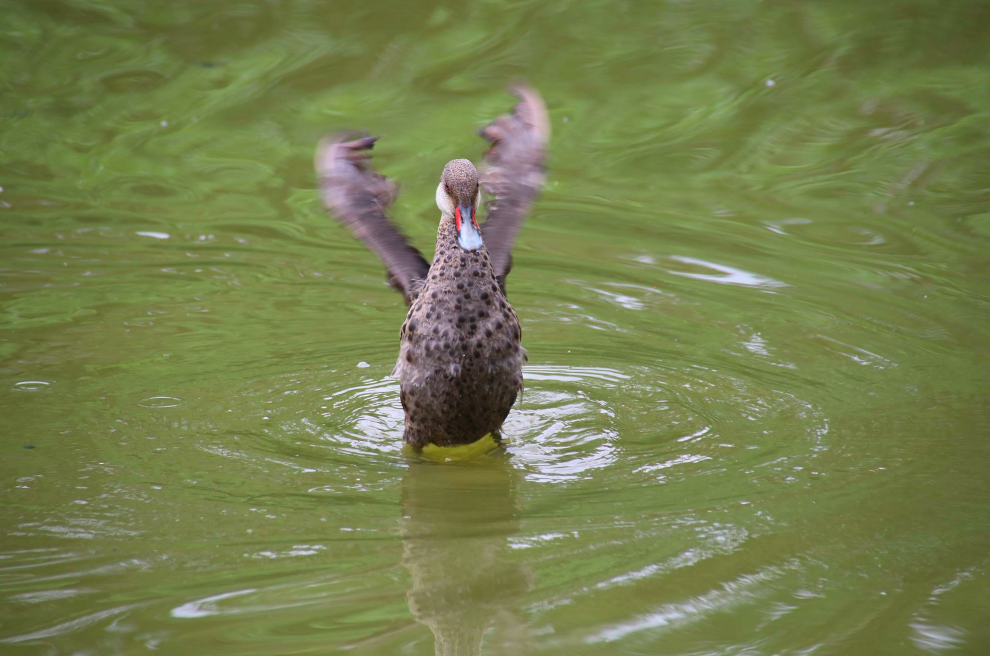
Photo Credit: Stephen Crafts
Santa Cruz Island, Galapagos, Ecuador
Bird of the Day: Anna’s Hummingbird
female – San Francisco, California
Addictions Abound, Solutions Hiding In Plain Sight

Orangutans rescued near a palm oil plantation in Kalimantan, Indonesia. Photograph: Vier Pfoten/Four Paws/Rex
Thanks to the Guardian for presenting this story by Paul Tullis:
How the world got hooked on palm oil
It’s the miracle ingredient in everything from biscuits to shampoo. But our dependence on palm oil has devastating environmental consequences. Is it too late to break the habit?
A fire at an oil palm plantation in Pekanbaru, Sumatra, due to intensive farming methods and the dry season. Photograph: AFP/Getty
Once upon a time in a land far, far away, there grew a magical fruit. This fruit could be squeezed to produce a very special kind of oil that made cookies more healthy, soap more bubbly and crisps more crispy. The oil could even make lipstick smoother and keep ice-cream from melting. Because of these wondrous qualities, people came from around the world to buy the fruit and its oil.
In the places where the fruit came from, people burned down the forest so they could plant more trees that grew the fruit – making lots of nasty smoke and sending all of the creatures of the forest scurrying away. When the trees were burned, they emitted a gas that heated up the air. Then everybody was upset, because they loved the forest’s creatures and thought the temperature was warm enough already. A few people decided they shouldn’t use the oil any more, but mostly things went on as before, and the forest kept burning.
This is a true story. Except that it is not magic. The fruit of the oil palm tree (Elaeis guineensis), which grows in tropical climates, contains the world’s most versatile vegetable oil. It can handle frying without spoiling, and blends well with other oils. Its combination of different types of fats and its consistency after refining make it a popular ingredient in packaged baked goods. Its low production costs make it cheaper than frying oils such as cottonseed or sunflower. It provides the foaming agent in virtually every shampoo, liquid soap or detergent. Cosmetics manufacturers prefer it to animal tallow for its ease of application and low price. It is increasingly used as a cheap raw material for biofuels, especially in the European Union. It functions as a natural preservative in processed foods, and actually does raise the melting point of ice-cream. Palm oil can be used as an adhesive that binds together the particles in fibreboard. Oil palm trunks and fronds can be made into everything from plywood to the composite body of Malaysia’s national automobile.

Read the whole story here.
Bird of the Day: Nicobar Scops-owl
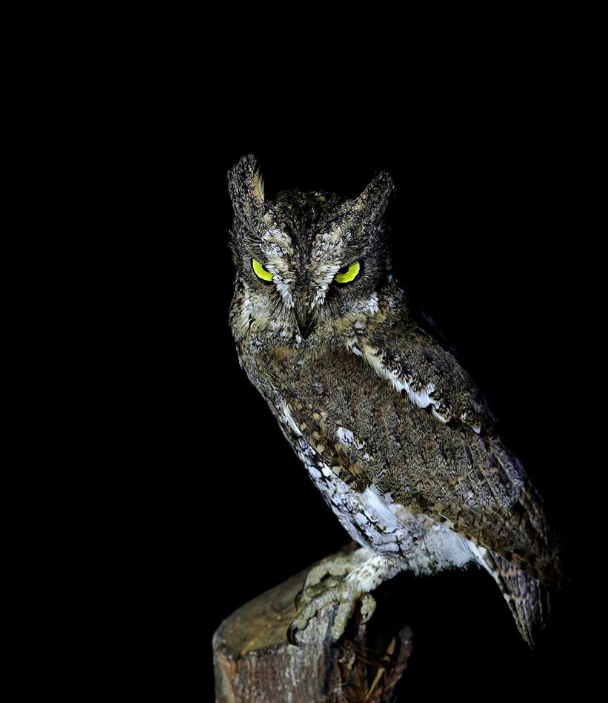
Nicobar, Andaman Islands
What’s The Delay?

In 2017, seventeen major wildfires in California were connected to P.G. & E. Photograph by George Rose / Getty
Sheelah Kolhatkar has a note, The P.G. & E. Bankruptcy and the Coming Climate-Related Business Failures, that gets me thinking. The standard thinking on why climate change is so difficult to do anything about is how it is seen as a problem we will encounter far off in the future. It obviously is not far off. It has started. Farmers have suffered. Big city folk have suffered. California dreamers have suffered. The immediacy needs to be framed accordingly:
On January 15th, the World Economic Forum issued its annual Global Risks Report, which presents the results of a survey of what policymakers and experts perceive to be the world’s greatest challenges and threats. The report categorizes concerns by color: blue for economic risks, orange for geopolitical risks, purple for technological risks, red for societal risks. This year, green, which denotes environmental hazards, was dominant: the top three risks, listed by the “likelihood” that they would occur, were extreme weather events, failure of climate-change mitigation and adaptation, and natural disasters. (Threats such as data fraud and cyber-attacks appeared lower down on the list). “Is the world sleepwalking into a crisis?” the report’s authors wrote. “Global risks are intensifying but the collective will to tackle them appears to be lacking.” Continue reading
Bird of the Day: Lesser Racket-tailed Drongo
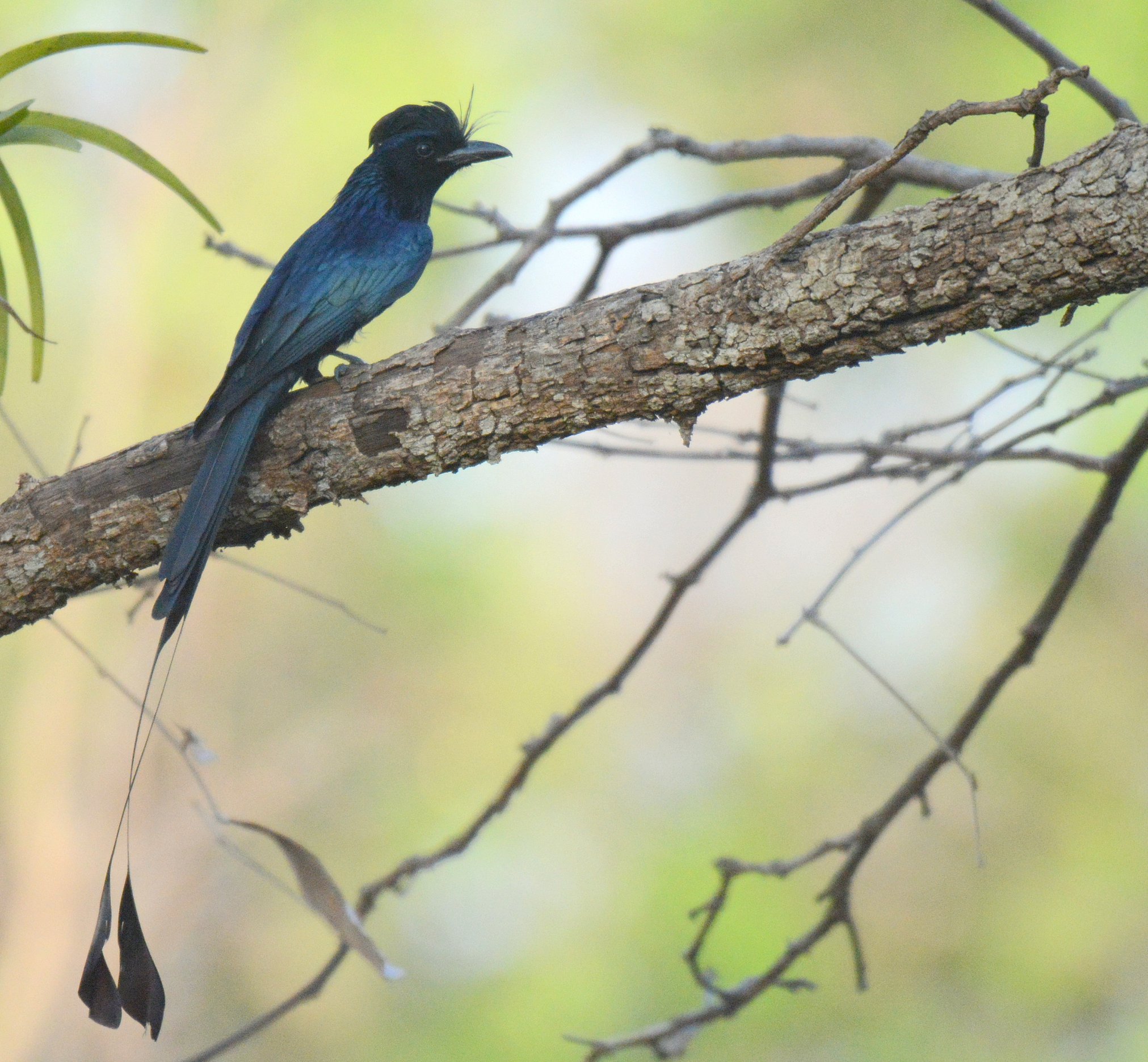
Kanha National Park, Madhya Pradesh
Elephants By The Sea
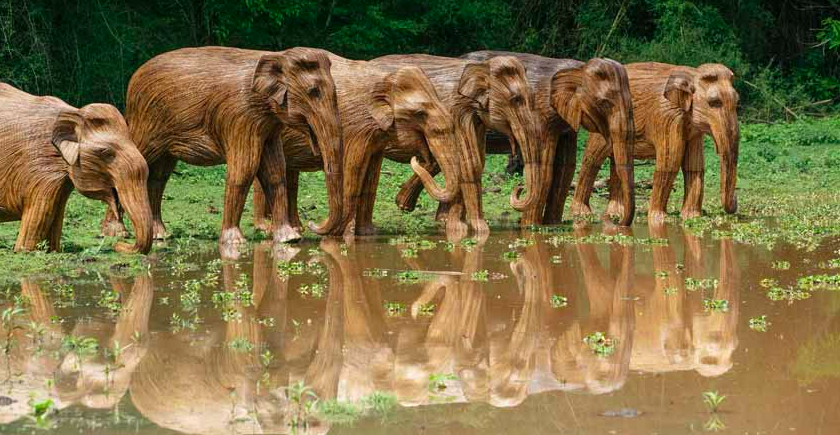
100 life-size lantana replicas of wild elephants will travel across three continents spreading the message of peaceful coexistence with nature.
The beautiful herd of Asian Elephants calmly drinking from this watering hole poses no threat to any onlooker. They’re actually sculptures made from the invasive lantana, introduced to the Indian subcontinent as an ornamental shrub by the British. The harmless looking plant is a scourge to native flora, animals and people of the regions where it’s taken over, as it literally poisons its surroundings so nothing else can survive there, destroying the natural biodiversity of the area.
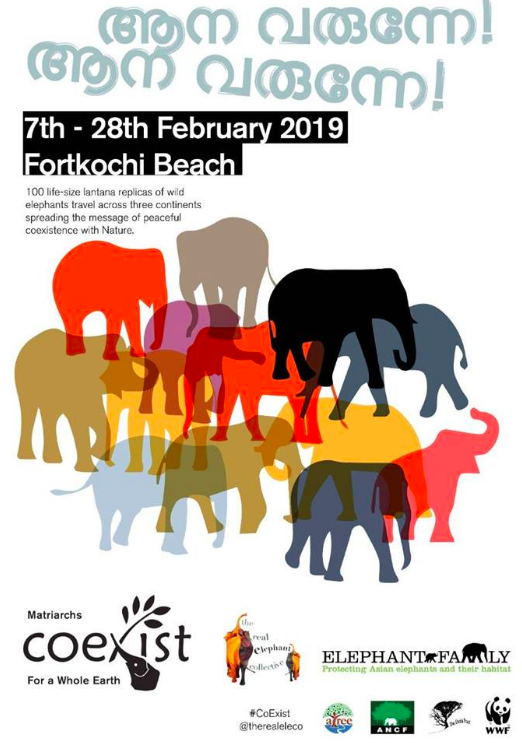 30 of these extraordinary, life-sized works of art have been on display in Kerala, at Kochi’s South Beach, coinciding with the Kochi-Muziris Biennale. The outdoor exhibit, entitled Co-Exist: Matriarchs for a Whole Earth, is on display for only until the end of February, after which it will travel to Bangalore and New Delhi. In 2020, the elephant models will be taken to England where they will be displayed at the Victoria and Albert Museum and the Royal Parks, both in London. In 2021, they will travel by truck across the USA, where they will finally be auctioned, the proceeds of which will go to preservation of wild animals.
The project is a collaboration between multiple organizations, designers and indigenous community artisans. Members of the Ashoka Trust Trust for Research in Ecology & the Environment (ATREE) devised a way to safely craft with lantana as a raw material and support for the making and display of lantana elephants is through the NGOs Elephant Family, The Real Elephant Collective (TREC), and The Shola Trust.
Fort Kochi To Have 100 ‘Lantana’ Elephants. And Here’s Why You Need To See Them
Highlighting the cause of nature and wildlife conservation at a global scale, the Lantana elephants are part of a greater initiative to raise funds for conservation and help people and elephants live together more harmoniously.
On February 7, if you are wandering around the popular South Beach in Fort Kochi, you are sure to come across a magnificent herd of 100 Asian elephants.
If you are wondering about the possibility of such a huge congregation of these beings at one place, let us break the news.
These are beautifully sculpted life-size elephants that have been made by tribal artisans from Thorapalli in Gudalur using Lantana camara or Lantana, a toxic invasive weed.
Lantana elephants are part of a greater initiative to raise funds for conservation and help people and elephants live together more harmoniously.
“Our vision is to bring Asia’s elephants and the issues they face out of India and the shadow cast by the African ivory crisis. With Asian elephants numbering only a tenth of their African counterparts, the importance of this unique migration cannot be underplayed. The survival of a species is at stake,” says Ruth Ganesh, principal trustee and the creative force of Elephant Family.
She had conceptualised the Lantana herd along with Shubhra Nayar of TREC. Modelled on real elephants from the Gudalur-Pandalur region, in its bid to raise awareness and funds for the conservation of Asian elephants, this unique project is also clearing the harmful Lantana from the Nilgiri forests while providing livelihoods to about 70 artisans from the Paniya, Bettakurumba and Soliga communities.
With their inherent knowledge of wild elephants and their exceptional crafting skills with Lantana, these artisans are bringing life to the elephant forms, while earning a dignified income. The elephants are designed by Shubhra Nayar and Tariq T of TREC, with Subhash Gautam overseeing the process. Continue reading
Bird of the Day: Red-crowned Woodpecker
Parque del Acueducto, Cali, Colombia
15 Minutes Of Fame For A Good Cause
It takes the full 15 minutes of video above to fully appreciate what happened a few days ago. The soundbite 57 second version had me convinced that the senator was haughty and deserved to be schooled by these kids. But the full picture above, as often happens, provides better perspective, an attribute of little l liberalism. She was not quite the jerk I first thought.

In an exchange that went viral, the senator from California demonstrated why climate change exemplifies an issue on which older people should listen to the young. Photograph by Mark Peterson / Redux
There was a moment in time when a political slogan about something very important became a movement with potential; and then it seemed to disappear as quickly as it had appeared. That was my first exposure to political activism, and certainly not my last. But it provided an important lesson. Use the time you have on the stage wisely. I get reminded of this constantly in the last few years. This dispatch by Bill McKibben is what I take away from the moment these kids had in the spotlight:
Bird of the Day: Galapagos Hawk
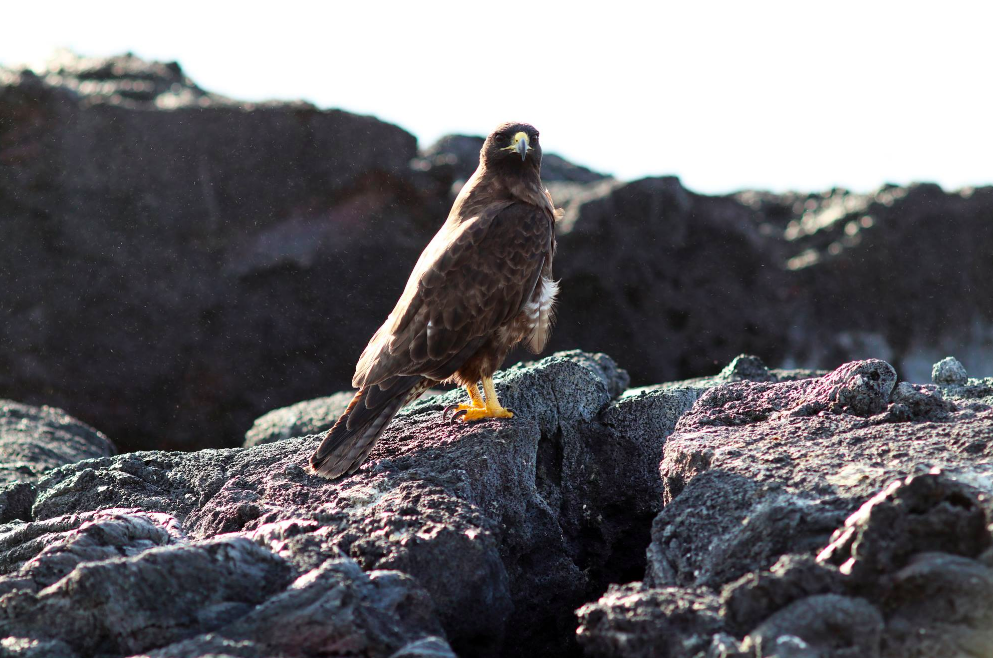
Photo Credit: Stephen Crafts
Fernandina Island, Galapagos, Ecuador
Anything But Sweet
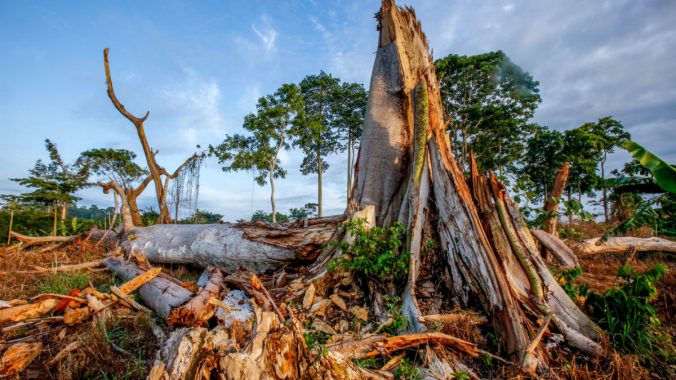
Trees felled for a cocoa plantation inside the Scio Forest Reserve in western Ivory Coast. MIGHTY EARTH
Fred Pearce provides puzzling yet somehow understandable examinations of environmental challenges, that make it impossible to look away with a clear conscience. Since reading this (note the photo above and in that story) I have been paying more attention to chocolate and its origins. I appreciate Mr. Pearce’s deep dive into the dark reality documented in this story:
The Real Price of a Chocolate Bar: West Africa’s Rainforests
Ivory Coast has lost more than 80 percent of its forests in the last 50 years, mainly to cocoa production. The government has a plan to turn over management of former forest to international chocolate manufacturers: Is it a conservation strategy or a land grab?
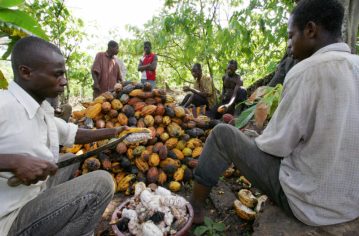
Workers cut cocoa in the Ivory Coast village of Godilehiri. Most of the country’s cocoa is grown by small farmers, on plots of 7 to 10 acres. ISSOUF SANOGO/AFP/GETTY IMAGES
How can you save the last rainforests from rampant deforestation in one of Africa’s most biodiverse countries? A crackdown on those responsible — in this case, chocolate growers and traders? In the Ivory Coast, the government thinks differently. It is unveiling a plan instead to remove protection from most of its remaining forests and hand them over to the world’s chocolate traders. Is this madness, a brutal land grab, or the only way out?
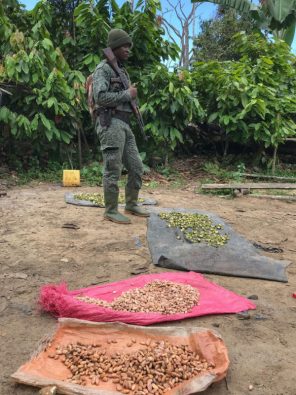
A park ranger stands over illegally harvested cocoa, found during a routine patrol of the Cavally Classified Forest in Ivory Coast. MIGHTY EARTH
In the past half-century, few countries have lost rainforests as fast as the Ivory Coast. More than 80 percent of its forests are gone, most following an illegal invasion by as many as a million landless people into national parks and other supposedly protected forests. The Marahoue National Park alone has 30,000 illegal inhabitants. The invaders are growing cocoa to supply the global chocolate business.
The Ivory Coast, a West African country the size of New Mexico, produces more than a third of the world’s cocoa. The crop contributes around a tenth of the nation’s GDP. But around 40 percent of the country’s cocoa crop — more than a tenth of the world’s chocolate bars — is grown illegally in the country’s national parks and 230 supposedly protected government-owned forests, known as forêts classée, says Etelle Higonnet of Mighty Earth, a United States-based environmental group active in cataloging the footprint of key global commodities.
Most cocoa is grown in monocultures of what is known as the full-sun system, requiring the removal of all surrounding trees. Meeting the world’s insatiable demand for the beans that make chocolate has resulted in many protected areas being “completely converted to farms,” according to Eloi Anderson Bitty of the University Felix Houphouet-Boigny in Abidjan. Continue reading
Bird of the Day: Yellow-throated Bulbul

Preparing For Global Big Day 2019
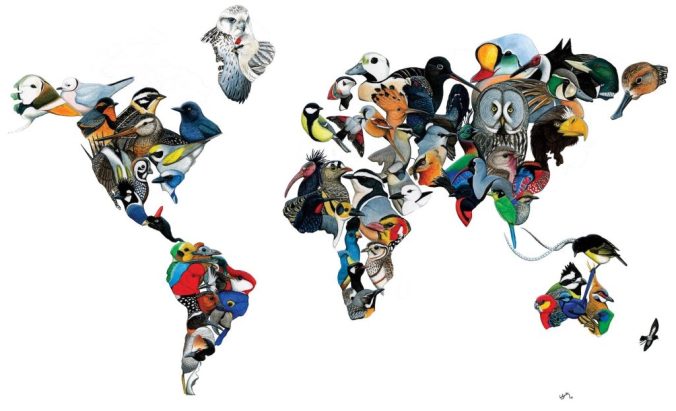
Global Big Day artwork by Luke Seitz
The first time we took part in this annual event, we had already had several years of advance prepping. For example, we had this young man as an intern who was something of a birding wunderkind. Ben helped us determine whether our region of the Western Ghats was likely to appeal to birdwatchers. Short answer, yes. That same summer, 2012, Seth was in his second year working for the Lab of Ornithology and we could see that not only our company’s work but our own family was becoming more birdy, if not yet bird-nerdy.
This year will be the best year yet for birding, and to prove it I am starting today to get ready for the next Global Big Day. I do not know where we will be that day, yet, but I am working on plan. May I suggest you do the same?
Global Big Day—4 May 2019
By Team eBird
Last May, more than 30,000 people took to fields and forests around the world, noting more than 7,000 species in a single day—Global Big Day. In less than 3 months, birding’s biggest day is coming back. Wherever you are in the world, you can be a part of birding’s next world record!
On 4 May, will you join more than 20,000 others and become a part of Global Big Day? You don’t have to commit to birding for 24 hours—an hour or even 10 minutes of watching birds makes you part of the team. Visit your favorite spot or search out someplace new; enjoy a solo walk or get some friends to join in the Global Big Day fun.
How to participate
- Get an eBird account: eBird is a worldwide bird checklist program used by millions of birders. It’s what allows us to compile everyone’s sightings into a single massive Global Big Day list—while at the same time collecting the data for scientists to use to better understand birds. Sign up here. It’s 100% free. Continue reading
Bird of the Day: Burrowing Owls
Reserva Nacional Lomas de Lachay, Peru
Whale Fall

Illustrated by Armando Veve
Whales and other charismatic marine megafauna are frequently in the news related to discoveries of their mysterious navigational or communication skills, or with bad news about the negative impacts of ocean acidification or other human interaction. It never occurred to us how the decomposing carcass of something that immense can be a biological gift to marine systems that could last centuries.
A Whale’s Afterlife
On the day before Thanksgiving, 2011, Greg Rouse, a trim marine biologist in his fifties, was tidying his lab at the Scripps Institution of Oceanography, in La Jolla, California. Rouse studies the worms and other small animals that inhabit the deep sea. He was organizing his microscopes, dissection supplies, and jars of deep-sea critters when he received a long-anticipated e-mail.
In the late two-thousands, Rouse and Eddie Kisfaludy, then an operations manager for Virgin Oceanic, had begun meeting with officials from the National Oceanic and Atmospheric Administration (NOAA) and the city of San Diego to pitch an alternative approach to the disposal of dead whales. Often, whales that wash up on shore are hauled to landfills or pushed back into the water. Rouse and Kisfaludy wanted to tow one out to sea, sink it to the seafloor, and watch what happened. Whale falls, as marine biologists call such events, create pop-up habitats that may serve as stepping stones for organisms migrating from methane seeps or hydrothermal vents to other parts of the ocean. Precisely how this works, and which species colonize the carcass as it degrades, were open questions that Rouse hoped to answer.
In the e-mail, a biologist from NOAA wrote that a large female fin whale had washed ashore four days previously, on the rocky beach at Point Loma, just west of downtown San Diego. The NOAA team had already moved the carcass to the protected beaches of Mission Bay and performed a necropsy, concluding that the whale had been hit by a ship. Now they were ready to hand it over to Rouse: if he could mobilize the necessary resources on short notice, the whale was his to sink.
Rouse quickly met up with Kisfaludy to strategize. They needed a boat big enough to tow a sixty-foot, twenty-three-ton whale, so Kisfaludy leaned on a Newport-based friend, Chris Welch, for the use of his large catamaran. To sink the carcass, they sourced five tons of rusty chains from Newport Harbor and another two tons of iron shackles from the Scripps scrap yard, in San Diego.
On Thanksgiving morning, Welch set out in his catamaran—rusty chains on board—and sailed south. The next day, he met up with Rouse, Kisfaludy, and a growing group of intrigued friends at the dead whale. It rested on the sand, immovable. At high tide, however, the carcass began to float, and the team made its move. They tied seven ropes around the whale’s tail and sailed west. Several hours passed. The weather was crisp and sunny, and there was little boat traffic. To Rouse’s surprise, the whale had attracted no scavengers, despite its exposed rolls of dark purple muscle draped in white, translucent fat. The team began to consider names for the whale. Someone suggested Rosebud, and it stuck. Continue reading
Bird of the Day: Dalmatian Pelican
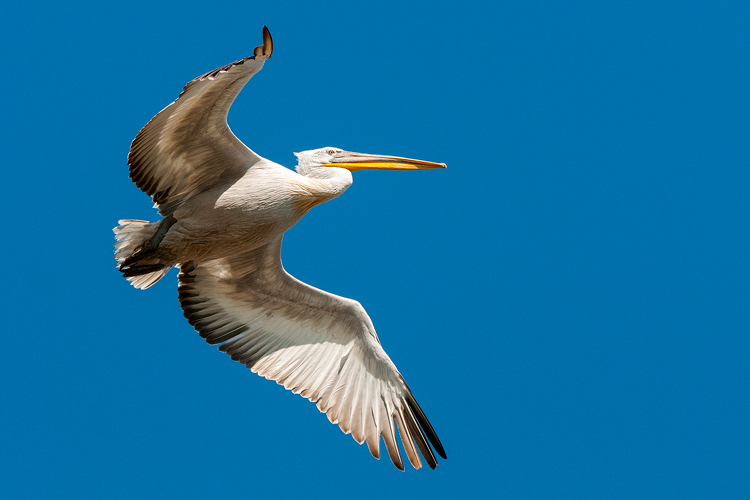
Volga Delta, Russia
 Organikos