Darwin, Northern Territory
Darwin, Northern Territory
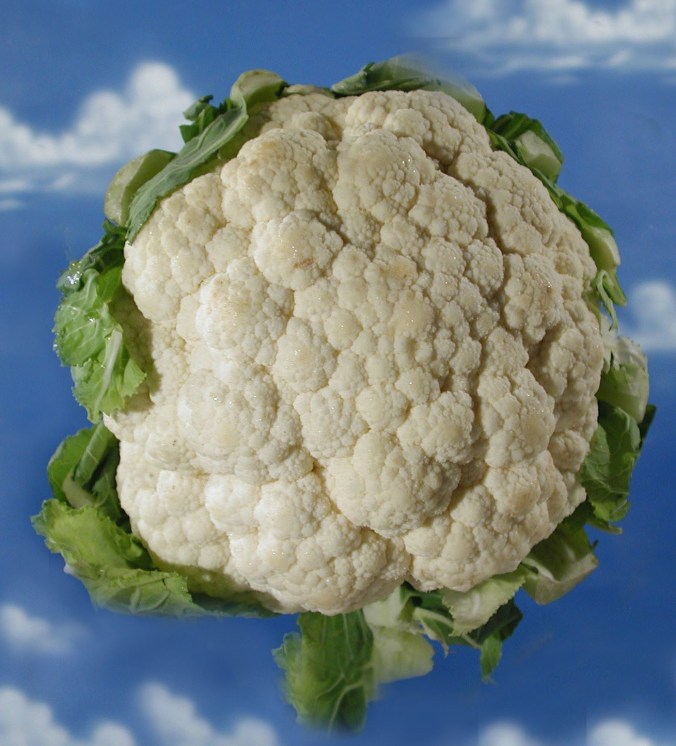
Tony Cenicola/The New York Times
Several of us who contribute here recently tested homemade pizza using the product pictured below, we pass the story along to our foodie friends, vegetarian and otherwise. Our thanks to Anahad O’Connor for this:
The Ascension of Cauliflower
Food companies are capitalizing on the low-carb, gluten-free trend by using vegetables like cauliflower to replace flour, rice and other simple carbs.
Pizza made with a cauliflower crust.
For Gail Becker, a former marketing executive who has two sons with celiac disease, finding gluten-free pizza that her kids could enjoy has long been a challenge.
So a few years ago, Ms. Becker started making her own, using a crust that contains cauliflower instead of white flour. Her sons loved her cauliflower creation so much that in 2016 Ms. Becker quit her job and launched her own company, Caulipower, which sells frozen cauliflower pizzas and cauliflower baking mix.
Cauliflower pasta looks like pasta made from wheat.
What Ms. Becker did not anticipate is how quickly it would catch on. Caulipower is now a multimillion-dollar brand, with cauliflower pizzas sold in 9,000 stores nationwide, including Whole Foods, Walmart, Safeway and Kroger.
“One thing that we were very insistent on when we started our brand is that we reference cauliflower in the name,” said Ms. Becker, who lives in Los Angeles. “We want to celebrate the vegetable. We’re not trying to hide it or sneak it in.” Continue reading
Sattal, Uttarakhand

China, Taiwan, Japan and South Korea account for well over two-thirds of high seas fishing. Photograph: Laura Lezza/Getty Images
If you are trying to watch what you eat for sustainability and impact, Justin McCurry, in Tokyo writing for the Guardian, has this story to keep in mind:
The ‘dark fleet’: Global Fishing Watch shines a light on illegal catches
Low light imaging data being used to expose unregulated and unreported fishing on the high seas
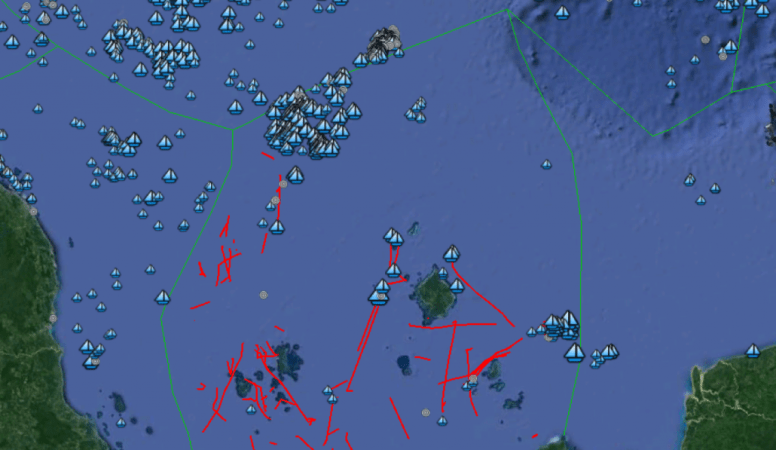
These vessels (indicated with blue boat icons) in the Natuna Sea off Indonesia were detected by VIIRS, and are suspected to not be using VMS. The red lines indicate VMS tracks from the same day.
New data is being used to expose fleets of previously unmonitored fishing vessels on the high seas, in what campaigners hope will lead to the eradication of illegal, unregulated and unreported fishing.
Global Fishing Watch (GFW) has turned low light imaging data collected by the US National Oceanic and Atmospheric Administration (NOAA) into the first publicly available real-time map showing the location and identity of thousands of vessels operating at night in waters that lie beyond national jurisdiction. Continue reading
male – Baja California Sur, Mexico
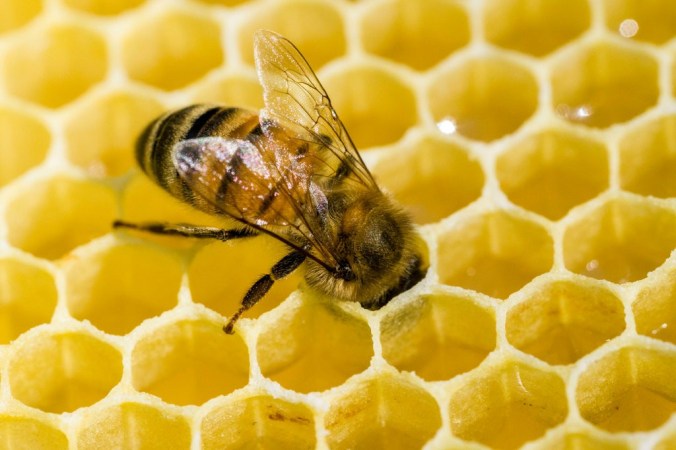
Not only can a honey bee count, it understands the concept of zero, according to researchers. CreditFrank Bienewald/LightRocket, via Getty Images
Thanks as always to James Gorman, one of the best illuminators of any variety of natural mysteries who we never tire of citing in these pages. He tells funny stories sometimes, about beautiful as well as awesome phenomena that we want to know. And he knows how to tell it:
Do Bees Know Nothing?
Researchers say bees understand the concept of nothing, or zero. But do we understand what that means?
What would it mean if bees could understand the concept of nothing?
That would be really something.
Bees were rewarded when they landed on cards with more shapes.CreditScarlett R. Howard et al.
Yet that is what scientists reported Thursday in the journal Science. Bees had already demonstrated they could count. Now, the researchers wrote, bees have shown that they understand the absence of things — shapes on a display in this experiment — as a numerical quantity: none or zero.
This is a big leap. Some past civilizations had trouble with the idea of zero. And the only nonhuman animals so far to pass the kind of test bees did are primates and one bird. Not one species, one bird, the famed African gray parrot, Alex, who knew not only words, but numbers. Continue reading
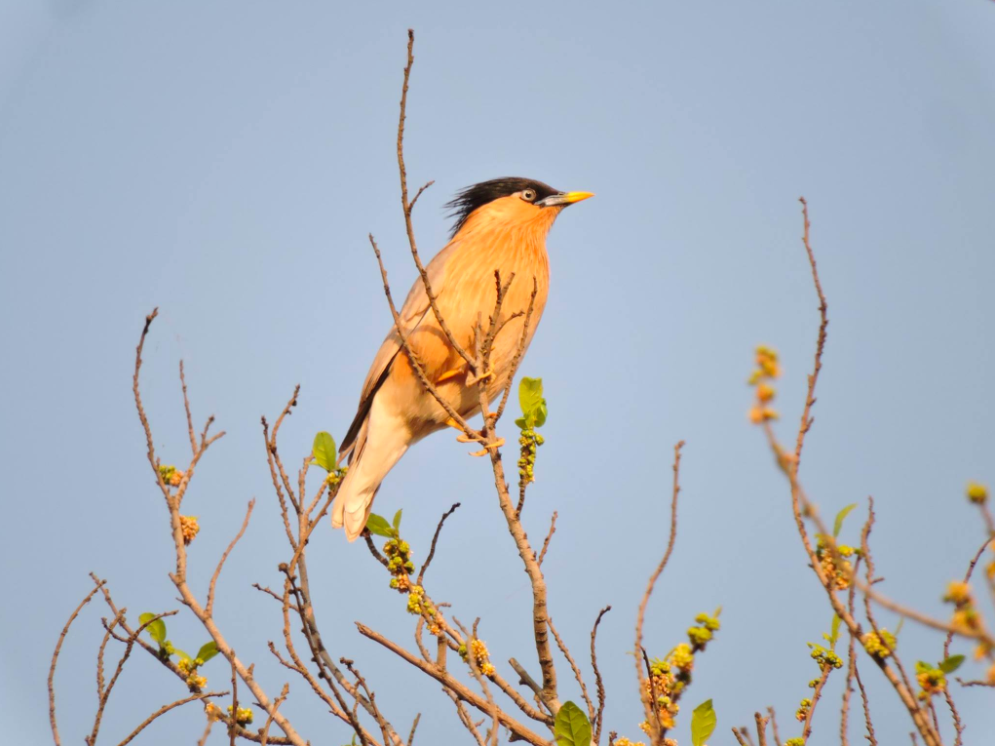
Lucknow, Uttar Pradesh
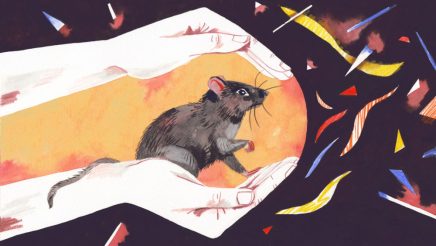
ILLUSTRATION BY LUISA RIVERA/YALE E360
Charismatic megafauna are impossible to resist caring about. Charismatic microfauna, or flora, less so. Yet more than two decades of experience in Costa Rica have taught us to appreciate the latter more than we did before. That is a function of science leading the way in conservation efforts in this small country, followed by a new form of tourism that we have been working in since the mid-1990s. That new form leveraged the skills of biologists as guides who provide interpretive experiences in the rainforest and other ecosystems, making a walk in the woods that much more interesting. So this story below catches my attention. It focuses on another small pioneering country that I have long studied from afar, admired, but not yet visited. Thanks to Brandon Keim and his colleagues at Yale Environment 360, for this story that motivates me to make that visit:
Do Conservation Strategies Need to Be More Compassionate?
Some scientists and ethicists are criticizing traditional conservation strategies, which they say focus on saving valued species while discounting the lives of less charismatic animals. Will these advocates of “compassionate conservation” point the way to new approaches, or are they simply being naïve?
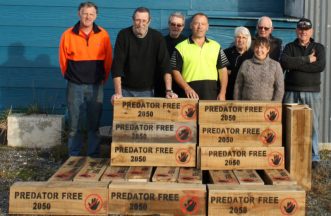
Volunteers for New Zealand’s Predator Free by 2050 campaign in front of predator traps, which are available for the public to borrow. NEW ZEALAND DEPARTMENT OF CONSERVATION
At a moment of best-selling animal intelligence books and headlines about songbird language and grieving elephants, it’s easy to forget that nonhuman minds were until recently considered — by most serious-minded scientists, anyway — to be quite simple.
Well into this millennium, animal consciousness was regularly dismissed as either nonexistent or profoundly dissimilar to our own. Animals were considered “conscious in the sense of being under stimulus control,” as the famed psychologist B.F. Skinner opined so neatly in 1974, expressing a conventional wisdom that dated to the zoological musings of Aristotle. The notion of animals as thinking, feeling beings was relegated to the edges of serious discourse.
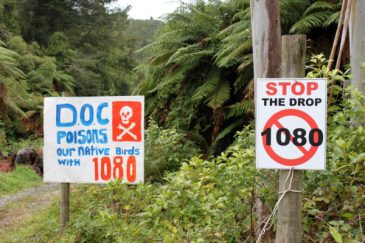
Signs opposing New Zealand’s use of landscape-scale poisoning campaigns to eradicate non-native predators, such as rats and weasels. ELI DUKE/FLICKR
Those days are past, buried by an avalanche of scientific findings and history-of-science critiques. More people than ever worry about the welfare of farmed animals; pets are practically citizens; and wild animals too are increasingly regarded as beings with whom people share fundamental aspects of inner life. Yet in some places, that mind-denying legacy survives — including, say a small but vocal number of scientists, ethicists, and animal welfare activists, in conservation. In their eyes, the discipline devoted to protecting Earth’s life has a certain blind spot to the animals themselves. Continue reading
Crooked Tree, Belize
 There is a saying, often attributed to Mark Twain (though it appears nowhere in his published writings), that history never repeats itself but it often rhymes. That quote comes to mind reading this report below by the Oakland Institute, in light of yesterday’s news from Greece. There is a rhyme with no reason that echoes between the two stories. It also brings to mind, for me, an ever-present question about the work I have done for the last two decades. Tourism, even if it is sustainable tourism development, has its downsides. So, I am always on the lookout for ways to avoid regret in projects I take on, and how they are executed. More often than not, if I sense regret it is about not having had enough impact. I prefer that to the regret of too much of this type of impact:
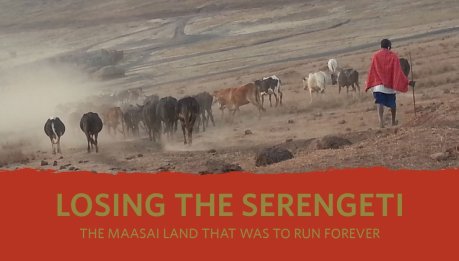
Losing the Serengeti: The Maasai Land that was to Run Forever is based on field research, never publicly-seen-before documents, and an in-depth investigation into Tanzania’s land laws. This report is the first to reveal the complicity between Tanzanian government officials and foreign companies as they use conservation laws to dispossess the Maasai, driving them into smaller and smaller areas and creating a stifling map of confinement. Continue reading
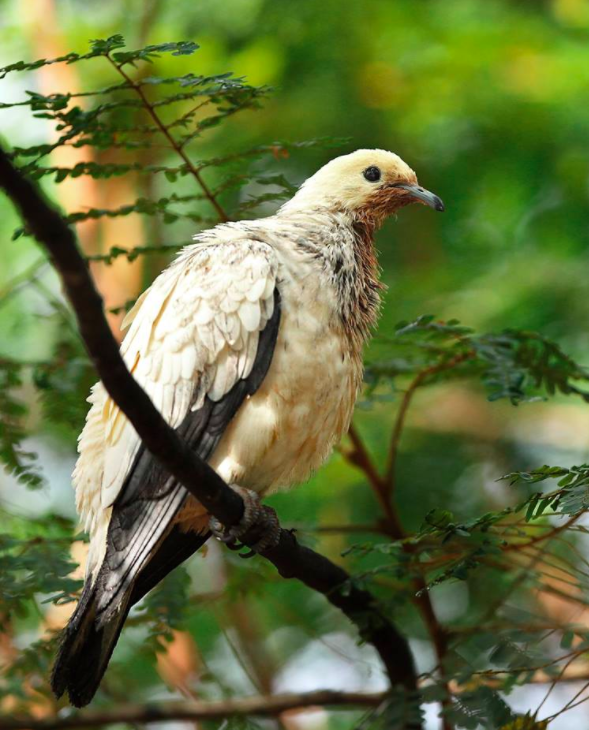
Campbell Bay, Nicobar Islands

Tourism is Greece’s biggest foreign currency earner. Photograph: Costas Baltas/Reuters
Nearly forty years ago I was in Greece for the second time. I accompanied my mother on a visit to the village where she was born and had lived until her teens. We had spent an extended period in that village ten years earlier, and into my child’s mind it had imprinted vivid memories that, by 1979, were as fresh as the smell of bread baking in the stone oven of that village home. And now, that re-visit with my mother is as vivid as can be, and even has a sound track. That album had just been released and someone in the village had a cassette tape of it, and it played from the sound system of a Volkswagen Beetle, doors open, as we had a meal overlooking the mountains.
I have had one opportunity to bring to Greece the sustainable tourism development tools I have been working with since the mid-1990s. This recent story in the Guardian, too short to truly appreciate the scale of the questions raised, is a welcome reminder to me of the work to be done in a place I care deeply about.
Greece tourism at record high amid alarm over environmental cost
With 32 million visitors expected this year, fears grow that the country cannot cope
Greece is braced for another bumper year. The tourists will not stop coming. For every one of its citizens, three foreign visitors – 32 million in total – will arrive this year, more than at any other time since records began.
It’s an extraordinary feat for a country that has battled with bankruptcy, at times has been better known for its protests and riots and, only three years ago, narrowly escaped euro ejection. Tourism is the heavy industry that has helped keep catastrophe at bay.
But is Greece almost too successful for its own good? Tourist numbers have increased by an additional two million every year for the past three years. Arrivals from China alone have doubled since 2017. But with forecasts predicting record numbers over the next decade, a growing number are asking: can Greece really cope? Continue reading
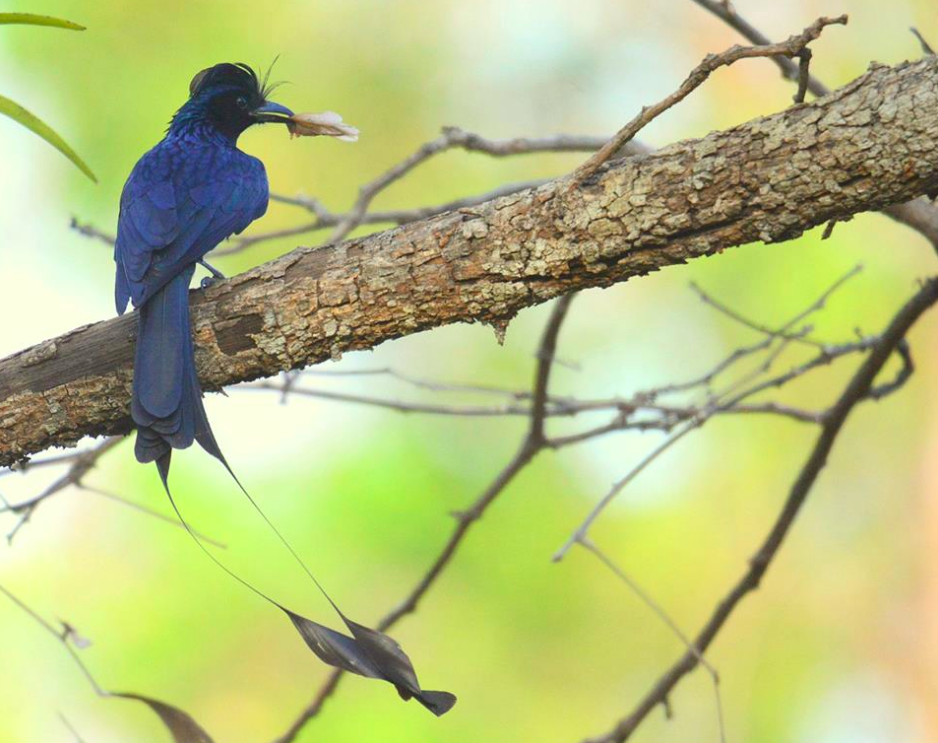
Kanha National Park, Madhya Pradesh

A surprising reproductive strategy could help to explain how stick insects—which are eaten by birds and don’t lay a lot of eggs—have managed to persist from generation to generation. Photograph by Education Images / UIG via Getty
Another day, another short-form wonder, thanks to Alan Burdick. His pieces are short, but to the point on topics we care about on this platform:
Why Stick Insects Might Be Into Birds Eating Their Kids
Stick insects make a certain amount of sense, evolutionarily speaking. They look like sticks, or twigs, or leaves; thus camouflaged, they presumably have a better chance of avoiding predators, reproducing, and passing on their stick-resemblance genes to their offspring. Except that birds still eat them, a lot. Stick insects don’t run fast, most don’t fly, and the females typically don’t lay eggs in large numbers. So there’s a mystery: How do they manage to persist from generation to generation? Why, having managed to exist, do they continue to do so? Continue reading
female – Baja California Sur, Mexico

Photograph by Francis Amiand / Spoon /Pointed Leaf Press
Hannah Goldfield, in this short piece about the spoon, reminds me that Bee Wilson’s book about the fork came to my attention about three years into our Kerala, India experience. I tend to favor stories about the history of something taken for granted. When it is involves foodways, I’m in. Five years ago, when that book came out, I was firmly entrenched in a new way of eating, namely with my right hand and no utensils. Today, reading about the spoon, I can relate to the author’s preference because, given the choice between spoon and fork I will choose the former. Given the choice between a meal that favors one or the other, I will choose the spoon-forward meal. But if I am somewhere eating something that hands-on is okay, keep the spoon and fork off the table.
In Praise of Eating Almost Anything with a Spoon
The introduction to the most recent version of Emily Post’s Table Setting Guides includes the following mandate: “Only set the table with utensils you will use. No soup; no soup spoon.” Sounds pretty reasonable, as far as Emily Post rules go, but I beg to differ. Who says that soup spoons are only for soup, or should even be called soup spoons at all? I have long admired the way utensils are used in parts of Southeast Asia, including Thailand: the spoon is the most important instrument, held in the dominant hand and used to bring food—soupy or otherwise—to the mouth; the fork plays a supporting role, used only to push morsels onto the spoon, and chopsticks are generally reserved for noodles. I’ve been eating Thai food this way ever since I learned about the custom, dipping spoonfuls of rice into coconut curries, herding green-papaya salad, spangled with peanuts, chili, and tiny dried shrimp, into the curvature of a spoon. It feels elegant, efficient, economical—nary a drop or a morsel is wasted. Continue reading
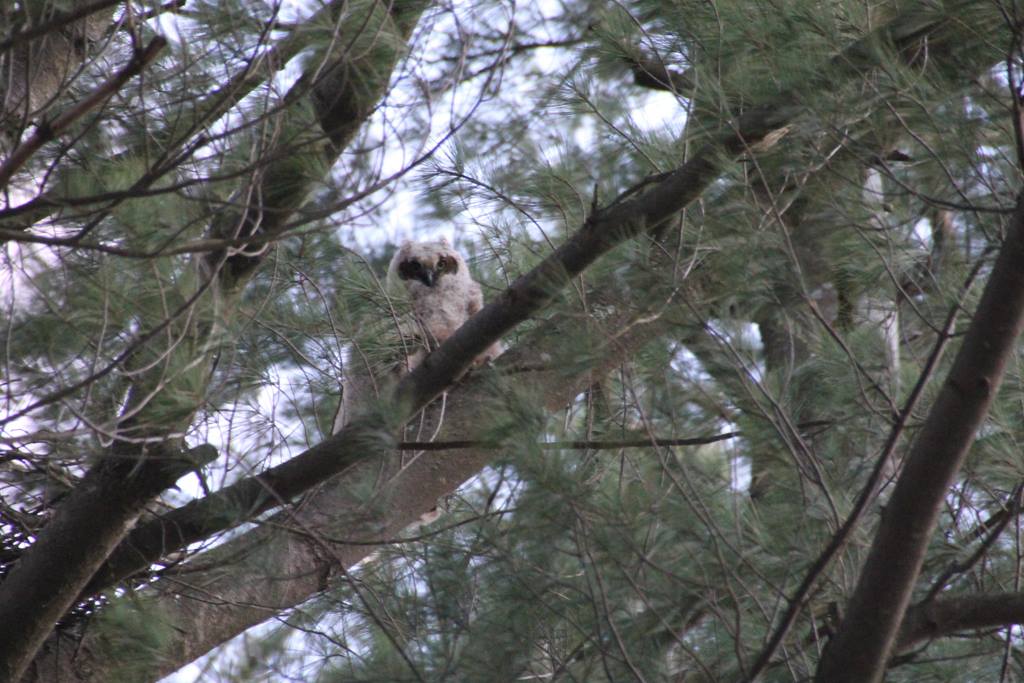
photo credit: Stephen Crafts
Juveline – Boylston, MA
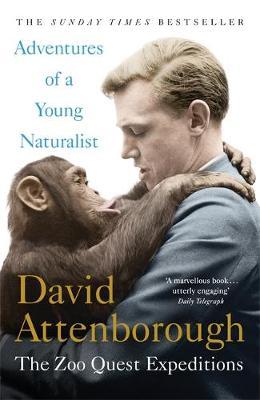 There is a reason why David Attenborough is the name that appears most frequently in these pages over the last seven years. So how did I miss this publication date nine months ago? Now there are several reviews and I am just late to the table. Nevermind that. Just read some of what Frans de Waal, the most recent reviewer, has to say:
The soothing, authoritative voice of David Attenborough has become such a widely recognized feature of nature documentaries that there are now all sorts of spinoffs. Funny animations show gorillas munching on leaves while gossiping about their encounter with the pith-helmeted explorer. Spoof documentaries of our species’ mating rituals show young men drinking beer in a Canadian bar while Attenborough’s voice-over notes that “the air is heavy with the scent of females.” In my classes at Emory University, I show so many snippets of BBC documentaries that I need to warn students that not all of our knowledge about animal behavior comes from this omnipresent talking gentleman. He is just the narrator.
David Attenborough searching for armadillos. Photograph from David Attenborough
But “just” doesn’t do justice to his role, because Attenborough co-wrote the programs and the insertion of his persona into almost every scene is deliberate. It is the key to the success of “Life on Earth,” “The Blue Planet,” “Planet Earth” and all those other BBC nature series we love. It all started with a 1950s television program featuring animals from the London Zoo. The animals were brought into a studio, where the famous biologist Julian Huxley handled them while explaining their anatomy, habits and special skills. The occasional escapes and other mishaps on this live program greatly contributed to its entertainment value. Continue reading

Bangalore, Karnataka

Cattle at an illegal settlement in the Jamanxim National Forest, state of Para, northern Brazil, November 29, 2009. With 1,3 million hectares, the Jamanxim National Forest is today a microsm that replicates what happens in the Amazon, where thousands of hectares of land are prey of illegal woodcutters, stock breeders and gold miners. Photograph: Antonio Scorza/AFP/Getty Images
The argument made below by Damian Carrington, the Guardian’s Environment editor, is one nobody can hide from. We are not. Contributors on this platform have been reducing our intake of these forms of calories over the last couple years. We can report on its not being as difficult as it may sound at first to carnivores, ice cream aficionados and milk-drinkers. We are down some 40% and pushing the envelope further as fast as we can. It is not enough, relative to what these numbers say:
Avoiding meat and dairy is ‘single biggest way’ to reduce your impact on Earth
Biggest analysis to date reveals huge footprint of livestock – it provides just 18% of calories but takes up 83% of farmland
Avoiding meat and dairy products is the single biggest way to reduce your environmental impact on the planet, according to the scientists behind the most comprehensive analysis to date of the damage farming does to the planet. Continue reading




 Organikos