
with a common carp – Sivarpanam Palace, Tamil Nadu
with a common carp – Sivarpanam Palace, Tamil Nadu
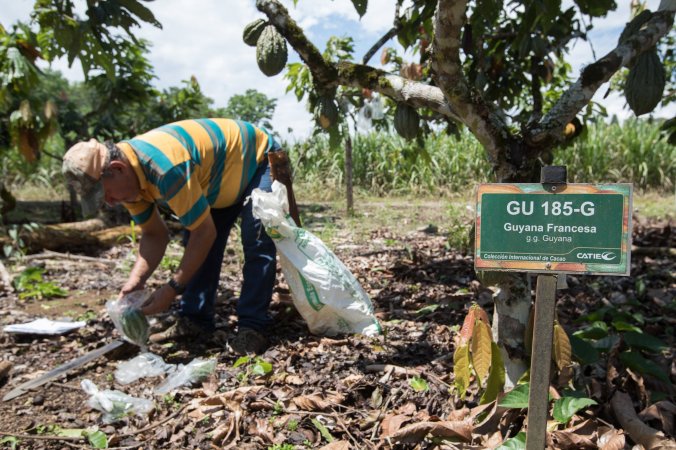
At the International Cacao Collection in Turrialba, Costa Rica, José Antonio Alfaro examined pods — which hold the seeds that make chocolate — treated to resist a devastating fungus. Only a few cacao varieties are widely cultivated, making them susceptible to outbreaks. Credit Mónica Quesada Cordero for The New York Times
As we transitioned from life in India back home to Central America this year, patrimonial foods, and the ecological considerations of food sourcing has been a primary interest. Our pages have featured stories about monoculture agriculture endangering a well loved crop: bananas and coffee have cycled through similar situations. Below is an example of experiments with hybridization probably saving a species.
A Battle to Save the World’s Favorite Treat: Chocolate
TURRIALBA, Costa Rica — The trees of the International Cacao Collection grow here in an astonishing diversity of forms, bearing skinny cacao pods with scorpion-stinger protrusions, spherical green pods that could be mistaken for tomatillos, oblong pods with bumpy skin resembling that of the horned lizard — all in colors ranging from deep purple to bright yellow.
Within each of these pods are seeds that yield something beloved by billions: chocolate.
But despite this diversity, few cacao varieties are widely cultivated, and that’s a problem: Like many other crops, cacao is under constant threat from diseases and environmental challenges exacerbated by our tendency to grow only a few varieties with similar or identical genetic traits and defects.
“Most varieties produced worldwide belong to a narrow set of clones selected in the forties,” said Wilbert Phillips-Mora, who oversees this collection of 1,235 types of cacao trees and heads the Cacao Genetic Improvement Program at C.A.T.I.E. (an acronym in Spanish for the Tropical Agricultural Research and Higher Education Center).
A narrow gene pool means that most commonly cultivated varieties of cacao are susceptible to the same diseases, and these blights can spread quickly.
Cacao production brought relative prosperity to the Caribbean coast of Costa Rica until the late 1970s, when farmers began to notice that pods on their trees were developing a fuzzy white fungal coating and eventually mummifying.
The fungus — Moniliophthora roreri, also called monilia or frosty pod rot — soon spread around the country, and by 1983 Costa Rican exports of dry cacao beans had declined by 96 percent. The industry here has never recovered.

Leimhakong, Manipur

A barbecued vegetable platter, top, with kale rib and carrot “brisket.” Beluga lentils, black rice and chimichurri broth, left, and a side of crisped smoked beef from Stemple Creek Ranch. Credit Preston Gannaway for The New York Times
Although not quite an example of “Model Mad“, this culinary entrepreneurial activism sends a message to both consumers and food industry colleagues alike.
San Francisco Chefs Serve Up a Message About Climate Change
Karen Leibowitz and Anthony Myint opened the Perennial in San Francisco last year with a clear mission in mind: Run an environmentally friendly restaurant with a minimal carbon footprint, and inspire other restaurateurs to do the same.
As [the current administration] has questioned the existence of climate change, Ms. Leibowitz and Mr. Myint have emerged as activists, at the forefront of a growing movement of chefs who not only recognize and measure the impact of their industry on the planet, but also look for new ways to undo the damage.
Mr. Myint and Ms. Leibowitz, who are married, have been immersed for the last few years in the research that directs every decision at the restaurant, like choosing the kitchen’s energy-efficient equipment and its raw ingredients, many of which are grown in ways that can regenerate the soil. Continue reading
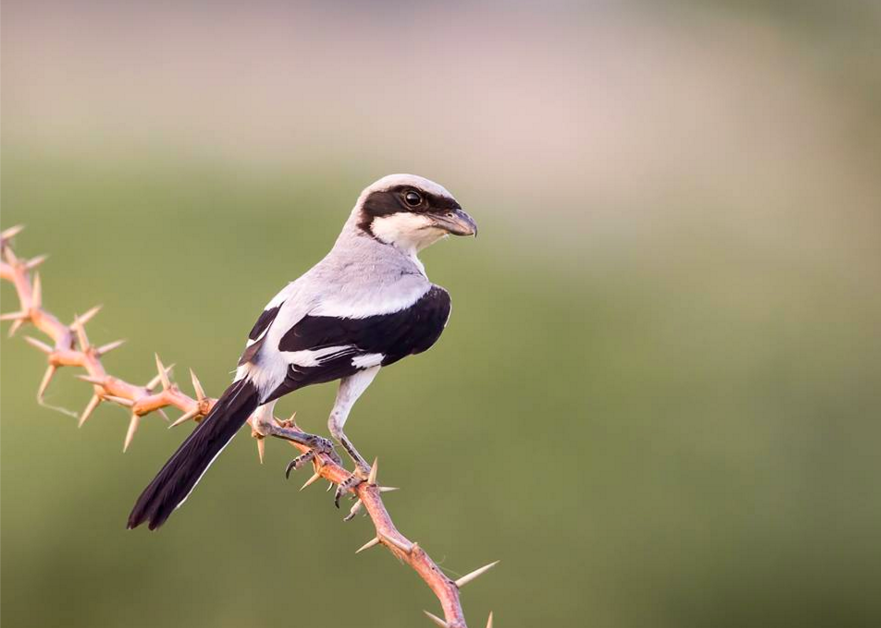
sub-adult – Vijayapura, Karnataka

Sophia Spencer and Morgan Jackson co-wrote a scientific paper on Twitter, entomology and women in science, after a tweet about Sophia’s love for bugs went viral
It’s good to find an inspiring story highlighting a child’s interest in scientific exploration and the support of parents and the entomological community to foster that passion. Thanks to NPR for bringing it to our attention.
Once Teased For Her Love Of Bugs, 8-Year-Old Co-Authors Scientific Paper
Sophia Spencer, 8, loves bugs — especially grasshoppers. She’s an expert on insects, and likes to give her littlest friends an occasional ride on her shoulder.
That used to earn her mockery from her peers. But now it’s earned her a massive outpouring of support — and a byline in the Annals of the Entomological Society of America.
Everything changed after Sophia’s mom, Nicole Spencer, reached out to scientists for support last year.
She wrote to the Entomological Society of Canada and explained the dilemma. Her daughter wanted to know if she could learn more about bugs as a job, but her mom wasn’t sure how to encourage her. And she wanted to reassure her that her entomological enthusiasm wasn’t weird.
Mission accomplished. Continue reading
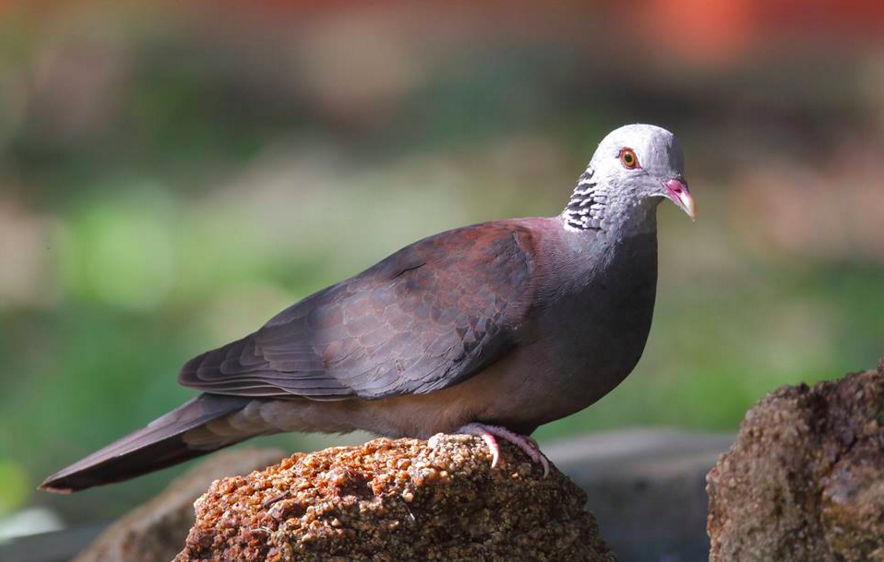
Bangalore, Karnataka
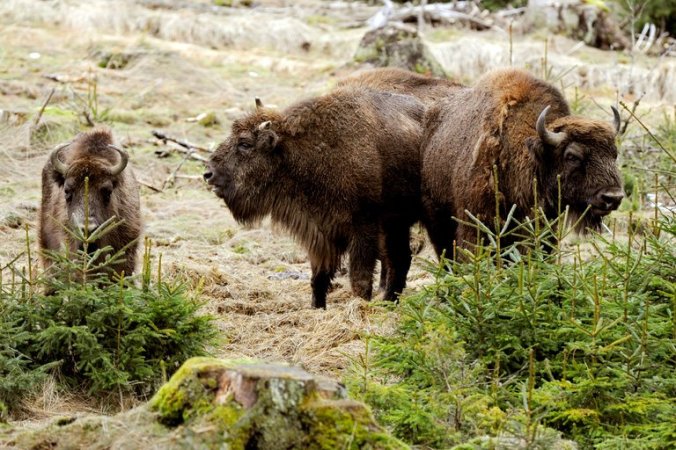
European bison near the town of Bad Berleburg, Germany, in 2013. Credit Marius Becker/Picture Alliance, via Associated Press
Bison in Europe have not been on our agenda for a while, though rewilding in Europe remains a topic we monitor and share here with regularity. Progress seemed more the rule than the exception; so this recent story from Germany takes us by complete surprise:
Last week, a rare wild bison was spotted wandering alone near the town of Lebus in eastern Germany. A local official, alarmed that the animal could be dangerous, ordered hunters to shoot it and one of them did, using a rifle to kill an animal that had not freely roamed Germany for several hundred years, conservationists say.
The killing of the mature male European bison on Sept. 14, which was first reported by local news outlets, set off an outcry among conservationists, who have worked to protect the species and increase its population. The World Wide Fund for Nature in Germany has begun a lawsuit against the local official who gave the order, Heiko Friedemann, setting off a state investigation before it goes to court. Continue reading
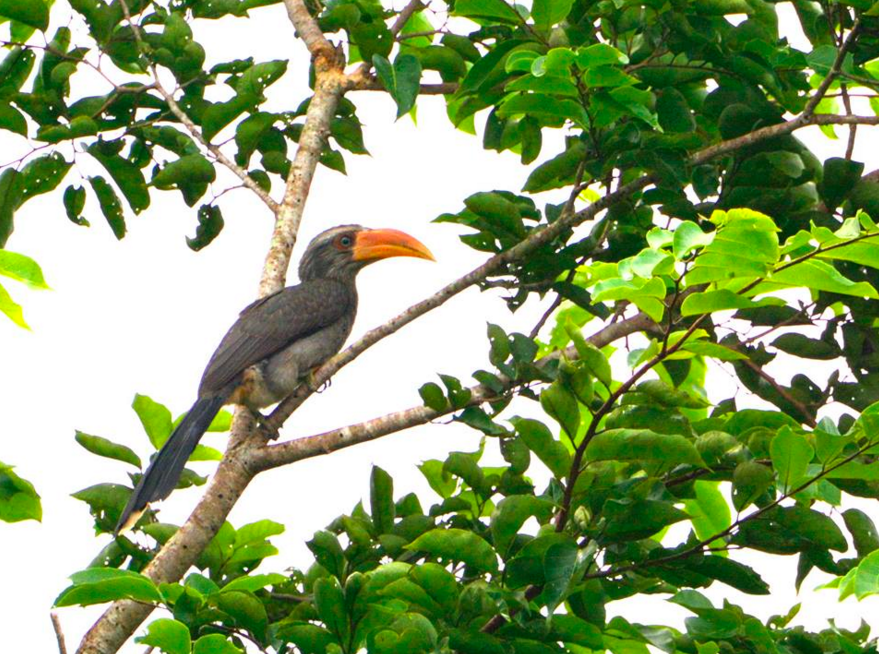
Thattekad Bird Sanctuary, Kerala

Illustrations by JON HAN
Once again we thank NYTimes Science writer Justin Gillis for this primer on a complex and politically weighty issue.
Climate Change Is Complex. We’ve
Got Answers to Your Questions.We know. Global warming is daunting. So here’s a place to start: 17 often-asked questions with some straightforward answers.
1.Climate change? Global warming? What do we call it?
Both are accurate, but they mean different things.
You can think of global warming as one type of climate change. The broader term covers changes beyond warmer temperatures, such as shifting rainfall patterns.
President Trump has claimed that scientists stopped referring to global warming and started calling it climate change because “the weather has been so cold” in winter. But the claim is false. Scientists have used both terms for decades.
2.How much is the Earth heating up?
Two degrees is more significant than it sounds.
As of early 2017, the Earth had warmed by roughly 2 degrees Fahrenheit (more than 1 degree Celsius) since 1880, when records began at a global scale. The number may sound low, but as an average over the surface of an entire planet, it is actually high, which explains why much of the world’s land ice is starting to melt and the oceans are rising at an accelerating pace. If greenhouse gas emissions continue unchecked, scientists say, the global warming could ultimately exceed 8 degrees Fahrenheit, which would undermine the planet’s capacity to support a large human population.
3.What is the greenhouse effect, and
how does it cause global warming?We’ve known about it for more than a century. Really.
In the 19th century, scientists discovered that certain gases in the air trap and slow down heat that would otherwise escape to space. Carbon dioxide is a major player; without any of it in the air, the Earth would be a frozen wasteland. The first prediction that the planet would warm as humans released more of the gas was made in 1896. The gas has increased 43 percent above the pre-industrial level so far, and the Earth has warmed by roughly the amount that scientists predicted it would.

Eaglenest Wildlife Sanctuary, Arunachal Pradesh
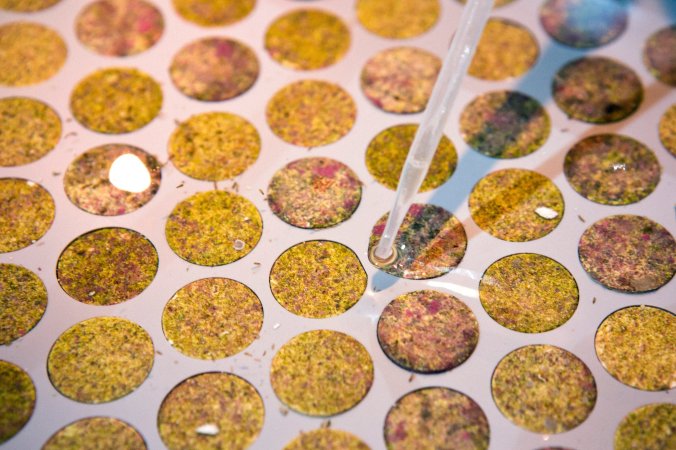
A researcher used a pipette to release coral larvae into trays to encourage settlement and growth. Credit David Maurice Smith for The New York Times
This feature story suggests that even as we stress nature on a global scale, there are creative scientists working on fixes for particular challenges:
Building a Better Coral Reef
As reefs die off, researchers want to breed the world’s hardiest corals in labs and return them to the sea to multiply. The effort raises scientific and ethical questions. Continue reading
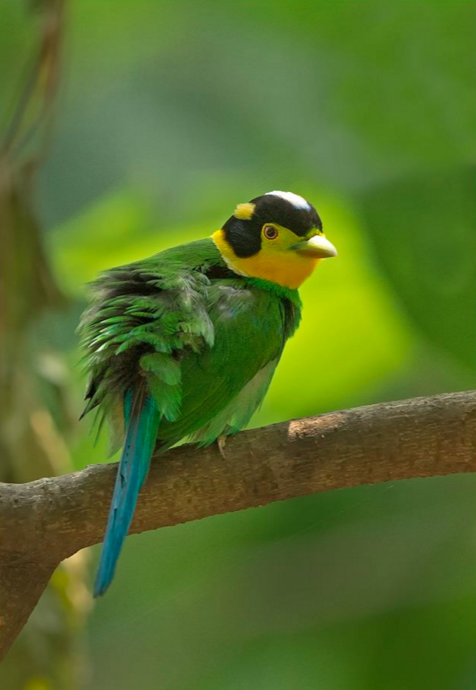
Bhimtal, Uttarakhand

Thanks to Jonathon Shaw and Harvard Magazine for bringing our attention to this book:
Life Beyond Sight
The microbial earth, brought into view
IN ROCKS AND SOIL, air, ponds and oceans, life is dominated by creatures that humans cannot see. Microbes thrive everywhere, from gardens and kitchens to the harshest environments on the planet: under polar ice, in hydrothermal vents at the bottom of the sea, in hot springs that spew acid. A single gram of soil teems with billions of them, and their genetic diversity is equally impressive, dwarfing that of all the plants and animals
on Earth. Life at the Edge of Sight: A Photographic Exploration of the Microbial World (forthcoming from The Belknap Press of Harvard University Press), brings the planet-shaping diversity of these single-celled, microscopic organisms into view through stunning images. Co-authors Roberto Kolter, professor of microbiology and immunology, and Scott Chimileski, a research fellow in microbiology and immunology at Harvard Medical School, share their passion for the subject in part by magnifying what cannot be seen unaided, in part by revealing large-scale microbial impacts on the landscape. Kolter has long been a leader in microbial science at Harvard, while Chimileski brings to his scholarship a talent for landscape, macro, and technical photography…
Read the whole article here, and if you happen to be in Cambridge (MA, USA) this exhibition might be of interest:
World in a Drop: Photographic Explorations of Microbial Life
The minuscule ecosystem within a single drop of water is home to an astonishing diversity of organisms busily living out their lives and interconnected by myriad complex relationships. The photographic exhibit World in a Drop is an aesthetic journey into this microbial world, as revealed through cutting-edge imaging
technologies. With expertly executed photography, videography, and poetic narration, Scott Chimileski and Roberto Kolter capture the intrinsic beauty of a mysterious world that is seldom recognized.

Bangalore, Karnataka
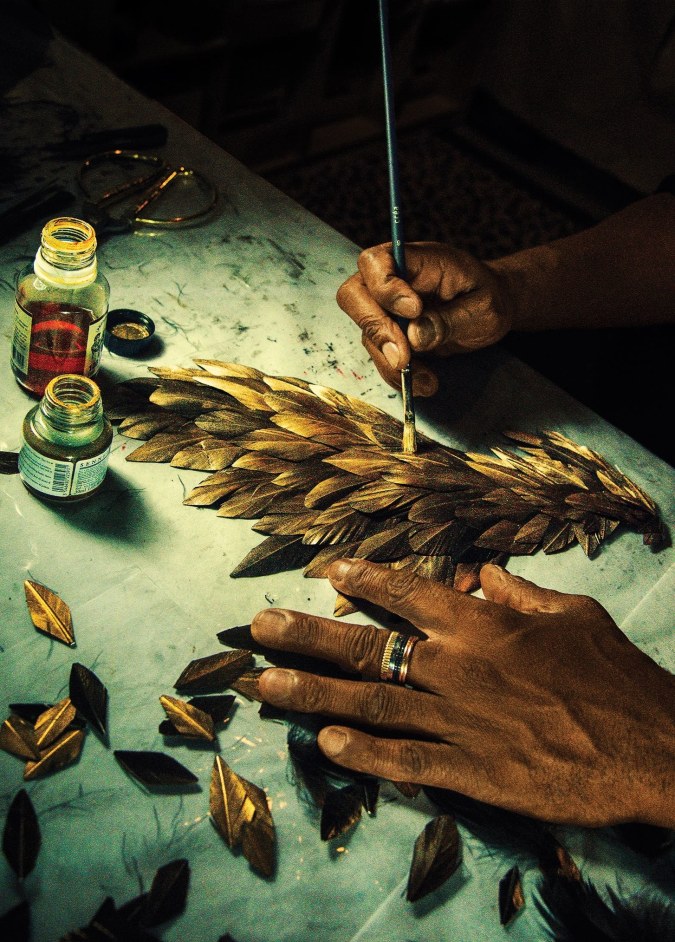
Charles-Donatien paints and lacquers goose feathers in his studio. Photograph by Pari Dukovic for The New Yorker
The Style issue of the New Yorker is the least interesting of the year, from the perspective of these pages; and yet on occasion even in this one they deliver something we can mull over:
The Eternal, Seductive Beauty of Feathers
We’ve been dressing up as birds since the Stone Age. Eric Charles-Donatien has brought the craft of featherwork into the twenty-first century.
Not surprisingly Burkhard Bilger is the journalist who pulls this off. Our Bird Of The Day (365 times for seven years running) feature exposes us to feathers of such variety that we could not resist giving Mr. Bilger the benefit of the doubt on this one:
There is such a thing as too much beauty. So the stuffed bird on the counter seemed to be saying. It was a Himalayan monal, Lophophorus impejanus, Liberace of land fowl. Its head was emerald, its neck amber and gold, its back a phosphorescent violet that flared to a sunburst at the tail. A pouf of feathers jutted from its head like a tiny bouquet. Named for Lady Mary Impey, the wife of the Chief Justice of Bengal in the late seventeen-hundreds, it had a stout, ungainly body swaddled in bright plumes as if for an audience with the maharaja. It was a turkey that wanted to be a hummingbird. Continue reading

Vijayapura Outskirts, Karnataka
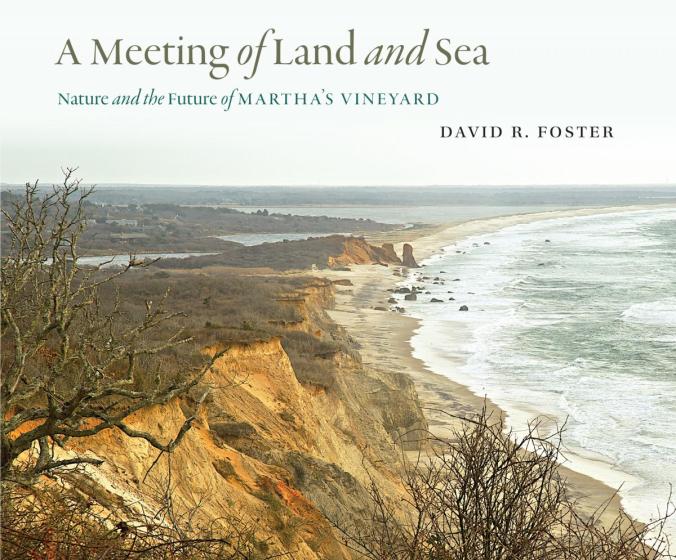
Whether or not you have been to Martha’s Vineyard, if you have been through our pages at all you will understand how this excerpt from the above book captures our attention and why we are interesting in tracking it down for a closer look:
The Vineyard landscape is distinct in many ways — most notably in land values, pace of development toward full build-out, the assemblages of plants and animals, and past success in land protection — but it typifies many qualities of Massachusetts and the greater New England region, including their conservation challenges. They share the history of agricultural and woodlot land use, the ongoing growth of their forests, the tension among farmed, open, and wooded lands, the relentless sprawl of development, the fragmentation of the land by many small, private landownerships, and the looming threats from climate change, sea level rise, insect outbreaks, and other stresses. Nevertheless, the Vineyard has put itself into a particularly strong position to address the looming challenges due to its expansive breadth of conserved lands, its forward-looking and Island-wide planning efforts and knowledge base about the landscape, and the capacity for ongoing land protection and stewardship. Continue reading

Bangalore, Karnataka
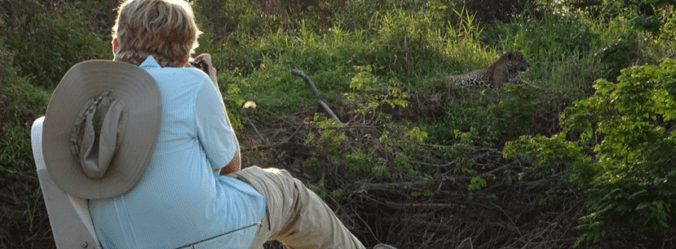
A recent study found that the value of jaguars to tourism (US$6,827,392) was far in excess of the cost to ranchers from depredation of their cattle (US$121,500)
The intersection between jaguar territory and tourism has been part of our work for decades, in both the Paraguayan Pantanal, Costa Rica’s Osa Peninsula and more recently in northwestern Belize.
We’ve seen the efficacy of species protection via conservation tourism when the economic value of species survival is quantified. This is good news for one of our favorite animals.
Curiosity saves the cat: Tourism helps reinvent the jaguar
From villain to hero, the jaguar (Panthera onca) stands at the cusp of a radical overhaul in its public image. As the largest cat in the Americas, the species commands a dominant role in the food chain of its native Pantanal – a vast swathe of tropical wetland that encompasses parts of Brazil, Paraguay and Bolivia. Once hunted for its fur, the jaguar’s appetite for the abundant prey in the Pantanal has led it into deadly conflict with ranchers in recent decades, casting it as the stalking menace of livestock and livelihood in a region where much of the land is reserved for cattle rearing. However, in a hopeful development for conservationists, researchers have revealed in a new study published in Global Ecology and Conservation that jaguars are worth 60 times more to tourism than the cost the big cats inflict on ranchers.
“The study represents a regional reality in the Pantanal,” said Fernando Tortato, research fellow at Panthera, the global wild cat conservation group that helped lead the study. “Where the jaguar brings in far more revenue than the potential damage it can cause.”
Jaguars once abounded from the southwestern U.S. to Argentina, but their numbers have fallen due to hunting and habitat loss. In the Amazon rainforest, deforestation is an ongoing threat, even while the dense foliage often precludes human encounters with jaguars. In the absence of benign tourism opportunities there is demand for jaguar teeth, paws and claws as souvenirs.
But jaguar’s predilection for lush and low-lying forest makes the Pantanal a stronghold for the species. The wetland’s web-like tributaries also open the wild cat’s home to human exploration, allowing tourists to share in their company.
In the Pantanal, the biggest threat to their survival is conflict with ranchers. Continue reading

 Organikos