Community Conservation in the Arnavon Islands

ACMCA ranger Dickson Motui clears a path for the hatchlings. Photo © The Nature Conservancy (Justine E. Hausheer)

We value sea turtles as an important part of the ocean ecosystem, and are always happy to hear about new conservation stories regarding them. In many coastal areas, the sea-faring reptiles are hunted for their meat and their eggs are harvested from sandy nests, quite often illegally. We report on poaching frequently here, but have good news from the Solomon Islands, where The Nature Conservancy is helping with community conservation in the Arnavons:

After a 40-year history punctuated by arson, conflict, and poaching, conservation efforts in the Arnavon Islands are yielding a glimmer of hope for hawksbill sea turtles. Now, Conservancy scientists are working with local communities to make these critical islands the first site to be registered under the Solomon Islands’ 2010 Protected Areas Act.

Continue reading

Community, Collaboration & Conservation 2011-2016

As pop-ups go, this has been long-lived. We listened to the communities we came to Kerala to serve; we collaborated with them every day of the week, each month, year after year since arrival; and the conservation work will continue. We will be watching and commenting from our new site at lapazgroup.net, which will retain all our material from the past five years.

My personal thanks to all the individuals who are listed in the Contributors section above. It would be unfair to highlight any one or even just a few of them. By definition each one broke through the inertia sometimes described as the collective action problem–leaving it to someone else to do–and did the writing and illustration needed to make our work resonate with a broad audience. And if you look at the number of views, visitors and comments they left behind, our readers seemed to appreciate all that. We had employees, as well as interns, plus friends and family— even our main man on more than one occasion contributing–individually, collectively, collaboratively.

Thanks said, we hope you will continue to follow us after the name change in a couple days.

Bad News for the Night Sky

Credit: The authors of the manuscript. Prepared by Fabio Falchi

It is unsurprising to learn that light pollution has increased in the fifteen years since the first global map tracking the spread of artificial lumens, but disappointing to hear nonetheless. Last week we posted about one downside to lights in the dark, two years ago shared the idea of “dark sky parks,” and four years ago linked to an initiative to reduce light pollution. Carl Engelking writes for the Discover Magazine blog on the new atlas of the night sky:

The beauty of the night sky is rapidly fading, and an update to the first global light pollution map, created 15 years ago, makes that painfully clear.

The new atlas revealed that more than 80 percent of the world lives under light-polluted skies – that rises to 99 percent of the population in the United States and Europe. One-third of humanity can no longer see the Milky Way. As the new map shows, the night sky is slowly retreating to the glow of artificial light.

Continue reading

The Collective Of Raxa

As we wind down this pop-up endeavor, a comment on our collaborators. First and foremost on the George M George of 2010, whose vision was what got this collective going. George had come to my attention ten years earlier in a classroom in France, where I was offering a course called Organizational Behavior in the Masters program Cornell Hotel School had established there. My first, and lasting impression of George was that he valued laughter over all else. Continue reading

Migrations in the “Animal Internet”

© BBC

A couple weeks ago we shared a story about animals’ ability to travel without getting lost, and we’ve also featured pieces about migration in birds and butterflies. That eBird post from Seth is a direct example of what Alexander Pschera calls the “animal internet,” where data is accumulated in life that can be tracked, whether with devices or by people connected around the world. John Vidal reviews Pschera’s new book and covers the idea for The Guardian:

Aristotle thought the mysterious silver eel emerged from the earth fully formed. The young Sigmund Freud could not understand how it reproduced, and modern biologists puzzled for years over whether it ever returned to the Sargasso Sea, where it was known to breed.

Last year a team of Canadian scientists found conclusive proof of that extraordinary journey. They strapped tracking devices to 38 eels and followed as they migrated more than 900 miles at a depth of nearly a mile to the Sargasso, in the Atlantic near Bermuda. This year French researchers used geolocators to watch them descending European rivers and passing through the Strait of Gibraltar, heading for the same spot.

Continue reading

Arecibo Observatory at Risk, but Defended

Photo by Nadia Drake

If you’re a fan of James Bond films, then chances are you’ve seen the Arecibo Observatory in Puerto Rico on a screen at some point–it was the location for the climax of Goldeneye, where Pierce Brosnan debuted as the British spy character. The largest radio telescope in the world, and for several decades managed by Cornell University, Arecibo Observatory is now threatened with defunding in the coming year, but the community around it in Puerto Rico, as Nadia Drake (whose father once directed the Observatory) reports for NatGeo and Science Friday, is rallying around it:

SAN JUAN and ARECIBO, Puerto Rico — Francisco Cordova just started his job as director of Puerto Rico’s Arecibo Observatory, the world’s largest radio telescope. But at a public meeting on day two of his new post, he was already facing the iconic telescope’s potential demolition.

At meetings June 7 in San Juan and Arecibo, students, scientists, observatory staff and community members spoke about what would be lost in terms of science and education if the observatory were to close, an outcome that no one in attendance seemed to find acceptable in any way. As the world’s largest single-dish radio telescope, Arecibo is famous for searching for distant galaxies,  gravitational waves, and signs of extraterrestrial life.

Continue reading

Raxa Collective, A Purposeful Pop-Up

When the first post appeared on this site we did not have a specific end date in mind. But now we do. Nearly 7,000 posts, half a million views and 1,825 days later on June 14, 2016 five years of blogging about community, collaboration and conservation around the world under the banner of Raxa Collective will be complete. We will continue these endeavors, and more, under the banner of La Paz Group. We will incorporate enhancement and expansion ideas that our readers, friends, colleagues and contributors have all shared with us.

Raxa Collective has had a very specific objective: the creation of a meaningful brand with community, conservation and collaboration as the core values. Xandari is that brand; it is the legacy of a collaboration between MLHS and La Paz Group. We expect that Xandari’s remarkable sense of community will continue to flourish under MLHS’s own guidance, as La Paz Group moves on to new challenges in the realm of entrepreneurial conservation.

Biomimicry Institute Ideas

Illustration by Franz Eugen Köhler via Wikimedia

Just a few days ago we shared a piece on biomimicry, and two weeks before that, this little drone showed the advantage of copying flying animals’ ability to perch. Today, via GreenBiz.com, we heard from the Biomimicry Institute about three ways that asking nature “how do you make energy?” can potentially help industries like construction, transportation, and energy:

Humans are becoming increasingly dependent on our ability to connect via technology and easily access the energy grid. Practically every facet of our lives is somehow plugged in and powered up. Yet as our demand for power increases, so must the innovative and life-friendly ways we access and use that energy.

Here’s a light bulb idea: how does nature make energy? For the billions of species that have existed on planet earth, humans are the only ones who have placed such a premium on unsustainable and non-local sources of energy. How then, does nature balance its energy books while producing relatively little energy waste?

Continue reading

Engineering Solutions to Disease

We haven’t feature lyme disease much here, although it’s a highly problematic pathogen that will become more common with a warming climate. The exact same goes for Zika, a much newer danger in the United States. This week in the New York Times, an article by Amy Harmon covers the idea of changing the gene pool in white-footed mice in Nantucket to fight Lyme disease, and a video explains how infecting the Aedes aegypti mosquito may help stop the spread of Zika. Below, the article:

Can genetically engineered mice save Nantucket from the scourge of Lyme disease?

If the 10,000 residents of the Massachusetts island did not have such a soft spot for deer, they might not be entertaining the prospect, which could provide the groundwork for an even more exotic approach to controlling tick-borne diseases on the mainland.

Continue reading

Building Better With Bees

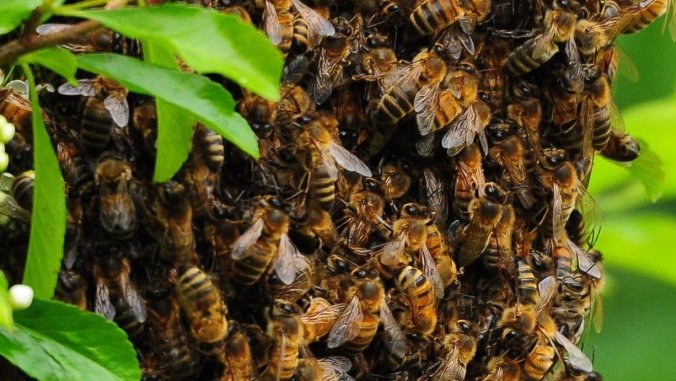
Late spring is swarm season, the time of year when bees reproduce and find new places to build hives. John Clift/Flickr

Thanks to National Public Radio (USA):

Spring Is Swarm Season, When Beekeepers Are On The Hunt For New Hives

Late spring is swarm season — the time of year when bees reproduce and find new places to build hives. Swarms of bees leave the nest and zoom through the air, hovering on trees, fences and houses, searching for a new home.

While a new neighborhood beehive can be stressful for homeowners, it’s an exciting time for beekeepers, who see it as an opportunity.

Recently, these vital pollinators have been under threat. U.S. beekeepers report losing about a third of their honeybee colonies each year in recent years. And North America’s 4,000 other species of native bees are also declining.

So, when a swarm is announced on the Bee Town Bee Club Facebook page in Bloomington, Ind., beekeepers race to call dibs. Continue reading

Celebrating Two Decades Of La Paz Group

The exact date of La Paz Group’s founding precedes the date on which the company was formally incorporated; it is fair to say that moving to Costa Rica was the inception. At about this time of year in 1996 our family moved to Costa Rica so that I could begin field work on the initiative I had already accepted responsibility for starting in 1995.

It was an initiative perfectly suited for me, just completing my doctoral dissertation at the same time that Costa Rica’s President, Jose Maria Figueres, was two years into his quest to make Costa Rica a model of sustainable development. My dissertation research provided theoretical foundation for the initiative, and motivation for me to “test it” in the marketplace. I was extremely fortunate to be in the right place at the right time.

Two decades later, the concept of entrepreneurial conservation, which was at the heart of the sustainable development initiative in Costa Rica’s tourism sector starting in the mid-1990s, is thriving. La Paz Group is, as well, as we will begin illustrating on these pages starting today.

New Carbon Capture Method in Iceland

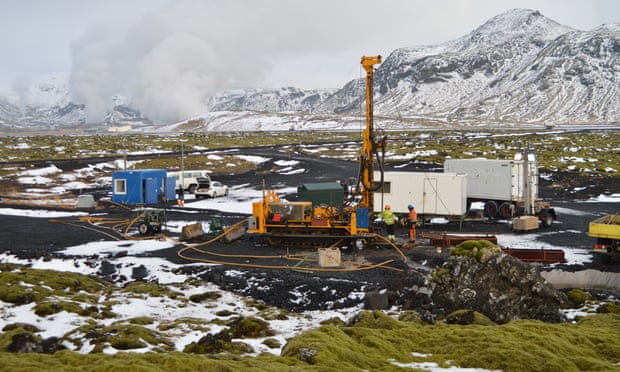
Site close to the Hellisheidi geothermal power plant, where CO2 was injected into volcanic rock. In two years it was almost completely mineralised. Photograph: Juerg Matter/Science via The Guardian

We’ve discussed carbon capture before, in the chemical sense with scrubbers at coal-plants and regarding the history of coal, but most of our posts have been concerned with lowering carbon emissions rather than sequestering it. Today we learned that a new technique tested in Iceland turned CO2 released from a geothermal plant into a limestone of sorts, where it appears to no longer contribute to global greenhouse gases. Damian Carrington reports for The Guardian:

Carbon dioxide has been pumped underground and turned rapidly into stone, demonstrating a radical new way to tackle climate change.

The unique project promises a cheaper and more secure way of burying CO2 from fossil fuel burning underground, where it cannot warm the planet. Such carbon capture and storage (CCS) is thought to be essential to halting global warming, but existing projects store the CO2 as a gas and concerns about costs and potential leakage have halted some plans.

Continue reading

Murphey Candler Park

Not far from where my grandmother lives just outside of Atlanta, there’s a public park with a lake that I have recently visited several times to go birding. On eBird, the park’s hotspot boasts one hundred and fifty-four species of birds, so it was a natural place for me to check out, especially given that the park’s lake might attract some water birds I haven’t seen yet.

In addition to the thirty-eight species I saw myself during three morning walks around the lake–several of which will become Bird of the Day photos over the following months–I also enjoyed the forest scenery in this suburban oasis, and got to see Continue reading

Bravo, Tim Samuel

Screen Shot 2016-06-09 at 7.56.25 AM

Associate Professor Ian Tibbetts, a fish biologist at the Centre for Marine Science at the University of Queensland, says that while it’s difficult to tell from photos alone, the fish looks like it could be a juvenile trevally, which are known to seek shelter among the stingers of certain jellyfish. In this case, the situation may have taken a surprise turn for the small fish, which ended up inside the jellyfish.

Glancing at this image does not give clarity on what it is, so someone’s description is required. It is an intersection of nature’s surprises and the even greater surprise of a photographer capturing nature’s surprises. As if you needed us to remind you how awesome nature is, we send you to Tim Samuel’s portfolio, where you can also order prints and learn that he:

Continue reading