Adaptation’s Last Chances

lead_960 (1)

Thanks to the Atlantic‘s excellent science writer, Ed Yong, for this:

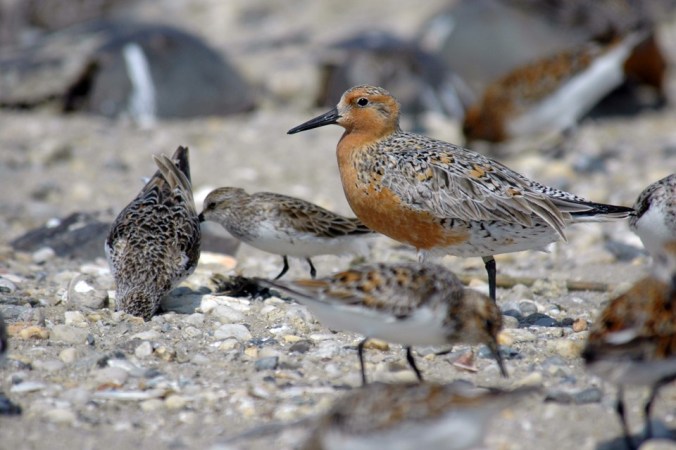
Climate Change Is Shrinking Earth’s Far-Flying Birds

In which the red knot is the canary, and the planet is the coalmine.

ED YONG

Every year, flocks of red knots criss-cross the globe. In the summer, these shorebirds breed in the Arctic circle, making the most of the exposed vegetation and constant daylight. Then, anticipating the returning ice and continuous night, they fly to the opposite end of the world. Different populations have their own itineraries, but all are epically long: Alaska to Venezuela; Canada to Patagonia; Siberia to Australia.

These migratory marathons mean that the red knot’s fate in one continent can be decided by conditions half a world away. And that makes it a global indicator, a sentinel for a changing world. It is the proverbial canary in the coalmine, except the mine is the planet.

And the canary is shrinking. Continue reading

Animal Kingdom Selfies

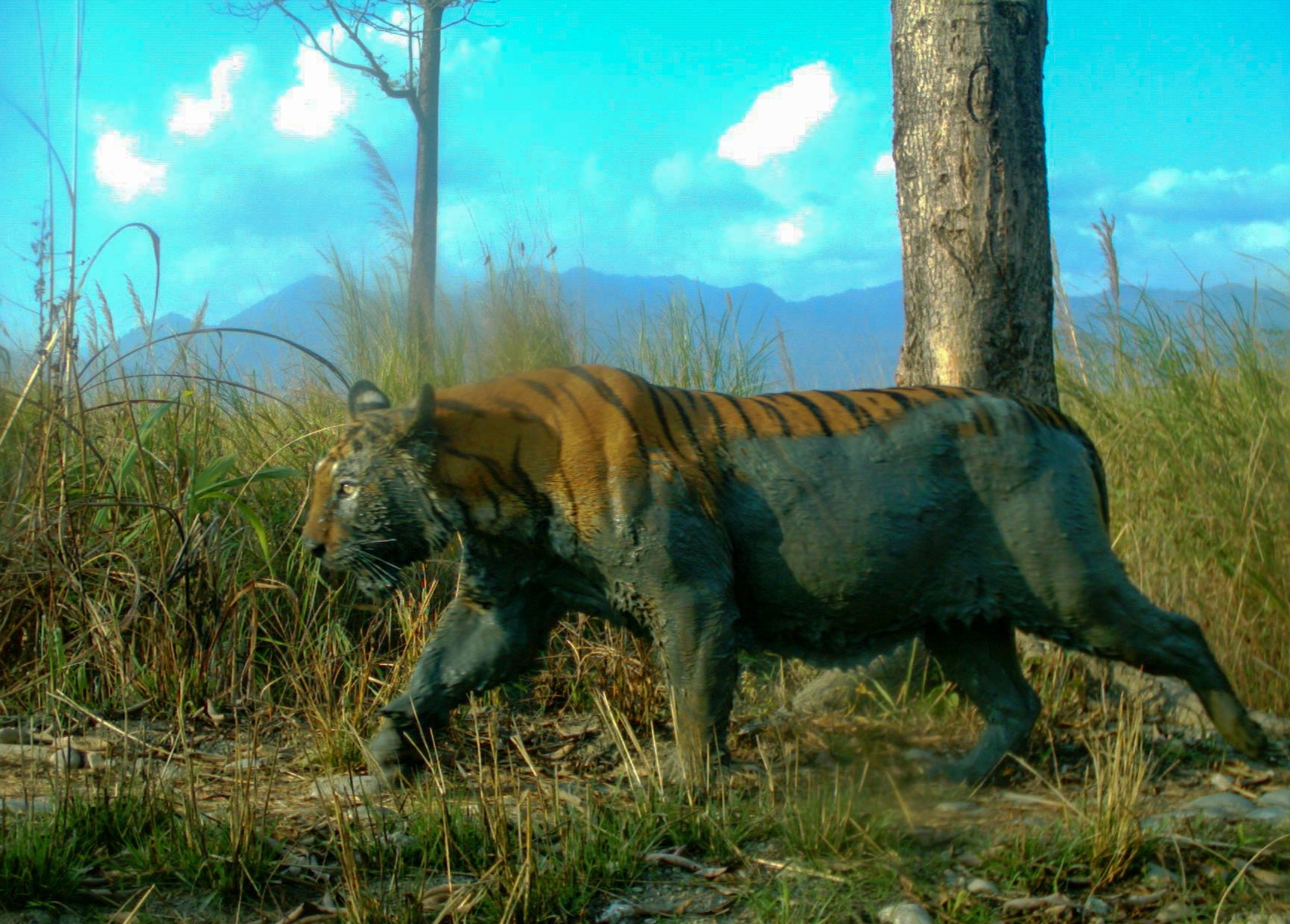
This tiger has emerged from a cooling mud bath at Manas National Park in India. Researchers can identify individual tigers based on their unique array of stripes. Credit: WWF-India. Courtesy of “Candid Creatures: How Camera Traps Reveal the Mysteries of Nature,” by Roland Kays (May 2016, Johns Hopkins University Press

Once again, Science Friday has come through with a cool article about an interesting subject. It contains excerpts from a new book containing images from camera traps, which are good research tools for animals that try to avoid humans. We’ve featured the devices a lot as a result, and now we get to continue doing so. Julie Leibach reports:

A new book of unabashed selfies has been released, but it reveals neither hide nor hair of a Kardashian. There is, however, plenty of hide and hair. Candid Creatures: How Camera Traps Reveal the Mysteries of Nature, by zoologist Roland Kays, is an album of wildlife photos captured with camera traps—devices that researchers install in the field to record members of the animal kingdom as they lope, scamper, or climb about their business. Kays’ book is also a rich summary of the insights that scientists have gained from using these tools.

Continue reading

The Medium Is The Message

o-COLUMNS-570.jpg

Charcoal has often been used by artists as a tool for sketching, but now this:

Floating Charcoal Sculptures Explore The Complex Relationship Between Man And Nature

Priscilla Frank
Arts Writer, The Huffington Post

Charcoal is a natural substance derived from the geological process of burning trees. The light black residue that remains, though created by nature, has a distinct architecture to its rough sides and sharp edges, reminiscent of the shapes made, consciously, by man.

Korean artist Seon Ghi Bahk uses this unorthodox artistic material to explore the complex and interwoven relationship between nature and human civilization. While Western culture has the tendency to view our natural surroundings as either a tool of human civilization or a pleasant backdrop for our daily lives, Bahk paints, or rather sculpts, a more nuanced picture.

Continue reading

Greenpeace, At It, As Ever

2500.jpg

Thanks to the Guardian for ongoing coverage of the band of environmentalists who are doing their best to keep the planet’s oceans healthy:

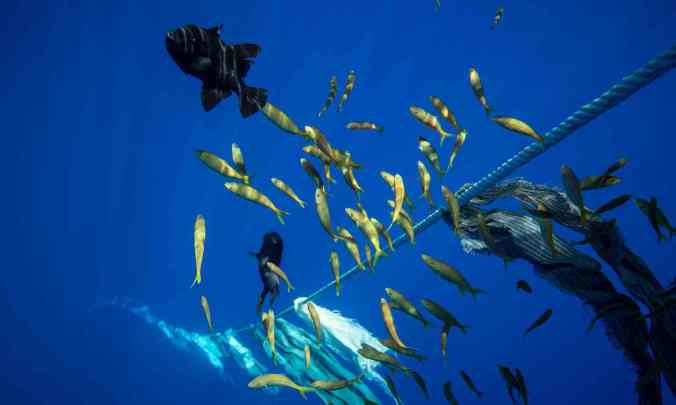
Greenpeace activists target destructive fishing in Indian Ocean – in pictures

With some Indian Ocean tuna stocks on the brink of collapse, the expedition exposes harmful methods by the world’s largest tuna company, Thai Union, owner of John West

Continue reading

DELIghtful Animation

Adam Pesapane has floated onto our radar several times in the past, and each time we’re left amazed. The level of creativity goes without saying.

Watch (and listen to!) the video above for the sheer pleasure of it. If you’re in need of a “pick me up”, explore more on his site, including his charming commercial pieces, all found under “films” here.


Balancing Conservation With Use

Bill-Clark_605

Photo courtesy of William Clark. William Clark, Harvey Brooks Professor of International Science, Public Policy, and Human Development at Harvard Kennedy School, has co-authored a new book on sustainability. “Achieving more equitable and sustainable use of the Earth requires a great deal of working together,” he said.

Thanks to the Harvard Gazette for this interview with William Clark:

Pursuing sustainability

A Q&A on connecting science and practice, balancing conservation with use

By Amanda Pearson, Weatherhead Center Communications

United Nations Secretary-General Ban Ki-moon on Friday will welcome 130 heads of state who have pledged to sign the Paris Agreement, the global agreement on managing climate change. For William Clark, Harvey Brooks Professor of International Science, Public Policy, and Human Development at Harvard Kennedy School (HKS), sustainability is a global imperative and a scientific challenge like no other.

Clark sees the Paris Agreement as just one step, though an important one, in this urgent pursuit, as officials wrestle with how to meet the needs of a growing human population without jeopardizing the planet for future generations. He and co-authors Pam Matson of Stanford University and Krister Andersson of the University of Colorado at Boulder tackle that issue in a new book, “Pursuing Sustainability: A Guide to the Science and Practice.” By looking at sustainability as a means of alleviating poverty and enhancing well-being, the book highlights the complex dynamics of social-environmental systems, and suggests how successful strategies can be shaped through collaborations among researchers and practitioners.

Clark, who trained as an ecologist, said that while exhausting Earth’s natural resources would jeopardize future generations, sustainability could counter that. The goal is to find a healthy equilibrium between human adaptation and natural evolution. Clark, the co-director of the Sustainability Science Program at HKS, spoke with the Weatherhead Center for International Affairs about building a more sustainable future. Continue reading

3.5 Beautiful Minutes

Screen Shot 2016-05-09 at 8.54.30 AM

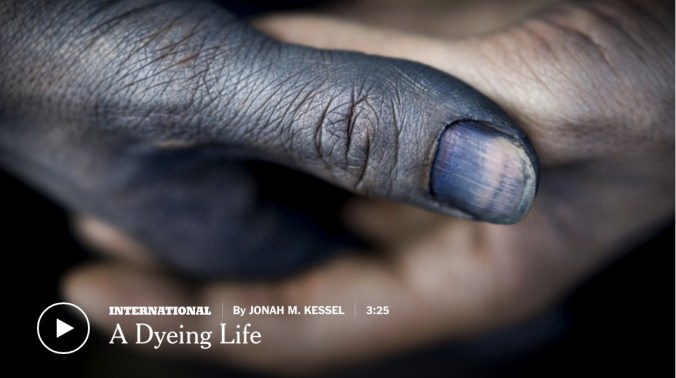
Image by Jonah M. Kessel/The New York Times.

Disillusioned with China’s urban dream, a young man set off on a 15-year walk and rediscovered his family’s ethnic Miao traditions.


In The Interest Of Debate On GMOs

We are concerned, and therefore generally against, GMOs up to now. But we are not 100% sure and so welcome new information when it is available. The University of Washington’s magazine, Conservation, is back in full awesomeness as a public service:

Despite the controversy surrounding genetically modified crops, they can be an important tool for developing disease-resistant crops that can eliminate the use of pesticides and reduce crop losses. In a trio of papers published recently in Nature Biotechnology, researchers documented how new, faster methods of isolating genes—and looking in some unexpected places—led them to identify, clone, and transfer disease-resistant genes into soybean, wheat, and potato plants. Continue reading

Diesel’s Downsides

4096

Exhaust from a diesel engine is tested for nitrogen oxides. Photograph: Patrick Pleul/EPA

Thanks to the Guardian’s Environment section:

Europe’s problem with diesel cars

By 

New UK government tests confirm that diesel cars produce a lot more air pollution in real-world driving when compared with the legal tests. Those sold since 2009 emitted six times more nitrogen oxides, on average.

Compared with the stricter standards applied to petrol cars, the average diesel sold between 2009 and 2015 emitted 19 times more nitrogen oxides.

In 2014, more than half of new cars in Europe were diesel, so solving our air pollution problems will not be easy. The Airuse project highlighted the role of taxation in car buying choice. All European countries, except the UK, have lower tax on diesel fuel compared with petrol. Continue reading

If You Happen To Be In San Sebastian

bilbleadsanseb

Construcción Vacía, San Sebastián, Spain by Jorge Oteiza

Phaidon, the great book company, shares this news from one of our favorite places in Spain:

Given its political backdrop, the quest for artistic freedom in Spain has perhaps been necessarily more tumultuous than elsewhere. Jorge Oteiza and Eduardo Chillida’s Grupo Gaur took the fight to the dictatorship in 1966, casting off the vestiges of costumbrismo (folkloric realism) at the same time. For this reason, sculpture retains an elevated status in the country not least in the seaside town of San Sebastián, near Bilbao. The resort is an art nouveau gem, with stately belle époque facades and a nose for a party. Continue reading

Dirty Things Dominate

Holloway-Hannibals-Route-290x149-1462556756 (1)

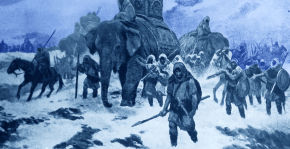
The Carthaginian general Hannibal is remembered for his march across the Alps with thirty-seven elephants, but scholars have long disputed exactly which route he took over the mountains. ILLUSTRATION COURTESY UNIVERSAL HISTORY ARCHIVE / UIG / GETTY

Nature appreciation in these pages frequently has to do with dirty things that are simply fascinating. Related topics we care about such as conservation, as often as not have to do with dirty things; as in, things that need to be cleaned up. Here is another slightly odd appreciation of dirty things that fits the dirty but fascinating and useful category:

Searching for Signs of Hannibal’s Route in DNA from Horse Manure

BY MARGUERITE HOLLOWAY

More than two thousand years ago, thirty-seven elephants from heat-shimmering latitudes ascended Europe’s highest mountain range, tramped though snow and across ice, and breathed the thin air of high altitudes. Those that survived the perilous journey met with a bitter winter and war, as the Carthaginian general Hannibal, who had urged them through the Alps, battled the emergent Roman Republic. Continue reading

Waddler Utility

duck-parade_custom-581ea4c0b2ef8bc06e405fc310706495ca268162-s1400-c85

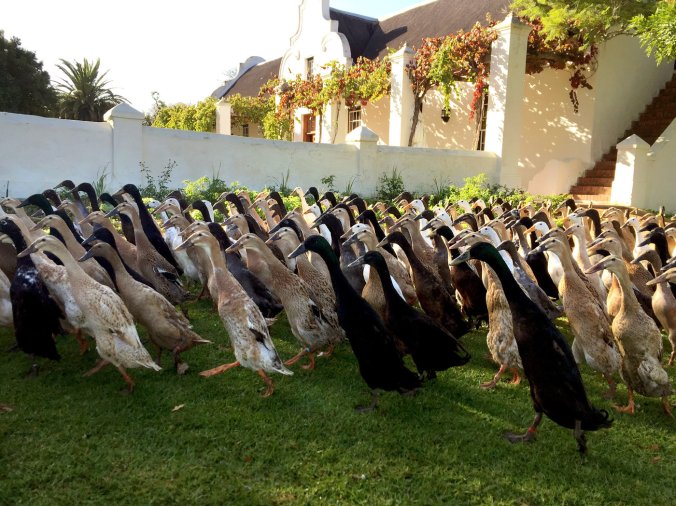
Indian runner ducks have been used in Asia for thousands of years to control pests. Now they’re used in a South African vineyard to eat snails that damage the vines. Sarah Birnbaum for NPR

We are pleased to know that birds from India have such enormous value in places outside India:

For This Vineyard, It’s Duck, Duck, Booze

On Vergenoegd Wine Estate in Stellenbosch, South Africa, about a thousand Indian runner ducks parade twice a day into a vineyard to rid it of pests. It’s a remarkably orderly scene.

Unlike your typical waddling duck, these ducks don’t sway back and forth. They run quickly in a straight line.

Every morning at 9:45 a.m., they emerge from a gate and zip around the gleaming white manor house – even sticking to a manicured gravel path. They run in formation. Their beaks all point in the same direction, their bodies all turn at the same time — like they’ve worked on the choreography beforehand.

The previous owner of the wine estate, John Faure, is a bird lover and brought them over from Asia. They have been at the estate for at least 30 years. Continue reading

Octopus Painted with Its Own Ancient Ink

Image of the completed octopus ink drawing. Photo by Esther van Hulsen, via ThisIsColossal

Octopuses are impressive animals, given their incredible intelligence, impressive sight, and, of course, number of limbs. Now, we’re learning that the pigment in their ink, which has been known to preserve well when fossilized, can still be used today for illustrative purposes. In fact, an English paleontologist did it in the 19th century, and more recently by Esther van Hulsen! More from Kate Sierzputowski at This Is Colossal:

Dutch wildlife artist Esther van Hulsen was recently given an assignment unlike her typical drawings of birds and mammals from life—a chance to draw a prehistoric octopus 95 million years after its death. Paleontologist Jørn Hurum supplied Hulsen with ink extracted from a fossil found in Lebanon in 2009, received as a gift from the PalVenn Museum in 2014.

Continue reading

Scientists Speak On Behalf Of Yellowstone Grizzly Bears

Thank you, EcoWatch, for keeping us posted on Jane Goodall’s never-ending advocacy on behalf of various members of the animal kingdom we co-inhabit the earth with:

Dr. Jane Goodall is one of 58 prominent scientists and experts who have signed a letter asking the U.S. Fish and Wildlife Service (USFWS) to retain Endangered Species Act protections for Yellowstone-area grizzly bears. Continue reading