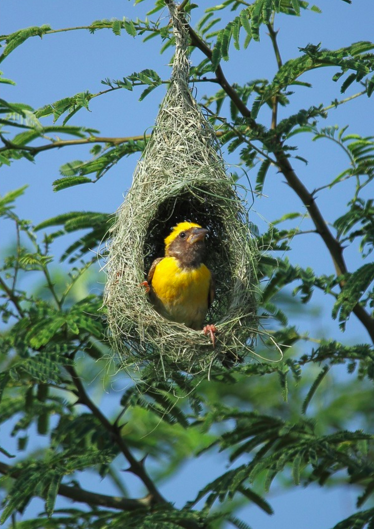
Bird of the Day: Baya Weaver Male in the nest

Composite image by Levon Biss via ThisIsColossal
About five years ago we featured a piece that coined the term “entomotography,” and we’ve been sharing stories about insects frequently since then; one was even closely related to this post and could have shared the title, of bees photographed close-up. The specimens shown below, however, are not single photos but actually composite images of thousands of shots in the best lighting for each angle, stitched together to create amazing results. Kate Sierzputowski writes for ThisIsColossal:
Commercial photographer Levon Biss typically shoots portraits of world-class athletes—sports players caught in motion. His new series however, catches subjects that have already been paused, insect specimens found at the Oxford Museum of Natural History. The series originally started as a side-project capturing the detail of bugs that his son would catch at home, and is now displayed at the museum in an exhibition titled Microsculpture.

Composite image by Levon Biss via ThisIsColossal

Image by Shutterstock.com via Conservationmagazine.org
Lots of energy is wasted by buildings that don’t have appropriate insulation or efficient HVAC systems. We’ve shared stories on lower-impact construction, like this recent piece on passive homes, and Conservation Magazine now has an article on a new way to decide on the city scale what buildings to retrofit – replace old types of windows, switch out light bulbs, etc. – based on research in Massachusetts. Prachi Patel reports:
In 2015, buildings of all types accounted for 40 percent of all energy consumption in the U.S. and 20 percent of the nation’s carbon dioxide emissions. Retrofitting old, energy-inefficient structures with efficiency features will be key for reducing their large carbon footprint. Many cities and states offer substantial incentives to home and commercial building owners who make such upgrades.
But instead of offering incentives willy-nilly, cities could use a smarter way to get the biggest energy impact, researchers at Massachusetts Institute of Technology say. Some buildings are bigger energy-hogs than others. MIT professor of civil and environmental engineering Marta González and her colleagues have come up with a streamlined way to identify the culprits with the biggest room for improvements. Their simple model, published in the Journal of the Royal Society Interface, could help city planners identify buildings where retrofits will have the biggest effect on a city’s overall greenhouse gas emissions.
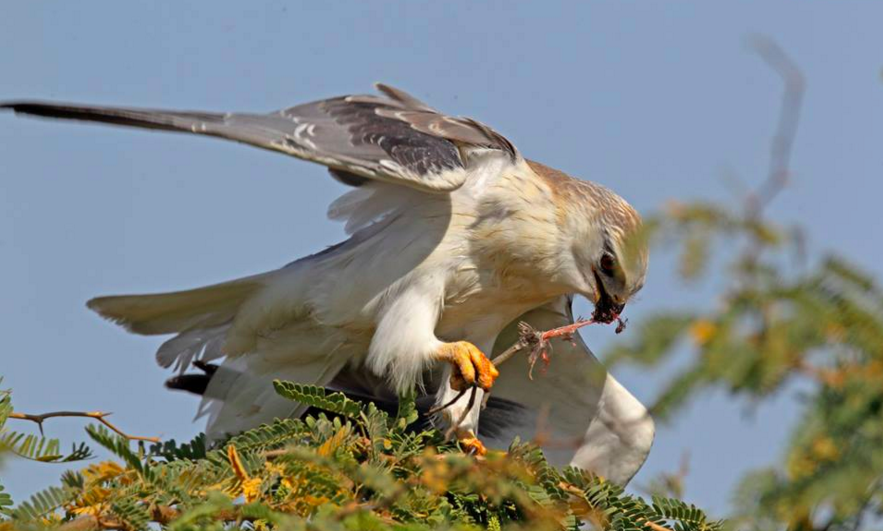
Great Rann of Kutch, Gujurat

Last year while doing one of our favorite work “responsibilities”, two of our team spent some time with guests at Xandari Harbour. The family happened to be from Finland, and one member of the family happened to be a composer of film scores and ballets. We’ve kept in touch, and they recently shared this amazing production of the Little Mermaid by the Finnish National Opera Ballet.
The blend of ballet, contemporary dance, unusual costuming and staging with 3D technology all merge to create an amazing staging of a creatively interpreted classic.
Click here or the photo for the evocative trailer…

By NATALIA V. OSIPOVA. Image by Joshua Thomas for The New York Times.
Thanks to the New York Times for continuing to reach for our attention (click above to go to the video):
Eduardo Rivera, a Mexican-born farmer living in Minnesota, is striving to make organic vegetables accessible to the Latino community.

Tacacori, Costa Rica
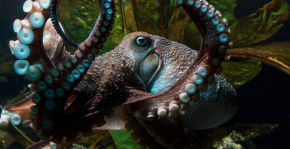 We are susceptible to stories that spotlight animal intelligence, and challenge our assumptions about the unique capacities of humans. Cleverness and intelligence can be difficult to parse, so the details of the story matters. This one is better than most such stories for reasons we cannot quite explain:
Earlier this month, under the cover of night, an octopus named Inky hauled his basketball-sized body out of the tank he shared with a companion at the National Aquarium of New Zealand, heaved himself across the floor, and squeezed his gelatinous mantle into a narrow drain leading to the Pacific Ocean. Continue reading

Illustration by Dr. Otto Wilhelm Thomé via Wikimedia Commons
We’ve discussed ants living with plants in the past, actually in the context of acacia trees like Ed Yong mentions in his post. And there’s proof of plants sending pheromonal signals to wasps that will parasitize the caterpillars eating the plant’s leaves; this article in the NatGeo Phenomena blog reminds us of that:
Six years ago, Anke Steppuhn noticed that the bittersweet nightshade, when attacked by slugs and insects in a greenhouse, would bleed. Small droplets would exude from the wounds of its part-eaten leaves. At the same time, Steppuhn and her colleagues saw that the wild plants were often covered in ants.
These facts are connected. Steppuhn’s team from the Free University of Berlin, including student Tobias Lortzing, have since discovered that the droplets are a kind of sugary nectar, which the beleagured nightshade uses to summon ants. The ants, in return for their sweet meals, attack the pests that are destroying the plant. And this discovery provides important clues about the evolution of more intimate partnerships between ants and plants.
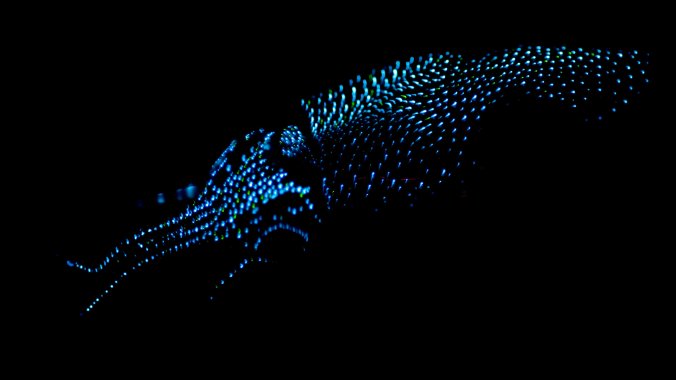
A firefly squid in Japan. The best time to see them is between March and June. Credit Michael Ready/Visuals Unlimited, Inc., via Getty Images
It is Science section day in the New York Times, and this story doubles as a travel recommendation:
Hop on a fishing boat in Toyama Bay, Japan, in the wee hours of the morning and you may feel as if you’re in a spaceship, navigating through the stars. That’s because each year, between March and June, millions of firefly squid transform the water into a galactic landscape. Lucky for you, all you need is a reservation to come aboard, your eyes and perhaps a really good camera.
The firefly squid may bring to mind a lightning bug. But the cephalopod is three inches long and flies through the sea, not the sky. And instead of a single light on its belly, it has five around each eye, three each on the tips of two of its arms and even more covering its body. Continue reading
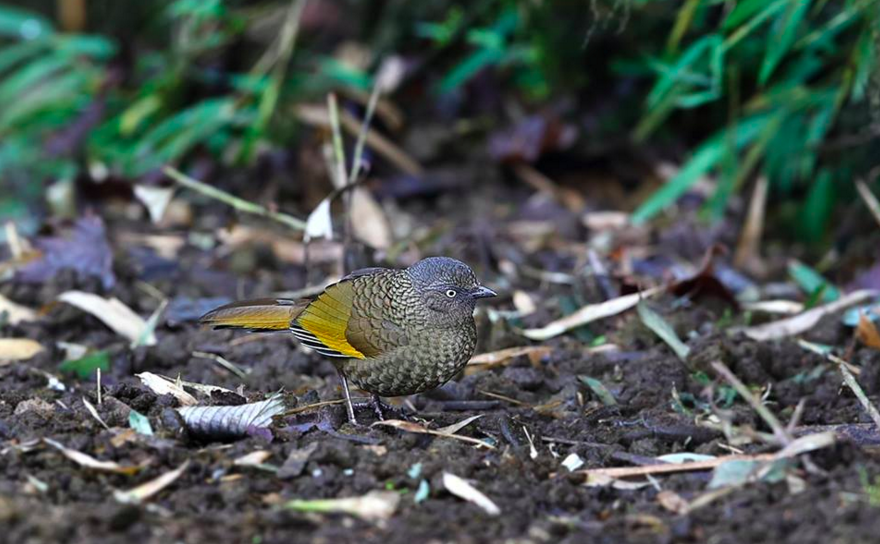
Tumling, Nepal

Wind turbines at the Snowtown Facility.
Any story regarding the expansion and encouragement of renewables to promote sustainable development is a good story in our book, and we’re impressed by the Clean Energy Council policy manager’s statement, “If South Australia was a nation, it would be second only to Denmark [in renewables].” South Australia is a state in the middle of the southern coast of the country, about a hundred square miles larger than the US state of Texas, so it’s great to hear that such a large area relies so much on innovation. Kathy Marks reports for the Guardian:
In a state that leads the country – in fact, much of the world – in producing electricity from renewable sources, Snowtown is wind central. The first stage of a $660m, 270-megawatt farm, with 47 turbines, opened in 2008, 5km west of the town; the second, adding another 90 turbines, came on stream in 2014.
Developed by New Zealand’s Trustpower, South Australia’s biggest wind facility – and Australia’s second biggest – created hundreds of construction jobs and 21 permanent positions.

Florida manatee Credit: Carol Grant/Getty Images via Scientific American
When we wrote about “sea-cows” before here it was in a post about water hyacinth. Now Scientific American is sharing some good news on the species that we weren’t aware about, with great increases in their population’s numbers. Sean Carroll reports:
Good news seems to be rare these days, and good news about the environment even rarer.
But in January this year, after fifty years on the endangered species list, the US Fish and Wildlife Service (FWS) proposed to remove the manatee as its numbers in Florida have increased 400% in the past 25 years. And just this month, the FWS proposed to delist the Greater Yellowstone grizzly population as the number of bears has increased from 136 in 1975 to about 700 today.

Jaipur, Rajasthan

NEW VENTURE: Deniston Mariano Dutra and his son Matheus Correia Dutra harvest cacao seeds. After giving up on cattle, the family replanted their farm with these indigenous trees. © Kevin Arnold via TNC
We care deeply about Amazonia, and Brazil is the country with the most deforestation in the river region, specifically from cattle ranching. But good news is coming from The Nature Conservancy in the April/May issue, where, as the article’s subtitle reads, “After decades of turning forests into pastures and fields, Brazilian landowners have begun reversing the trend.” Julian Smith reports for the TNC Magazine:
Lazir Soares de Castro stands amid white and gray Nelore cattle on his ranch in São Félix do Xingu, a remote and sprawling county on Brazil’s northeastern Amazon frontier. Beyond a wooden fence, high grass and scrub brush fade into sporadic trees in the distance.
Still vital at 70, Soares describes how different this area looked when he arrived in 1984, when it was all virgin rainforest. “It was the poorest area. There was no electricity, no telephone, no TV, no roads, nothing.” The military dictatorship then running the country was encouraging settlers to occupy the Amazon in the name of national security. “There was no organized environmental policy,” Soares says.

The sand hills of Alberta © Ken Ilgunas via NYTimes
We’d never given this issue much thought, but the idea of private property remaining accessible to others who will act responsibly as passersby is an interesting one. If nothing is damaged and the goal is simply to get from one place to the other, or enjoy nature without borders, then why not? Ken Ilgunas writes an opinion editorial for the Sunday edition of the New York Times:
A COUPLE of years ago, I trespassed across America. I’d set out to hike the proposed route of the Keystone XL pipeline, which had been planned to stretch over a thousand miles over the Great Plains, from Alberta, Canada, to the Gulf Coast. To walk the pipe’s route, roads wouldn’t do. I’d have to cross fields, hop barbed-wire fences and camp in cow pastures — much of it on private property.
I’d figured that walking across the heartland would probably be unlawful, unprecedented and a little bit crazy. We Americans, after all, are forbidden from entering most of our private lands. But in some European countries, walking almost wherever you want is not only ordinary but perfectly acceptable.
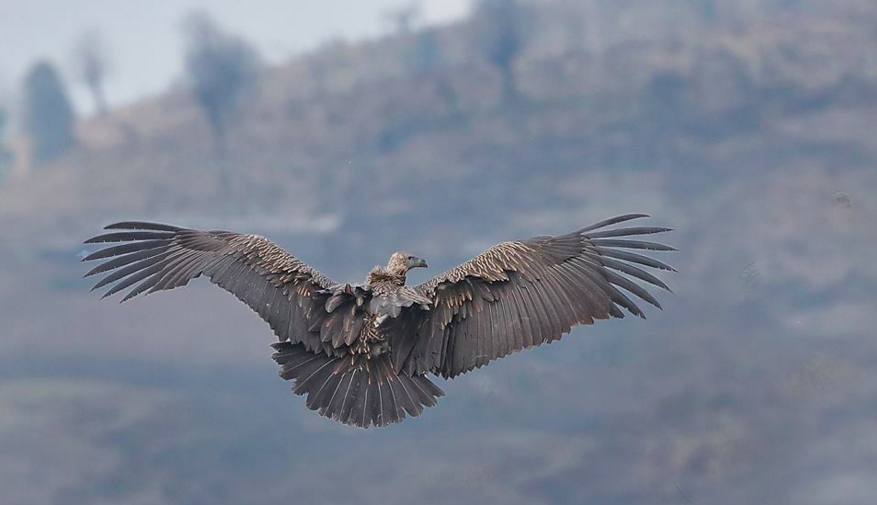
Tumling, Nepal

Vincent Lai with the Treo he rescued. “A phone can last for a very, very long time,” he said. CreditNicole Bengiveno/The New York Times
No one on our team is exempt from the temptation to have the latest, greatest whatever. But we have gotten into the habit of reminding each other it is not always necessary. Frequently not. Almost never, actually. We never tire of sharing, and hope you never tire of reading, new stories about re-use, recycle and up-cycle options in our every day lives:
Choosing to Skip the Upgrade and Care for the Gadget You’ve Got
By
Vincent Lai was working at a recycling facility in New York and sorting through a bin of used cellphones a few years ago when he dug up a Palm Treo, a smartphone that was discontinued last decade.
Mr. Lai, 49, tested the Treo and found it still worked. So he took the device home and made it his everyday mobile companion, much as one would adopt an abandoned animal on its way to being euthanized. Continue reading
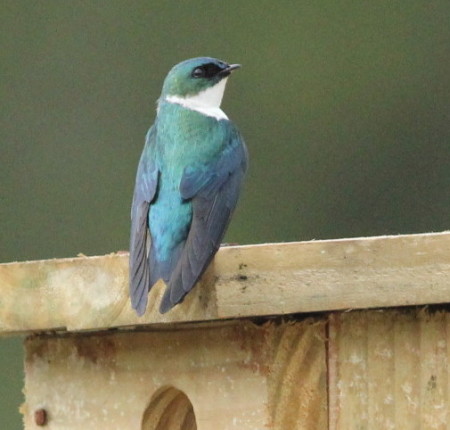
Male Hispaniolan Golden Swallow perched over-top an artificial nest-box in Parque Valle Nuevo, Dominican Republic; July 2014.
With a title like that, I’m hoping that many of you instinctively hucked your laptops across the room, sprinted out to the barn and started hitching your pride-and-joy appaloosa to the covered wagon your grandpappy gave to you as a belated wedding gift back in the summer of ‘69. Just don’t forget the “caulk the wagon and float” option if you’re coming from the mainland.
If you decide to make the journey, I suggest making landfall on the beautiful island of Hispaniola (gold deposits have all but dried up in Jamaica – but more on that later). Trade in your bikini and flip-flops for some long pants and hiking boots, because what you came for can only be reliably found high up in the mountains. Not that I like to give away too much insider advice, but if I were you, I’d keep heading up until you’ve reached the Hispaniolan pine forests – the highest altitude forest type you’ll find on the island. Find a grassy clearing, sit down, and wait, because at this point, the gold is going to come to you! With mighty wings (~11cm long each), fearsome talons (actually you’d have to strain to even notice the legs on this bird), and a relentless hunger for meat (prey doesn’t get much bigger than an 8mm march fly), watch out as the infamous Golden Swallow comes tearing over the nearest hillside radiating its majestic golden sheen across the lands…wait…wait…I can’t do this anymore. It’s a tiny bird that can’t peck to save its life, and unless the light of a passing-by solar flare manages to reflect off the swallow’s dorsal plumage at a perfect 47.86o angle, the bird is green!

Preuss’s Red Colobus, one of the 25 most endangered primates in the world
We hate poaching, so any novel method of preventing it is good news in our opinion. From Claire Salisbury for Mongabay’s Great Apes series, on a new project to particularly protect the Preuss’s Red Colobus, a severely endangered primate in Africa:
Cameroon’s Korup National Park is home to elephants, chimpanzees, red colobus monkeys, drill, and a myriad of noisy species, whose squawks, squeals and howls fill the forest air. For more than two years, twelve acoustic monitors were deployed there and recorded every sound covering a 54 square kilometer (21 square mile) area of protected tropical forest.
They were tuned to listen around the clock for just one sound: gunshots.
“Our ultimate goal is to improve the effectiveness of anti-poaching patrols in African tropical forest protected areas,” Joshua Linder, one of the lead scientists working on the acoustic monitoring project, told Mongabay.
Bushmeat is a major source of protein in Central Africa, with 4.5 million tons extracted from the Congo Basin each year. Taking bushmeat itself is not always illegal, and it can be a vital source of protein for the poor and a valued commodity for the rich. But hunting endangered species, especially within protected areas, is against the law. It can pose a real threat to the survival of animal populations, and particularly to rare species.
 Organikos