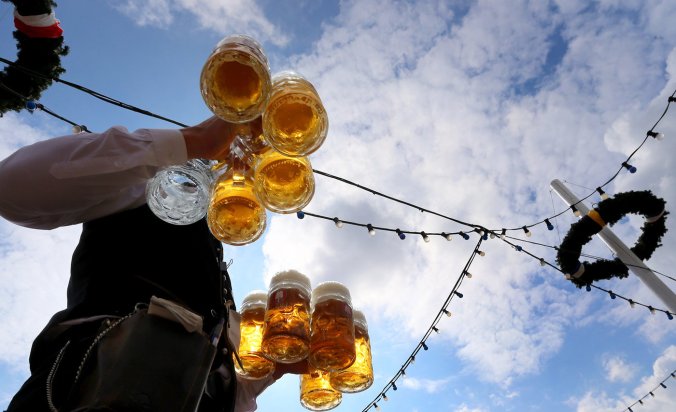
A waiter carries beers at the Theresienwiese fair grounds of the Oktoberfest beer festival in Munich, southern Germany, last September. For centuries, a German law has stipulated that beer can only be made from four ingredients. But as Germany embraces craft beer, some believe the law impedes good brewing. Karl-Josef Hildenbrand/AFP/Getty Images
Laws can come and go, as far as we are concerned (and we get the point here), but purity remains forever of value (thanks to National Public Radio, USA):
Germany’s Beer Purity Law Is 500 Years Old. Is It Past Its Sell-By Date?
With more than 1,300 breweries producing some five-and-a-half thousand different types of beer, Germany is serious about the amber nectar. There’s even a word for it –bierernst – which means “deadly serious” and translates literally as “beer serious.”
This sober attitude applies particularly to the German beer purity law known as the Reinheitsgebot. Introduced in 1516 by Duke Wilhelm IV of Bavaria, the decree allows for only hops, barley, water and, later, yeast in every Stein. For 500 years, this recipe has served Bavaria very well, and for the last century, the rest of Germany. Continue reading







 We are susceptible to stories that spotlight animal intelligence, and challenge our assumptions about the unique capacities of humans. Cleverness and intelligence can be difficult to parse, so the details of the story matters.







 Organikos