Ocean Cleanup Project Tests Successfully

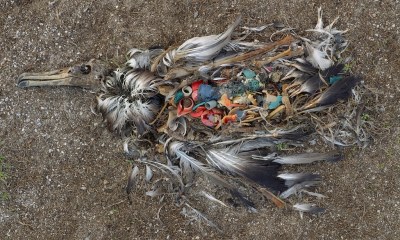
Around 90% of the world’s sea birds have eaten plastic items that they mistook for food, a study estimates. Photograph: Chris Jordan/Midway: Message from the Gyre

We’ve alluded to the Great Pacific Garbage Patch before, though we haven’t shared any stories covering it directly. Last week, The Guardian reported some good news from The Netherlands, where the prototype for a 100km-long, crowdfunded cleanup boom for the ocean was tested successfully. Arthur Nelsen reports:


Further trials off the Dutch and Japanese coasts are now slated to begin in the new year. If they are successful, the world’s largest ever ocean cleanup operation will go live in 2020, using a gigantic V-shaped array, the like of which has never been seen before.

The so-called ‘Great Pacific garbage patch’, made up largely of tiny bits of plastic trapped by ocean currents, is estimated to be bigger than Texas and reaching anything up to 5.8m sq miles (15 sq km). It is growing so fast that, like the Great Wall of China, it is beginning to be seen from outer space, according to Jacqueline McGlade, the chief scientist of the UN environmental programme (Unep).
Continue reading

The Journey of the Xandari Commuters

I wrote about my daily “commute” in the first post I wrote upon arriving to Xandari as an intern. However, circumstances have changed since then (I am proud to say that I am officially a company employee now), so I think it’s only fair for me to share an updated version that not only illustrates my own personal account but also reflects that of many other employees of the hotel as well.

Continue reading

A Hairy-looking Future

Scanning electron microscope image of hairs on a honeybee’s eye. Image © Georgia Tech, CC BY

Last week a pair of scientists writing for The Conversation (a news source with what they call “academic rigor, journalistic flair”) and also Discover Magazine’s science blog discussed the merits of hair in keeping animals clean. We found it pretty interesting, and hope you will too:

Watch a fly land on the kitchen table, and the first thing it does is clean itself, very, very carefully. Although we can’t see it, the animal’s surface is covered with dust, pollen and even insidious mites that could burrow into its body if not removed.

Staying clean can be a matter of life and death. All animals, including us human beings, take cleaning just as seriously. Each year, we spend an entire day bathing, and another two weeks cleaning our houses. Cleaning may be as fundamental to life as eating, breathing and mating.

Yet somehow, cleaning has gotten little attention.

In our new review article in the Journal of Experimental Biology, we discuss how cleaning happens in nature and whether animals indeed have principles for getting clean. We looked at microscope images to count the number and sizes of hairs across hundreds of animals. We read nearly a hundred articles on cleaning in nature, trying to put numbers onto the cleaning process.

Continue reading

A Timeless Moment on the Backwaters

A scenic backwaters view. Photo by S. Inman.

During my stay at Xandari Pearl – another charming property that I visited recently – I had the opportunity to go on one of the Riverscapes houseboats to have lunch and spend a few hours on the famous Kerala backwaters. I think I will remember this experience as the most peaceful that I have lived. Indeed, everything is united to provide you a relaxing and timeless moment.

Obviously the first thing that I noticed is the landscape and each element that surrounds it. It was my first time on the backwaters, and I have to say that this large expanse of water and all the green nature around it is quite wonderful. What makes it peaceful is the fact that you can just enjoy the moment and the view. You don’t have to do anything else! The best part is that except for the lapping of water and some birds, you can’t hear any sounds. It’s the best place to go unwind.

Continue reading

Because Coffee is ‘Human’

For those who believe life begins after coffee, the story of its origin will definitely sound familiar. Coffee grown worldwide can trace its heritage to the ancient coffee forests on the Ethiopian plateau, where legend says the goat herder Kaldi first discovered the potential of these beloved beans. It is said that Kaldi discovered coffee after noticing that his goats, upon eating berries from a certain tree, became so energetic that they did not want to sleep at night. Kaldi reported his findings to the abbot of the local monastery who made a drink with the berries and discovered that it kept him alert for the long hours of evening prayer. The abbot shared his discovery with the other monks at the monastery, and slowly knowledge of the energizing berries began to spread.

Now photographer Sebastiao Salgado takes readers deep into that grind with his latest collection, The Scent of a Dream: Travels in the World of Coffee that looks at the landscapes and labors behind the $100-billion-a-year business in ten countries around the globe.

Continue reading

Sheepdogs Active in Wildlife Conservation Yet Again

Phillip Root with the Maremma sheepdogs of Middle Island, Australia. The dogs were introduced there in 2006 to protect the little penguin, a native species. Credit David Maurice Smith for The New York Times

A few years ago, we shared the story of an effort by the Cheetah Conservation Fund in South Africa as part of their Cheetah Outreach project that involved Anatolian shepherd dogs. The idea was to help livestock owners raise the sheepdogs to guard their herds and therefore not feel the need to kill cheetahs that might see the sheep as potential prey. This program has worked out well, and now we’re hearing from the New York Times about another success story in Australia, although in this case the sheepdogs aren’t protecting livestock: they’re guarding the Little Penguin on Middle Island, Victoria from the introduced red fox.

‘Massacred,’ read the banner headline in the local newspaper — just the single word, as if describing an act of war. Below it was a photo of dead penguins and other birds, the latest casualties in Australia’s long history of imported species’ decimating native wildlife.

Foxes killed 180 penguins in that particular episode, in October 2004. But the toll on Middle Island, off Victoria State in southern Australia, kept rising. By 2005, the small island’s penguin population, which had once numbered 800, was below 10.

Continue reading

What Warm Temperatures in the Sub-Arctic Mean

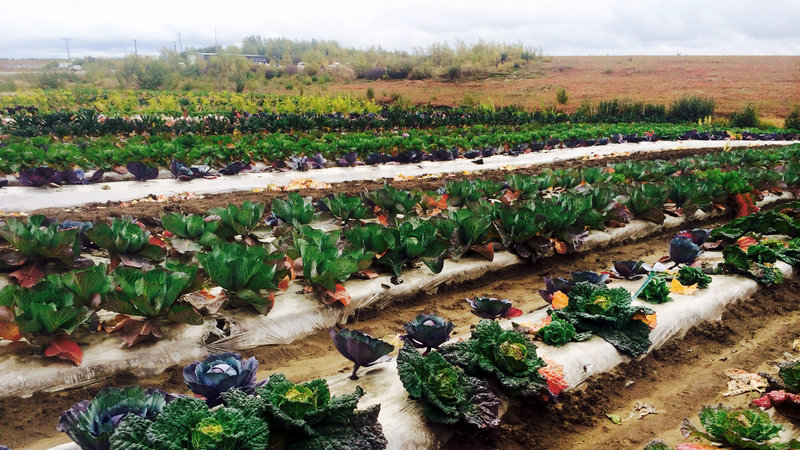
A field near harvest time at Meyers Farm in Bethel, Alaska, can now grow crops like cabbage outside in the ground, due to rising temperatures. PHOTO: Daysha Eaton/KYUK

A field near harvest time at Meyers Farm in Bethel, Alaska, can now grow crops like cabbage outside in the ground, due to rising temperatures. PHOTO: Daysha Eaton/KYUK

Farming in the Arctic? Well, it can be done. The reasons are many. For one, the climate is changing: Arctic temperatures over the past 100 years have increased at almost twice the global average.

On a misty fjord in Greenland, just miles from the planet’s second largest body of ice, Sten Pedersen is growing strawberries. Yellowknife, a Canadian city 320 miles below the Arctic Circle, hosted a farmers market this summer. And a greenhouse in Iqaluit, the capital of the vast Canadian Inuit territory of Nunavut, is producing spinach, kale, peppers and tomatoes. The frozen tundra of the Arctic is experiencing something of an agriculture boom. More

Continue reading

The Whale that just kept swimming … away

A wild Omura’s whale (Credit: Salvatore Cerchio et al/Royal Society Open Science)

Whales are the largest aquatic mammals on Earth, so it’s hard to believe that the first official sighting of the Omura’s Whales only happened recently near Madagascar. In 2003 Japanese scientists identified this whale as a new species; however, it was based on skeletal specimens and genetic tests.

Continue reading

When A Legend Fades Away

Stories about the Yeti date back thousands of years, especially in the Himalayan nations. Legends say it can be seen only when it comes down from the high mountains to lower elevation and that it passes through the forests and into the villages where it surprises or scares people and sometimes kills a yak for food. Several climbers claim to have seen an unusual animal on their way up Mount Everest. A few have taken photographs of very large footprints in the snow, claiming they belong to the Yeti. It has another name that many people will recognize: Abominable Snowman. Think of a big human-like animal covered in white hair, with huge canine teeth and very big footprints.

But now, no one’s looking for the Yeti.

Continue reading