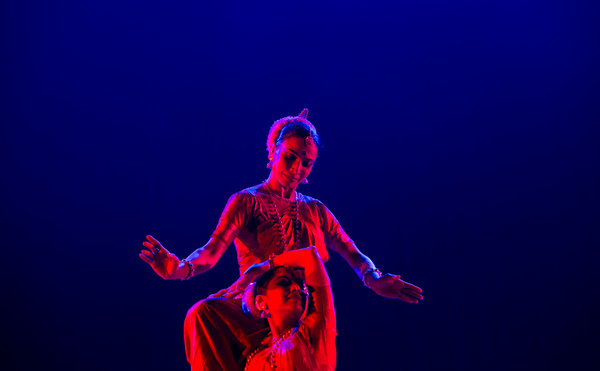
Bijayini Satpathy, top, and Surupa Sen in two duets, “Dheera Sameere” and “Kisalaya Sayana,” in Chennai, India. Credit Jyothy Karat for The New York Times
On February 4 Nrityagram, a dance troupe from India, will perform “Songs of Love and Longing” at Cornell University’s Barnes Hall. We normally do not take note of such performances at university campuses, even when the artist is from India. But this troupe is exceptional. Last week not far from Raxa Collective’s operations in Kerala, in the neighboring state, a Nrityagram dance performance led to this remarkable review in the New York Times:
A Sublime Touch, From Head to Heel
By ALASTAIR MACAULAY JAN. 6, 2015
CHENNAI, India — Who are the greatest dancers in the world today? Most of the contenders considered in the West for this category are the roving international stars of ballet. But many of today’s finest dance artists have been performing here at the Music Academy’s weeklong dance festival, which ends on Friday. Some — all women — have touched on the sublime.
Three have been practitioners of the Odissi genre: Sujata Mohapatra, who performed on Sunday, and the two leading dancers of the Nrityagram company, Surupa Sen and Bijayini Satpathy, who presented solos and duets on Monday. (I’ll consider other festival performances next week, some no less superlative.)
Odissi is the classical idiom deriving from the eastern state of Orissa (now named Odisha). Though its roots go back 2,000 years, by the 1940s and ’50s it was scarcely known, whereas now it is taught and performed around the world. These three artists exemplify the qualities that have often made Odissi seem the most sensuously poetic of all dance idioms.
Continue reading →











 Since we’re doing most of our packing today, we figured it would be a good time to share some photos of our gear before everything is stuffed into a suitcase. Below is a random selection of items we’ll be taking down to

 Organikos