Green Citizens, Green Consumers, Fear And Hope At The Aspen Ideas Festival

Thanks to James Fallows for referring this on his blog page on the Atlantic‘s website:

After a brief stage-business intro from me, the first 15 minutes or so are Harvey presenting an overview of how to think about carbon, coal, natural gas, electric grids, extreme weather, and other sources of problems and possibilities. The rest is our discussion, and questions from the audience.  Continue reading

Angels’s Trumpet – Datura suaveolens

Datura suaveolens

Angel’s Trumpet is native to Tropical America but naturalised in India, especially in the Western Ghats up to 2000 meters. It’s a tall shrub with very large drooping trumpet-shaped white flowers. Continue reading

An Old Dog Doing New Tricks

John W. Adkisson for The New York Times. Peony, a Carolina dog. Some of the breed’s rare traits include a fishhook tail, a pointed, somewhat lupine face and the habit of digging snout pits.

John W. Adkisson for The New York Times. Peony, a Carolina dog. Some of the breed’s rare traits include a fishhook tail, a pointed, somewhat lupine face and the habit of digging snout pits.

DNA is the trick that brings some new respect to this canine line, in a debate we did not even know about until today’s New York Times Science section revealed it:

Carolina dogs, like a few other breeds, are without certain genetic markers indicating European origins, suggesting they have been in the Americas Continue reading

Exploring My New Surroundings

Mountain ridge border between Kerala and Tamil Nadu

Mountain ridge border between Kerala and Tamil Nadu

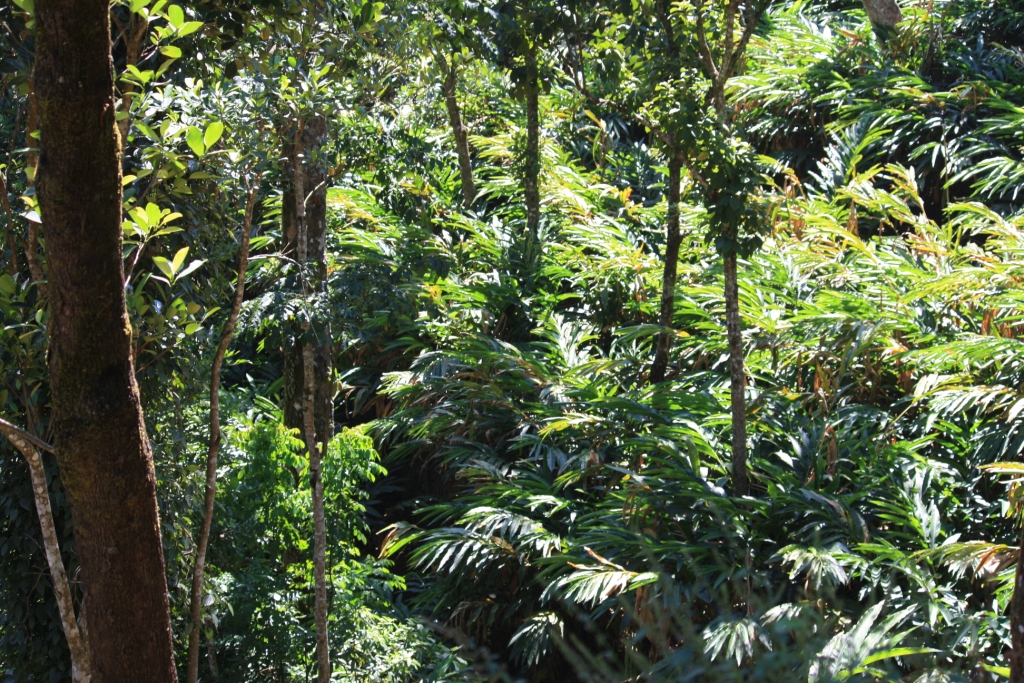
This past weekend I was able to explore the surrounding areas of Kumily and Thekkady, where I am staying for the next three and a half months. For this trek I went with RAXA Collective team member Salim, who is very knowledgeable and familar with the area. First he took me to see a scenic overlook. Here I saw and learned about the natural mountain border that separates parts of the state of Kerala and Tamil Nadu.  After a short drive from the overlook we arrived at a small spice plantation where Salim taught me about some of the local spices grown in the area such as cardamom, lemongrass, mint, and cinnamon. Continue reading

Is An Organic Diet Better?

Associated Press photo. Organic foods have made big inroads in supermarkets like this Hannaford store in Quincy, Mass.

Associated Press photo. Organic foods have made big inroads in supermarkets like this Hannaford store in Quincy, Mass.

This question is asked in relation to the diet of a particular nation, but the various answers provided by these experts could apply anywhere:

Sales of organic food have been rising steadily over the past decade, reaching almost $30 billion in 2011, or 4.2% of all U.S. food and beverage sales, according to the Organic Trade Association.

Many of the consumers who purchase these products say paying more for organic produce, milk and meat is a trade-off they are willing to make in order to avoid exposure to chemical pesticides and fertilizers and milk from cows given bovine growth hormone. But other families—especially those whose food budgets may be more limited—wonder if organic food is really worth its hefty price tag.

So far, researchers haven’t been able to provide them with a definitive answer. Continue reading

Why agroforestry has struggled in Barrio Nuevo

The sacrifices of agriculture are obvious to some, yet unperceived by others.

The sacrifices of agriculture are obvious to some, yet unperceived by others.

Good news: after lots of talking, listening, and uphill walking, we’ve completed our work in Barrio Nuevo. Researching the shade coffee project in Barrio Nuevo was extremely insightful. I admit, the success of the project was a bit disappointing, but this itself was a lesson in being more detached form one’s research. From a research standpoint, there’s nothing wrong with a project failing. What good would this evaluation be if we were only confirming that everything was going well?

So what went wrong? Why did it go wrong? How can it be fixed? And is there hope for agroforestry in Barrio Nuevo still? These are the questions I’ve been asking myself for almost a month and here’s what I’ve concluded from the first stage. Continue reading

Kashmir In Watercolor

This slideshow requires JavaScript.

Thanks to India Ink for this story:

Four years ago, Masood Hussain, one of Kashmir’s most renowned artists, worked on a series of watercolors of places, people and activities in and around his city, Srinagar. Imbued with realistic touches, alive with filigree details, and emitting a translucence bequeathed by the medium in the hands of a master, the series “Transparent Strokes” was snapped up by visitors to the city. Continue reading

To Read It To The End, You Must Disbelieve It

Mark Thomas (left) and Guy Shorrock keep watch on Britain’s egg obsessives. “These are not normal criminals,” Shorrock says. Photographs by Richard Barnes.

Thanks to the New Yorker‘s commitment to a difficult topic–birds and their fate at the hands of regular and irregular people–and especially to Julian Rubinstein and his confidants for this taxing piece of journalism:

On the afternoon of May 31, 2011, Charlie Everitt, an investigator for the National Wildlife Crime Unit in Edinburgh, Scotland, received an urgent call from a colleague in the Northern Constabulary, the regional police department whose jurisdiction includes the islands off the country’s western coast. The officer told Everitt that a nature-reserve warden on the Isle of Rum, twenty miles offshore, had reported seeing a man “dancing about” in a gull colony. Everitt looked at the clock. It was 4 p.m., too late to catch the last ferry, so he drove Continue reading

If You Happen To Be In London

This slideshow requires JavaScript.

The National History Museum in London is offering an opportunity to see works by a photographer whom you might have first encountered here, or you may be a member of his online community:

The world premiere of Sebastião Salgado: Genesis unveils extraordinary images of landscapes, wildlife and remote communities by this world-renowned photographer.

Sebastião Salgado: Genesis
11 April – 8 September 2013
Waterhouse Gallery Continue reading

Powdermill Avian Research Center (PARC)

This slideshow requires JavaScript.

Thanks to Atlantic‘s website for hosting the Venue folks’ post about this remarkable research station devoted to a phenomenon we pay tribute to every day. In particular, this post helps understand a century+ of evolution in the research tools used to study the behavior of birds:

On a recent morning, Venue joined researchers Luke DeGroote, Amy Tegeler, Mary Shidel, Kate Johnston, and Matt Webb, as well as several dozen warblers, catbirds, and a cuckoo, for a tour of the various devices of bird surveillance at the Powdermill Avian Research Center (PARC), part of Carnegie Museum of Natural History’s Powdermill Nature Reserve. Continue reading

Chellarkovil Waterfalls- Thekkady

Chellarkovil Waterfalls

Chellarkovil Waterfalls

Chellarkovil Waterfalls is located just 14km from Thekkady. Especially during the monsoon the cascading waterfalls and the abundance of flora make this place a trekker’s and photographer’s paradise. Continue reading

Impossible, Past Tense

There are already more than a million views of this, in what looks like one day’s time (but may be a hoax and may be old news, but does not look like either as this is posted, so we hope to add to the hype if we are correct).  Thanks to the folks at The Verge for this story:

A Canadian duo and their Kickstarter-funded, pedal-powered helicopter have won one of the longest-standing challenges in the history of aviation — keeping a human-powered aircraft hovering up in the air at height of at least 9.8 feet, within a 32.8 by 32.8-foot square, for 60 seconds minimum. The challenge, known as the Sikorsky prize, has withstood at numerous failed attempts since it was established in 1980, 33 years ago, even with a $250,000 bounty. But it was finally bested earlier in June by the Atlas, a gigantic human-powered helicopter designed by Cameron Robertson and Todd Reichert, aeronautical engineers from the University of Toronto, who cofounded a company AeroVelo. Continue reading

Sagan’s Pale Blue Dot

Scientists, among other communities we follow, make us smile when they speak in a language we can understand (those of us who are not scientists, which is most of us on this site). We have had occasion in the past to point to the famed scientist and former Cornell University professor Carl Sagan, and now Robert Krulwich shares this video on one of his Wonders posts (after clicking through, scroll down):

…Looking at this, Carl Sagan thought, first, how small we look, how small we are — which inspired him to write his eloquent Pale Blue Dot meditation, which, if you haven’t read it lately, take a minute and a half to look at this short version gorgeously animated by Joel Somerfield at Order, a British design studio. Carl Sagan himself is narrating. Continue reading

Bird Dust-bathing in D.C. and Shark Tail-whipping in PH

These House Sparrows, one of the sixteen focal species of the Celebrate Urban Birds program, were all dust-bathing together next to the sidewalk near the Washington Monument as I walked past this week. Birds dust-bathe to clean their feathers of oils and parasites, and the behavior is well-documented in this species.

On the other side of the world, just a few days ago, footage was released of previously undocumented (but formerly observed) behavior in Philippine thresher sharks, pelagic predators with a prodigious posterior. A thresher shark’s tail comprises about half of the shark’s total length, and in the video Continue reading