Finca Work

I had more butterfly luck this morning when, exiting the trail from my lodgings onto a dirt road, I spotted a Hamadyas glauconome glauconome, commonly known as the Guatemalan or Glaucous Cracker, on a tree nearby. Although I didn’t know it at the time, the males of this species can create a cracking sound while flying. I had heard this sound from flying insects several times as I biked along the road during my stay here, but had never been able to identify the source. The specimen photographed here was a female, however, because once I got close enough to take the shot, it flew away silently. After breakfast, I was crossing the long suspension bridge that leads to the bungalows and one of the trees next to the railing, whose canopy was roughly level with the bridge, had flowers that had attracted another butterfly. Despite the length of time that the butterfly stayed at the flowers to collect nectar, I have not been able to identify it from the various photos I took, because it never opened its wings to show the markings that would give it away in a guidebook.

However, one animal I have been able to identify is a little lizard that I found while walking a trail. More specifically of the family Polychrotidae, or an anole lizard, the species I was lucky enough to encounter was the indigo-throated anole, Anolis sericeus. I have learned that all anoles have at least some ability to change color, they all have dewlaps, which are cartilaginous frills below the neck, and, like many lizard families, they can relieve themselves of their tail if sufficiently threatened. Fortunately my presence was only frightening enough for the anole to reveal its beautiful frill and, as I approached for a close-up, run off.

When I was done with my little hike, I headed to the finca, where I was to see the recently planted saplings and the cleaning of last year’s crop area. Continue reading

Sunset Hill

The right arm of the Ocotal cove, the hill directly visible from the restaurant and beach, is just as important a landmark as Morgan’s Rock itself, since it is actually part of the property and is not hidden from view at certain angles. When one looks out at the ocean from the ecolodge, one sees this hill first; the rocks at its base withstand the constant onslaught of thundering waves, and the steep rocky slope is almost completely covered in verdure.

The prominence might be called Sunset Hill, due to its function as the lookout point for guests who wish to watch the sun descend into the ocean from a high vantage point. From most locations on the property, viewing a full sunset is impossible since the Hill is in the way.

I left the ecolodge in the morning today to climb Sunset Hill and see what the trail was like without the dim lighting that would accompany a sunset. Before approaching the hill, I found two low-hanging coconuts and cut them with some stem as handles—I knew it would be a hot and long climb and wanted some refreshment at the top. Despite the additional weight, the climb was not too difficult, but I was left sweating when I reached the first stop: a bench set in the trough of the two wave-like hills with a view of the whole cove and ecolodge. Setting the larger coconut aside, I grabbed the other and used my pocket-knife (Wenger Swiss Army, Patagonian Expedition Race Edition) to cut a channel through to the small orb holding the water. The can-opener proved the perfect tool for this job, since the blade was short enough to present little danger to my fingers in case of a mishap, and I could also apply significant pressure to leverage chunks of husk out of the way without fears of bending or breaking the metal.

After a few minutes I had reached my goal. This fact was drawn to my attention mostly by the popping sound and burst of water that sprayed up to soak my face. Setting my dripping glasses aside (I only wear my old pair while hiking, in preparation for these unforeseeable events) to dry, I widened the hole slightly and titled the large vessel back to drink the refreshing water.

I am used to drinking coconut water from the fruit itself, but in a very different fashion: street-vendors in Central America and India use a machete to hack the top off the coconut and stick a straw in the near-perfect circle they’ve created. Using my tiny tool to pry open the fruit’s tough skin and press my lips to it like a certain Tom Hanks character made me feel much less touristy than I do when I buy a street-coconut. After all, I had not only selected the fruit off the tree myself, but had also carried it up a significant slope and used its water to cool off before continuing the climb to the Sunset Summit.

To reach the summit, one merely has to climb the stairs set into the hill. This is not a great challenge, but in what was now a midday heat, the stairs were unwelcome. However, compared to the tall limestone steps of Tikal temples, or the uneven sandstone tomb-paths of Petra, these simple wooden planks set into the earth were nothing—a mere ten-minute task, if that. When I completed my ascent, it was instantly clear why the hill has been chosen as a sunset lookout. The height of the hill, along with its projection from the mainland by roughly a kilometer, presents a worthy view even without the sun setting over the water. A little lizard, which I later identified as a rose-bellied spiny lizard, was resting in the full sun that fell on the top of a railing post.

I enjoyed my second coconut in a cooler location: the middle of the stairs, where the overhanging branches of bushes and trees create a tunnel blocking the sun. A little more cautious, I avoided getting sprayed, and slowly consumed my drink before descending the hill and returning to the beach. On my way there, I saw a pair of mating butterflies that I believe to be Papilio thoas nealces, and once I got to the beach I found a Draedula phaetusa. As I walked from the beach to the road, a Microtia elva fluttered along the path and rested a while on a nearby bush. It was a lucky day for butterflies, and I look forward to photographing and identifying more of them, especially once I have a camera that can zoom!

Newspaper Products

In the bathrooms at Morgan’s Rock, the trash cans are little green plastic bins covered in what appears to be painted wickerwork. However, closer inspection reveals that the woven material covering the bins and little caps is in fact newspaper that has been twisted into long strands and braided into shape. Despite the paint job, one can still see the letters and broken images on the baskets, and this simple artisanal craft adds a creative and rustic touch to what would otherwise be a banal bathroom fixture.

The bungalows are equipped with the above rectangular variations of newspaper bins for composting, recycling, and trash, and seeing the different colors next to each other convinces me that the unpainted version is the most attractive. Unfortunately, it is also the least common, as all the bathroom trash bins I’ve seen look like this.

I spoke to Alba, the General Manager, about the bins and asked where they were made. She answered that several towns in and around the Rivas area have handicraft shops, and that as part of community support Morgan’s Rock purchased these sorts of things for both utility and decoration. Rivas is a city and a department (sort of like a province, I think), so I will need to find out how widespread this newspaper craft actually is, because there could be an important collaboration between Nicaraguan and Indian newspaper craftspeople (Kerala in particular has been working on an utilitarian recycling over the past few years).

FRA and Periyar

In my last post, I wrote about and linked to some writing about the Forest Rights Act of 2006, legislation which gives added to protection to tribal communities with a traditional claim on protected and preserved land in India. I ended by speculating about the difference between policies and practices regarding human-animal cohabitation at other wildlife sanctuaries and the one where I’m staying, which is in the Periyar Forest.

Well, I’ve spent the past couple days learning firsthand about the tribal community in around Kumily and Thekkady, and I can now with confidence confirm that the tribal heritage development and preservation initiatives in this area are indeed succeeding, and perhaps to a greater degree than at other parks. ‘Success’ is here defined as a community gradually finding sources of income that do not require the extraction of resources from the preserved environment.

To this end, in the Periyar there are four Community Development Committees, as well as numerous agencies designed to regulate and control interactions between the tribal community and the forest, and the tribal community and the market. I guess in the past tribal community members had been treated unfairly by buyers of their agricultural product (which is mostly pepper). Part of the CDCs’ job is to ensure that farmers are made aware of fair market prices and meet only with honest middlemen.

I met with the chairman of one of the CDCs and he told me about the economic and political structure of these relationships. He also told me that, at least within the Mannan community, more young peope are going on to professional schools and receiving advaced degrees, and that close to 50% of the tribal population now makes its primary income from outside the forest.

While these may be informal indicators of change and improvement as the Forestry Dept. defines it, they do point to developments in Kumily and India in general that it seems almost like you watch happening before your eyes on the ground.

More Wood

The finca connected to Morgan’s Rock, part of the Agroforestal forestry business whose owners also run MR and SM, is in the process of clearing the brush covering a large swath of land where new trees will be planted. The trees are going to be more separated than in the past so that more of them can grow to full potential faster. Some of the previous plantation plots have suffered from underdevelopment as a result of too much competition between cramped trees. As a result, these confined trees grow straight up and don’t mature in width as quickly, staying thin and branching upwards to reach the sun. One of the positive effects of this growth is that the branches are very straight instead of curvy, but there is less wood. Over the years the finca has planted over 1.5 million trees for harvesting, and 100,000 for reforestation.

When I arrived at the new plot of trees, Israel, supervisor of the workers clearing the land, showed me the distance difference between saplings, marked by long wooden stakes in the ground already cleared. There would be about a meter more between each tree and row. He pointed to the plantations on our right and started saying the names of different trees interspersed in the endless rows. “Caoba Africana, roble, cedro.” African Mahogany, oak, cedar. Other semiprecious-wood trees in the plantation are teak and pochote, which is covered in stubby spines from top to bottom. Every now and then I could see a tree with a yellow line painted on it, marking it for cutting in the coming months. Israel told me that at the moment they are culling about 20% of each tree plantation to promote the growth of healthy trees and cultivate wood for Simplemente Madera. This amounts to roughly 500 trees for each plot where healthier trees are busy growing to optimum maturity. A potential project would be following one of the trees marked for culling through the steps of cutting, processing, preparing, and buying; in “The Omnivore’s Dilemma,” Michael Pollan followed a calf from youth through fattening, slaughtering, processing, and the final consumption.

Just Wood

Simplemente Madera,” which means “just wood,”  is a Nicaraguan sister company to Morgan’s Rock that primarily uses sustainable wood sources—one of them is the tree plantations at Morgan’s Rock—certified by SmartWood according to the criteria set by the Forest Stewardship Council, an international NGO that sets standards for sustainable forestry worldwide. Providing furniture and architectural services, the company helped design and furnish Morgan’s Rock, and provided most if not all of the woodwork in several Nicaraguan houses and hotels.

Collaborating with the World Wildlife Fund and International Finance Corporation, in 2005 SM worked with a Nicaraguan indigenous community to develop the inspiringly magnificent One Tree program influenced by a similar project in the UK. SM is also attempting to salvage wood felled by Hurricane Felix and provides wood and carpentry services to the eco-surfboard company Ocean Green (which now offers 15% off your surfboard if you book a stay at Morgan’s Rock).

Based on fairly thorough browsing, the SM website hasn’t been updated since 2008. Keeping the information current would help make SM a more relevant member of the online carpentry community and generate further popular publicity for Morgan’s rock.

Sea Kayaking

Yesterday afternoon Harvey and I tried kayaking around the cove. Since the waters were very calm once we got past the waves, we decided to also paddle out of the cove and even past the literal Morgan’s Rock, a jagged tooth of rock sprouting from the ocean with a couple tufts of grass growing on it here and there. The Rock is actually part of the neighboring cove even though it doesn’t look it from the Ocotal beach (the ecolodge’s). We sat around for several minutes at a time, just feeling the waves lift and lower us on the water. It is an eerie feeling when you are so low in the kayak that you watch a swell block out the horizon and rise above your head, only to carry you up set you back down as it passes you, not truly a wave until it reaches the beach. Even with these peaceful pauses, the speed with which we were able to reach the rock told me that reaching San Juan del Sur by kayak within four hours was easily possible. After making sure that the next day’s weather would be safe, I made plans to set out early in the morning for SJdS with a fishing boat, the Eco I, as an escort.

*

Today I left the beach at around 6:50AM. It was high tide, and there were many small waves crashing onto the shore and my kayak as I tried to make my way over to the fishing boat anchored a couple hundred meters out. Once I was properly soaked, I got past the waves and greeted the two fishermen, Jacinto and Alejandro, passing them my backpack after removing my large water bottle and sunglasses. Jacinto checked his phone—it was 7:00AM, time to start. I shoved off the Eco I and started paddling.

The monotony of the trip was broken by scenery and “visits” by animals. A needlefish jumped out of the water a couple yards in front of me; frigate birds would start a dive towards the water and suddenly pull up, their prey apparently swimming for cover; over a dozen butterflies (not all at once) fluttered wildly over the waves of the open ocean–a comical sight. I couldn’t help thinking that if I was only a few miles further off shore, I may attract dolphins. However, despite my motored escort boat I didn’t feel safe kayaking out that far, and my job was to determine the duration of a trip to any of the coves south of Morgan’s Rock. Throughout the trip the coastline was a comforting danger—I could easily see the waves crashing violently into the many rocks protecting the shore, so I always maintained my distance from the coast even though there may be less wind to slow my voyage.

Huge rock formations and green forests provided most of the interesting landscape, although I also passed the well-known surfing beach, Maderas (which I will save more details on for a future post) and the Survivor filming site Playa El Toro. While in the open ocean I took two or three breaks of about a minute each to drink some water and stretch my fingers and shoulders, as well as to rearrange the Buff I had put on my left shoulder to block some of the harsh rays poking through the clouds (one of which, by the way, looked stunningly similar to a hummingbird’s head, with eye detail and everything). Once I entered the San Juan del Sur bay, passing the immense US Navy Hospital Ship on my right, the wind picked up to the point that I had to take several more breaks to loosen my shoulders. I had no idea how long I’d been kayaking, but I was ready to ride a wave onto shore and use my legs for a change. When I was a couple hundred meters from the beach, the fishing boat pulled up behind me and dropped anchor. I went ashore and bought the fishermen and myself a drink and some snacks, then kayaked back to the Eco I and tied my craft to the larger one. From leaving the Eco I at Morgan’s Rock to returning to it from the San Juan del Sur shore, the trip had taken two and a half hours.

Our ride back was much more relaxing, and I asked Jacinto questions about potential and current ocean excursion offerings while Alejandro fished and made a comment every now and then. One fun activity that Jacinto mentioned is diving with an air-hose the way it used to be done with huge brass helmets (except now one simply uses a mouthpiece), so I plan on trying that out as soon as possible.

Kayaking in the sea brought back memories of the last time I had a paddle in my hands: while exploring the blue caves in the cliffs of Koločep, an island off the coast of Dubrovnik, Croatia. Although the Adriatic Sea is radically different from the Pacific Ocean, my arm muscles certainly thought the same of the two experiences.

My Search for a Boa Constrictor

Growing up in Costa Rica, I was always interested in snakes. Finding the bones of a tiny garden snake and then a group of baby coral snakes in my back yard generated more curiosity than fear, and being able to hold a baby boa constrictor that my friend had found in his yard was an amazing experience.

Since then, I have read about Burmese pythons invading Florida and looked for opportunities to photograph snakes at every opportunity. Last summer, in Kerala, I was lucky enough to find a green vine snake while hiking, but what I’d really like to find is a boa constrictor, perhaps due to my childhood experiences, or because the species is often held in captivity as pets or zoo attractions and I want to find one free in the wild.

This morning I went on a trail hike with Harvey, and we saw a group of howler monkeys, several birds, and a couple variegated squirrels. But it was towards the end of our excursion that we found a creature worth seeing that wasn’t warm-blooded. As we walked on a dirt road between two rows of tall trees, something large rustled loudly in front of us. On the back of the blur twisting through the grass on the side of the road, I thought I saw markings I recognized. Maybe this was a young boa constrictor! I quickly cut left while pulling out my camera and approached the still-moving snake. It was already climbing a tree, and I managed to take a few shots once it was up in the branches. I could easily see that it was yellow mixed with a much darker color, maybe green or black, but it was quickly clear that what we were looking at wasn’t a boa constrictor, since the yellow was so bright and its head wasn’t arrow-shaped. When we got back to the lodge, Harvey and I carefully reviewed the few pictures and attempted to identify the snake with a few guidebooks. Based on the colors, size, and where we found it, we decided it was a tiger rat snake. Despite our fortune at seeing such a large snake in the first place, I couldn’t help wishing it had been a boa.

Better luck next time.

But my search for the boa constrictor is far from over. Every time I hike I peer into the undergrowth or crane my neck to scour nearby branches. Perhaps I will have more chances at night, since the species hunts nocturnally. I plan on going on a few night walks to find the elusive strangler.

Some details on the tiger rat snake: This black and yellow species eats small mammals, frogs, and birds. It lives in trees or open areas at environmental edges, which is where we found it: at the edge of a dirt road not far from the mangroves and right next to a plot of trees planted by MR guests. When it sensed us, it slid through the grass and up a tree, giving evidence for the guidebook referring to the species as an “astonishingly agile climber,” as well as the Mexican common name voladora, or flyer. According to Twan Leenders, the Dutch herpetologist responsible for “A Guide to Amphibians and Reptiles of Costa Rica,” the tiger rat snake, or Spilotes pullatus, can occasionally “stand their ground when approached closely and employ an impressive threat display. The neck and the front of the body are compressed and sometimes lifted off the ground; the tail tip is rattled simultaneously, creating an audible buzz.” Although this behavior would have presented an awesome photograph opportunity, I’m glad the one we found didn’t feel threatened enough to defend itself aggressively.

The Estuary Part Two: Update

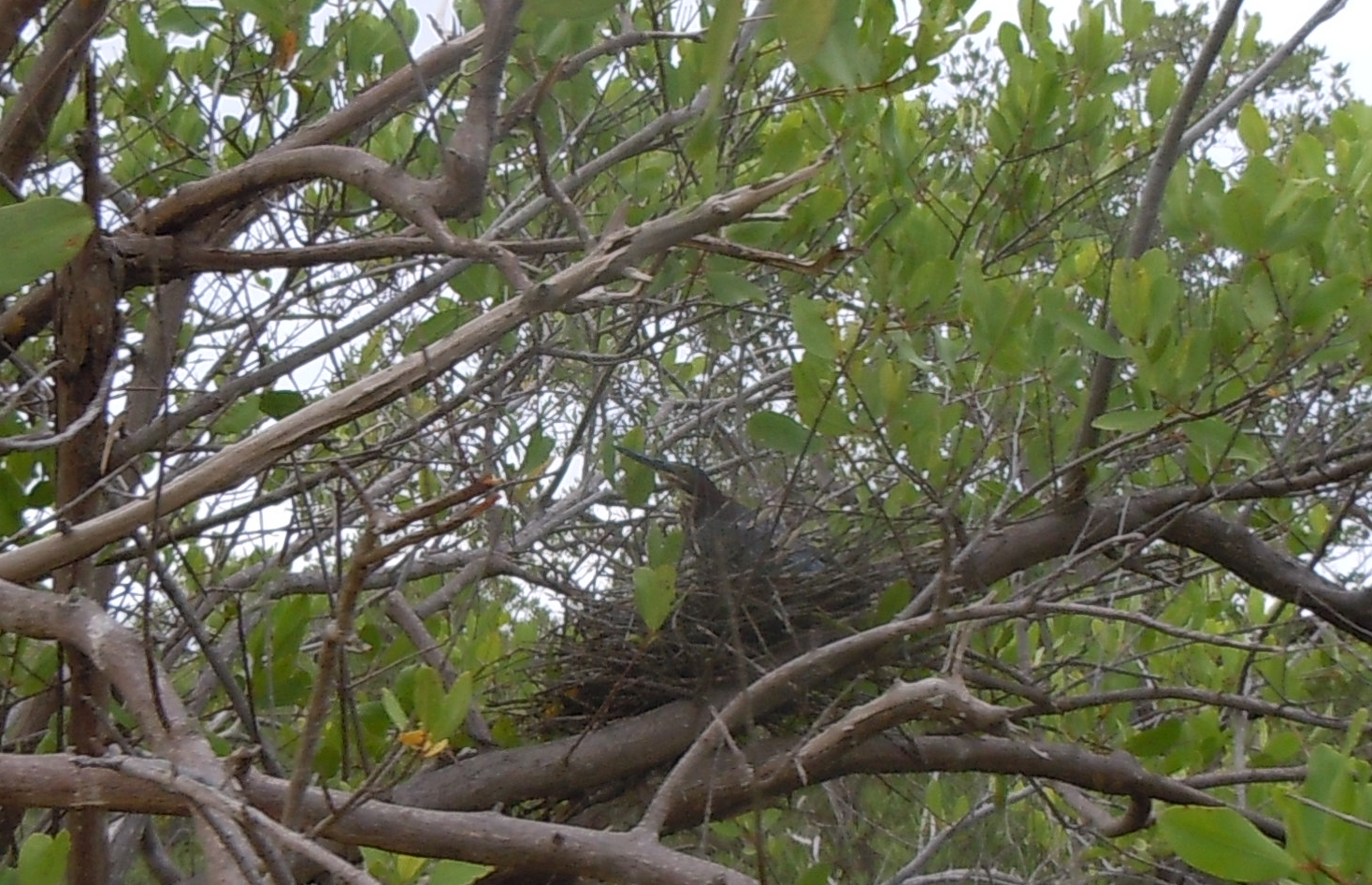
*The nested bird in my last post was a Green-backed Heron, and the woodpeckers were Lineated Woodpeckers. Other birds I’ve encountered are Great Blue Herons, White-tipped Doves, Muscovy Ducks, several hummingbirds and kingfishers, and more.

My kayak trip was the same as usual, with constant bird sightings and several howler monkeys in the trees above me. What changed was the end of the excursion. I decided to try kayaking down the stream of estuary water flowing into the ocean and see if I couldn’t catch a few waves close to shore before calling it a day. The stream of water was fairly shallow, with little piles of sand causing tiny swells of the sort seen over rocks in whitewater rivers. I had fun navigating these “water-bumps” and eventually made it into the ocean after a bit of shimmying past the shallower spots where I got grounded. I immediately set to getting past the already-broken waves so that I could catch one as it rose, like one does while boogie boarding or surfing. After getting buffeted around a bit by the incoming waves, I managed to turn the kayak around just in time to catch a small wave back to shore, paddling as I neared the sand so that momentum would carry me up the beach. Delighted by these first results, I continued to attempt kayak surfing for the next fifteen minutes before it got dark. Once it did, I dragged my kayak in and looked forward to doing the same the next day.

However, the estuary was a completely different place the next day. Very much open to the ocean, the mangrove sanctuary was continuously losing water. Slightly wary, I entered my kayak and paddled forwards. At first, the differences I noticed didn’t seem too grave: the water was shallower, but also very clear – I could actually see the bottom at some points. As I continued into deeper waters, the water darkened again but stayed quite shallow at some points. Once I got to the open area with the mangrove trees dotted around, I was able to distinctly see the effects of an estuary at a different point in its cycle: the mangrove trees had water-markings on them showing that the water levels had descended well over a foot. Here are some before-and-after shots: Black mangrove tree with distinct water markings, and branch before and after.

To read more about estuaries and their cycles, you can visit the National Oceanic and Atmospheric Administration’s educational tutorial. Follow the links on the right-hand column to learn about their importance ecosystem services and more.


The Estuary Part One

The estuary waters are always flat and calm, with practically no current apart from what the wind kicks up, and the OceanKayaks’ sensitivity to motion allows you to maneuver very adeptly around mangrove trees or floating logs. All the kayaks are doubles, but I have only gone out alone in the back, and later the middle, seats, joined either by Harvey in another kayak or by the winged microfauna (who tag along even when Harvey is keeping me company).

The estuary runs for over a kilometer and a half in a winding path, but there is also a larger open area with mangrove trees dotted inside it. The trees in this wide space are lower and farther apart, allowing you to get up close to the tree and check out the birds’ nests within. A couple times I have been able to see birds sitting in the nests up close, and it is fun to test how slowly you can approach them without scaring them away.

Paddling the estuary is a great activity because you can choose your pace very easily. If you want to take two strokes and then slowly glide along for a minute while looking for birds in the trees, then you can do so, as long as you make sure not to drift too far to one side and bump into a mangrove. If it is already getting dark and the mosquitoes are taking advantage of this fact, then you can see how much of a wake you can leave as you speed towards the beach and watch fish jump out of the water to get out of your way. I generally use the slow and photograph-friendly method on the way in to the estuary, where I can get shots of caterpillars or woodpeckers, and reserve the faster cardio-workout for the way back. I have been thinking about taking a kayak out onto the cove, where the waters seem pretty calm once you get past the first couple waves. I’ve never been on a sit-on-top kayak in the ocean before, so I’ll let you know how that goes.

Park Punditry

Canyon de Chelly; photo by Timothy Egan

Michael’s post dealing with the intersection of man and nature is crossing paths with a bit of wise observation from one of the great observers and writers plying the American West these days.

Reserves, the FRA, and tigers

I’m at the experience desk at Cardamom County, waiting for my first set of afternoon check-ins as a trainee. While waiting, I found some interestingly related articles about the Forest Rights Act, which is a piece of legislation passed in India in 2006. For all intents and purposes, the FRA allows tribal communities to petition the government for rights to lands they’ve historically dwelt on. The controversy surrounding this legislation is based on questions of anthropogenic cohabitation, deforestation, and the honesty with which the government handles petitions.

Here are a couple articles from India Together addressing certain of these issues.

From India Together,

“Unable to bear the hardships of leading a dignified life living cheek by jowl with wildlife, a large percentage of tribes living in forest areas crave for relocation, provided of course they get livelihood options, and are able to retain their cultural and tribal identity. Yet, anthropologists contend that tribes have been coexisting peacefully for thousands of years in wildlife reserves while the concept of wildlife and biodiversity conservation is nascent. In line with this, they say that relocation of the indigenous people will rob them of their dignity.”

“…the FRA says is that the development projects have to be appropriate; they have to be ecologically right, culturally sensitive and they should benefit people. The kind of projects which are coming up are mindlessly extracting water and forest resources on which people depend; these are not really ‘development’ projects. And if the FRA is coming in the way of such projects then it’s a good stumbling block to have.”

Of course, the Periyar Tiger Reserve (where I happen to be living) stands as a sort of counter-example to these more pessimistic perspectives on the FRA. Here’s a fairly old article (from 2007) about local, former poachers patrolling the park at night, protecting the wildlife from unauthorized exploiters.

I’m interested to find out if these policies still exist at Periyar. I’ll let you know what I find out.

Water, (bottled) water everywhere…

Since I arrived in Bangalore airport on June 3, I’ve heard about Baba Ramdev and his highly publicized, nine-day fast. What I learned today was that, while Ramdev was being treated for weakness due to his hunger strike, another, less-publicized hunger striker, Swami Nigamananda, was being treated in the same hospital. Nigamananda had been fasting for nearly four months (114 days!) to protest illegal pollution in the River Ganga, a holy site for practicing Hindus and also a vital source of water for nearly 400 million Indians. He died this morning, the last days of his strike overshadowed by Ramdev’s.

Before I left the U.S., many friends and family members had told me emphatically, don’t drink the water! When I would ask why, they replied as if it was common sense: well, it’s dirty. Some had apocryphal stories about some friend of theirs who had gotten sick after drinking from a tap in India, and I typically left it at that. But Nigamananda’s death raised the question again in my mind: why is water in India dirty? Is this just some immutable fact, some geological curiosity, or is it rather a human-created problem worth addressing?

These questions aren’t easily answered, just as any question posed about a nation as diverse and large as India is not. There are as many reasons why some water is dirty and some is clean, and investment in hi-tech treatment facilities isn’t always the difference (though it’s a start). I’m only recently wading into the dense information surrounding Indian water policy, the role of industrial polluters along India’s rivers in dirtying the water, and what is being thought of to clean up the situation.

Because let’s not forget: if clean tap water can’t be had, besides boiling all water, the alternative for the consumer is…bottled water. In the States, more and more people are coming to an awareness of the destructiveness of bottled water, but in most areas of the U.S. clean tap is readily available and people have a simple choice to make in how they get it. In India, this choice is not so simple.

The availability of clean water is a pressing environmental, health, and national security problem for the resident of India. But it’s also a problem for the traveller. As the number of empty bottles of water in my room mounts, and as the monsoons continue to dump rain on me all day,  I have to think: am I doing everything I can to combat this problem? As I increase the amount of boiled water I drink, I also am inclined to think more broadly. I’ll let you know what I come up with as I investigate the problem further.

In the mean time, here’s a video (by the same women who did ‘The Story of Stuff,’ which I highly recommend, though I sometimes can’t stand her tone) about bottled water v. tap water, with an emphasis on the U.S. India makes a guest appearance about half-way through, though in an unexpected way.

First Two Days at Morgan’s Rock

Day 1: After dinner, the rain had stopped and it was now pitch black outside, but the wind coming off the ocean made it feel cooler. The refreshing breeze helped me recollect the day’s highlights: Over a million native hardwood trees have been planted here since my father, my brother and I had been camping on this property a decade earlier; some of the guys I remember from then are now working as naturalist guides or kitchen staff; the organic farm is much more extensive, and hundreds of guests have come and gone from their bungalows.

The mind and breeze’s sweeps finished, and now reading, I heard crunching from the corner. At first I didn’t quite register it, and continued reading. When it continued, the interruption made me curious. I slowly stood and leaned around the large wooden column that was blocking my view of the corner in question.

The adolescent opossum and I both froze. It was about the size of a squirrel, and it had a Halloween crab dangling from its mouth. When it looked away I decided that it either couldn’t see me very well or didn’t see me as a threat, so I slowly inched my hand towards the camera that lay on the table up against my knees. Silently cursing the camera’s malfunctions that prevented me from being able to change any settings, including zoom, I turned and took a snapshot. The flash didn’t startle it, so testing my luck further I very slowly stepped over the table and around the column. About six feet away the opossum snapped out of the trance, and ran off with the crab. By chance it ran in a direction where it would have to climb a few steps, slowing it just enough to allow me a last photo as it hurried off.

small possum

Day 2: As a slight drizzle fell through the trees, we sat on wooden benches fixed in the back of a pickup truck on the way to the finca from the lodge. The finca is essentially a farm, of trees and livestock, that is connected to Morgan’s Rock and provides much of its food and maintenance services. After a few minutes it started raining hard, but neither I nor the two guests, a man and woman from Atlanta, minded getting wet after having endured the heat of the past couple days. Bismar, our guide, handed me his radio and cell phone to pass through the rear window to our driver, and I gave up my borrowed camera as well. Just as one of the guests was pulling on her travel poncho, which looked like a translucent red trash bag, Bismar called for a stop. Pointing, he said simply, “sloth,” and we looked up to watch a drenched and sorry-looking two-toed sloth inch its way from one branch to another, fur plastered to its body and spiking up on its head. “They sleep 14 hours a day,” said Bismar, “and only poop once a week.” I added that when they did relieve themselves, they had to do so on the ground. “If I had to climb down my tree every time, I’d probably only do it once a week too,” joked the guest to his wife. A few minutes later we reached the reforestation site, and met the man in charge of equestrian activity, Don Jesus, and started our horseback ride on the road towards the trail. Despite the rain, the horses easily climbed the slope up to the lookout point at the top of the wooded hill.

ocean view