Colonial History & Volcanic Mystery

We left in the morning with Bismar and the guests, transported by the senior driver Inocencio. Our first stop was about an hour and a half away: a town called San Juan de Oriente but known as La Cuña de los Artesanos, or “Artesans’ Cradle,” because literally everyone in town works with crafts for sale to tourists or hotels. We entered one of the pottery shops and went downstairs into the workshop, where a young man was waiting to give us a short presentation on pottery. He explained about his family’s business slowly in Spanish and Bismar translated for the guests. Then he took his seat at a wheel and started shaping a small bowl, using several homemade tools—a bicycle spoke, for example—to straighten its edges. The expression on his face showed how much he enjoyed the work, which certainly looked fun even should one have to shape clay all day, every day. After a couple minutes, a small and perfectly round pot was on the table in front of us. He talked some more about clay and then said, “At this moment in the process, the clay is still very fragile,” and demonstrated by plunging his fingers into the side of the vessel, leaving a deep impression in it.

Leaving the wheel, he led us to a larger table where wall lampshades were being made. Tools like a polished beach pebble and a child’s plastic spinning top were used to spread and smooth the paint that was applied with a brush made of a hollow pen and the hair of the girls in the family. A small kiln sat smoking in the corner, baking about twenty of the lampshades. Once the guests asked a couple questions, we thanked the young man, whose unbefitting name it turns out was Stalin, and went up to, of course, the pottery store. Continue reading

Newspaper Bags

As I suggested in my last post, I’ve recently spent less time in the Periyar Reserve, i.e. observing and chronicling my encounters with the myriad species of plants and animals there, and more time in and with the local community. Working with resort management and Forestry Dept. officials, I’ve been trying to get off the ground a microbusiness enterprise, operated by residents of Kumily and members of the tribal communities in Periyar East, with the initial goal of producing bags from recycled newspaper. This is related to the bigger goal of eliminating the use of plastic bags.

One such bag, made from recycled newspaper

There are several aspects to this project, and as I delve deeper into them the more complex and intriguing it seems to me. I think the easiest and best way to present the full picture, to identify the difficulties and possibilities inherent to it, is to tell the whole story of my involvement in the project, and in the process to clarify the context of my previous posts.

To set the scene, I offer, in shorthand, a cultural backdrop:

What was only recently a subsistence and agricultural culture and economy, the Cardamom Hills (like all of Kerala) has undergone something of an economic and cultural revolution over the past fifteen to twenty years. Though I’m not an expert in this field, I can say, based on firsthand accounts and observations, that as education levels have risen even among the poorest people in this area (Kerala’s literacy rate is, famously, over 90%), and as the opportunity to pursue non-agricultural employment and consume newfangled products has become commonplace in this area, the demand for disposable income and new ways of attaining it has also increased. Generally, this is true of India as a whole, and as a global phenomenon it really deserves a more nuanced treatment than I’m able to give it (for more information, I suggest you go to your local library or see your neighborhood economist). But, on a microcosmic level, it is perhaps most pronounced, complicated, and—in some ways—easily tackled in the tribal communities of India’s forests. Continue reading

The Kitchen Table Connection: Following the Paper Trail

She wasn’t the creator of the newspaper bag concept, but Diwia Thomas has done her part to merge their production with the world of community development. Based on a deeply rooted desire to help women create a degree of financial independence, this lifelong resident of Cochin has used her business acumen, social network and marketing skills to advantage.

With the limited supply of paper pulp in India, newspaper printers have implemented the innovative practice of a de-inking process for recycled newsprint. Currently about a quarter of the paper the printers use is recycled material, which has both saved on paper pulp imports and driven up the price paid per kilo for old newspapers. India has a well-established history of recycling and these new developments have given more financial incentive to do so.

Diwia knows the system, her clients and her resources well. It only takes a gentle nudge to friends and family to leverage the equivalent of their daily coffee expenditures in the form of a weekly donation of their newspapers—they give them to her instead of selling them to a recycler (who would pay an amount worth a coffee at a local café). Only full, flat sheets of newspaper can be used in bag production, but with the ubiquitous use of newspaper in this culture as wrapping for everything from eggs, to vegetable market goods to crockery, there is plenty to go around for other recycling purposes. Continue reading

Ecotourism as an Ecosystem Service

A good friend of mine has been working on developing a curriculum for sustainability lessons in Utica, and she asked me just a couple days ago for some help with the topic of ecosystem services. I thought it strange that she came to me (a hotelie, no less) for help on such a scientific topic, and I had to admit to her that my knowledge of the topic was shallow. Nonetheless, I pointed her to the UN’s 2005 Millennium Ecosystem Assessment (MA), the four-year study that is considered by the environmentalist community as the go-to resource on ecosystem services. I had skimmed the hefty 155-page synthesis report a few months earlier—I’d only initially did it because Eric Ricaurte, my research adviser, had recommended it to me—and I didn’t remember much from it. So after recommending the MA, I decided to read through some sections of it again.

Mangroves are a recognized source of ecosystem services. They buffer against storms, prevent erosion, and filter out toxins.

By way of background, ecosystem services are resources and processes that the natural environment provides for us. For example, trees provide oxygen for us to breathe, fish in the ocean serve as food, and earthworms help decompose our waste. But what caught my eye immediately from the Millennium Ecosystem Assessment was how it recognized ecotourism and recreation as important ecosystem services for humans. I couldn’t help but smile: while attempting to preserve their surrounding environments, eco-resorts around the world are also drawing upon this valuable ecosystem service by deriving revenue from it. Continue reading

Entomotography

We had been on bamboo rafts in the Periyar Lake most of the morning, and had gone on shore briefly to visit the night ranger’s encampment.  I had been there several times previously, but today was different. We witnessed one of the greatest wonders of the natural world—a mother elephant and her calf (because of a mother’s aggressively defensive instincts, it is rare for humans to see this combo in the forest).  It was too spectacular for words, and even photos are worth just a few thousand words—not nearly as much as it felt worth while there.

By midday we were back on the water, and the rush of seeing such a huge and intelligent creature bonding with its offspring was lingering, but passing. We landed for a bit of respite. As the rest of the group ate lunch and talked, I decided to renew that rush with a change of perspective: from charismatic megafauna to wily winged minifauna. I crouched on the parched rocks, squatted and staring at my camera’s viewfinder. I had been stalking my tiny target along the shore for almost 30 minutes, and had enough mud, pebbles, grass and dung on my knees to open eyes at a detergent expo.

My eyes strained to focus on the strangely camouflaged creatures I was hunting. Scanning the motionless terrain of the shoreline, I saw no movement except for the gentlest rippling of grass and the lake’s surface with the breeze. I got impatient and decided to draw them out of hiding. It wouldn’t take much – I lifted my foot and took a step forward, and there!

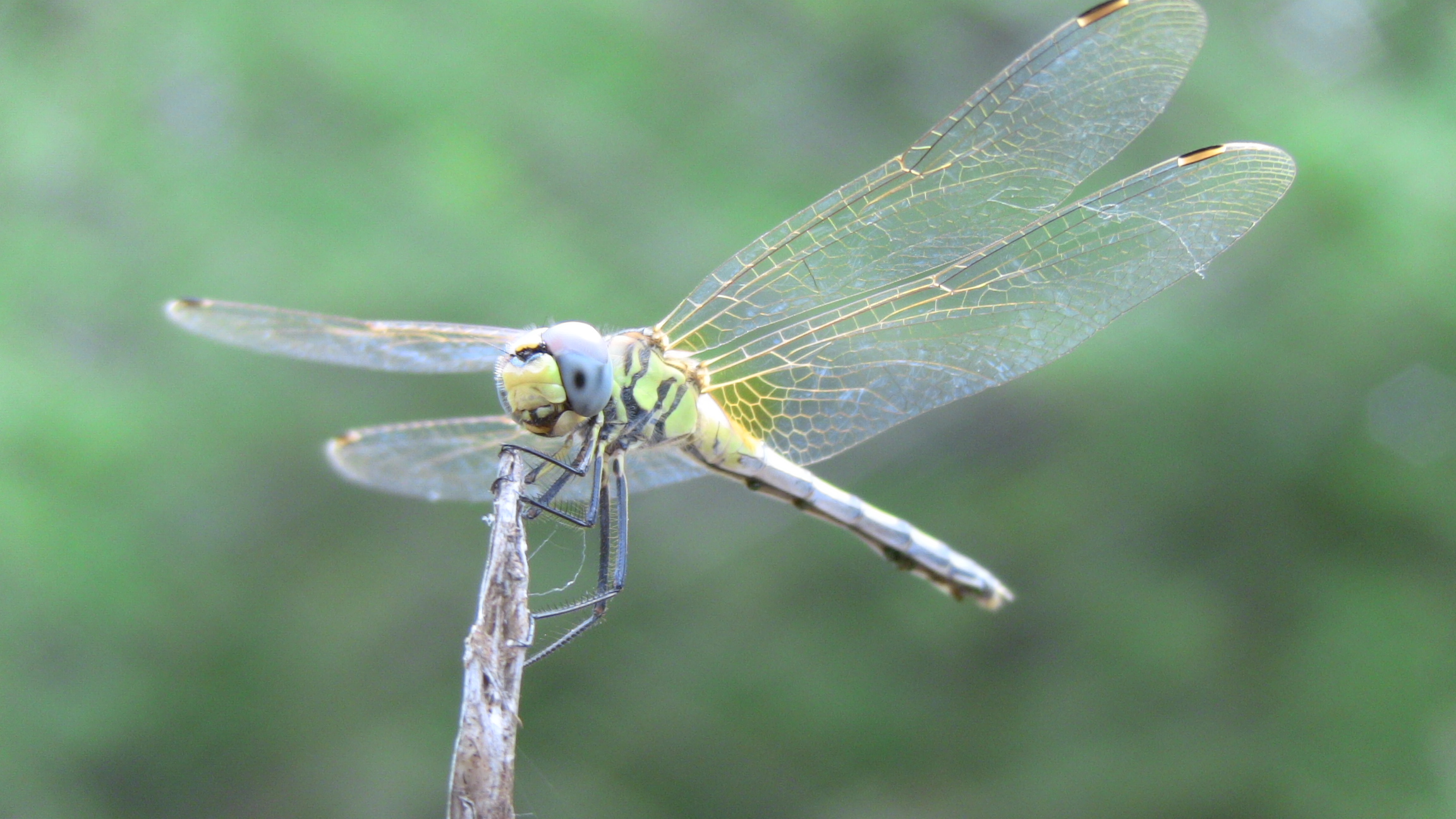
A bright blue-green dragonfly that had been surreptitiously clinging to a twig alighted, and began to zoom around. Continue reading

Scuba Fishing

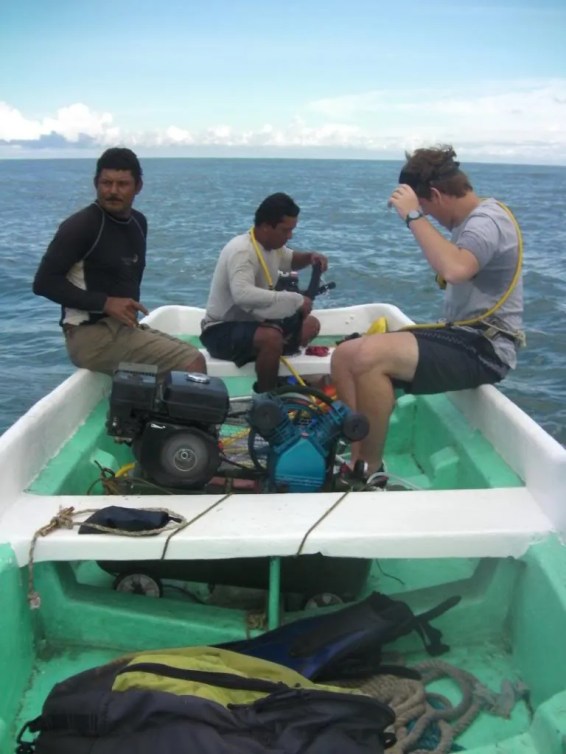
This morning Pierre and I got up early to go on a scuba fishing expedition with Jacinto and Juan. Using a kayak to cross the wide and deep channel the sea was cutting into the estuary, we headed to a spot where the waves were a bit calmer, and the fishermen came in a small motorboat to take us over to the Eco I. Unfortunately, it turned out that the smaller boat was to be our vessel for the morning, since the Eco I was out of fuel. A green air compressor machine sat in the middle of the boat, and the long air hose sat coiled at the bow with a couple pairs of flippers and snorkel sets.

Pierre and I installed ourselves at the stern and started putting on sunscreen. “The water visibility is a bit low today, but we will try to find some lobsters,” said Jacinto in Spanish. Juan drove the boat past Morgan’s Rock and close to the rocks on the next cove over. Then he handed the tiller to Jacinto and started pulling on some flippers, signaling for me to do the same. The two fishermen showed me how to operate the air regulator, which was the same sort found on a tank scuba set, and they helped tie the hose so that it fell over my shoulder and across my back.

Continue reading

Religion and Conservation

About 80% of the world’s population is religious.  Even though it might not always be apparent, religion often serves as a unifying value of people.  Many religions have traditional and ethical ideals that sanctify the earth and its resources, thus linking mankind’s religious life and the natural system of the world.  With this much of the world professing a faith, religion could play a tremendous role in conservation.

Continue reading

Arthropods and Sunsets

While walking on a trail today, Pierre and I came across a spider with a lime green back. As we approached it, it bared its behind at in our direction and dripped forth some dangerous-looking white liquid. They were very small droplets that didn’t spray towards us, but merely fell down to the dirt below the web. We paused to photograph this spider, keeping our distance in case what we had witnessed was just the priming of a more serious discharge mechanism, and then went on our way.

As I thought back on this spider I realize that we may have simply walked in on its moment of defecation, and incorrectly interpreted the droplets of excrement as an attack. A quick Ecosia search showed me that spiders’ poo is often white liquid that leaves a chalky residue, so I am starting to believe that what Pierre and I saw was not a direct assault but perhaps still a method of self-defense in some cases.

What we watched later in the day, however, was a clear attack. A millipede (which I incorrectly identify as a centipede in the short video I took) was beset upon by a fast-moving bug that darted at its writhing, myriapodous prey without mercy. Unfortunately, Pierre and I were on the way to Sunset Hill (see my previous post) so we had to leave at the risk of missing what we hoped would be a great view of the sunset.

When we got to the top of the hill, we were rewarded with the best sunset I’ve seen from the point so far out of the three times I’ve been up there. I think the better sunsets must be during the dry season, when there aren’t quite as many clouds covering the sun as it descends over the ocean horizon.

A Staff Tour

On its face, there is nothing remarkable about a company picnic. If what I’ve learned from media representations and other secondhand reports stands up, it seems that they happen just about everyday in some part or another of the world, and that they all involve a bit of hair-letting, whether with ice-cooler beer at the neighborhood park or mini-fridge delectables in Vegas. It is this understood relaxation—or evisceration—of daily norms, of one’s decorum, coupled with the acceptance of its temporality—because of course, work does go on the next day, and you must confront those who yesterday saw you transformed—that gives these professional gatherings their almost sacred quality in the religion of the workplace. Whether mentioned in hushed tones or all too self-consciously laughed off, the company picnic/outing/soiree is, in the daily grind’s cosmology, the potential site of the divine, of the disclosure of truth and the unmasking of custom.

So I don’t think I overstate it when I say that yesterday I bore witness to (and, yes, sometimes partook in) culture. Twenty hours in a bus through the hills of Tamil Nadu is culture, and my inability to draw from my fellow travelers a suitable translation of its subtleties (I mean, who can speak fluently about his own culture?) made it that much more profound. No, this may not have been ‘culture’ in the sense that the Martial Arts show down the street purports to be, nor is it ‘culture’ in the same way that the locally-inspired cuisine at Cardamom County’s All-Spice Restaurant is.

This was culture in the minute, unsalable sense. This is that culture which happens in the infinite, petty moments between friends. Continue reading

Cars for Children

Full disclosure: I feel sort of awkward drawing attention to this story. It describes one of the most unsettling and simply bizarre state initiatives I’ve heard of in a while, and I’m not entirely sure the matter merits space on this site. Alas, my provocative side gets the best of me sometimes and I am compelled to link to it, if only because it’s consistent with the problems I promised to raise yesterday, not to mention it’s pertinent to India and that it points to some of the truly hard questions we as a global population will have to ask ourselves in the coming century. These questions bear spiritual, physical, cultural, and ethical import, and how we answer them…well, that’s just more than I can deal with in this format.  Continue reading

Which God?

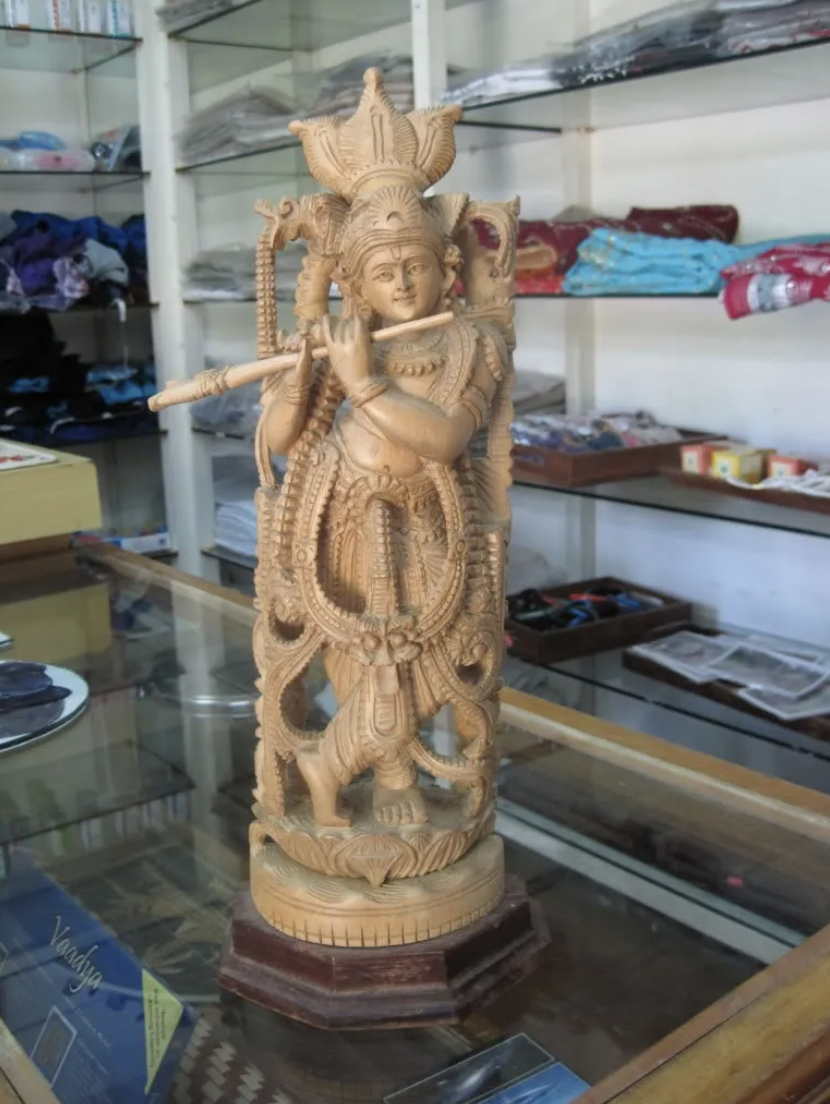
The other day I was working in the Ants gift shop with its manager Manoj, who also represents the helm of the guest relations experience department. When I began asking about the various products offered in the gift shop ranging from vibrant dhotis and saris to spice and herb books as well as delicately carved houseboat models, I noticed two sculptures of what appeared to me to be Hindu gods. It turns out the first god was Krishna, the young boy playing a flute. The second was the well-known elephant headed god, Ganesha.  If you’re not yet aware, Hinduism is a polytheistic religion. And by polytheistic that means there are over a whopping 330 million different gods in Hinduism. Continue reading

Carbon Emissions Series: Air Travel Efficiency

One of the more interesting responsibilities of my current internship here in DC is to peruse news articles and company/NGO reports that relate to corporate social responsibility. Last week, one particular report caught my eye because of its relevance to travel and tourism. Brighter Planet, a sustainability research and reporting company, recently published a white paper on airline efficiency. The paper, titled “Air Travel: Carbon and Energy Efficiency,” struck me as ironic. Air travel is a highly emissions-intensive mode of transportation and seemingly incompatible with sustainability. It accounts for 2% of global greenhouse gas emissions, a large number for a single industry.

Brighter Planet’s report, however, did not seek to justify flying. It instead analyzed a decade’s worth of data on a host of fuel consumption metrics on all major airlines. What the research found was intriguing and useful. The efficiency of a flight that you take is influenced by countless factors, but there are five main “efficiency drivers” that most significantly impact the GHG emissions of a flight: aircraft model, seat density, load factor, freight share, and distance. I’ll do my best to explain each of these briefly. Continue reading

Kayak Surfing with a Friend

Today I met Pierre de Chabannes, a young Frenchman interning at the Ponçon’s La Cumplida farm in Matagalpa. A student at a French University, he is working on repairing and improving the current hydroelectric dam/canal system in place at La Cumplida so that the farm can produce enough electricity to supply the surrounding area in Matagalpa.

After showing Pierre around the ecolodge, we decided to go kayaking in the cove. We went out past Morgan’s Rock and then crossed over to the other side of the cove before returning to the coast, where we caught a wave onto shore and tried surfing a couple times. Eager to surf some more, Pierre switched his seat to the back of the kayak (we’d had them in the middle), where he thought it would allow him to control the direction better, as well as prevent the nose of the kayak from plunging into the water and causing a flip (which had happened to both of us already). Controlling the direction was also useful because we had both been pushed parallel to the wave we were riding several times despite out best efforts. When he switched to the back seat, Pierre surfed all the way to shore with little difficulty, so I soon made the same change. Continue reading

Central American Pygmy Owl

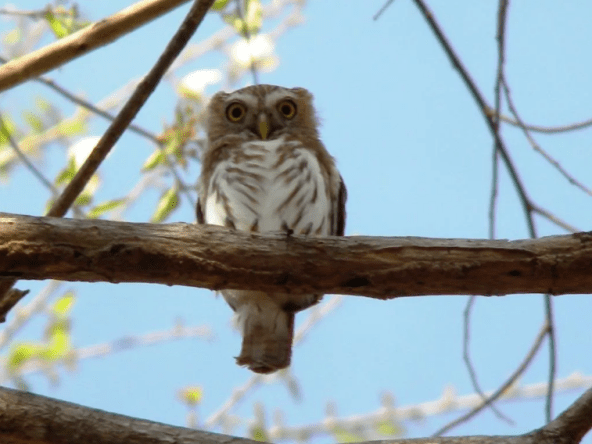
Today Harvey and I went on a nature walk with a couple guests from California. Interested in seeing birds, they had brought a pair of binoculars along, which we soon had an opportunity to use. We were walking along what seemed a deserted trail when Harvey suddenly motioned for us to stop and pointed up into the trees on our left. We saw nothing, and Harvey had to lead us along the branches with his finger to show the little fist-sized lump of white and light brown that was a pygmy owl. With the help of the binoculars and Harvey’s guidebook, we were able to identify it as a Central American pygmy owl. Without the binoculars it would have been impossible to distinguish between the three or four species of owl, since they are all roughly the same color and only differ in markings and patterns on their chest, head, and tail feathers. Although I couldn’t get a picture since it was too far away (still no zoom on the camera), here are some photos that Bismar took last summer, the season when trees’ foliage is much less dense and in some cases nonexistent.

It is winter (the rainy season) here now, and therefore very impressive that Harvey was able to spot the tiny bird through all the leaves without the help of a flashlight at night, which is when one usually sees the owls.

A Thousand Miles

I recently watched a video that became a personal challenge.  It brought to mind that famous Lao Tzu quote, “A journey of a thousand miles begins with one step.”

After watching this video, I arrived at the equation: small changes = sustainable.  In other words, sustainability is the thousand mile journey; small changes are the baby steps that get us there.  This video highlights our ability to grow as we challenge ourselves to do something new for a mere thirty days.  I thought and thought of something that could be worthy to merit a thirty-day challenge; however, it was then that I realized that I was taking the small step out of the equation—no task is too small towards my sustainable journey.

Continue reading

The Fundamental Question

It’s something I ask myself every day. I wake up, untangle myself from my bedding, and ask…Why on earth am I here on this planet? I reassure myself with some grounding answers, and once I get a glimpse of the world outside my window I answer like this…

Sustainability is my passion. Sustainable societies. Sustainable economies. Sustainable environments. Got the idea? Basically, my goals focus on sustainable lifestyle for sustainable futures. To achieve this, I not only try practicing an enduring lifestyle, but I also live to promote the conservation efforts of others around the word.

Having been raised in a developed country where varieties of information seem endless, it excites me when less informative, developing countries make strides towards conservation.  Here, I will share my excitement as I discover more about global conservation initiatives, and, in turn, hopefully my accounts will inspire citizens of all originations to join these efforts to conserve and protect the beauty this planet and its inhabitants have to offer.

An Introduction

Before I post again about things of substance, I wanted to take a moment to introduce myself to our readership, to share my interests and goals, and to spell out more clearly the reason to the madness of my earlier posts. If I’m not mistaken, my fellow contributors will be doing the same over the next few days.

I am, nominally, Michael Muller. In the fall, I’ll be a senior at Amherst College, where I study, among other liberal arts ‘disciplines,’ Political Science, in particular political theory and the history of political thought. I have a peculiar fascination with how different groups’ and individuals’ concepts and philosophies affect and create attitudes, and how these attitudes influence action. If this all sounds highfalutin or like pseduo-psychology, you’re on the right track.

Self-deprecation aside, however, I also have a passion for interpreting and, if possible, correcting injustice. Thanks in large part to my upbringing, I tend to identify with the cause of protecting the less-protected, whether it’s a social group, eco-system or idea. Of course this tendency is all well and good in theory, but its tendance requires greater sedulity in practice. When Crist offered me the opportunity to come work and write for Raxa Collective this summer, to identify problems with and solutions for conservation initiatives in Kerala, I immediately snagged the opportunity, understanding it not only as one that would allow me to effect change, but also one that would test, probe, relax and strengthen my still-developing convictions.

In my posts over the next four weeks, besides providing personal insight into the wonders of the Periyar, Kumily, etc., I hope also to problematize and contextualize my own experiences, to illuminate some of the complexities inherent to preservation and conservation in a rapidly developing nation (and world), and offer possibilities for readers and travelers to get involved in the conversation.

With that in mind, I will try to offer non-political entry points into political questions, while not neglecting or forgetting the reason I’m here, or, for that matter, why anyone from outside Kerala would come here: the impossible rarity of its natural and cultural riches.

Thanks for reading, and I look forward to comments. Let’s have a conservation conversation*!

*Sorry.

Damn Dams and Macaque

A couple of days ago, I hopped on a motorcycle (my first in 21 years!) helmed by Saleem, and headed across the border of Kerala into Tamil Nadu. I hadn’t realized until this trip just how proximate the neighboring state was, and that I had actually walked into it several times without realizing I had done so.

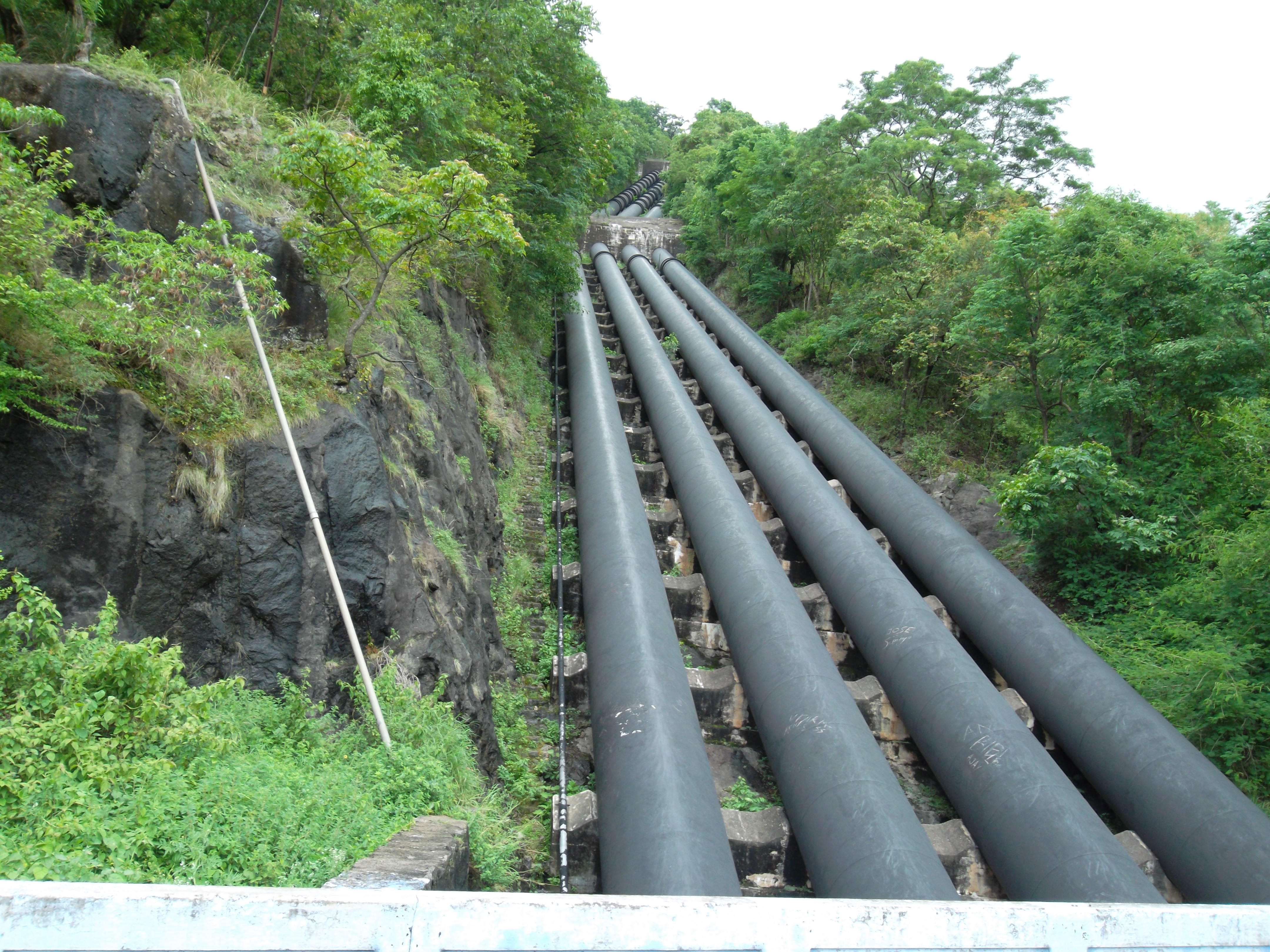
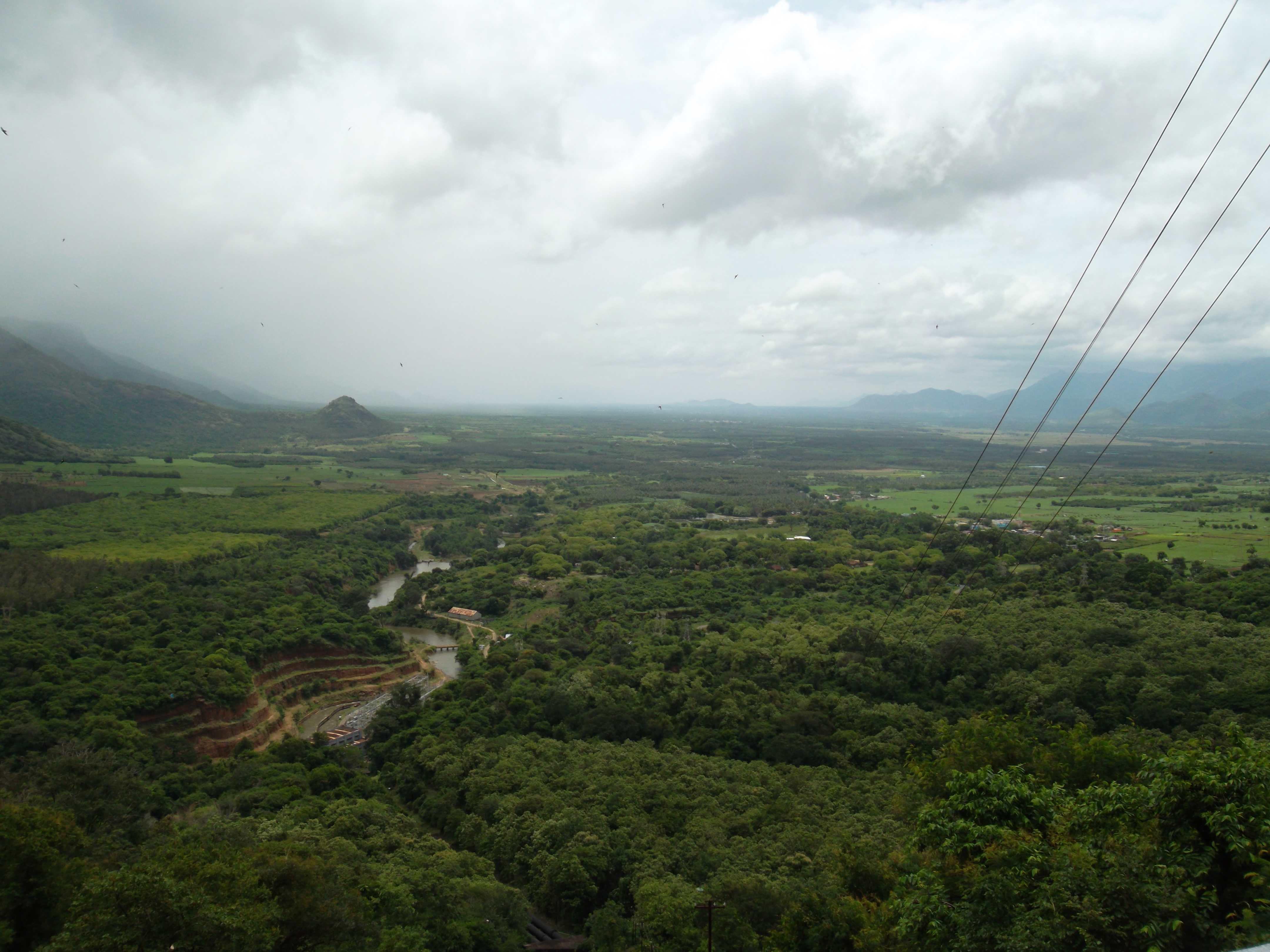
Saleem had plans to take me through the measure of forest that extends beyond Kerala to the penstock pipes that carry water from the Periyar River down to Tamil Nadu and a hydroelectric plant. These pipes are an attraction unto themselves, and looking over the slope down which they run provides a scenic view of the lush farmland of this TN valley.

At that time, I didn’t know– and Saleem only hinted at– how fraught with political tension the very spot we were standing is (and has been) to the Tamilians and Keralans. The provenance of this conflict is a century-old treaty between the Princely State of Travancore (which is now Kerala) and the Secretary of State for India, representing what is now Tamil Nadu. Essentially, this treaty gave to Tamil Nadu, an otherwise arid area, the right to use water from the Periyar River for irrigation– for 999 years. This agreement, for all intents and purposes, created the Tamil Nadu you see in the picture above. Continue reading

A Kipling Character at Morgan’s Rock?

It happened today.

I was on the Campesino Breakfast Tour with guests. We drove through the finca till we got to the Aguacate Farm, where the chickens, ducks, and cows are kept. Don Juan taught us how to milk a cow; the lactating mother was mooing with discomfort, eager to be relieved of her burden. Sitting on a one-legged stool that was tied to his waist, Don Juan expertly sent streams of white into a gray pail, and the guests crouched to do the same with early morning alacrity.

We filled up the pail, thanked Don Juan, and made our way to the chicken barn. Through the dim light and faintly unpleasant smell, about 180 chickens skittered about, clucking indignantly at the disturbance. A rake and shovel leaned against the wall, a wooden stick with little rawhide strings hung from a column, and a leather belt was wound around a rafter in the corner. The man who takes care of the chickens took Harvey aside and whispered something in his ear, then proceeded to lead the guests through the barn to show them the coops and water-troughs. While the guests were distracted, Harvey approached me.

And then it happened.

Continue reading

Sri Lankan Frogmouth

Early yesterday morning, Gourvjit and I met Saleem and Deepthi, a graphic designer who was collecting information about wildlife in the Periyar, for a trek into the forest. Because Gourvjit and I had recently been with Amie and Milo on a path typically followed from the boat landing–which was where we were meeting our guide this morning–to avoid touring the same land we asked the guide to lead us on a different route. He told us there was one which might yield some interesting wildlife sightings, but that the terrain would be a bit more difficult. We took the challenge, of course.

What our guide had neglected to tell us then, but which we soon realized, was that the route he had planned for us to take wasn’t really a ‘route’ at all. That is to say, to make our way we had to cut through 7 ft tall elephant grass and other underbrush, and we followed no well-worn groove in the dirt, or footpath. But in this manner we carved our way up a hillside, conquering some slippery rocks under foot, to a clearing, from which we could see a broad landscape of savannah hills and waterways.

Yet on the way down from the clearing these minor travails were justified as, after tramping through another patch of thick grass, our guide told us to be still while he pointed to what looked like a lump of tree–but with eyes. Deepthi whispered to me that we were seeing a Sri Lankan (or Ceylon) Frogmouth, a nocturnal bird native to the Western Ghats, whose skill at camouflage makes you about as likely to spot it as one of the Periyar’s 50 tigers. I can say very honestly that I have never seen a bird I was so taken with, with its wide-set and perfectly round eyes, and its blocky, brown, and perfectly rigid form. Because the Frogmouth hides in the daytime by keeping still, we were able to get unusually close to it for a good while before it was threatened and flew off to a tree with thicker foliage.

It was a really unique experience to see this bird, and one I’ll not soon forget. Luckily, Deepthi was able to capture some great shots of the bird. Check them out!