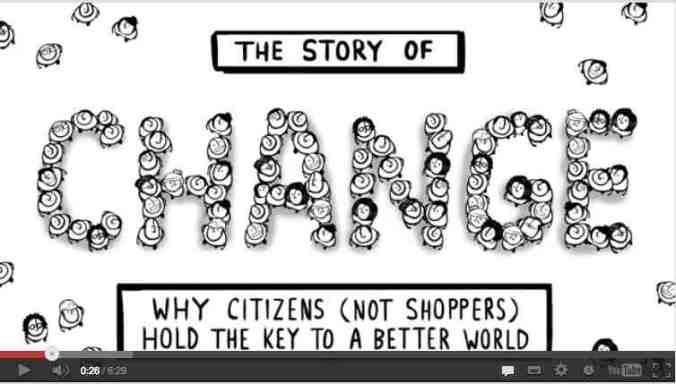
Click above to go to the location where Cornell University is hosting this brief video by a fellow alum of several Raxa Collective contributors:
Can shopping save the world? The Story of Change urges viewers to put down their credit cards and start exercising their citizen muscles to build a more sustainable, just and fulfilling world. Continue reading →
Lindsay France/University Photography. Annie Leonard visits campus in April.
Allegra was recently asking several Raxa Collective veterans (with the vast experience of two years maintaining this site), in advance of posting this, whether we had posted any “stories of stuff,” or heard of Annie Leonard before. The answers she got, incorrectly, were no and yes. Apparently it was forgotten that we have mentioned her “stuff” once previously in one of our earliest posts (note to WordPress: please improve your search function), but she most certainly had an influence on our interest in bringing more information from the field into the public domain using online distribution. So this news item caught our attention:
Annie Leonard, environmental activist and creator of the 2007 viral hit video “The Story of Stuff,” spent nearly 25 years traveling the world investigating environmental health issues and ecological sustainability.
This spring, she finished a long-overdue project she had put on hold during that time: completing her Cornell master’s degree. Continue reading →
Since I arrived in Bangalore airport on June 3, I’ve heard about Baba Ramdev and his highly publicized, nine-day fast. What I learned today was that, while Ramdev was being treated for weakness due to his hunger strike, another, less-publicized hunger striker, Swami Nigamananda, was being treated in the same hospital. Nigamananda had been fasting for nearly four months (114 days!) to protest illegal pollution in the River Ganga, a holy site for practicing Hindus and also a vital source of water for nearly 400 million Indians. He died this morning, the last days of his strike overshadowed by Ramdev’s.
Before I left the U.S., many friends and family members had told me emphatically, don’t drink the water! When I would ask why, they replied as if it was common sense: well, it’s dirty. Some had apocryphal stories about some friend of theirs who had gotten sick after drinking from a tap in India, and I typically left it at that. But Nigamananda’s death raised the question again in my mind: why is water in India dirty? Is this just some immutable fact, some geological curiosity, or is it rather a human-created problem worth addressing?
These questions aren’t easily answered, just as any question posed about a nation as diverse and large as India is not. There are as many reasons why some water is dirty and some is clean, and investment in hi-tech treatment facilities isn’t always the difference (though it’s a start). I’m only recently wading into the dense information surrounding Indian water policy, the role of industrial polluters along India’s rivers in dirtying the water, and what is being thought of to clean up the situation.
Because let’s not forget: if clean tap water can’t be had, besides boiling all water, the alternative for the consumer is…bottled water. In the States, more and more people are coming to an awareness of the destructiveness of bottled water, but in most areas of the U.S. clean tap is readily available and people have a simple choice to make in how they get it. In India, this choice is not so simple.
The availability of clean water is a pressing environmental, health, and national security problem for the resident of India. But it’s also a problem for the traveller. As the number of empty bottles of water in my room mounts, and as the monsoons continue to dump rain on me all day, I have to think: am I doing everything I can to combat this problem? As I increase the amount of boiled water I drink, I also am inclined to think more broadly. I’ll let you know what I come up with as I investigate the problem further.
In the mean time, here’s a video (by the same women who did ‘The Story of Stuff,’ which I highly recommend, though I sometimes can’t stand her tone) about bottled water v. tap water, with an emphasis on the U.S. India makes a guest appearance about half-way through, though in an unexpected way.

 Organikos