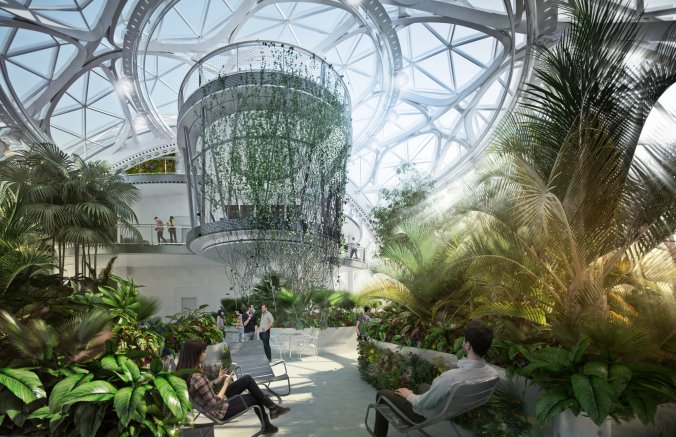
Renderings of the spheres at Amazon that show what the interiors are expected to look like. When they open in early 2018, the spheres will be packed with a plant collection worthy of top-notch conservatories. CreditNBBJ
An article in the New York Times helps to illuminate the logic of a company with billions of dollars to spend on its office infrastructure, a company that occupies”creative” space in the global economy, when they design the HQ of the future:
…“The whole idea was to get people to think more creatively, maybe come up with a new idea they wouldn’t have if they were just in their office,” said Dale Alberda, the lead architect on the project at NBBJ, a firm that has also worked on building projects for Samsung, Google and the Chinese internet company Tencent.
Tech companies have been eager to test ways to make workplaces more conducive to creativity. Some turn their offices into grown-up playgrounds, with beanbag chairs, ball pits and Ping-Pong tables…
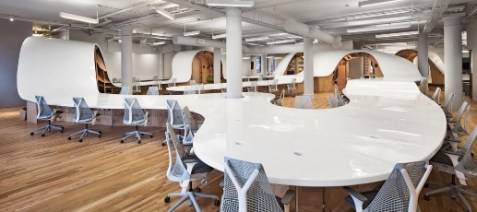
In New York City’s Chelsea neighborhood, the tech-centric creative company Barbarian Group created a fluid Superdesk to gather their employees at one endless table. Photo from The Creative Workplace
This comes not long after Apple’s own utopian creativity nest, among others in the cash-aplenty sector. A few months ago a book titled The Creative Workplace came to our attention.
We were already primed to think about office space again when we saw the book. A portion of our team was going to be transferring over to the client side at Xandari, starting July. This would give us some space to be creative with. And so we have done. Already we have welcomed the Rainforest “client-side” team into our office. S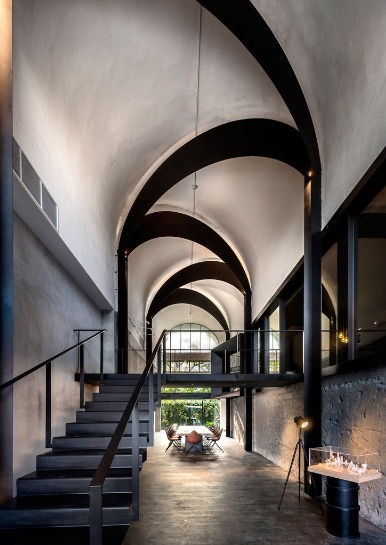 hared office space, akin to what we saw in one of the WeWork spaces in San Francisco recently, suits our office space well.
So the images from this book have been perfectly timed to stimulate our thinking. In our first round of office creativity thinking in 2011 we had a shell that dictated constraints. One of those was economic, aka rational business logic. We needed a certain “feel” to reflect our aesthetic, and to accommodate our workflow, but did not want to go over the top because that is not how we do things.
But we like pretty shiny things as much as the next person, so Continue reading
 Organikos