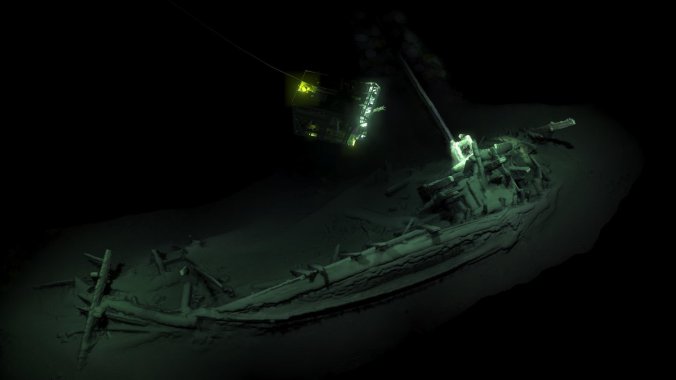
The Black Sea Maritime Archaeology Project says the intact shipwreck was discovered at a depth of more than 1 mile, where the scarcity of oxygen helped preserve the ancient vessel. Black Sea MAP/EEF Expeditions
Who knew there were still such discoveries to be made? Obviously, someone did. And Homer’s epic tale of Odysseus and his journeys plays a part in this story:
‘Oldest Intact Shipwreck Known To Mankind’ Found In Depths Of Black Sea
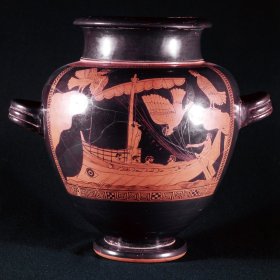
The recently discovered shipwreck reveals details that are similar to the ship on this famed ancient Greek vase, which dates to the fifth century B.C. and depicts Odysseus tied to the mast to brave the sirens.
Universal Images Group/Getty ImagesMore than a mile beneath the surface of the Black Sea, shrouded in darkness, an ancient Greek ship sat for millennia unseen by human eyes — until the Black Sea Maritime Archaeology Project happened upon its watery grave last year.
The team announced the find Tuesday, saying its discovery has been “confirmed as the oldest intact shipwreck known to mankind.” Radiocarbon-dated to roughly 400 B.C., the trading vessel plied the waves in the days of Plato and Sophocles, when the city-states of ancient Greece had scattered colonies all around the Black Sea.
Since then, it has sat at a depth that more than doubles the height of the tallest skyscraper in the world. In water that deep, oxygen is hard to come by, and because of that, so too are the organic processes that help drive decomposition. That left the ship all but undisturbed until the research team discovered it — along with dozens of other shipwrecks — during an 800-square-mile survey of the seabed. Continue reading
 Organikos