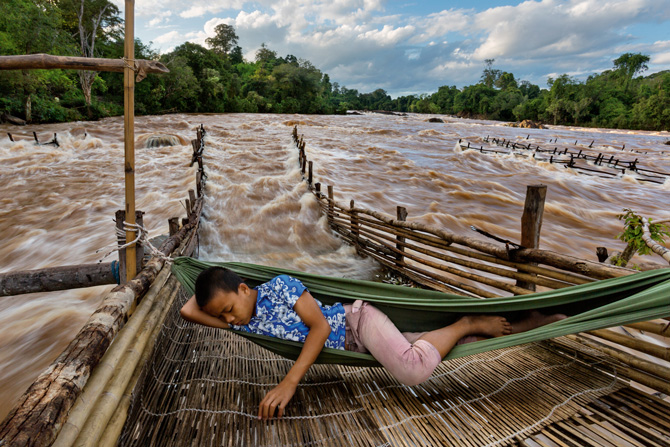
In southern Laos, near where the Don Sahong dam will soon rise, a fisherman’s son snoozes above his father’s weir, waiting for fish migrating upstream to tire and wash back into the trap. PHOTO: David Guttenfelder
Dams are barriers built across rivers and streams to confine and regulate water flow for irrigation and hydroelectricity. However, in recent years, the social, economic, and environmental impacts of these constructions have become a pressing concern. While dams are integral to agricultural irrigation, and can help control floods, the construction causes mass displacement, increases risks of earthquakes and landslides. Along the Mekong in China, the people need clean electricity but also the fish and rice that and undammed river provides.
Ban Pak Ing may be a vision of the future for many Mekong villages. Five more dams are under construction in China. Downstream, in Laos and Cambodia, 11 major dams—the first on the main stem of the lower Mekong—are either proposed or already being built. By disrupting fish migration and spawning, the new dams are expected to threaten the food supply of an estimated 60 million people—most of whom live in villages much like Ban Pak Ing. The electric power generated by the lower Mekong dams is destined largely for booming urban centers in Thailand and Vietnam. Kraisak Choonhavan, a Thai activist and former senator, calls the lower Mekong dams “a disaster of epic proportions.”
Continue reading →



 Organikos