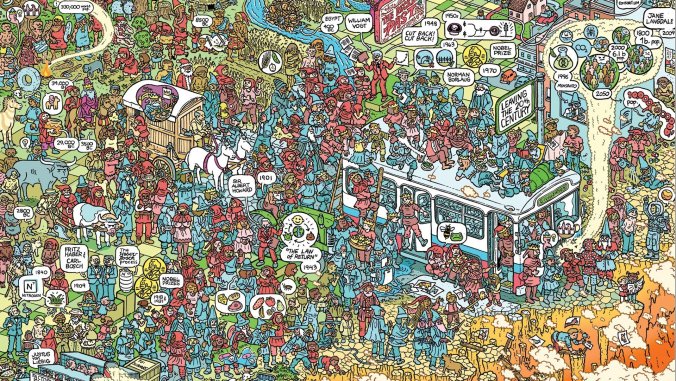
1491, 1493 & 2048

1920 (1).jpg

Ulises Fariñas

We have appreciated Charles C. Mann since our earliest awareness of his historical work when we started this platform in 2011. Now, he peers into the future, and we cannot close our eyes to the prospects he raises in this futurist epic in the upcoming edition of the Atlantic:

Can Planet Earth Feed 10 Billion People?

Humanity has 30 years to find out.

All parents remember the moment when they first held their children—the tiny crumpled face, an entire new person, emerging from the hospital blanket. I extended my hands and took my daughter in my arms. I was so overwhelmed that I could hardly think.

Afterward I wandered outside so that mother and child could rest. It was three in the morning, late February in New England. There was ice on the sidewalk and a cold drizzle in the air. As I stepped from the curb, a thought popped into my head: When my daughter is my age, almost 10 billion people will be walking the Earth. I stopped midstride. I thought, How is that going to work? Continue reading

Charles C. Mann, Come To Kerala!

Screen Shot 2013-10-15 at 9.47.30 AMMagazines are increasingly opening their archives, and the Atlantic has been at the forefront of sharing centuries’ worth of great writing. This particular great piece of writing is one whose author would no doubt appreciate the 1491-ness of Kerala. He joins a list of others we have already invited, for one reason or another. Click the image about to go to this writer/editor’s website and here for the 2002 article that begat the book:

1491

Before it became the New World, the Western Hemisphere was vastly more populous and sophisticated than has been thought—an altogether more salubrious place to live at the time than, say, Europe. New evidence of both the extent of the population and its agricultural advancement leads to a remarkable conjecture: the Amazon rain forest may be largely a human artifact
CHARLES C. MANN MAR 1 2002, 12:00 PM ET Continue reading

Footprints

As of this writing, the biographical section of this author’s personal website begins with an inaccuracy that can be easily forgiven.  He just hasn’t updated it yet.  That’s okay, glass houses and all.  But what about all the students interested in topics like this, at places like Brown and Cornell, who want to figure out how one becomes Charles C. Mann?  We learn a bit about the initial C in his name, but not about how he got interested in this topic, he prepared to research it, write it, etc.  That’s okay too.

He brings light to so many topics that we take for granted, even those of us studying some of these topics–do you picture the local population of what is now North America, pre-Columbus, riding horses?–that we can be thankful that he has been busy at researching and writing this book, and less busy explaining to us how he learned to do such work.  Just this passage should get you thinking:

Newspapers usually describe globalization in purely economic terms, but it is also a biological phenomenon; indeed, from a long-term perspective it may be primarily a biological phenomenon. Two hundred and fifty million years ago the world contained a single landmass known to scientists as Pangaea. Geological forces broke up this vast expanse, splitting Eurasia and the Americas. Over time the two divided halves of Pangaea developed wildly different suites of plants and animals. Before Colón a few venturesome land creatures had crossed the oceans and established themselves on the other side. Most were insects and birds, as one would expect, but the list also includes, surprisingly, a few farm species—bottle gourds, coconuts, sweet potatoes—the subject today of scholarly head-scratching. Continue reading