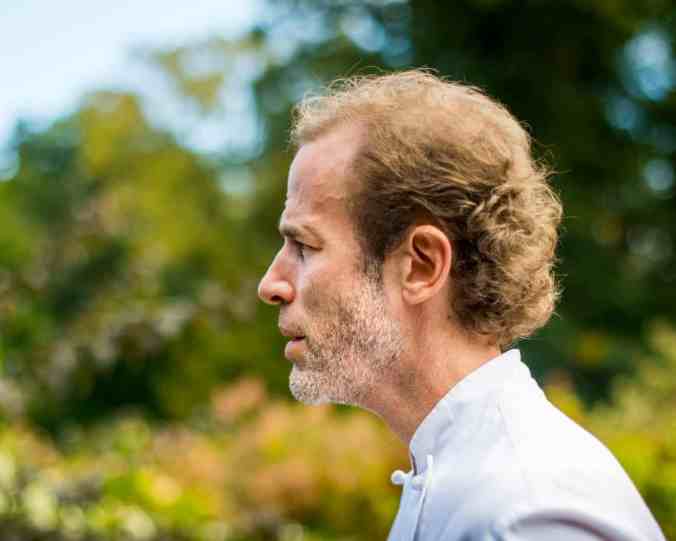
‘Restaurants can become these cathedrals of ideas.’ … Dan Barber chef and co-owner of Blue Hill restaurants in Manhattan and upstate New York. Photograph: Ali Smith for the Guardian
Thanks to Emma Brockes for this article, another in this important Guardian series:
Dan Barber: ’20 years from now you’ll be eating fast food crickets’
In the latest from our series on biodiversity, the Blue Hill chef says we’ve got sustainable agriculture wrong. It’s not a question of sacrifice, but deliciousness
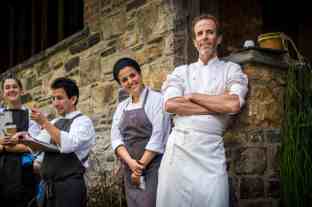
Barber holds a staff meeting. Photograph: Ali Smith for the Guardian
How does it taste?” says Dan Barber, regarding me expectantly in the garden of Blue Hill at Stone Barns, his restaurant in the Hudson Valley just north of New York. I am gnawing the crust of a large piece of bread that has been grown from Barber Wheat, a hybrid seed developed by Barber and his partners to be nutrient dense, high in yield and – a radical thought in seed breeding, apparently – full of flavour. (Whereas clapped out old seeds might yield 30 bushels an acre, Barber Wheat will stretch to 95). The bread is simultaneously light, and dense, and intricate in flavour in such a way that I can’t think of a single word to do it justice. Barber, who at 49 has the manic energy of someone for whom no plate of food will ever live up to the ideal in his head, looks at me gloomily. “That’s the whole problem with food writing,” he says.
‘At a restaurant you’re like a conductor in an orchestra.’ Photograph: Ali Smith for the Guardian
There are bigger problems in the food world. With the possible exception of “financial regulation”, there can be few more deadly phrases to the casual reader than “sustainable agriculture”, a heavy-weather issue most of us recognise as increasingly important but nonetheless killingly dull. This is where Barber, who set up his restaurant in 2004, is hugely persuasive, a charismatic leader who, if you talk to him for an hour while walking around the kitchen and bucolic surroundings of Stone Barns, will have you genuinely excited about crop rotation, and soil conditions, and the fact that the food industry is a dying behemoth reliant on low-yield, agronomically risky seeds that produce ever more tasteless and nutrition-less food.
“There’s never been a time where there’s been such a wholesale decline in frozen processed food,” he says. “Ever. The only units of those companies that are actually increasing market share are prepared vegetables that are not processed.” Which isn’t to say we are all rushing into the open arms of the nearest farmer’s market, although it is Barber’s mission, through his restaurants, to change this. Continue reading

 Organikos