Discovering Gold in the Greater Antilles (Part 3)

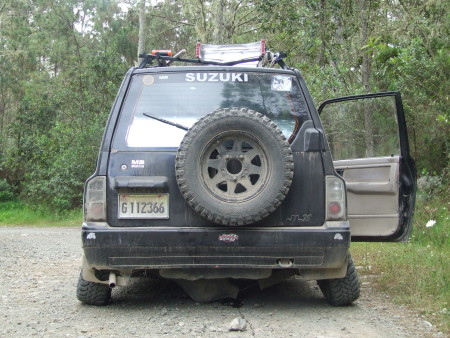
Our (un)faithful jeep breaks down again. This time the rear axle snaps in half. Not good. Parque Valle Nuevo, Dominican Republic, 2012.

This is the final installment of the series; you can read Part 1 and Part 2.

As my vision begins to clear, I know all-too-well what I’ll hear next…
Whoa, sounds like an adventure! So, tell me, what are your plans for a PhD?
[My vision goes dark again…]

In 2014, I conducted my last full field season in the Dominican Republic (in other words, I had burnt up all of my NSF funding and the winds of change were blowing my wife and me from Ithaca down to Raleigh). That being said, I was (and still am) extremely passionate about Golden Swallows, and more and more so about aerial insectivores throughout the Caribbean (swifts and swallows of course; those flycatchers and nightjars will have to find other sponsors). I did, however, have the pleasure of sneaking in one more (big) Golden Swallow adventure before my master’s defense came around. I was asked by Gary Graves, the Curator of Birds at the Smithsonian National Museum of Natural History, to finish the long-running census work he had been carrying out in Jamaica in search of the critically endangered Jamaican Golden Swallow (T. e. euchrysea) – the only other known race of Golden Swallow and one that hadn’t been reliably seen since the 1980’s. Gary had scoured the island except for two places the Cockpit Country in the northwest and the Blue Mountains in the southeast.
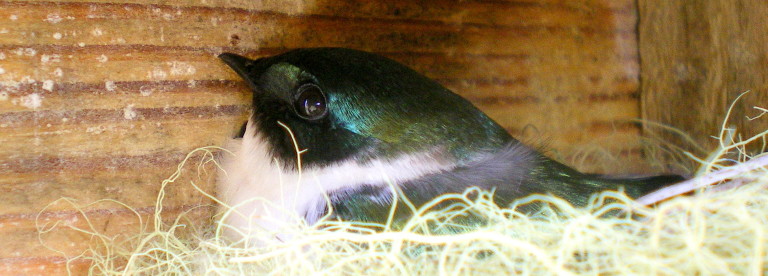
Adult female Golden Swallow incubating her clutch; Parque Valle Nuevo, Dominican Republic, 2013.
Continue reading

Discovering Gold in the Greater Antilles (Part 2)

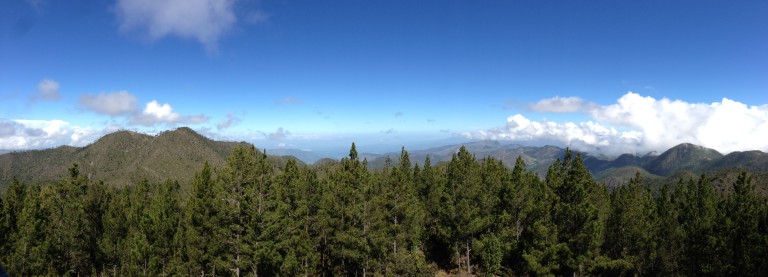
View of Parque Valle Nuevo from the top of the Pajon Blanco Fire Tower; Dominican Republic.

This post follows a previous piece, which you can read here.

And so we set out on an adventure of a lifetime with the underlying goal of studying a bird and using what we learned to help save that bird, while simultaneously nourishing an already burgeoning sense of local stewardship over Hispaniola’s feathered friends and the habitats they so deeply depend upon. We set the bar high from the beginning, and I can be honest in saying that I feel good about what we accomplished and where the project stands today.

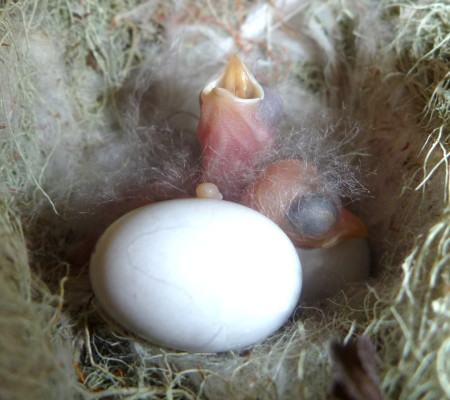
Two Golden Swallow chicks have just hatched. One begs for food, one contemplates life, and one refuses to come out; Parque Valle Nuevo, Dominican Republic, 2014.

However, as opposed to trying to tackle an impossible play-by-play of what transpired over those next three years (thankfully all of that information is in my master’s thesis and can be yours for just three easy payments of $29.99), I’m going to take a slightly different approach. I’m going to share with descriptions of images (and feelings) that go through my head when somebody kindly asks me, “So how’d that Golden Swallow Project go?” Little does that person know how much weight a question like that can have, or how it causes me to temporary black-out as my mind boards a high-speed emotional (and perhaps somewhat spiritual) roller-coaster from which there is little hope for return for at least the ensuing two minutes. So let’s go for a ride.

Continue reading

Discovering Gold in the Greater Antilles (Part 1)

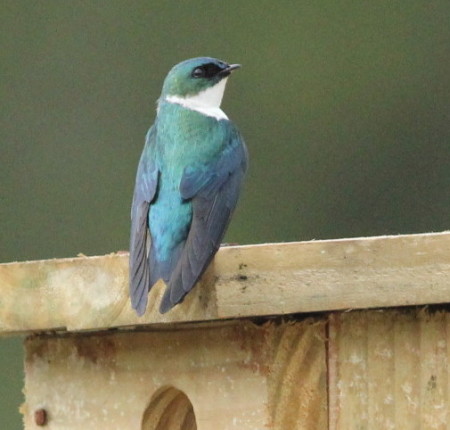
Male Hispaniolan Golden Swallow perched over-top an artificial nest-box in Parque Valle Nuevo, Dominican Republic; July 2014.

With a title like that, I’m hoping that many of you instinctively hucked your laptops across the room, sprinted out to the barn and started hitching your pride-and-joy appaloosa to the covered wagon your grandpappy gave to you as a belated wedding gift back in the summer of ‘69. Just don’t forget the “caulk the wagon and float” option if you’re coming from the mainland.

If you decide to make the journey, I suggest making landfall on the beautiful island of Hispaniola (gold deposits have all but dried up in Jamaica – but more on that later). Trade in your bikini and flip-flops for some long pants and hiking boots, because what you came for can only be reliably found high up in the mountains. Not that I like to give away too much insider advice, but if I were you, I’d keep heading up until you’ve reached the Hispaniolan pine forests – the highest altitude forest type you’ll find on the island. Find a grassy clearing, sit down, and wait, because at this point, the gold is going to come to you! With mighty wings (~11cm long each), fearsome talons (actually you’d have to strain to even notice the legs on this bird), and a relentless hunger for meat (prey doesn’t get much bigger than an 8mm march fly), watch out as the infamous Golden Swallow comes tearing over the nearest hillside radiating its majestic golden sheen across the lands…wait…wait…I can’t do this anymore. It’s a tiny bird that can’t peck to save its life, and unless the light of a passing-by solar flare manages to reflect off the swallow’s dorsal plumage at a perfect 47.86o angle, the bird is green!

Continue reading

Versatile Bamboo and Cast Aluminum Structures for the DR and Elsewhere

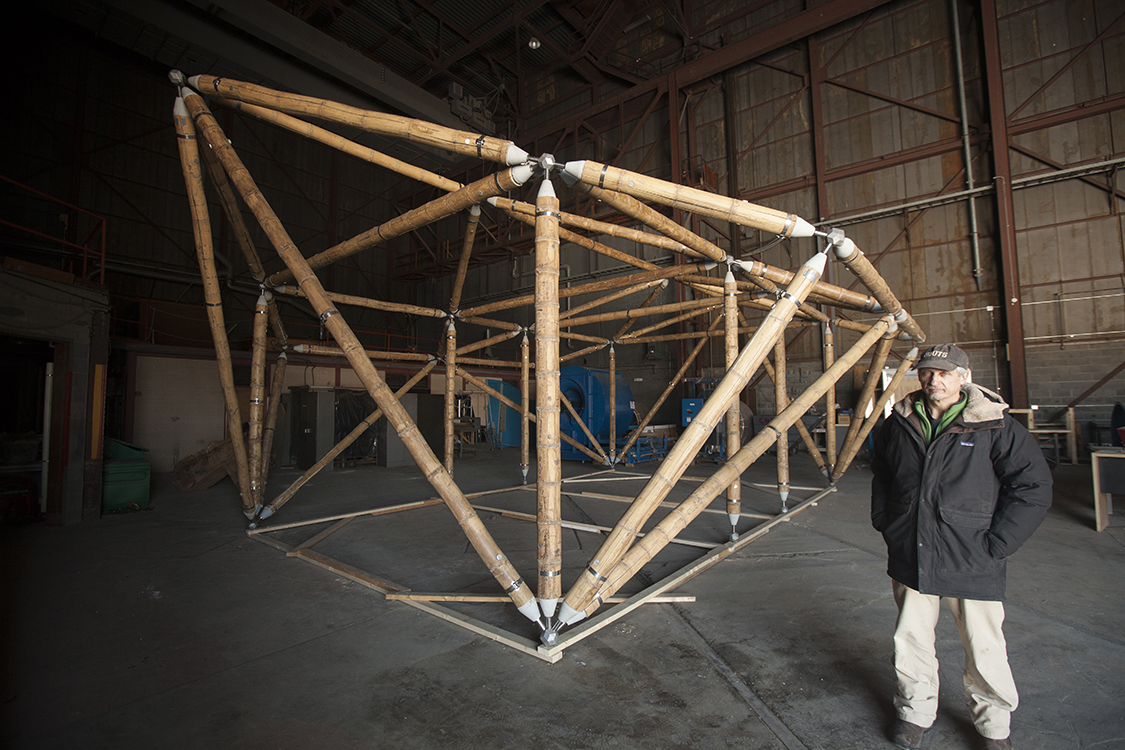
Jack Elliot and students completed a test build in Cornell’s High Voltage Laboratory before erecting the structure in the Dominican Republic. Photo © Robert Barker / University Photography

Bamboo comes up frequently on this blog, since it is such a fast-growing plant that can be used in various ways for construction and design. Recently, we learned of a collaborative project at Cornell University where bamboo-based structures intended to resist the violence of earthquakes and hurricanes in the Caribbean (and tested on the island of the Dominican Republic) use an aluminum joint system invented by a Cornell professor. Roger Segelken reports for the Cornell Chronicle:

The first field test of Design and Environmental Analysis (DEA) associate professor Jack Elliott’s “Triakonta” structural system stands in the Punta Cana coastal region of the Dominican Republic, as an outdoor classroom for the Puntacana Ecological Foundation.

“The structure itself is elegant and has sparked dialogue about sustainable architecture amongst visiting guests, students and even architects,” said Jake Kheel, M.S. ’02, environmental director of Grupo Puntacana, which operates a resort adjoining the eco-preserve where Cornellians and locals built the bamboo structure in mid-2015.

Continue reading