Anthropocene Perspective

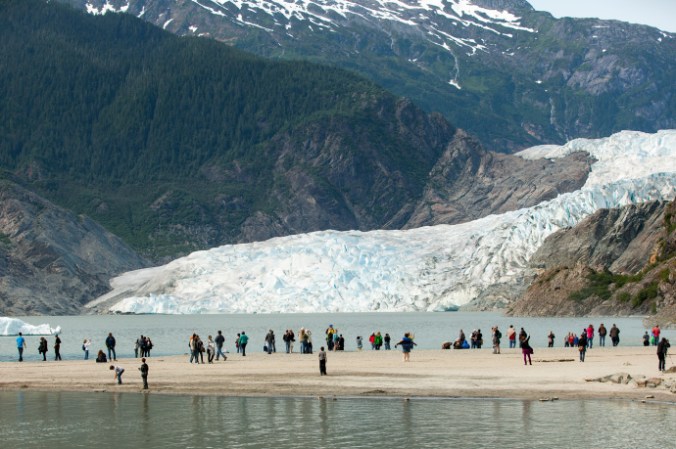
Tourists visit the the Mendenhall Glacier, in Alaska. Geologists are considering whether humans’ impact on the planet has been significant enough to merit the naming of a new epoch. CREDIT PHOTOGRAPH BY MATTHEW RYAN WILLIAMS/THE NEW YORK TIMES/REDUX

Tourists visit the the Mendenhall Glacier, in Alaska. Geologists are considering whether humans’ impact on the planet has been significant enough to merit the naming of a new epoch. CREDIT PHOTOGRAPH BY MATTHEW RYAN WILLIAMS/THE NEW YORK TIMES/REDUX

Thanks to, Michelle Nijhuis in general, for her science writing and environmental journalism–making these topics simultaneously fun and fascinating, if also sometimes depressing; and to the New Yorker for making space for this note in which she briefly explains the naming of the epoch we live in:

The duties of the Anthropocene Working Group—a thirty-nine-member branch of a subcommission of a commission of the International Union of Geological Sciences—are both tedious and heady. As the group’s chairman, Jan Zalasiewicz, whom Elizabeth Kolbert wrote about, in 2013, says wryly, “People do not understand the very slow geological time scale on which we work.” Yet the A.W.G.’s forthcoming recommendations may bring an end to the only epoch that any of us have ever known—the Holocene, which began after the last ice age, about twelve thousand years ago, and lasts to this day. The group’s members are pondering whether the human imprint on this planet is large and clear enough to warrant the christening of a new epoch, one named for us: the Anthropocene. If it is, they and their fellow-geologists must decide when the old epoch ends and the new begins.

In a paper published today in the journal Nature, Continue reading

Humanity’s Diet Makes A Difference, Historically As Well As Futuristically

On the timescale of evolutionary history, paleo enthusiasts note, agriculture is a fad. Credit Illustration by Mike Ellis.

On the timescale of evolutionary history, paleo enthusiasts note, agriculture is a fad. Credit Illustration by Mike Ellis.

Since the early days of this blog we have been hungry consumers of environmental long form journalism, of which Elizabeth Kolbert’s New Yorker chronicles are best-in-category. They are also, frankly, almost always depressing.

Nonetheless, they put humanity into its natural context. This not-at-all-depressing chronicle demonstrates the value of that contextualization well:

The first day I put my family on a Paleolithic diet, I made my kids fried eggs and sausage for breakfast. If they were still hungry, I told them, they could help themselves to more sausage, but they were not allowed to grab a slice of bread, or toast an English muffin, or pour themselves a bowl of cereal.

Continue reading

Climate Change Preparedness

Photograph by Ed Kashi/VII.

Photograph by Ed Kashi/VII. On Monday, the United Nations Intergovernmental Panel on Climate Change released a report on the impacts of global warming, for which it says the world is ill prepared. Elizabeth Kolbert wrote about a leaked draft of the report in this piece, originally published on November 5, 2013.

Not everything we read pleases us. So not everything we post on this site, in spite of our overriding mission to report positive news about conservation wherever we can find it, is meant to draw a smile. Wouldn’t be prudent, as someone once said. Nor would it be prudent to assume someone, somewhere, or anyone anywhere, has taken appropriate measures to even catalogue ways in which we should be preparing for the consequences of climate change. Not if, as some greedy doubt-mongers want people to wonder, but when. Thanks to Elizabeth Kolbert, our favored dismalist on climate change, for this Comment on the New Yorker‘s website:

Late last week, a Web site that claims that there is no scientific consensus on global warming published a leaked draft report on the impacts of global warming. The leak was apparently intended to embarrass the authors of the report, which is the latest installment from the Intergovernmental Panel on Climate Change. However, it seems mostly to have had the opposite effect: Continue reading

Kolbert, Kerala & Clouds

Reading this post from Elizabeth Kolbert, a familiar cloud of doom came over me.  Read almost anything she writes, and you will know what I mean.  She writes most frequently about seemingly intractable environmental problems, and those about climate change have the most intense effect on me.  But ignorance is not an option, so I read.  The cloud lasted about seven hours, and parted just now in a most interesting manner. As if my head were just lifted out of the sand.  First, the portion that stuck with me:

Since we can’t know the future, it is possible to imagine that, either through better technology or more creativity or sheer necessity, our children will be able to find a solution that currently eludes us. Somehow or other, they will figure out a way to avoid “a 4°C world.” But to suppose that an answer to global warming can be found by waiting is to misunderstand the nature of the problem.

Continue reading