History Underground

The tunnel system must be one of the most mysterious engineering projects in Liverpool’s history. One entrance into the tunnels was found in the basement of their patron’s former house (Credit: Chris Iles/Friends of Williamson’s Tunnel)

The Williamson’s tunnel system must be one of the most mysterious engineering projects in Liverpool’s history. One entrance into the tunnels was found in the basement of their patron’s former house PHOTO: Chris Iles

The Williamson Tunnels are a labyrinth of tunnels and underground caverns under the Edge Hill district of Liverpool in north-west England. They were built in the first few decades of the 1800s under the control of a retired tobacco merchant called Joseph Williamson.The purpose of their construction is not known with any certainty. Theories range from pure philanthropy, offering work to the unemployed of the district, to religious extremism. Although some of the tunnels have been lost over the years, a lot of them still exist today, under what is now a residential area. One section of the tunnels has been cleared and renovated and is open to the public. The remaining parts of the labyrinth are closed, with many suspected tunnels yet to be rediscovered.
Continue reading

Repel, Trap and Steer Light

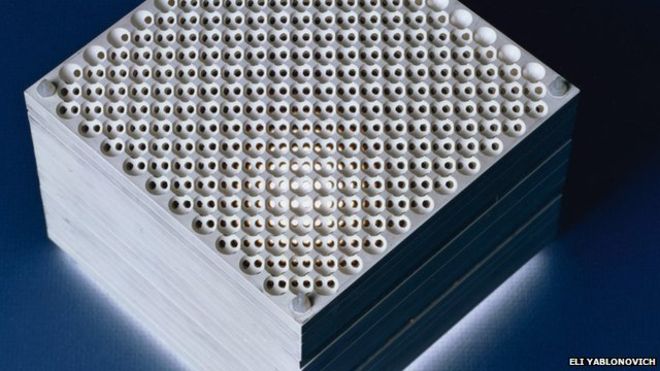
Photonic crystals can manipulate light in the same way that a semiconductor like silicon can steer electrical current. PHOT: Eli Nablonovich

Photonic crystals can manipulate light in the same way that a semiconductor like silicon can steer electrical current. PHOTO: Eli Nablonovich

The US physicist who first discovered “photonic crystals” which can repel, trap and steer light is to receive the Newton Medal, the BBC has revealed. This is the highest honor given by the Institute of Physics in London. Prof Eli Yablonovitch of the University of California, Berkeley, proposed and created the crystals in the 1980s.  Photonic crystals are periodic dielectric structures that have a band gap that forbids propagation of a certain frequency range of light. This property enables one to control light with amazing facility and produce effects that are impossible with conventional optics. Butterfly wings and the colorful plumage of peacocks and some parrots all contain examples, which were only understood after Yablonovitch and his fellow physicists fully described photonic crystals in the 1980s.Even the chameleon was recently shown to produce – and control – its color using the shape of photonic crystals.

Continue reading