For Whom the Bell Tolls

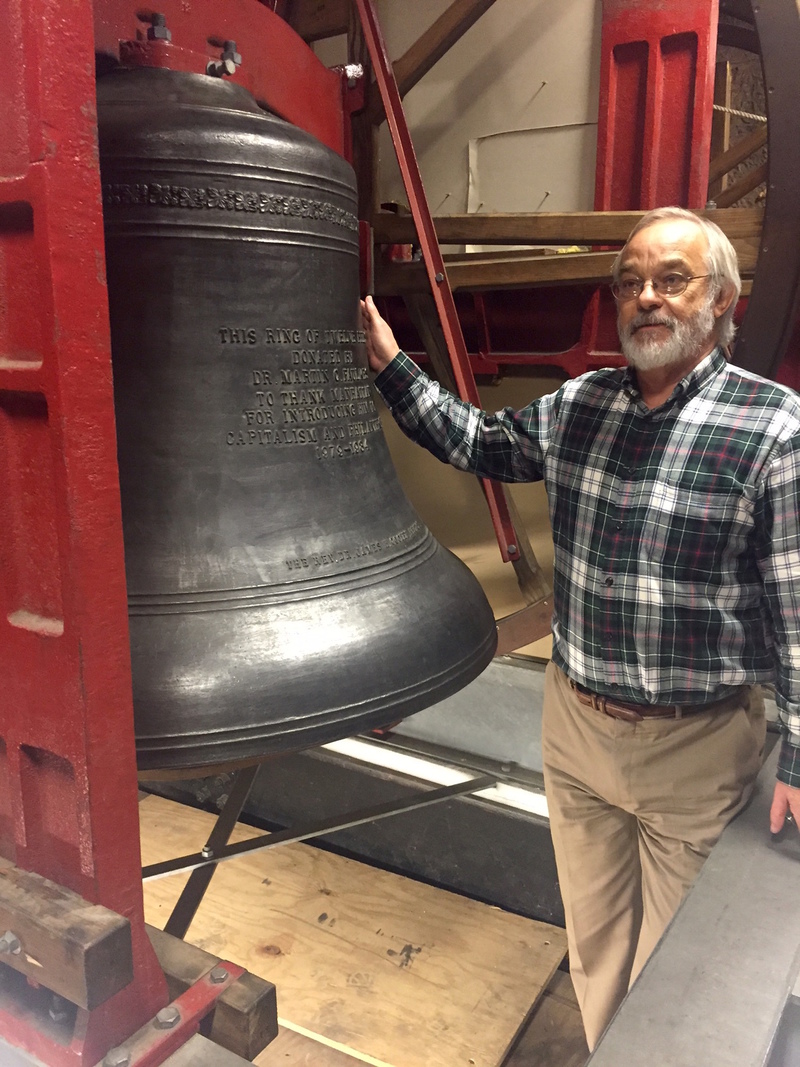
Tony Furnivall beside one of the dozen bells in Trinity Church's clocktower. (Photo: Ella Morton)

Tony Furnivall beside one of the dozen bells in Trinity Church’s clocktower. (Photo: Ella Morton)

If you’ve still not knocked off “do the new” on the year’s bucket-list, we have a suggestion. Join the Wednesday Night rites of New York’s church bell ringers.

Bell ringing, also known as change ringing, is what Furnivall calls “an ultra-niche interest.” Originating in medieval England, it is practiced by an estimated 40,000 people around the world today, mostly in the United Kingdom and among countries of the former British Empire. In the U.S., there is a small but enthusiastic bell-ringing scene, spread across 42 towers. The North American Guild of Change Ringers, established in the 1970s, calls ringing “a team sport, a highly coordinated musical performance, an antique art, and a demanding exercise.” “We ring bells to celebrate,” Furnivall says, and if you’re spry enough to clamber up a clock tower, you can grab a rope and join in the fun.

Continue reading

History Underground

The tunnel system must be one of the most mysterious engineering projects in Liverpool’s history. One entrance into the tunnels was found in the basement of their patron’s former house (Credit: Chris Iles/Friends of Williamson’s Tunnel)

The Williamson’s tunnel system must be one of the most mysterious engineering projects in Liverpool’s history. One entrance into the tunnels was found in the basement of their patron’s former house PHOTO: Chris Iles

The Williamson Tunnels are a labyrinth of tunnels and underground caverns under the Edge Hill district of Liverpool in north-west England. They were built in the first few decades of the 1800s under the control of a retired tobacco merchant called Joseph Williamson.The purpose of their construction is not known with any certainty. Theories range from pure philanthropy, offering work to the unemployed of the district, to religious extremism. Although some of the tunnels have been lost over the years, a lot of them still exist today, under what is now a residential area. One section of the tunnels has been cleared and renovated and is open to the public. The remaining parts of the labyrinth are closed, with many suspected tunnels yet to be rediscovered.

Continue reading