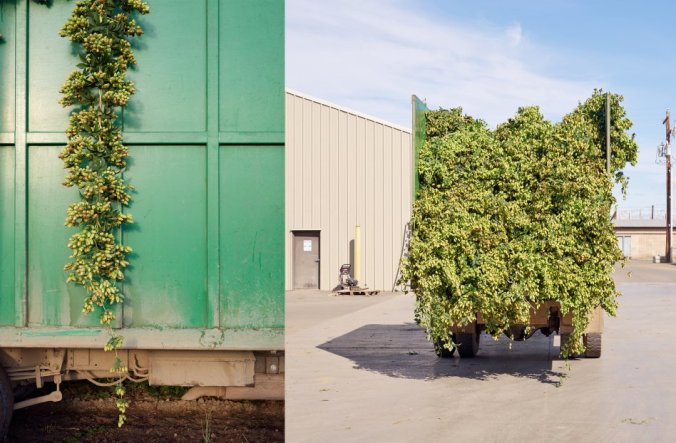
Trucks loaded with hops (Photo: Spencer Lowell)
Outside Magazine offers this primer on the ascendence of one of the key ingredients in one of the oldest fermented beverages:
How Hops Became the Star of American Brewing
The craft beer revolution turned the tall cousin of cannabis into a breakout ingredient, infusing your brew with flavors and aromas that range from stone fruit to barrel oak. Christopher Solomon hits the road to understand why hop madness isn’t over yet—and why brewers and plant breeders are always on the prowl for the next big thing.
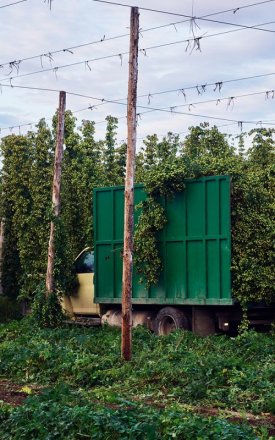
Hop harvesting in Washington State’s Yakima Valley (Photo: Spencer Lowell)
The 2019 American Hop Convention, held in January in Monterey, California, was part agriculture conference and part old-home week. Almost all of the nation’s beer hops—and roughly 40 percent of all hops in the world—are grown by about 75 farms in Washington, Oregon, and Idaho, many of them owned by families who have farmed hops for four or five generations. At the convention, everybody seemed to know everybody. This gave a loose feel to the proceedings, which recognize and celebrate the fact that only one thing can be done with the crop the conventioneers produce: mix it with malt and water, ferment the liquid, and drink the beer you’ll get after a few weeks. During afternoon coffee breaks, everybody cracked a cold one.
That wasn’t the only reason for the festive mood. The past 15 years have witnessed a spectacular surge in craft brewing in the United States; more than 85 percent of Americans now live within ten miles of a brewery. U.S. beer culture, once a punchline, has become the most vibrant on earth.
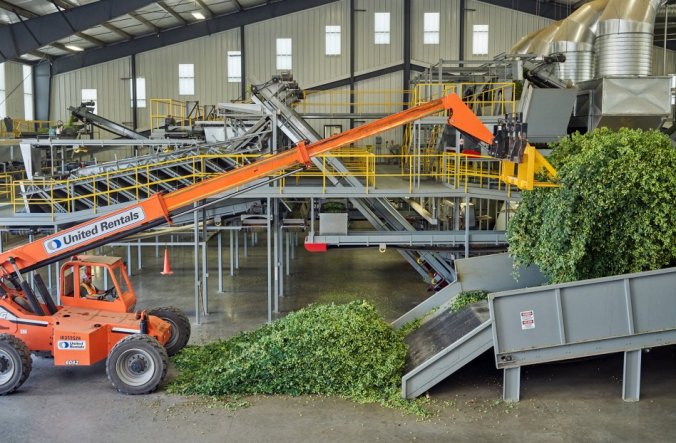
Hop bines being loaded into a machine that shakes out the aromatic cones (Photo: Spencer Lowell)
The hop industry has been a beneficiary and driver of this renaissance. Hops once were considered a drab ingredient, tossed in mainly to preserve the beer, thanks to antibacterial properties of the resins found in hop flowers, which are also called cones. Today, hops are the star of American brewing. Continue reading
 Organikos