Introduced Species in the Galápagos

Feral goats on Isabela Island. Photo by Galápagos National Park Service.

Yesterday I wrote about the case of the North American beaver being purposefully introduced to Argentinian Patagonia for a business venture and having severe unintended consequences on the environment in both Chile and Argentina. Most of us think of Patagonia as a pretty faraway and isolated place, and its location so far down the southern hemisphere merits that. The Galápagos Islands are another place geographically apart from most of us–that distance accounts for the specialized evolution that took place in the archipelago over millennia.

The isolation of the Galápagos from the rest of the world for so long, and the relatively small size of the islands, means that it is especially vulnerable to opportunistic species that can become invasive. In the same way that the Canadian beavers had no natural predators in Patagonia, common domesticated goats, when introduced to different islands in the Galápagos by sailors centuries ago, were able to roam and multiply, which was the travelers’ goal Continue reading
Diving with Scuba Iguana

Scuba Iguana trips start from the office on Charles Darwin Ave. either going north in a taxi to Itabaca Canal or taking a boat at the Scuba Iguana dock behind the office. All boat rides ranged from 35 to 120 minutes, and were generally pretty smooth. On the way, we could see Common Noddies, Blue-footed Boobies, Elliot’s Storm Petrels, Galápagos Shearwaters, and on North Seymour I saw a Red-billed Tropicbird twice! If I remember correctly, some Nazca Boobies were sitting on the coast of Floreana as well.

Continue reading

Galápagos Sea Lions

I just got back from Isabela Island, where I was able to snorkel with a sea lion as playful as the ones in this video (taken, once again, by the ScubaIguana guide Quike Morán), and play with it alone in the relatively shallow waters of Tintoreras (named for the reef sharks that can often be seen there; tinto is red in Spanish; you get the point).

I tried to mimic the swirling, bubble-blowing, and alternating fast and slow approaches as I played with the juvenile sea lion, and was rewarded with a dance even longer than that seen in the video. Continue reading

My First Dives in Galápagos (2/2)

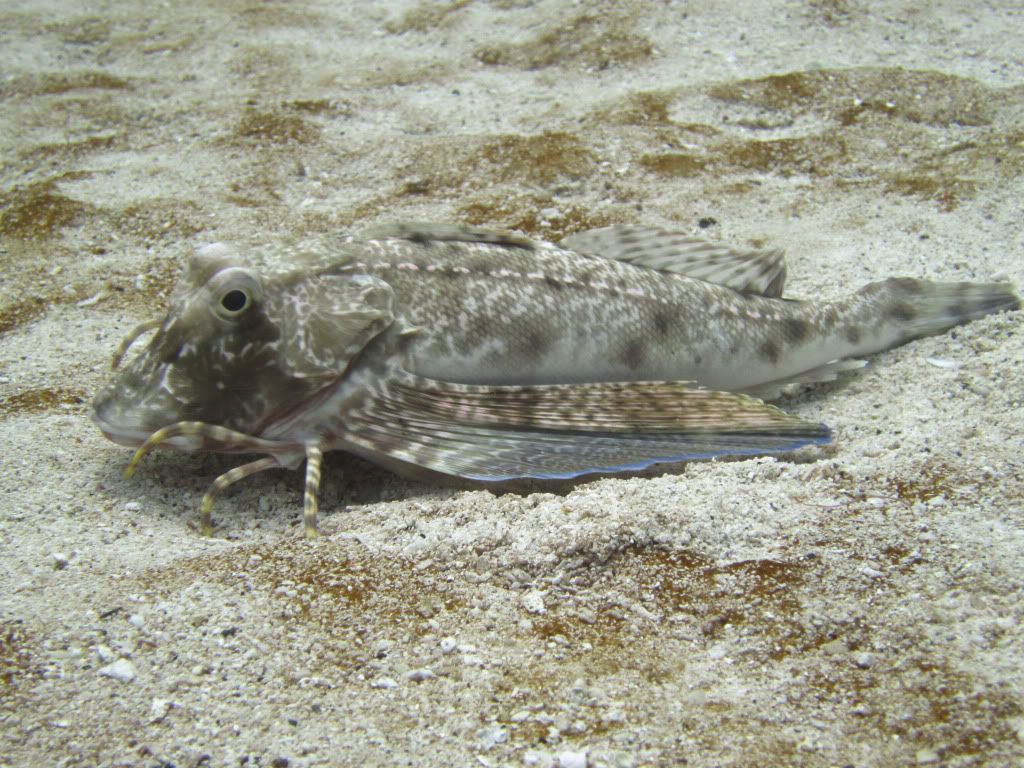
Six legs and two sail-like fins! What?!

My last post shared a video of some of my scuba trips and a few images of two absolutely bizarre ocean species: the Red-lipped Batfish and the Galápagos Searobin. I had no clue that any such creatures existed in nature, or at least not under the light of the sun no more than 15 meters below surface level. Once again, Quike Morán of Scuba Iguana took the pictures and video with a point-and-shoot digital camera in a plastic waterproof case, and the two dives featured here were at Seymour Island and Mosquera Island, north of Santa Cruz.

My First Scuba Dives in Galápagos (1/2)

Last week, I had my first, second, third, and fourth dives since I got my CMAS diving certification in 2007 in Croatia. I saw two of the weirdest organisms I’ve ever encountered in the flesh (to be named in the next post), and was also able to fulfill one of my longtime wishes: to be underwater with any aquatic mammal!

I leave for a camping trip on the island of Isabela today, so for now my two brief and scheduled posts will be limited to a couple photos and the video that will be in each! All images and videos were taken by Quike Morán, my Scuba Iguana guide.