Scotland’s Farmed Salmon Deserves Attention

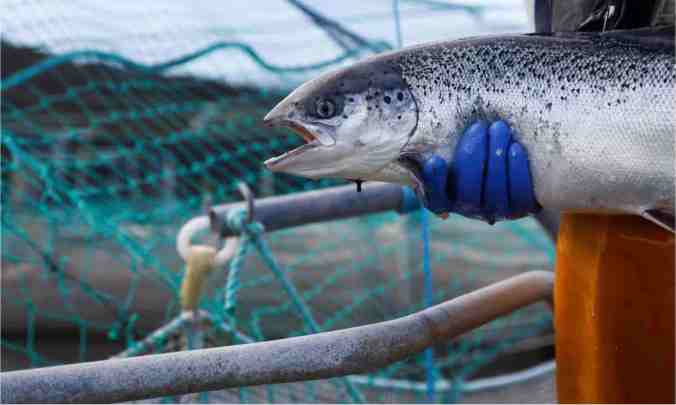
Salmon farms certified as organic have to adhere to certain standards. Photograph: Murdo MacLeod/The Guardian

Scotland has been moving in the right direction in other ways, so this call for action in an area where they have not been leading with best practices is worthy of attention. Thanks to the Guardian’s Karen McVeigh for providing it:

‘Unacceptable greenwashing’: Scottish farmed salmon should not be labelled organic, say charities

Open letter calls for Soil Association certification to be removed from industry, amid concerns of negative environmental impact

The British body that certifies food in the UK as organic has been accused of misleading consumers over its labelling of Scottish farmed salmon.

Thirty charities, conservation and community organisations, including WildFish, the Pesticide Action Network and Blue Marine Foundation, say the negative environmental impacts of the industry in Scotland “run completely counter” to the principles of the Soil Association’s promotion of healthy, humane and sustainable food. Continue reading


Documentaries : The Carbon Rush by Amy Miller

carbon rush credit Amy Miller

I am from Europe where since the Roman conquest forest and civilization were perceived as antagonistic. Silva, the forest, was wild and needed to be tamed, and ager, the man-made open space was culture. So when Western countries debate of reducing deforestation and planting trees to offset carbon emissions, you can bet they mean elsewhere.

We have shops where you can buy a wooden chair but in exchange you pay for a carbon offsetting voucher which will allow for trees to be planted somewhereThat’s the thinking behind the Clean Development Mechanism (CDM), which allows a country with an emission-reduction or emission-limitation commitment under the Kyoto Protocol to implement an emission-reduction project in developing countries. Director Amy Miller went around the world to meet the communities where some of those offsetting projects were implanted.  See the trailer after the jump.

Continue reading

Green Backlash

My course load this semester throws some very interesting subject matter my way. In one of my classes, Marketing Research for Decision-Makers, the professor was asking the class to brainstorm a specific hospitality-related topic to research. The professor said that last year the class had looked into sustainable hospitality, and in passing, he mentioned that he and a colleague had put together a report on the class’s findings.

The report, titled Reversing the Green Backlash: Why Large Hospitality Companies Should Welcome “Credibly Green” Competitors, was written by Michael Giebelhausen and Helen Chun. It addressed a very interesting issue: how consumers would view a company if it introduced green initiatives. One of the steps consisted of in-depth interviews in order get people’s opinions on such initiatives. Results showed that interviewees distrusted company motivations for implementing sustainability programs. That is, the interviewees doubted that companies actually cared about the environment; they assumed they were instead implementing green practices for the marketing appeal and cost savings.

Greenwashing, the use of deceptive marketing to promote a company's sustainability, has exploded among hospitality firms.

Continue reading