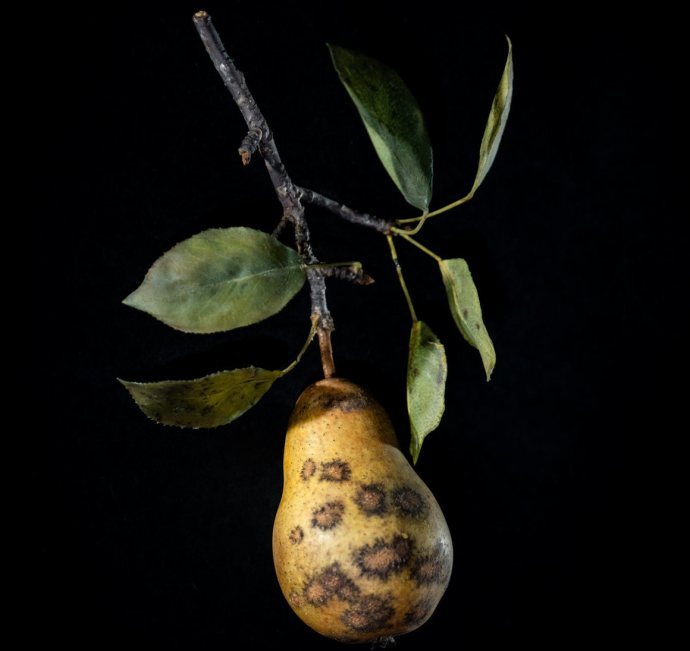
A glass pear, Pyrus communis, afflicted with pear scab, caused by the fungus Venturia pirina. JENNIFER BERGLUND © 2019 PRESIDENT AND FELLOWS OF HARVARD COLLEGE
Thanks to Jessica Leigh Hester at Atlas Obscura for this:
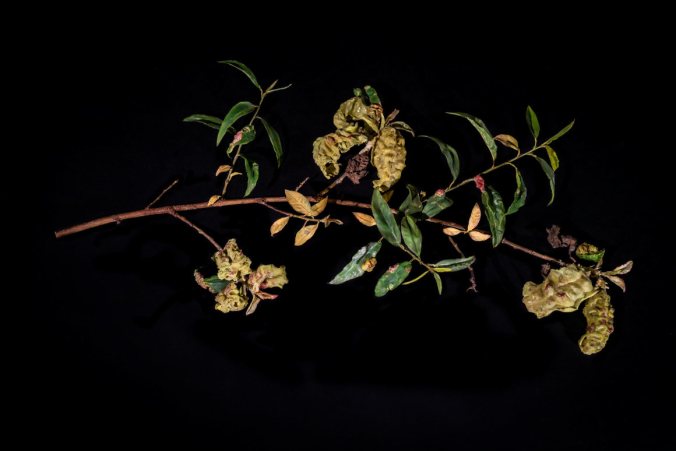
A glass branch of a peach tree, Prunus persica, having a rough go of it. JENNIFER BERGLUND © 2019 PRESIDENT AND FELLOWS OF HARVARD COLLEGE
Feast Your Eyes on These Delicate Glass Models of Decaying Fruit
Blighted, century-old produce goes back on display for the first time in decades.
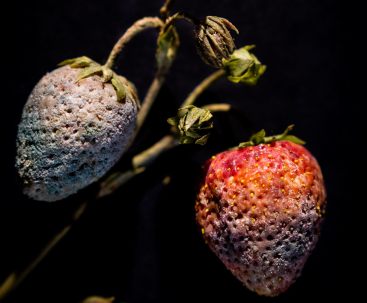
Glass strawberries, or Fragaria, gone white with imitation Penicillium. JENNIFER BERGLUND © 2019 PRESIDENT AND FELLOWS OF HARVARD COLLEGE
THERE’S SOMETHING A BIT BRAIN-SCRAMBLING about this particular buffet of fruit. If you’ve ever let something languish on the counter or in the fridge a little too long, the white fuzz blanketing the shriveling strawberries or the spots of rot on the surface of a pear might look fairly familiar. But there’s something else that doesn’t feel quite right.
“You almost expect to be able to smell it,” says Scott Fulton, a conservator at the Harvard Museum of Natural History. “We all know what a rotten apple smells like.” But the fruit Fulton has been working on doesn’t smell at all: It’s made of glass. Beginning August 31, 2019, it will all be behind glass, too, back on temporary exhibit at the museum after nearly two decades in storage. Continue reading
 IN ROCKS AND SOIL
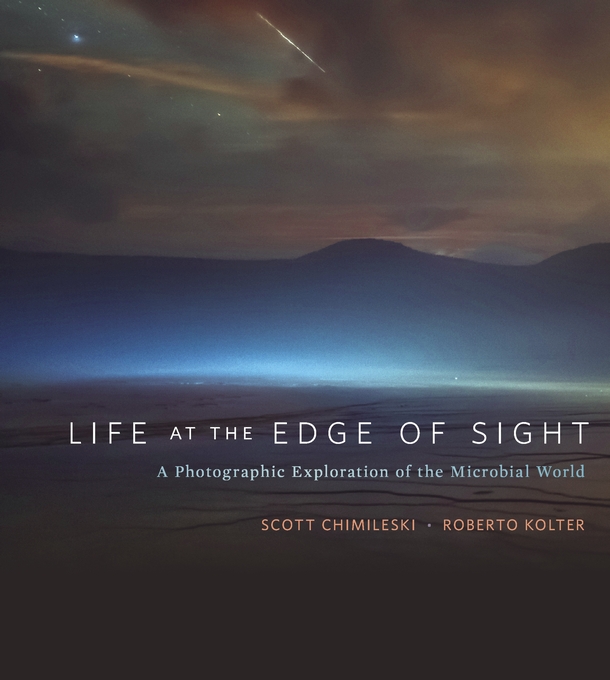
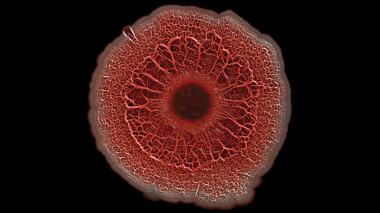 on Earth. Life at the Edge of Sight: A Photographic Exploration of the Microbial World (forthcoming from The Belknap Press of Harvard University Press), brings the planet-shaping diversity of these single-celled, microscopic organisms into view through stunning images. Co-authors Roberto Kolter, professor of microbiology and immunology, and Scott Chimileski, a research fellow in microbiology and immunology at Harvard Medical School, share their passion for the subject in part by magnifying what cannot be seen unaided, in part by revealing large-scale microbial impacts on the landscape. Kolter has long been a leader in microbial science at Harvard, while Chimileski brings to his scholarship a talent for landscape, macro, and technical photography…
 technologies. With expertly executed photography, videography, and poetic narration, Scott Chimileski and Roberto Kolter capture the intrinsic beauty of a mysterious world that is seldom recognized.
 Organikos