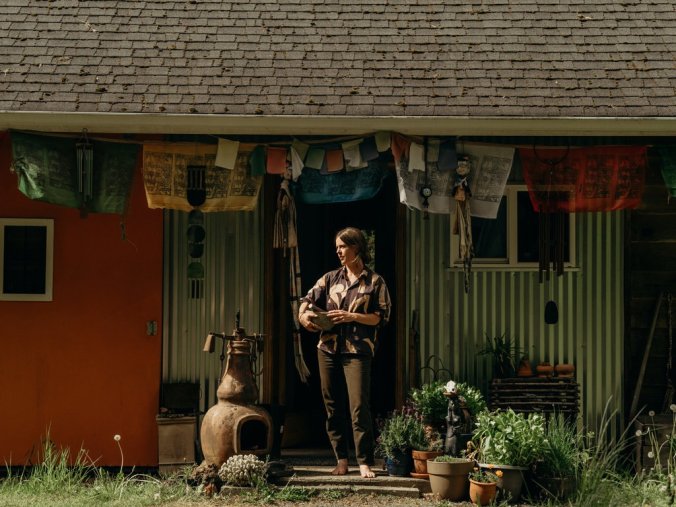
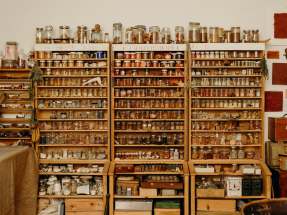
Inside Gustafson’s cabin are shelves lined with samples of ocher and the powdered pigments she makes from them. She likes to keep all processing to a minimum: She hand-grinds specimens with a mortar and pestle and then runs the resulting powder through a sieve. It’s more “personal and connective” that way, she says. Kyle Johnson
In the Pacific northwest of the United States there is a hunter-gatherer renaissance that we have been paying attention to in recent years, if only at our desks. The Willows Inn was the first story we started following, but they continue to come our way, including today. Improbably captivating, this story is about a need to know, and in the process conserve knowhow, about the source of naturally occurring colors that has a history as old as art. Even if some colors are not inherently charismatic (in the eye of the beholder), we take note:
The Woman Archiving the World’s Ochers
At her cabin in the woods of Washington, Heidi Gustafson is creating a many-colored library of one of mankind’s first pigments.
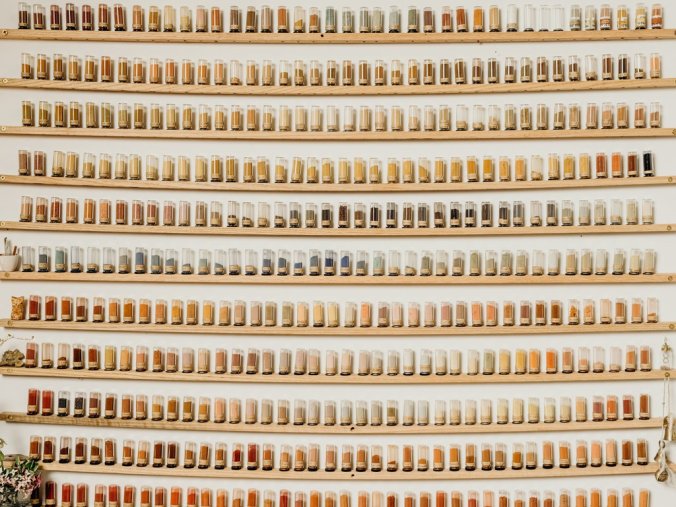
The archive at Gustafson’s cabin comprises over 400 vials of hand-ground ocher, and she doesn’t have an endpoint in mind. “I’ll keep doing it and see where it leads me,” she says. Chantal Anderson
“This piece has a lot less iron in it and a lot more clay,” she says of a shard of rock discovered on the sand. “You can use it right away. It’s like a giant piece of sidewalk chalk.” Kyle Johnson
Heidi Gustafson has Whidbey Island’s Double Bluff Beach to herself. But she’s not sunbathing or scanning the waves for whales. Instead, she’s traveled to the northern end of Puget Sound in Washington to crouch, back to the ocean, foraging for ocher at the base of a cliff. Armed with a small magnet and a knife, she stoops low to assess the striations in the rock face, formed by glacial activity hundreds of thousands of years before.
Gustafson considers ocher to be any natural material primarily made up of iron (hence the magnet) that contains oxygen, a definition that she acknowledges is a bit “less strict” than ones used in various scientific communities. Seeking out the material has become, by happenstance, her life’s work.
An especially low tide reveals a large piece of barnacle-clad red ocher that came from the nearby cliff. “It’s probably between 150,000 and 200,000 years old,” Gustafson says. She often contacts geologists if she needs help dating ocher from a particular site. Kyle Johnson
For years, she has been engaged in a wide-ranging, multidisciplinary exploration of the mineral: collecting samples all over the Pacific Northwest; grinding shards down into pigments she sells to artists through her website Early Futures; making her own art with ocher pigments; and, at her small cabin near the foothills of the Cascade Mountains, creating an extensive ocher archive to catalog samples she’s gathered along with submissions of the mineral sent in from all over the world. While there has recently been renewed interest in creating paints from natural pigments, Gustafson’s focus is on ocher alone — and it extends beyond the material’s artistic uses to its scientific, symbolic and spiritual properties.
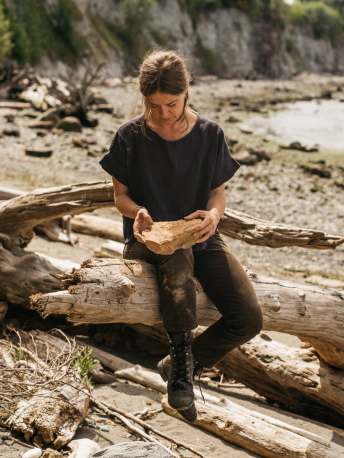
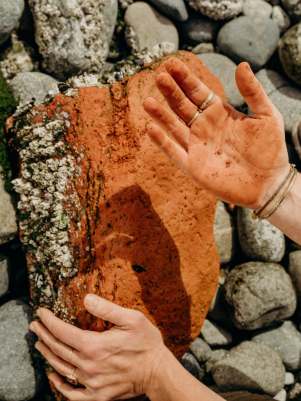
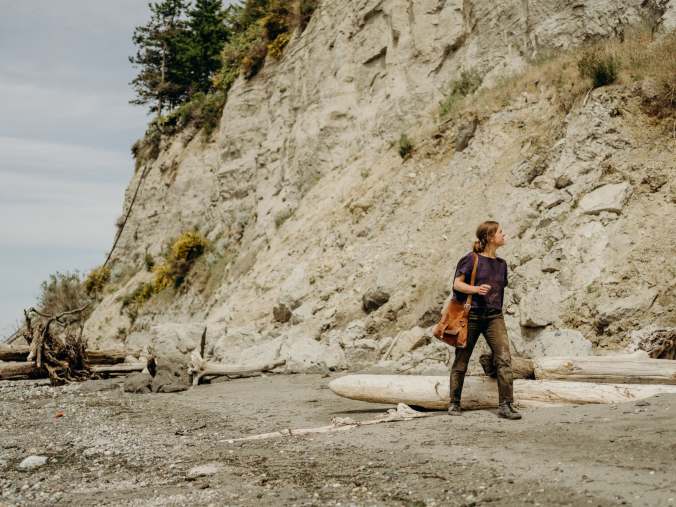
Heidi Gustafson, who has spent the past five years collecting and working with ocher, walks along Whidbey Island’s Double Bluff Beach, off the coast of Washington, in search of the material. She came to scout this area, where she spent time as a child, after recalling its interesting cliff exposure. The beach is a scenic two-hour drive from her cabin near the foothills of the Cascade Mountains. Kyle Johnson
Her first encounter with the earthy compound began at a less scenic location than Double Bluff Beach: a Safeway parking lot in Oakland, Calif. Several years after earning a B.F.A. in sculpture at the Maryland Institute College of Art, Gustafson moved to the Bay Area to get a masters in philosophy, cosmology and consciousness at the California Institute of Integral Studies. After graduating in 2014, she wasn’t sure what to do. Continue reading
 Organikos